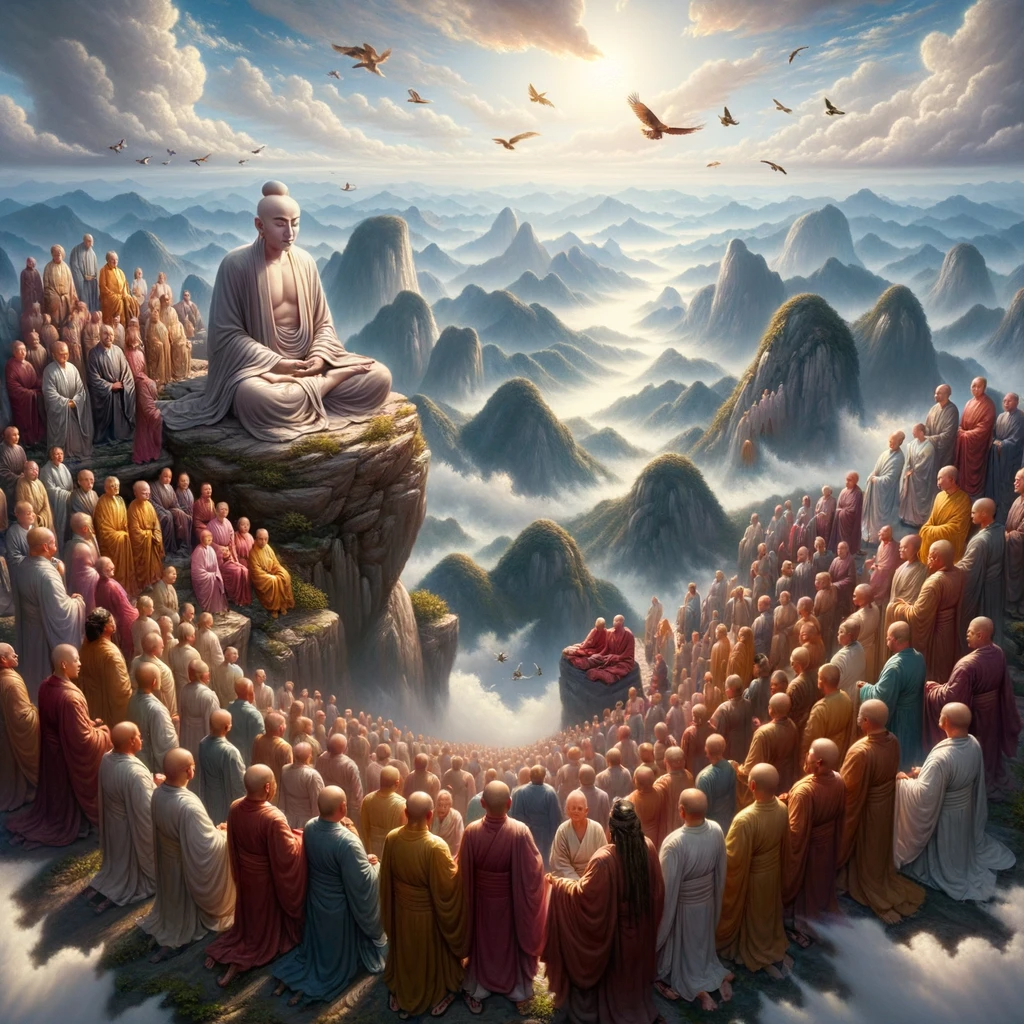
The Gathering at Eagle Peak Mountain:
Eagle Peak Mountain Gathering:
Amidst the serene landscape, the Lord meditates atop a peak, surrounded by twelve hundred Arhat monks. The tranquil mountain setting under a blue sky hints at a larger assembly of celestial beings.
Thus, I heard this tale in ancient times. The Lord, surrounded by a vast gathering of twelve hundred Arhat monks, dwelled on Eagle Peak Mountain in the city of Rajgir. These monks, noble and stainless like majestic elephants, had accomplished their tasks, freed themselves from worldly ties, and attained perfect knowledge. They were masters of self-control, liberated in thought, and possessed of transcendent faculties.
Among the esteemed disciples present were Venerable Aggata-Kaundinya, the Arhat Undefiled by Knowledge; Venerable Assaji, the Arhat Horse-Catcher; Venerable Vappa, the Arhat Vessel Keeper; Venerable Mahanama, the Arhat Great Name; Venerable Bhadrika, the Arhat Fortunate Black; Venerable Mahakassapa, the Great Kassapa; Venerable Kasyapa of Uruvelva, the Kasyapa from Uruvelva; Venerable Kasyapa of Nadika, the Kasyapa from Nadika; Venerable Kasyapa of Gaya, the Kasyapa from Gaya; Venerable Sariputta, the Arhat Foremost in Wisdom; Venerable Mahamoggallana, the Great Moggallana; Venerable Mahakaccayana, the Great Kaccayana; Venerable Aniruddha, the Arhat Undefiled Sight; Venerable Revata, the Arhat Son of King Suddhodana; Venerable Kapphina, the Arhat Radiant; Venerable Gavampati, the Arhat Bull-Tamer; Venerable Pilindavatsa, the Arhat Crested Peacock; Venerable Vakkula, the Arhat Fragrant; Venerable Bharadvaja, the Arhat Bharadvaja; Venerable Mahakosala, the Great Kosala; Venerable Nanda (alias Mahananda), the Arhat Great Joy; Venerable Upananda, the Arhat Good Joy; Venerable Sundara-Nanda, the Arhat Beautiful Joy; Venerable Purna Maitrakanyaputra, the Arhat Son of Queen Maitri; Venerable Subhuti, the Arhat Goodness; Venerable Rahula, the Arhat Fetter Breaker. Alongside them were other great disciples, including Venerable Ananda, still in training, and two thousand other monks, some still in training, while others were masters.
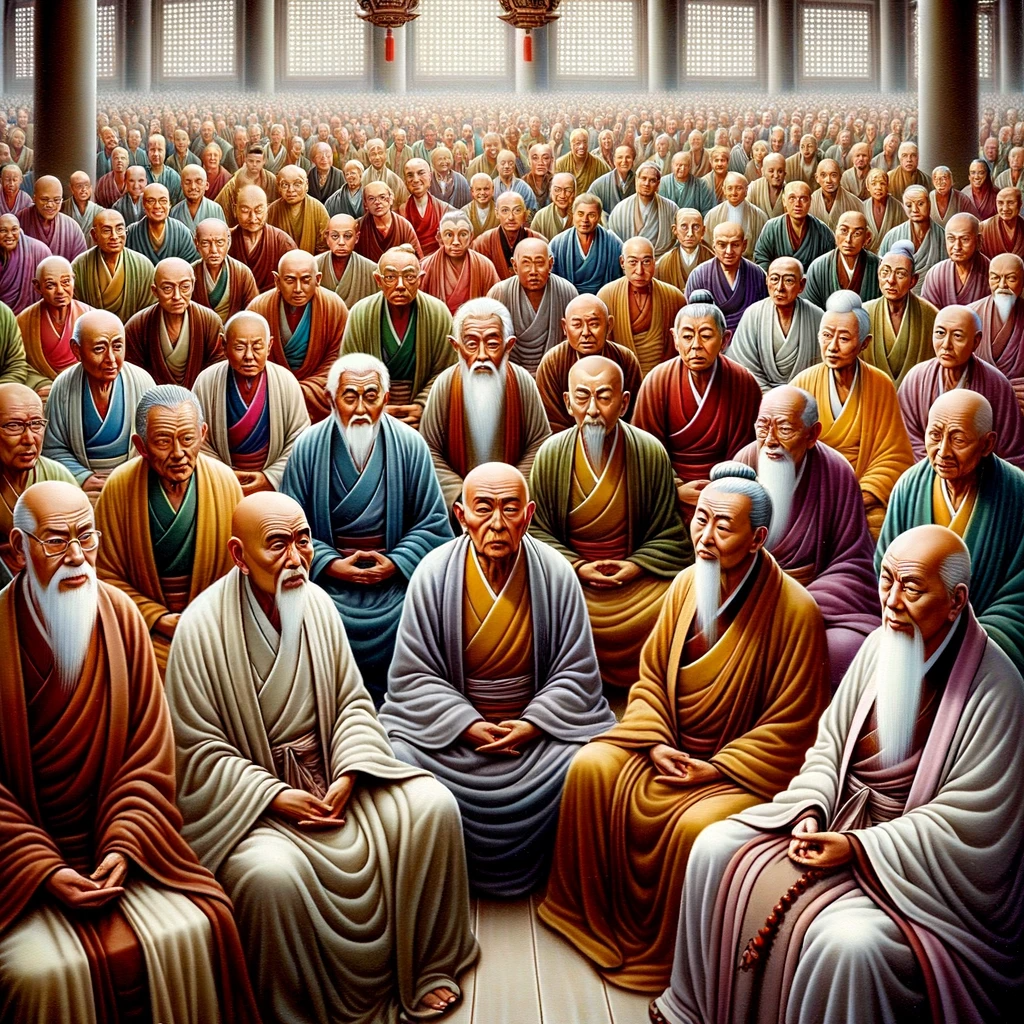
Monastic Assembly:
A close-up showcases the esteemed disciples, diverse in appearance, engaged in deep contemplation and discussion, embodying unity in purpose.
These monks, noble and stainless like majestic elephants, had accomplished their tasks, freed themselves from worldly ties, and attained perfect knowledge. They were masters of self-control, liberated in thought, and possessed of transcendent faculties.
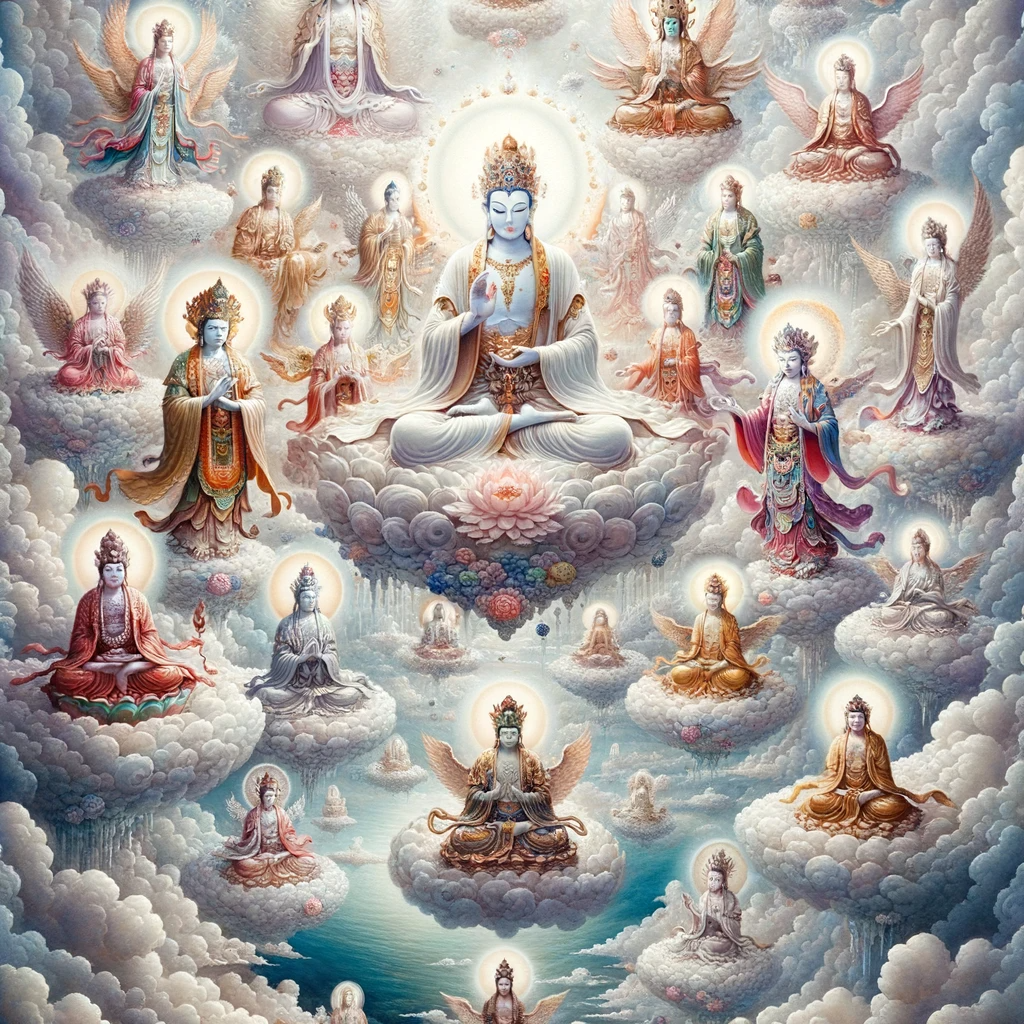
Bodhisattvas on Clouds:
Ethereal clouds hold a vast array of Bodhisattvas, each radiating symbols of wisdom, compassion, and strength. Their divine presence emphasizes commitment to enlightenment.
Moreover, an impressive assembly of eighty thousand Bodhisattvas, unwavering in their commitment to supreme enlightenment, stood firmly in wisdom. They had won the favor of countless Buddhas and cultivated goodness under many Supremely Awakened Beings. Endowed with immense charity, they possessed the wisdom to convey the teachings of the Tathāgata. Renowned in myriad worlds, they had saved innumerable beings. Among them were Bodhisattva Mahāsattva Mañjuśrī, the Bodhisattva of Wisdom, the royal prince; Bodhisattvas Mahāsattvas Avalokitesvara, the Bodhisattva of Compassion, Mahāsthāmaprāpta, the Bodhisattva of Great Strength, Sarvarthaman, the Bodhisattva of Accomplishment, Nityodyukta, the Bodhisattva of Ever-ready Vigilance, Anikshiptadhura, the Bodhisattva of Immeasurable Determination, Ratnakandra, the Bodhisattva of Moonlight, Bhaishajyaraja, the Bodhisattva Medicine King, Pradanasura, the Bodhisattva Gernerous Hero, Ratnaprabha, the Bodhisattva of Jewel Radiance, Purnakandra, the Bodhisattva of Complete Radiance, Mahavikramin, the Bodhisattva of Great Courage, Trailokavikramin, the Bodhisattva who Treads on the Three Worlds, Anantavikramin, the Bodhisattva of Boundless Courage, Mahapratibhana, the Bodhisattva of Great Vows, Satatasamitabhiyukta, the Bodhisattva Always Accompanied by Vows, Dharanidhara, the Bodhisattva who Holds the Dharani, Akshayamati, the Bodhisattva with Immeasurable Mind, Padmasri, the Bodhisattva with Lotus-like Radiance, Nakshatraraga, the Bodhisattva of Star-like Radiance, and Bodhisattva Mahāsattva Maitreya, the Future Buddha, along with Bodhisattva Mahāsattva Simha, the Lion.
Further, Bhadrapala, the Auspicious Protector, led the 16 virtuous men; followed by Ratnikara, the Charioteer of Precious Virtues; Susarthavaha, Carrying a Beneficial Purpose; Naradatta, the Bestower of Joy; Guhagupta, the Hidden Guardian; Varunadatta, the Gift of the Water Deity; Indradatta, the Bestower of Rain; Uttaramati, the Supreme Mind; Viseshamati, the Distinguished Mind; Vardhamanamati, the Expanding Mind; Amoghadarsin, the Infallible Seer; Susamsthita, the Well-established; Suvikrantavikramin, the Courageous Adventurer; Anupamamati, the Incomparable Mind; Suryagarbha, the Essence of the Sun; and Dharanidhara, the Holder of the Dharani.
Together with eighty thousand Bodhisattvas, among whom those above were the chiefs.
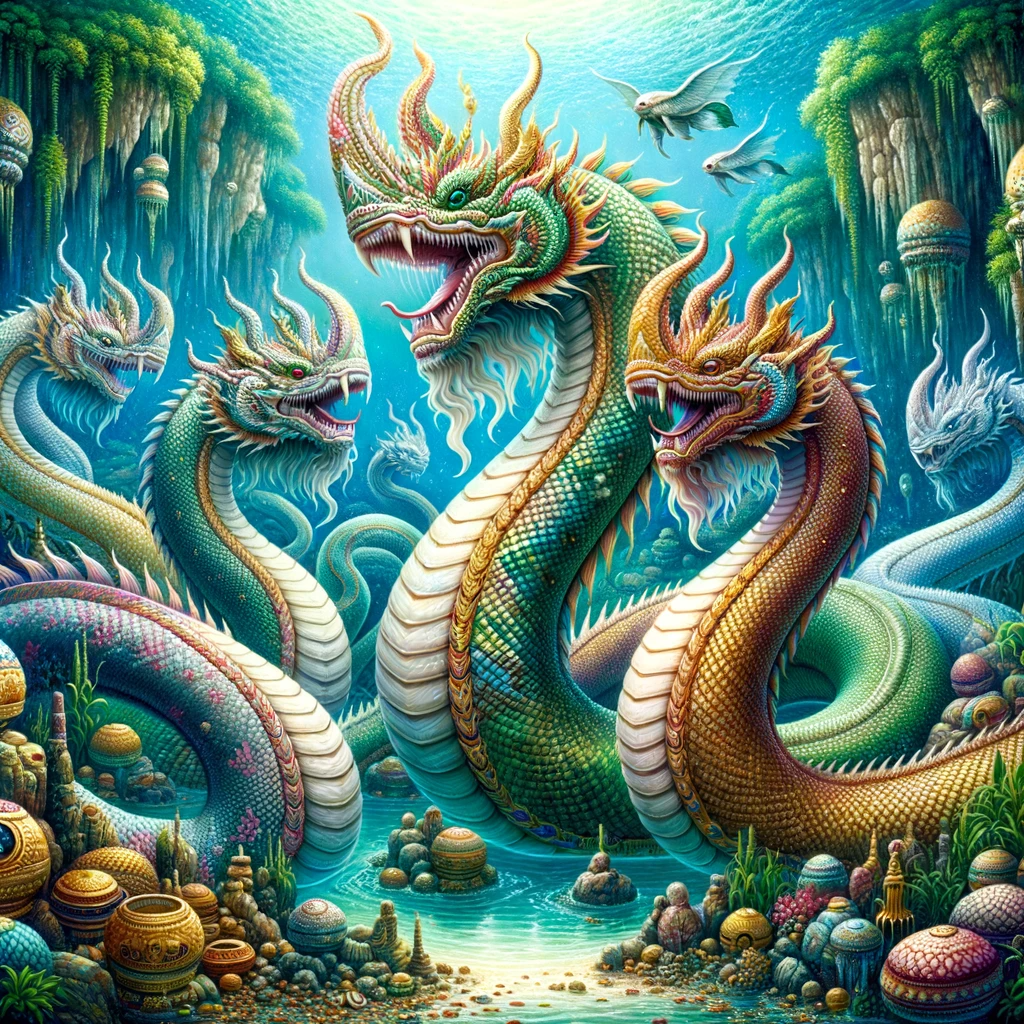
Naga Kings in the Underwater Realm:
The revered Naga kings, depicted as majestic serpentine figures, reside in a tranquil underwater world, symbolizing the deep connections between humans and nature.
The assembly gathered includes the esteemed Naga kings: Nanda, the embodiment of bliss; Upananda, known for his wisdom; Sagara, exuding majestic presence; Vasuki, a symbol of power; Takshaka, representing nobility; Manasvin, the sage; Anavatapta, exuding serenity; and Utpalaka, radiating light.
These revered Nagas and their vast retinues, numbering in the hundreds of thousands of myriads, join the celestial gathering to pay homage to the Buddha. As protectors of nature, they exemplify the deep connection between humans and the natural world.
In Buddhist cosmology, the Nagas are respected beings who seek the teachings of enlightened ones like the Buddha. Their presence reminds us of the vastness of knowledge and the treasures hidden within our hearts. They inspire us to protect and preserve our environment, embodying the importance of harmony with nature.
These serpentine beings teach us about the significance of inner wisdom and the spiritual depths we can explore on our journey to enlightenment. As guardians of sacred knowledge, the Nagas symbolize the profound relationship between humanity and the wisdom of the natural world.
Nagas are fascinating beings of myth and legend, depicted as semi-divine serpents with great wisdom and power. In Hindu and Buddhist traditions, they are revered as guardians of sacred sites, treasures, and profound knowledge, residing in underwater realms.
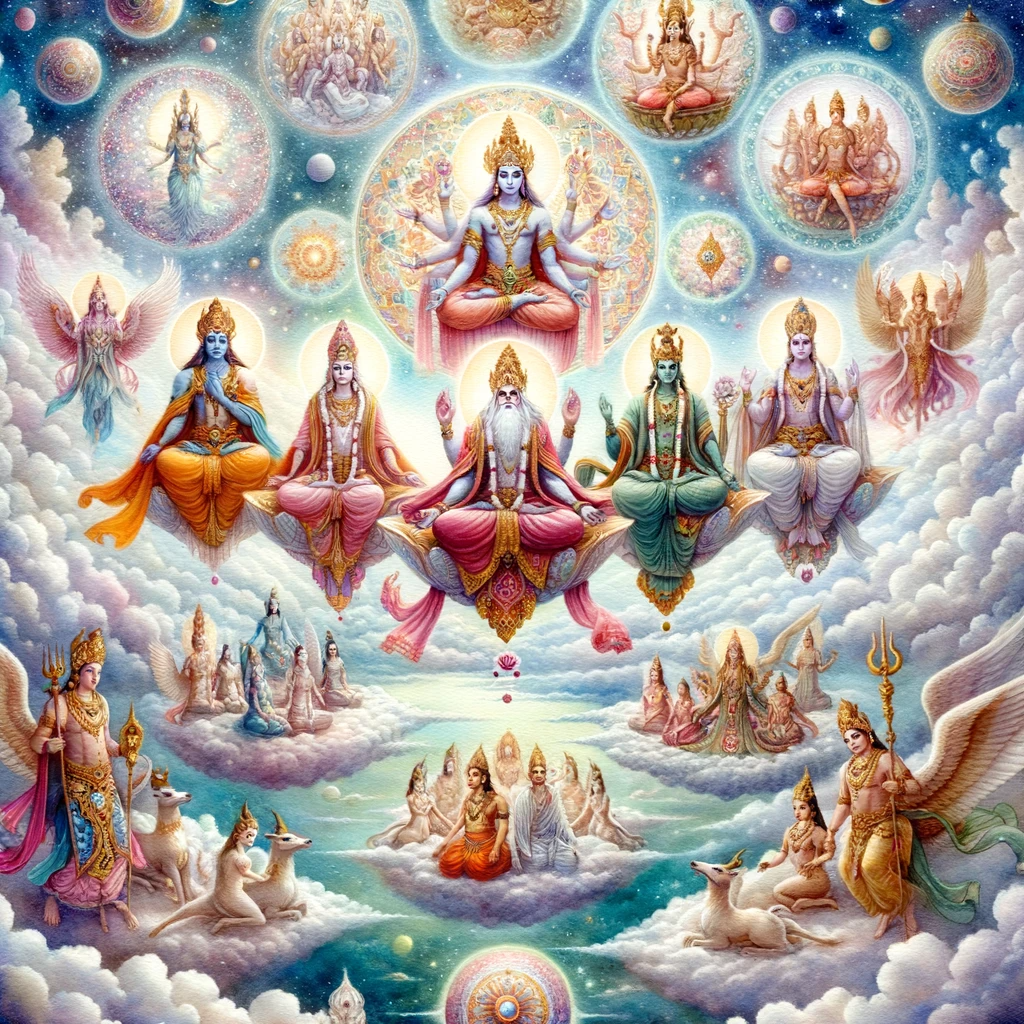
Celestial Gathering:
Floating above a sea of clouds, celestial beings like Shakra and the rulers of the Cardinal Points gather, accompanied by the tranquil Brahma-Kayika gods. Kinnaras, Gandharvas, and Garudas add a touch of musical enchantment.
Further, Shakra, the ruler of the celestials, with twenty thousand gods, his followers, such as the god Chandra (the Moon), the god Surya (the Sun), the god Samantagandha (the Wind), the god Ratnaprabha (Jeweled Radiance), the god Avabhasaprabha (Radiant Light), and others.
Further, the four great rulers of the Cardinal Points with thirty thousand gods in their train, namely the great ruler Virudhaka (Guardian of the Southern Direction), the great ruler Virupaksha (Guardian of the Western Direction), the great ruler Dhritarashtra (Guardian of the Eastern Direction), and the great ruler Vaisravana (Guardian of the Northern Direction).
The gods Isvara (Supreme Lord) and Mahesvara (Great Lord), each followed by thirty thousand gods.
Further, among the assembly of celestial beings known as the Brahma-Kayika gods — divine inhabitants of higher realms, renowned for their profound tranquility, meditative wisdom, and celestial radiance — we find Brahma Sahampati, the esteemed “Lord of the Universal Sound.” He was vital in humbly requesting the Buddha to teach the Dharma to benefit all sentient beings.
Accompanying Brahma Sahampati are his twelve thousand devoted followers, among whom the exalted figures of Brahma Sikhin and Brahma Gyotishprabha are renowned for their virtues and luminous presence. They gather in deep reverence and attend important assemblies, seeking the wisdom of the enlightened one as they continue their path toward spiritual enlightenment.
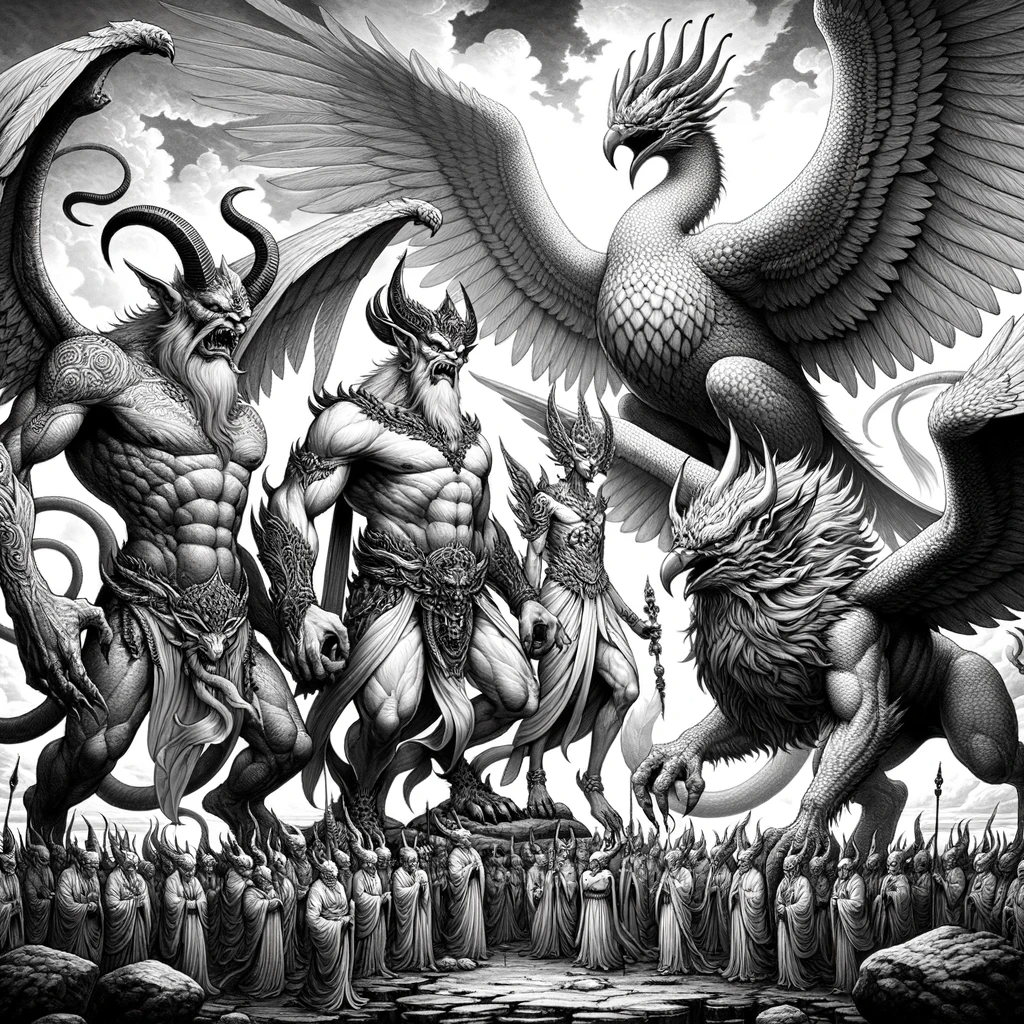
Demon and Garuda Outskirts:
The powerful demon chiefs stand alongside soaring Garuda chiefs, their vast wings casting shadows. Despite their might, a sense of reverence permeates the scene.
Alongside these celestial beings, the assembly includes the four chiefs of the demons, followed by numerous demon followers in many hundred thousand myriads. These powerful demon chiefs are Bali, the formidable Kharaskandha, the indomitable Vemakitri, and the cunning Rahu.
Moreover, we find the four Garuda chiefs, accompanied by many hundred thousand myriads of Garudas. Among them are the Garuda chiefs Mahategas, renowned for their great wingspan, the majestic Mahakaya, the virtuous Mahapurna, and the esteemed Maharddhiprapta.
Lastly, attending the gathering is Agatasatru, the benevolent king of Magadha and the son of Vaidehi.
These diverse beings from various celestial realms come together to pay homage to the Buddha, expressing their devotion and seeking his teachings to deepen their spiritual understanding and continue their journey toward enlightenment.
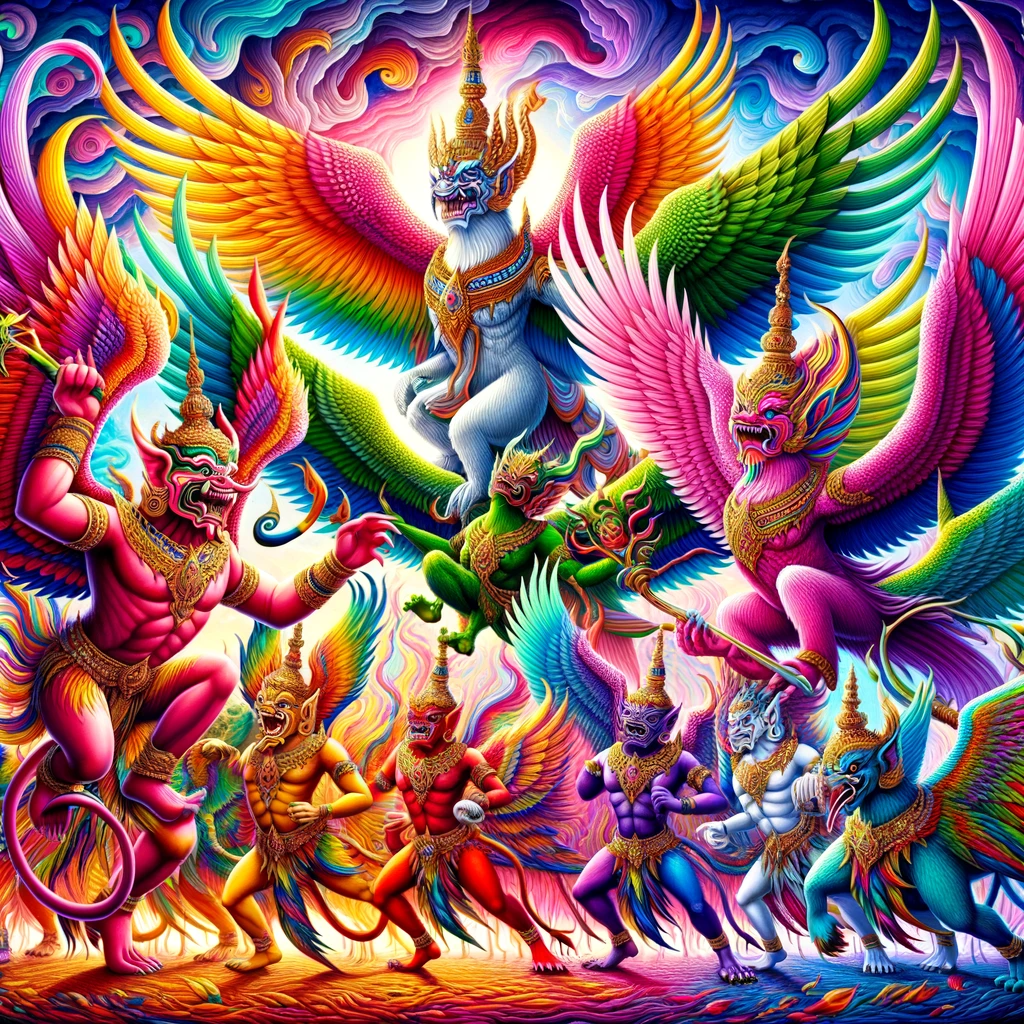
Vibrant Demon and Garuda Gathering:
A colorful rendition of the previous scene, with the demon and Garuda chiefs depicted in vivid hues, emphasizing unity and reverence in a riot of color.
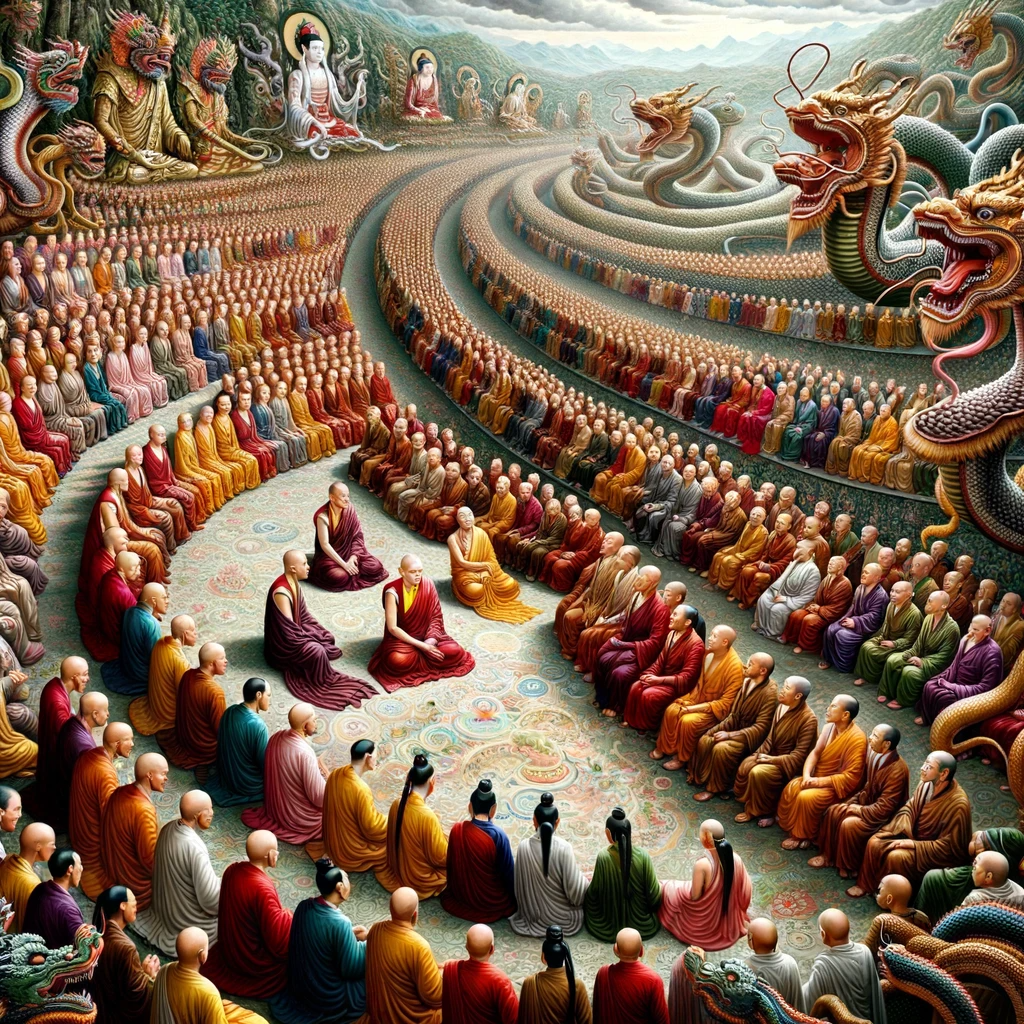
Vast Panoramic Assembly:
A wide view captures the entire gathering — from the Lord and his disciples to the celestial beings — all united in purpose, seeking wisdom and enlightenment.
At that moment, the Lord, surrounded and honored by the devoted assembly of four classes of hearers, had just concluded his profound teaching known as ‘The Immeasurable Meanings’ — a profound discourse designed to enlighten Bodhisattvas and suitable for all Buddhas. Seated in a tranquil cross-legged posture upon the seat of wisdom, he entered the profound meditation called ‘the Samadhi of Immeasurable Meanings.’ His body rested motionless, and his mind attained perfect tranquility.
 Mr. Altig’s Overview of the Wonderful Dharma of the Lotus Sutra
Leave a comment