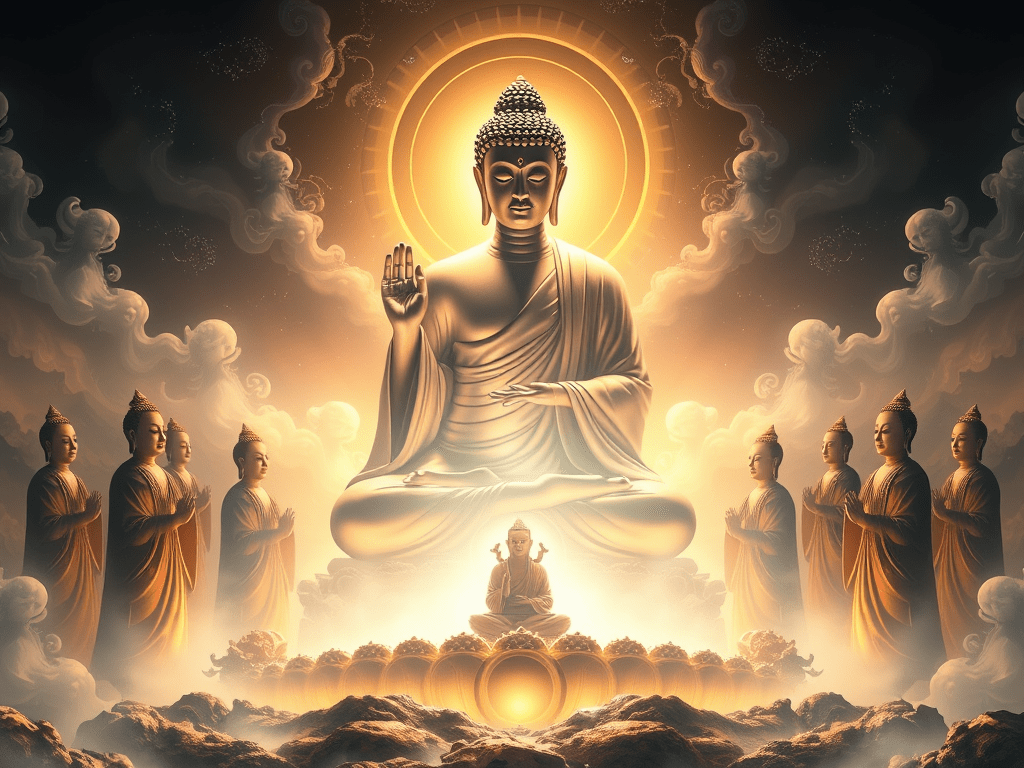
The Profound Revelations of Lotus Sutra Chapter Fifteen – “Emerging from the Earth”
This briefing synthesizes the core themes, most important ideas, and factual points from the provided sources on Chapter Fifteen (“Emerging from the Earth”) of the Lotus Sutra. This chapter marks a pivotal transition in the Sutra, shifting from “provisional teachings” (shakumon) to “essential teachings” (honmon), revealing deeper truths about the Buddha and universal salvation.
I. Core Teaching: Transition to the Essential Teaching and Revelation of the Eternal Buddha
Chapter Fifteen serves as a critical juncture, initiating the “essential teaching” (honmon) of the Lotus Sutra. This shift moves beyond the historical understanding of Shakyamuni Buddha and his provisional teachings (shakumon) to unveil more profound, ultimate truths. The central revelation is that of the Eternal Buddha, a concept that radically redefines Buddhahood from a historical figure to a universal, omnipresent life force of compassion and wisdom.
- Pivotal Transition: Chapter Fifteen “initiates the ‘essential teaching’ (Jpn. honmon), which encompasses the latter fourteen chapters of the Sūtra.” This moves “from an exoteric, historical understanding to an esoteric, eternal perspective.”
- The Eternal Buddha Concept: While the specific phrase “Eternal Buddha” is an interpretive concept prominent in East Asian Buddhism (especially Tiantai and Nichiren traditions), the Sutra reveals that Shakyamuni “actually attained Buddhahood in the inconceivably remote past.” This implies that the Buddha’s apparent “passing away into nirvana” is merely a “skillful means” to encourage diligent practice.
- Universal Buddhahood: The “I” in the Buddha’s proclamation of his eternal attainment “represents the living beings of the Dharma realm. Everyone in the Ten Worlds is referred to here in the word ‘I’.” This profoundly means, “We are all ‘eternal Buddhas.’ Ordinary people are Buddhas just as they are.” The universe itself is also described as the “eternal Buddha,” emphasizing interconnectedness and inherent wisdom.
II. The Buddha’s Proclamation: Health, Readiness, and Ancient Ties
The Buddha’s declaration in Chapter Fifteen signifies his eternal nature and the pre-existing connection with sentient beings, setting the stage for the emergence of the Bodhisattvas of the Earth.
- Buddha’s State of Being: The Buddha proclaims, “Truly, truly good men! I am peaceful. I am in good health. The living beings are ready to be saved. They do not fatigue me because I already taught them in their consecutive previous existences, and also because they have already honored the past Buddhas respectfully and planted the roots of good.” This transcends a mere physical report, signifying “complete enlightenment and liberation from all forms of suffering and defilement,” reflecting the “intrinsic quiescence and eternal nature of the Dharmakaya.”
- Ancient Karmic Connections: The Buddha’s lack of fatigue and the “readiness” of beings stems from a deep, ancient connection. These beings “have, in lifetime after lifetime, have always received my teaching, and they have also paid reverence to and venerated the Buddhas of the past, thereby planting the roots of goodness.” This establishes that enlightenment is nurtured over “countless rebirths,” with “roots of goodness” representing foundational spiritual predispositions.
III. The Emergence of the Bodhisattvas from Underground: Identity, Role, and Astonishment
A central dramatic event of Chapter Fifteen is the sudden appearance of innumerable Bodhisattvas from underground, a phenomenon that challenges conventional understanding and necessitates the revelation of the Eternal Buddha.
- Dramatic Emergence: The “ground of the Sahā-World… quaked and cracked, and many thousands of billions of Bodhisattva-mahāsattvas sprang up from underground simultaneously.” Their numbers are “equal in number to the sands of sixty thousand Ganges Rivers,” each leading vast retinues. They possess “golden-colored bodies,” “gigantic bodies, great supernatural powers, and inconceivable wisdom,” having practiced “under the ground” for “countless ages.”
- Four Leading Bodhisattvas: Among this multitude, four leaders are named: Superior Practices (Jōgyō), Boundless Practices (Muhengyō), Pure Practices (Jōgyō), and Firmly Established Practices (Anryūgyō). They are “outstanding in appearance” and act as “guiding teachers” for the assembly.
- Maitreya’s Perplexity: The appearance of these unknown Bodhisattvas causes “astonishment and perplexity” for Maitreya Bodhisattva, who questions how Shakyamuni, born only eight decades prior, could have trained such an ancient host. This question is explicitly asked “for the sake of people in the future who may have doubts about this point,” serving as a crucial narrative device leading to the “Life Span” chapter (Chapter 16).
- True Disciples and Propagators: Shakyamuni reveals these are “his original disciples whom he has been teaching since long ago.” They are entrusted with the “vital mission of propagating the Lotus Sūtra in the challenging, defiled age of the Latter Day of the Law,” embodying a “great vow… to eternally strive to guide people to enlightenment in this suffering-filled saha world.”
- Action of the Bodhisattvas: Their primary “action… is Nam-myoho-renge-kyo,” the fundamental Law pervading the universe. They are “experts in the art of life who help people transform themselves on the most fundamental level and gain true inner happiness,” rooted in the understanding that “both they and others possess the Buddha nature.”
IV. The Path to Universal Enlightenment and Practical Implications
The teachings of Chapter Fifteen emphasize radical inclusivity, the transformative power of the Dharma, and call for active, compassionate engagement from practitioners.
- Radical Inclusivity: The Lotus Sutra’s “true greatness” lies in its ability to “open the way to enlightenment for the unfortunate beings denied Buddhahood in the provisional teachings.” This includes “evil people, who are represented by Devadatta,” and “women, who are represented by the dragon king’s daughter,” demonstrating that “even Icchantikas Can Attain Buddhahood Through the Mystic Principle of Changing Poison Into Medicine” and “in one’s present form.”
- “Changing Poison into Medicine”: This vital principle, explained in relation to Chapter 15, asserts that “earthly desires and suffering can be transformed into benefit and enlightenment by virtue of the power of the Mystic Law.” It transforms “the three paths [of earthly desires, karma, and suffering] into the three virtues: the Dharma body, wisdom, and emancipation,” serving as a “brilliant source of hope.”
- Practical Implications for Practitioners:
- Self-Awareness and Mission: Practitioners are called to recognize their own inherent Buddhahood and their role as “Bodhisattvas of the Earth”—”a protagonist in the effort to enable all people to attain enlightenment.” This fosters a “clear and compelling sense of mission and identity.”
- Compassionate Action: The core ethos is “universal compassion,” recognizing that “we cannot be truly happy while others remain miserable.” This fuels a “determination to benefit all beings,” sustained by belief in others’ potential.
- Active Embodiment of the Law: The Bodhisattvas of the Earth’s “action… is Nam-myoho-renge-kyo,” meaning practitioners must “actively embody and propagate the fundamental Law.” This involves “tirelessly reaching out to each individual with compassion and courage until fresh life force wells forth” and “persevere[ing] in conducting sincere dialogue” to “awaken the Buddha nature of others.”
V. Enduring Message and Relevance
Chapter Fifteen is not merely a historical narrative but a living prophecy, calling forth practitioners in every age to embody its teachings and contribute to universal enlightenment.
- Living Prophecy: The Sutra “functions as a living, dynamic prophecy that actively calls forth its own practitioners across different eras.” The “unprecedented occurrence” of the Bodhisattvas’ emergence “is continuously reenacted in the present through the dedicated actions of its votaries.”
- Ongoing Relevance: By internalizing these teachings and acting as modern-day Bodhisattvas of the Earth, practitioners “can contribute to the ongoing manifestation of the Buddha’s eternal compassion in the world, making the Sūtra’s profound message profoundly relevant and actionable for navigating the complexities and challenges of the modern era.”
 Mr. Altig’s Overview of the Wonderful Dharma of the Lotus Sutra
Leave a comment