Date: September 1, 2025
Source: Excerpts from “Lotus Sūtra Chapter Analysis: The Transformation of Worldly Adornment into Spiritual Merit: An Exegesis of King Wonderful-Adornment’s Offering in the Lotus Sūtra”
This briefing document summarizes the key themes, ideas, and facts presented in the provided analysis of Chapter Twenty-Seven of the Lotus Sūtra, focusing on the story of King Wonderful-Adornment.
Executive Summary
Chapter Twenty-Seven of the Lotus Sūtra, detailing the offering of King Wonderful-Adornment, serves as a powerful allegory for spiritual transmutation, where material wealth and ego are transformed into a foundation for enlightenment. The narrative highlights Mahayana principles of universal enlightenment, skillful means (upāya), and the valorization of lay practice. It illustrates how worldly life can be reconciled with the path to Buddhahood, emphasizing the accessibility of the Dharma to all beings regardless of their background or past beliefs. The story is underpinned by a profound karmic backstory, where past actions dictate present opportunities for spiritual growth, leading to a “family revolution” that guides the king to the correct path.
Key Themes and Most Important Ideas/Facts
1. The Narrative Foundation: King Wonderful-Adornment’s Journey to the Dharma
- Philosophical Schism: King Wonderful-Adornment, ruler of the world Light-Adornment, initially held “deviant views” and was a devout believer in Brahmanism, an “externalist” teaching. In contrast, his wife, Queen Pure Virtue, and their two sons, Pure Storehouse and Pure Eye, had cultivated the bodhisattva path and possessed “mighty spiritual powers, blessings, virtues, and wisdom.” This internal conflict within the royal family sets the stage for spiritual intervention.
- Karmic Debt Repaid: The story is rooted in a past-life karmic debt. In a previous existence, the future King Wonderful-Adornment sacrificed his own spiritual practice to assist three other practitioners by performing mundane tasks. These three practitioners later attained Buddhahood and were reborn as his wife and sons, whose mission is to guide the king to the Buddha way, thus repaying their debt. This illustrates “that actions, even mundane ones like cooking and cleaning, have far-reaching karmic consequences that transcend a single lifetime.”
- Skillful Means (Upāya) in Action: The sons, at their mother’s urging, employ “skillful means” to convert their father. They manifest “spiritual transformations,” such as flying high in the air and emitting water and fire, which deeply impress the king and purify his mind. These displays are not random but a deliberate “skillful means to break through the king’s rigid, externalist beliefs.” The king, awakened by these wonders, asks about their teacher, leading him to Cloud-Thunderpeal-Star-King Flower-Wisdom Buddha.
- Present-Day Identifications: The analysis reveals the past and present identities of the characters:
- King Wonderful-Adornment: Becomes Bodhisattva Flower Virtue.
- Queen Pure Virtue: Becomes Bodhisattva Light Shining Adornment Marks.
- Pure Storehouse: Becomes Bodhisattva Medicine King.
- Pure Eye: Becomes Bodhisattva Medicine Superior.
2. The Symbolic Language of the Offering
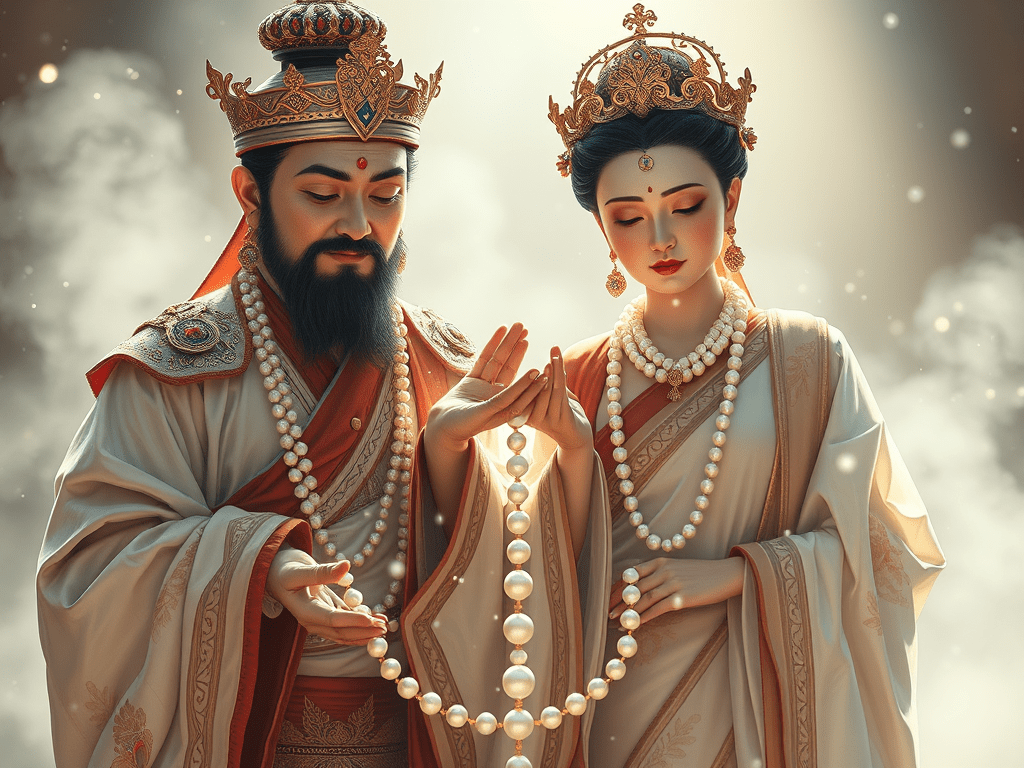
- Renunciation of Worldly Power (Pearl Necklaces): Upon meeting the Buddha, the king and queen offer their “pearl necklaces, ‘worth hundreds of thousands,’”. This act is a “profound symbolic renunciation of their worldly attachments and royal status.” It demonstrates a shift in values, transforming material wealth into “a spiritual act of merit, using their wealth for the benefit of all beings and for the furtherance of the Dharma.” The king’s name, “Wonderful-Adornment,” transforms in meaning from external jewels to internal virtue.
- Spiritual Transcendence (Tāla-Tree): The necklaces fly “seven times as high as the tāla-tree.” While the tāla-tree is a measure of height, it also symbolizes “uncharitable individuals and their disgraceful nature” in some Hindu traditions. The ascent “seven times” this height represents a complete transcendence of the king’s former “unfruitful” and spiritually empty existence, with the number seven symbolizing spiritual completion.
- Foundation of Merit (Jeweled Platform): The necklaces miraculously transform into a “jeweled platform” upon which the Buddha sits. This platform symbolizes “a spiritual foundation built upon accumulated virtues and merits” and a “permanent, sacred space—a physical representation of their purified minds and the immense spiritual merit of their conversion.”
3. Thematic Insights: A Parable of Universal Liberation
- “Family Revolution” and the Bodhisattva Path: The story exemplifies the bodhisattva ideal of liberating others, beginning with one’s own family. This concept, termed a “family revolution,” validates the application of Dharma within the domestic sphere and highlights how “family members can serve as ‘good and wise advisors’ for one another.” This makes the Dharma accessible and applicable to lay practitioners.
- Skillful Means (Upāya) and the One Vehicle: The king’s conversion is a prime example of upāya. The sons’ use of spectacular powers, rather than just philosophical discourse, mirrors the Buddha’s own pedagogical strategy, where all teachings (the “three vehicles”) are “expedient means” to lead beings to the “single, ultimate goal of Buddhahood.” This practical demonstration shows “how the Buddha’s great compassion leads him to adapt his teachings to suit many different kinds of people and contexts.”
- Universalism of the Lotus Sūtra: The narrative demonstrates the Lotus Sūtra’s “democratization of enlightenment.” The king, a layperson with “deviant views,” receives a prophecy of his future Buddhahood as “Sala-Tree-King Buddha,” confirming that “no one is beyond the reach of the Dharma.” This aligns with the Parable of the Medicinal Herbs, emphasizing that the Dharma is available to all, regardless of their capacity or status.
4. Contextualization and Interpretive Frameworks
- Historical Context: The Lotus Sūtra emerged during the Mahayana movement (1st century BCE to 2nd century CE), which emphasized “compassion and the bodhisattva ideal” and the necessity of “liberating others from suffering in addition to oneself.” This contrasted with earlier, more individualistic pursuits of enlightenment. The king’s story is a “powerful endorsement of this new, compassionate, and universalist vision of the Dharma.”
- Commentarial Traditions:Tiantai School (Zhìyǐ): The founder, Zhìyǐ (538–597), provided the crucial karmic backstory, transforming the tale into a narrative of “karmic fulfillment and the repayment of a past debt,” reinforcing Mahayana interconnectedness.
- Nichiren Buddhism: Nichiren (1222–1282) viewed the Lotus Sūtra as the “sole object of veneration” and the king’s story as a “prime example of the ‘family revolution.’” For Nichiren, “each character of the sutra considered ‘a living Buddha,’” making the story a “living model for contemporary practice, particularly for laypeople.” The modern Sōka Gakkai movement also emphasizes this “family revolution.”
Conclusion
The story of King Wonderful-Adornment is a rich allegory for spiritual growth, illustrating the profound Mahayana concept of transforming worldly attachments into spiritual merit. It teaches that enlightenment is a path of transmutation, where material wealth and family relationships can become vehicles for liberation. The king’s journey, facilitated by his sons’ skillful means, affirms the Lotus Sūtra’s core message: the path to Buddhahood is universally accessible, transcending past beliefs, social status, and the ordinary circumstances of worldly life. It ultimately reconciles the sacred and the profane, demonstrating that deep spiritual transformations can arise from everyday relationships and actions.
 Mr. Altig’s Overview of the Wonderful Dharma of the Lotus Sutra
Leave a comment