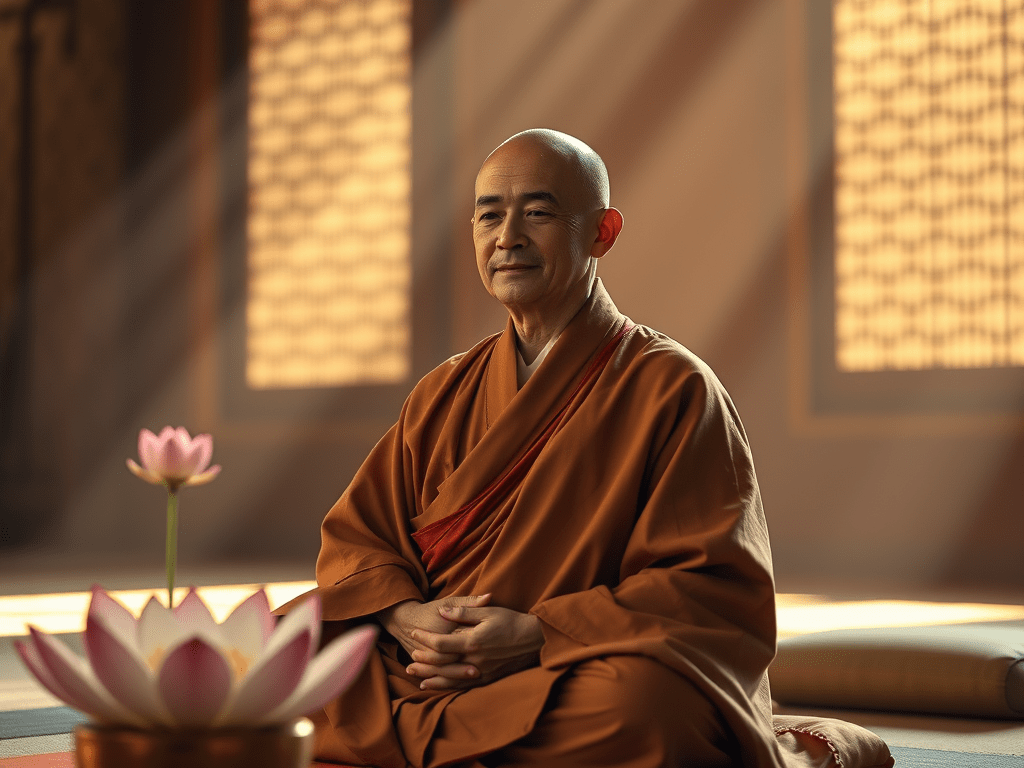
This briefing document synthesizes key themes and concepts from Chapter 10 of the Lotus Sūtra, “A Teacher of the Dharma,” focusing on the Buddha’s instructions to Medicine-King Bodhisattva regarding the three indispensable conditions for propagating the Dharma: the Room, the Robe, and the Seat. It emphasizes the Sūtra‘s unique status, the challenges of the “evil age,” and the practical application of these teachings for contemporary Bodhisattva practice.
I. Introduction: The Dharma Teacher’s Calling and the Primacy of the Lotus Sūtra
The Lotus Sūtra presents a foundational framework for those aspiring to the Bodhisattva path and dedicated to the benefit of all beings. These teachings are “not a mere list of virtues, but a systematic, integrated guide for all who seek to propagate the Dharma.” The three core metaphors—the Room, the Robe, and the Seat—are presented as “indispensable conditions that must be cultivated prior to embarking on this sacred mission.”
A. The Lotus Sūtra‘s Elevated Status and the One Vehicle (Ekayāna)
The Lotus Sūtra holds a “unique and elevated status within the Mahāyāna tradition,” described by the Buddha as “foremost” among all scriptures and “the treasury of the Buddhas’ secrets and essentials.” It reveals the “One Vehicle” (Ekayāna), the singular path to Buddhahood universally available, superseding the traditional goal of individual liberation (arhatship).
B. The Context of the “Evil Age”
The propagation of the Sūtra is forewarned as being “most necessary, yet most challenging, during the ‘evil age after my extinction’.” The Buddha predicts “hostility and jealousy toward this sutra abound even when Tathagata is present in the world, how much more so after his extinction?” This context highlights the revolutionary nature of the Sūtra‘s teachings—asserting universal Buddhahood—and underscores the need for a specific spiritual and psychological armament for Dharma teachers in a resistant world.
C. The Threefold Guide for the Dharma Teacher
| Metaphor | Literal Meaning (as per Sūtra) | Practical Application |
| Room of the Tathāgata | Great Compassion | Cultivating empathy and connection |
| Robe of the Tathāgata | Gentleness and Patience | Developing spiritual fortitude |
| Seat of the Tathāgata | Voidness of all things | Seeing the interdependent nature of reality |
Part I: Entering the Room of Great Compassion
“To enter the room of the Tathāgata is to have great compassion toward all living beings.” This is the “very foundation of the Bodhisattva path,” motivating individuals to “forgo the rewards of a pure land” and voluntarily “be reborn in this evil world” to expound the Dharma.
A. Compassion as a Foundational State (mahākaruṇā)
Compassion here is not merely an emotion but a “foundational state of being, a deep, empathetic connection to the suffering of all sentient beings.” This state is cultivated by overcoming the “clinging to a solid, separate, and permanent self,” which creates a bias towards one’s own suffering. When this illusion is seen through, “the energy of self-concern naturally and effortlessly extends to all beings.”
B. Practical Application: Creating a “Room of Dialogue”
In contemporary terms, “entering the room” involves creating a “warm and welcoming space for dialogue.” This shifts from a “vertical relationship—where one person imparts knowledge to another—to a horizontal one, where there is a feeling of sympathy and respect among equals.” This is manifested through “active listening, letting go of personal expectations or judgments, and seeking to understand another’s point of view without interruption.”
III. Part II: Wearing the Robe of Gentleness and Forbearance
“To wear the robe of the Tathāgata means to be gentle and patient.” This is the “spiritual armor of the Dharma teacher,” designed to protect against “intense ‘mockery and disparagement’” in the evil age. It represents a spirit of perseverance that is “neither retreating nor conceding defeat,” demonstrating the “spiritual courage to continue reaching out to others and never give up on them.”
A. Patience as Active Fortitude (kṣānti pāramitā)
This patience is a “deep spiritual fortitude” allowing practice and teaching “in the face of adversity without anger or despair.” It exemplifies the Buddha’s “skillful means (upāya)” in adapting teachings to beings’ levels, as powerfully illustrated by the “Parable of the Prodigal Son,” where the father patiently guides his son towards his inheritance.
B. Practical Application: “Sacrificing our Bodies Through Dedicated Work”
The radical self-immolation of Medicine-King Bodhisattva symbolizes “complete and unsparing dedication.” In a modern context, “wearing the robe” means “sacrificing our bodies through dedicated work,” a commitment to “long-term, unflagging effort for the sake of the Dharma.” This includes the “willingness to answer a student’s question for the tenth time with the same gentleness and patience as the first.”
IV. Part III: Sitting on the Seat of the Voidness of All Things
“To sit on the seat of the Tathāgata is to see the voidness of all things.” This is the “ultimate wisdom that makes both compassion and patience possible.” Śūnyatā (voidness) does not mean nothing exists but rather that nothing has “inherent existence (svabhāva)” or a fixed, independent nature, as all phenomena “arise due to a complex web of causes and conditions and are thus impermanent and interdependent.”
A. Philosophical Elaboration: The Threefold Truth (Tiantai School)
While Madhyamaka focuses on the emptiness of inherent existence, the Tiantai school, rooted in the Lotus Sūtra, offers the “Threefold Truth” (sān dì):
- Emptiness (Kū): Phenomena are devoid of fixed, inherent existence.
- Provisional Existence (Ke): Phenomena have a temporary, conventional reality, fully functional.
- The Middle Way (Chū): The non-dual synthesis, realizing phenomena are “simultaneously empty and provisionally real.”
B. The Middle Way and Compassionate Action
This Middle Way provides the “philosophical justification for compassionate action.” By seeing through the illusion of separate phenomena, one realizes “all things are radically interconnected and interdependent, part of a single, interfused web of reality.” Thus, “acting with compassion is not an act of an ‘I’ helping a ‘you’; it is the natural, non-dualistic expression of the interconnectedness of all reality.” The wisdom of the seat ensures that compassion is a “liberating, non-attached action.”
V. Part IV: Contextual and Practical Significance
A. The Symbolic Healer: Medicine-King Bodhisattva
The teaching is addressed to Medicine-King Bodhisattva (Bhaiṣajyarāja), a figure associated with healing. His role as a “spiritual healer parallels the mission of the Dharma teacher, who works to cure the ‘diseases’ of ignorance, greed, and anger.” His past act of self-immolation symbolizes “complete and unsparing dedication of one’s entire being to the Dharma.”
B. Parables of Skillful Means (Upāya)
The Lotus Sūtra uses parables as “blueprints for the path”:
- The Burning House: Compares saṃsāra to a burning house and the Buddha (father) using expedient “vehicles” (earlier Buddhist traditions) to lure children to safety, eventually revealing the “single, ultimate vehicle of Buddhahood.” This illustrates the Buddha’s “skillful means (upāya)” in adapting teachings.
- The Prodigal Son: The wealthy father patiently guides his long-lost, impoverished son, gradually elevating his position and building his confidence before revealing his true identity and inheritance. This is the “ultimate model for the work of the Dharma teacher, who must meet people where they are and, with boundless patience and wisdom, gradually guide them toward their own enlightened potential.”
VI. Conclusion: The Integrated Practice of a Bodhisattva
The Buddha’s teachings on the Room, Robe, and Seat are an “integrated, interdependent system of practice,” not fragmented virtues. “Great compassion is the motivation and purpose for action; gentleness and patience provide the spiritual fortitude to sustain that action in a challenging world; and the wisdom of voidness is the ultimate insight that enables and perfects both.”
A. Collection of Merit and Wisdom
This integrated practice is framed as the “collection of merit” (compassion, patience) and the “collection of wisdom” (understanding voidness). Both are “necessary for an effective and liberating path.”
B. Contemporary Application: Becoming an Emissary of the Tathāgata
- The Room: Cultivated through “active listening and non-judgmental inquiry,” creating a “room of dialogue.”
- The Robe: Worn by “persevering in these efforts despite setbacks,” embracing “long-term work of ‘burning your body through dedicated work’.”
- The Seat: A continuous practice of “remembering the interdependent nature of reality,” seeing the “latent potential” in every person and situation, which “prevents burnout and inspires persistent, confident action.”
By cultivating these qualities, an individual “is not just practicing a philosophy; they are becoming, in this very moment, an emissary of the Tathāgata, carrying out the Buddha’s work to bring relief and enlightenment to all beings.”
 Mr. Altig’s Overview of the Wonderful Dharma of the Lotus Sutra
Leave a comment