Introduction: The Puzzle at the Heart of the Lotus Sūtra
Ancient spiritual texts are often filled with baffling paradoxes. These seemingly impossible scenarios aren’t mistakes; they are deliberate puzzles designed to shatter our ordinary understanding and reveal a deeper, more profound truth. One of the most striking examples of this comes from the Lotus Sūtra, during a culminating event of cosmic scale known as the “Ceremony in the Air.”
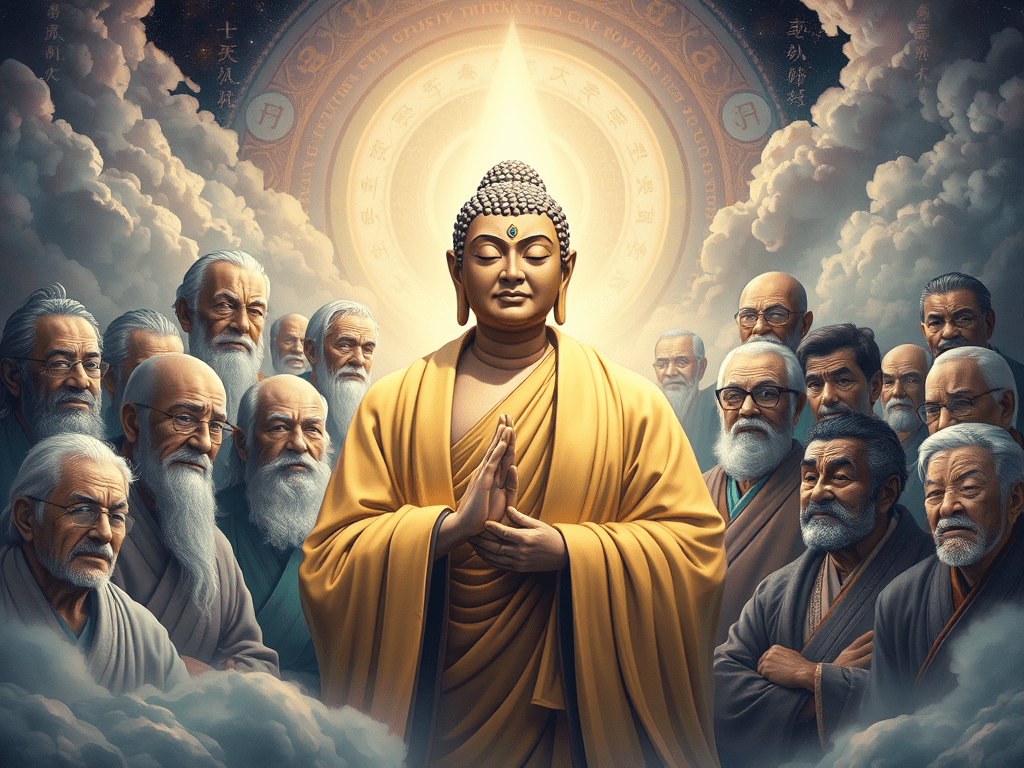
The scene is a cosmic mystery in the making. The Buddha, having achieved enlightenment only “forty-odd years ago,” is teaching an immense assembly. Suddenly, the earth splits open, and a host of ancient, powerful bodhisattvas emerges from the very space belonging to our world. They are his disciples. The entire assembly, including his most advanced followers, is thrown into a state of profound shock. How could the Buddha, in such a short time, have trained this countless multitude of majestic, golden-hued beings?
The great Bodhisattva Maitreya, speaking for everyone, articulates the sheer absurdity of the situation with a memorable analogy. The paradox he presents is not a flaw in the text, but the precise setup for one of the most important revelations in Mahayana Buddhism—a truth so deep it required a cosmic riddle to unlock.
It is as difficult as to believe a handsome, black-haired man twenty-five years old who points to men a hundred years old and says, ‘They are my sons,’ or as to believe men a hundred years old who point to a young man and say, ‘This is our father. He brought us up.’
——————————————————————————–
1. The Buddha You Know Was a Character He Played.
The Buddha’s solution to the “young father, old sons” paradox is to reveal that his entire historical life was a form of strategic performance. He explains that he did not, in fact, attain enlightenment for the first time forty-odd years ago under a tree in India. The truth is that he “actually attained Buddhahood in the inconceivably remote past.”
His life as Siddhartha Gautama—his birth, his search for truth, his enlightenment, and even his eventual death—was an “expedient means,” a kind of divine play staged for the benefit of humanity. But why? The sūtra explains using the Parable of the Skilled Physician. The parallels are explicit: the Physician is the Buddha, his sons are all living beings, the poison they’ve taken represents our delusions, and the medicine he offers is the Dharma, his teaching. In the story, some of the poisoned sons are so delirious they refuse the antidote. To shock them into action, the father pretends to die, sending a messenger to announce his death. Grief-stricken, the sons finally take the medicine and are cured.
Similarly, the Buddha explains that if he remained in the world forever, his followers might take his presence for granted, becoming “arrogant and selfish, or become discouraged and neglectful.” By feigning his own birth and death, he creates a sense of “spiritual urgency.” This revelation transforms the Buddha from a single historical figure into a timeless, cosmic presence whose compassion is so profound that he stages his entire life story to guide us toward awakening.
——————————————————————————–
2. Enlightenment Isn’t an Escape—It’s Right Under Your Feet.
The dramatic emergence of the “Bodhisattvas of the Earth” is a profoundly symbolic event. Before they appear, countless bodhisattvas from other, purer worlds offer to stay and teach the Lotus Sūtra in our world after the Buddha is gone. In a stunning move, the Buddha politely declines their prestigious offer, stating that our world, known as the Saha world, has its own bodhisattvas perfectly capable of the task. Then, the ground trembles and an innumerable host wells up from the “space belonging to this world” beneath the surface.
These are not just any disciples; they are led by four figures whose names symbolize the Mahayana path itself: Superior Practices, Boundless Practices, Pure Practices, and Firmly Established Practices. They are the embodiment of the very virtues one seeks to cultivate. The symbolism here is revolutionary. These are not enlightened beings from a distant, heavenly “Pure Land.” They are indigenous to our world of suffering. By rejecting outside help and entrusting the future of his teaching to them, the Buddha makes a radical statement. As the scholar Tao Sheng interpreted it:
…living beings inherently possess an endowment for enlightenment, and it cannot remain concealed; they are bound to break the earth of defilements and emerge to safeguard the Dharma.
This isn’t just a preference; it’s a radical affirmation. The path to enlightenment is not about escaping our flawed reality, but about transforming it from within. The Buddha is telling us that the tools for our own liberation are not “out there”—they are native to the very soil of our suffering, proving our world “can be the very stage for enlightenment.”
——————————————————————————–
3. Sincere Doubt Is a Spiritual Superpower.
In many spiritual traditions, doubt (Vicikicchā) is considered a “mental illness” or an obstacle to progress. The Lotus Sūtra presents a radically different perspective by distinguishing between two types of doubt. Early in the sūtra, five thousand arrogant members of the audience, whose doubt is rooted in ignorance, simply “get up and walk out” before the deepest truths are revealed. Their questioning goes no further than their own preconceived notions.
Maitreya’s questioning, in contrast, is held up as a model of ideal practice. His doubt is not a hostile challenge born of arrogance. It is an “earnest plea for clarity” made “especially for the sake of people in the future.” Faced with an impossible contradiction, he seeks a deeper understanding on behalf of everyone. The Buddha doesn’t rebuke Maitreya; he praises him for asking about this “great matter,” validating the inquiry and using it as the perfect prompt to reveal the sūtra’s deepest truth about his eternal nature.
Asking such questions about the Lotus Sūtra is even described as a “rare source of good fortune” and one of the “six difficult acts” that is a “sure indication” of one’s ability to attain Buddhahood. The takeaway is powerful: true spiritual understanding isn’t about blind faith. It’s an active, courageous process that pits sincere, clarifying doubt against arrogant, dismissive doubt. “It is only through sincere questioning that we find the Buddha’s mind and make it our own.”
——————————————————————————–
Conclusion: Making the Buddha’s Mind Our Own
The paradox of the young father and his ancient sons is a gateway to three profound truths. First, the historical Buddha we know is a compassionate manifestation of a timeless, eternal presence. Second, the potential for enlightenment is not in some faraway paradise but is buried right under our feet, within the soil of our own imperfect world. And third, sincere, courageous questioning is not an obstacle to faith but the very key that unlocks the door to wisdom.
These revelations invite us to see ourselves and our world differently. They suggest that our spiritual journey is not about passively receiving answers, but about actively seeking them.
If the deepest truths are only revealed through sincere questioning, what is the one “impossible” question you’ve been afraid to ask?
 Mr. Altig’s Overview of the Wonderful Dharma of the Lotus Sutra
Leave a comment