1.0 Introduction: The Four-Line Verse That Unlocks a New Reality
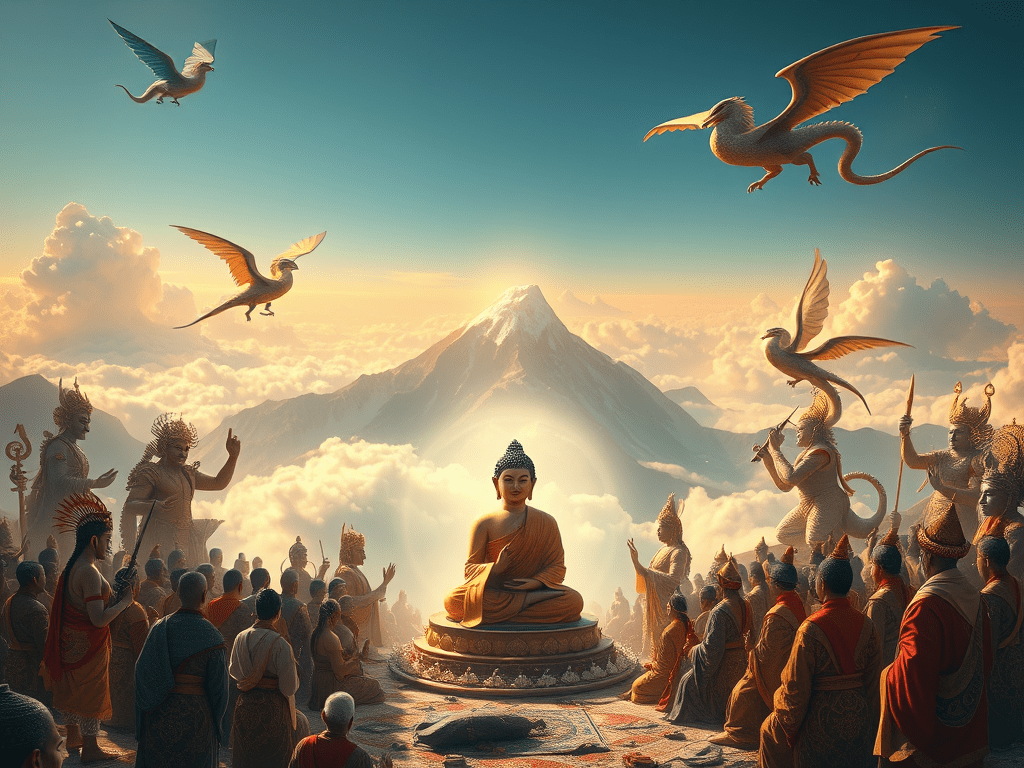
Imagine a scene from deep antiquity: atop the sacred Vulture Peak, the Buddha addresses a cosmic assembly of gods, dragons, celestial musicians, and all manner of beings, both human and non-human. This epic setting is a deliberate signal that the teaching to come will shatter our ordinary perception of reality. It is in this transcendent context that he offers a simple four-line verse containing profound, counter-intuitive secrets for finding “joys and wonders” in a world of “conflict and suffering.”
The core teaching is captured in this short verse, or gatha:
If you wish to obtain quickly the knowledge Of the equality and differences of all things, Keep this sūtra, and also make offerings To the keeper of this sūtra!
This verse was delivered to a great disciple named Bhaiṣajyarāja, the Medicine-King Bodhisattva. His very name, “King of Medicine,” symbolizes the Dharma’s power to heal the spiritual ailments that cloud our vision. Though the verse seems straightforward, its lines contain a radical blueprint for altering the very foundation of how we see. This article will unpack five of the most impactful ideas hidden within this powerful teaching.
2.0 Takeaway 1: This World of Suffering Is the Paradise You’re Seeking
The first mind-bending truth is a direct challenge to one of our most fundamental assumptions: that liberation means escaping this flawed world for a better one. Mahayana Buddhism radically reframes this by teaching that our ordinary world of struggle, the Saha world of samsara (suffering), is simultaneously the eternal Pure Land of nirvana (enlightenment). As the great philosopher Nāgārjuna taught, there is no ultimate duality between them.
This reframes the entire spiritual path. The goal is not to flee our reality but to fundamentally transform our perception of it. The work is entirely internal. Our physical eyes, clouded by what Buddhists call the “Eight Worldly Winds” (praise and blame, pleasure and pain), see only conflict. But a cultivated “wisdom eye” can perceive the ultimate truth. The Tiantai school of Buddhism puts this in startling terms: “every event is both entirely Buddhahood and entirely ‘deviltry’ at the same time. The difference lies in one’s perception.” This is an incredibly empowering realization: joy and wonder are not in a distant future or another place, but are accessible right here, right now, by seeing this world correctly.
3.0 Takeaway 2: A Sacred Text Can Be the Living Body of the Buddha
The instruction to “keep this sūtra” implies something far more profound than mere preservation. In this tradition, the Lotus Sūtra is considered a “Dharma relic,” granting it a status equal to the Buddha’s own physical remains (śarīra). This elevates the text from a collection of words into a living, potent entity.
The Buddha teaches that wherever the sutra is kept, taught, or copied, a commemorative monument (a stupa) should be erected, because the “perfect body” of the Buddha is already present in that very place. This is a staggering metaphysical claim. It means the act of engaging with the Dharma is not symbolic; it is participatory and reality-altering. The source text reveals the ultimate implication: “the act of embracing the Dharma in the form of the sutra makes the text, the practitioner, and the place of practice non-dual.” The text, the person upholding it, and the location fuse into a single manifestation of the Buddha’s living wisdom. Reading and study become a sacred act of embodying an enlightened presence.
4.0 Takeaway 3: The Most Powerful Offering Is to the Keeper of the Flame, Not the Flame Itself
The verse makes a highly counter-intuitive claim: making offerings to a person who “keeps this sūtra” is even more meritorious than making them to the Buddha. To understand the staggering weight of this instruction, we must know the story of the one receiving it, the Medicine-King Bodhisattva.
In a past life, he was known as “One-Who-Delights-All-Beings-to-See.” To show his devotion, he performed the ultimate offering—he set his own body alight, burning for 1,200 years. Later, he burned his arms for an astonishing 72,000 years. The Buddha delivers his teaching on offerings to the very being who embodies its most extreme and selfless expression. In this context, his instruction becomes clear. Since the historical Buddha has entered parinirvana, the living practitioner who upholds the teaching becomes the embodied, accessible link to the Dharma in our world. They are the living continuation of the Buddha’s work. The Buddha commands his followers to:
…press your palms with reverence” and make offerings to these individuals “as you would to a Lord of the World”.
This is a profound statement on the value of the living tradition. Wisdom is not a historical artifact, but a continuous presence passed through its dedicated keepers.
5.0 Takeaway 4: The Secret to True Sight Is Understanding “Emptiness” and “Interconnection”
The verse’s ultimate goal—to know the “equality and differences of all things”—is achieved by seeing with the “eyes of the Buddha.” This enlightened vision perceives two foundational principles: emptiness (śūnyatā) and dependent origination (pratītyasamutpāda).
Emptiness does not mean that things don’t exist. It means they lack a fixed, independent essence. Everything is a product of interconnection. A flower only exists due to the confluence of non-flower conditions like sunlight, soil, and water. This is dependent origination. Because all things are dependently arisen, they are “empty” of a standalone self. This is their ultimate “equality.” Their temporary forms and functions are their “differences.”
This philosophical insight is the key that unlocks the other takeaways. It is the realization of emptiness that dissolves the false duality between the “world of suffering” and the “Pure Land.” This is also the basis for the Lotus Sūtra’s core doctrine of the One Vehicle (Ekayāna). The Buddha uses various teachings (the “differences”) as skillful means (upāya) tailored to different people, but they all lead to one destination (the “equality” of universal Buddhahood). This understanding moves us beyond a rigid, conflict-driven worldview to see the fluid, interconnected nature of reality.
6.0 Conclusion: Are You Ready to See with New Eyes?
The five takeaways from this single verse all point to a central, unifying theme: the path to finding joy and wonder is an internal transformation of perception, not an external change of circumstances. The suffering we experience is not caused by an inherently flawed world but by a deluded way of seeing it through our physical eyes.
This ancient teaching provides a blueprint for awakening our “wisdom eye.” It reveals that reality is more fluid, more sacred, and more interconnected than we conventionally perceive. The paradise we seek is not in another place, the wisdom we need is not locked in the past, and the freedom we desire is found by looking at this very world with a new kind of vision.
What in your world might look different if you chose to see it not just with your physical eyes, but with a wisdom that perceives the wonder in all things?
 Mr. Altig’s Overview of the Wonderful Dharma of the Lotus Sutra
Leave a comment