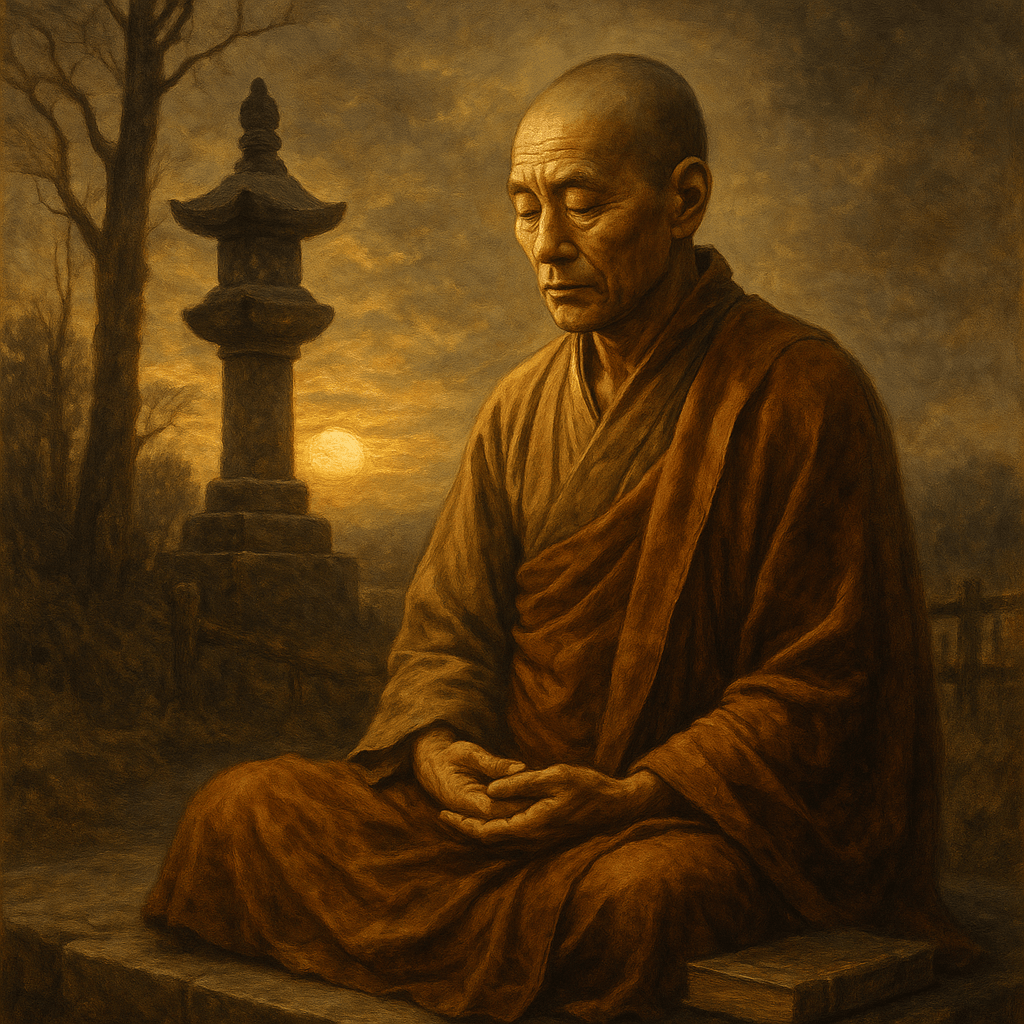
Have you ever felt the frustration of trying to share an important idea or a deeply held belief, only to be met with conflict and disagreement? In what often feels like an age of quarrels, it’s easy to assume the biggest obstacle is external opposition. But ancient Buddhist wisdom identifies this era with a specific spiritual diagnosis: the Latter Day of the Law (Mappō), a prophesied age of profound spiritual decline and conflict. For this exact environment, a text called the Lotus Sūtra offers a surprising and psychologically profound strategy.
In a section called the “Peaceful Practices,” it reveals that the most powerful technique for sharing wisdom isn’t about winning arguments. It’s about a radical transformation of our own minds. Here are three of its most impactful takeaways.
The Real Enemy Isn’t Them, It’s Your Own Spiritual Ego
When we set out to share something we value, the Lotus Sūtra‘s “third peaceful practice” warns that the most dangerous hindrance isn’t persecution from others, but the “temptation arising from the ‘inner heart’.” This internal obstacle is identified as spiritual arrogance (Mano-māna).
The text is remarkably specific about what this looks like. It’s the act of criticizing fellow seekers, pointing out their shortcomings, calling them “lazy,” or telling them they “can never become enlightened.”
The core analysis here is profound: this criticism is a “symptom of the critic’s own underlying spiritual immaturity” and “doctrinal uncertainty.” Judging others is a psychological mechanism we use to feel superior when we lack unshakeable conviction in our own beliefs. But it runs deeper than mere insecurity. Such judgment is a fundamental rejection of the very teaching one claims to uphold—the Lotus Sūtra‘s central premise of a universal, inherent Buddha-nature in all beings. To deny someone’s potential is to deny the core of the philosophy itself.
The Ultimate Power Move: Unwavering Respect, Even Under Attack
Chapter 20 of the Lotus Sūtra provides the ultimate example of this practice in the story of a figure known as Bodhisattva Never Disrespectful. His entire spiritual practice consisted of one simple, unwavering action. He would meet every single person, bow deeply to them, and affirm their highest potential.
His exact words were a powerful and consistent declaration of faith in others:
“‘I have deep reverence for you and I will never treat you with disrespect, contempt, or arrogance. Why? Because all of you are practicing the bodhisattva way and will surely become Buddhas!’”
The reaction he received from “unkind people” was not acceptance, but violence. He was met with verbal abuse and physical assault. Yet his response was extraordinary. To escape the beatings, he would run away, but even from a distance, he would continue shouting his message of reverence.
This reveals the truly radical nature of the teaching. While another chapter promises that for a true practitioner, “Swords and staves will not touch him,” Never Disrespectful is clearly physically beaten. This isn’t a contradiction; it’s the key to the superpower. The protection promised is spiritual invulnerability, not physical immunity. His inner state remained unassailable, and he transformed the persecution he endured into a “mystical cause” that forged a karmic connection with his attackers. The suffering wasn’t a failure of the practice; it was a necessary tool for their salvation.
The story’s conclusion is the ultimate proof. After suffering for their actions, his attackers were eventually reborn in his presence and, because of the bond he had forged, were finally led to enlightenment. His practice saved not only himself, but even his most violent persecutors.
Your Inner Stance Becomes Your Outer Reality
The Lotus Sūtra promises concrete rewards for those who master this internal practice. The foremost is the ability to “expound the Dharma without disturbance.” Those who achieve this inner peace can “stroll about without fear, like the lion king,” their wisdom shining “like the sun.” This inner stance is what gives all outward actions their power. Without it, the controlled speech recommended by the sutra becomes mere flattery, and disciplined conduct becomes empty ritual. A pure mind is the “locus of authenticity” that makes our actions effective.
This practice actively creates a positive environment. The text explains that by eliminating arrogance, the practitioner is able to “have good friends.” This isn’t passive; reverence acts as a “self-fulfilling prophecy.” By treating every person as if they already possess the capacity for enlightenment, you create an environment of trust and respect that makes them receptive to your message, thereby helping to awaken that very potential you revered.
The ultimate result is a powerful outward effect. The text promises that a “great multitude will come to him, hear and receive this sūtra from him, keep it after hearing it, recite it after keeping it, expound it after reciting it, [and] copy it or cause others to copy it after expounding it.” This chain reaction, vital for spreading ideas, begins with a mind free from judgment.
A Final Thought
Ultimately, the Lotus Sūtra‘s “Peaceful Practices” deliver a timeless lesson: our internal state of mind—specifically, the eradication of arrogance and contempt—is the single most critical factor in successfully sharing what we value with the world. True influence isn’t projected outward; it radiates from a core of inner peace and profound respect for others.
It leaves us with a powerful question to consider: What if the most effective way to change the world around us isn’t through argument, but through a radical practice of reverence for the hidden potential in everyone we meet?
 Mr. Altig’s Overview of the Wonderful Dharma of the Lotus Sutra
Leave a comment