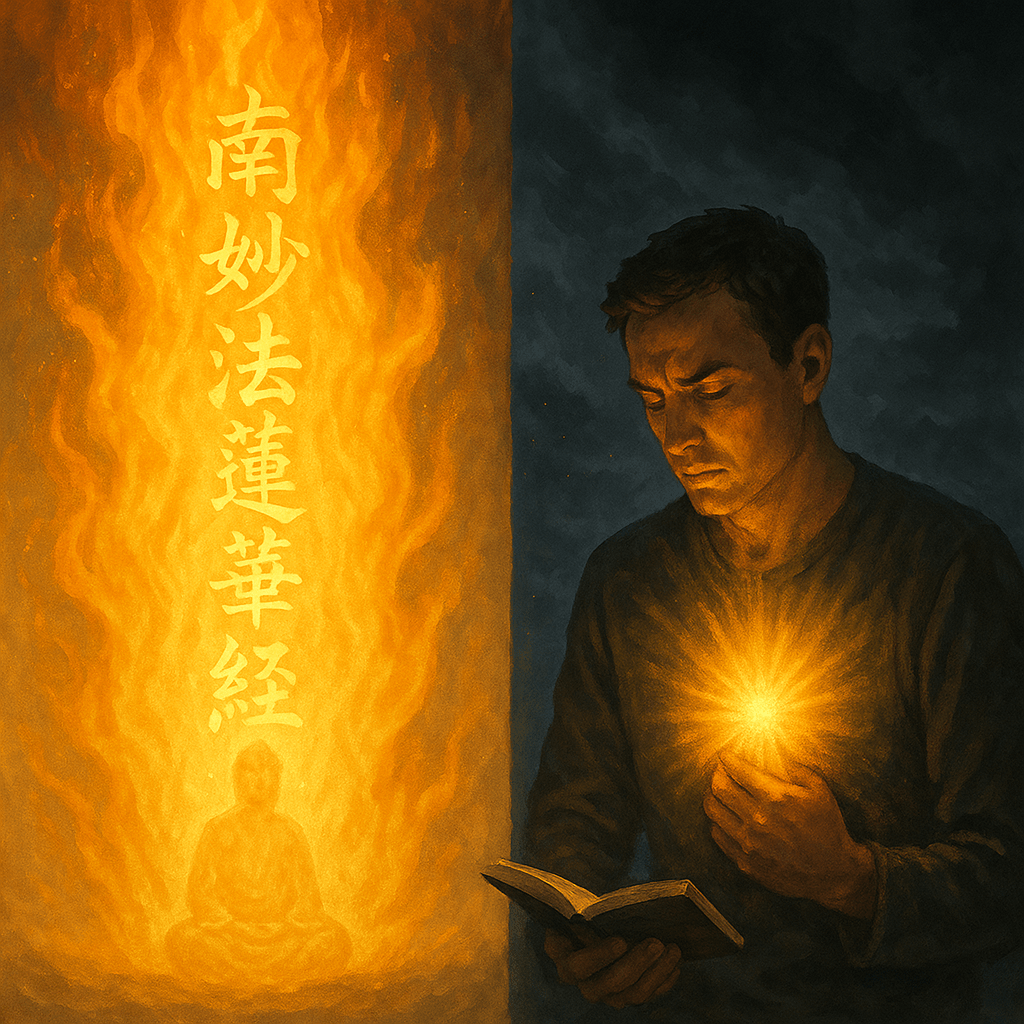
Introduction: What Does It Mean to Give Everything?
What does it truly mean to dedicate yourself to a cause? When we think of ultimate sacrifice, we often imagine a single, heroic act that costs the giver everything. But what if the greatest offering isn’t a final, spectacular gesture, but a continuous way of living? This question lies at the heart of one of the most profound and challenging stories in the Buddhist canon, found in the Lotus Sūtra.
The story tells of the Bodhisattva Gladly-Seen-By-All-Beings, a being of immense spiritual power. To express his devotion, he performed an act of supreme, almost unimaginable, sacrifice: he anointed his body with fragrant oils and set himself ablaze, burning for twelve hundred years as a luminous offering to the Buddha. The light from his body illuminated the entire universe, a symbol of wisdom eradicating “the ignorance of the long night of delusion.” This presents a central tension: if this is the standard for the perfect offering, how could the Sūtra’s promise of enlightenment for all people possibly be fulfilled?
This is where the 13th-century Japanese teacher Nichiren Daishonin provides a radical and life-affirming reinterpretation. He was teaching during what Buddhism calls the Latter Day of the Law (Mappō)—a spiritually degenerate age when such extreme ascetic practices were seen as impossible and ineffective for ordinary people. To bridge this gap, he translated this seemingly impossible, transcendent act into an accessible and profound philosophy for living a meaningful life in the midst of our ordinary, and often difficult, reality. He taught his followers how to make the ultimate offering not by ending their lives, but by fully living them—a practice he called “reading the Lotus Sūtra with our bodies.”
——————————————————————————–
1. The Ultimate Treasure Isn’t a Miracle—It’s You.
Before his act of self-immolation, the Bodhisattva Gladly-Seen made magnificent offerings using his supernatural powers. He conjured vast quantities of “heavenly flowers and precious scents” to present to the Buddha. These were gifts beyond the wildest dreams of any mortal, created from nothing but spiritual force.
Yet, in a moment of profound insight, he had a crucial realization. He understood that these spectacular, external gifts, no matter how miraculous, were less significant than the offering of his own self. In the Sūtra, he thinks to himself:
But these offerings are less valuable than the offering of my own body.
This is a powerful and revolutionary shift in thinking. It establishes that the ultimate value in the universe isn’t in transient, magically created riches. The most precious treasure is grounded in the entity of life itself. The self, after all, is the “repository of karma and the potential for Buddhahood.” The greatest gift you can give is the one you already possess: your own life, dedicated to a higher purpose.
——————————————————————————–
2. Your Body Is a “Treasure Tower,” Not an Obstacle.
Many ascetic traditions view the physical body as an obstacle to be overcome—a defiled shell that traps the spirit and must be subdued or transcended through extreme practices. The Lotus Sūtra, however, teaches the principle of sokushin jōbutsu, or “Attaining Buddhahood in this very body.” This means enlightenment isn’t something that happens after death or by escaping the physical world; it is realized within our current physical and emotional existence.
Nichiren built upon this idea to completely reframe the meaning of the Bodhisattva’s offering. The logic is doctrinally necessary: if enlightenment is to be realized within this very body, then the literal destruction of that body would make realizing its inherent potential in this lifetime impossible. The body cannot be a mere obstacle to be discarded. Instead, it is the sacred “Treasure Tower,” the essential vessel required for realizing the ultimate truth of the cosmos (Myōhō). To destroy it would be counterproductive.
This is the central paradox: the ancient story involves self-immolation, but Nichiren’s philosophy derived from it teaches that the ultimate offering is to use one’s life, not end it. The body becomes the instrument of enlightenment, the very stage on which the drama of awakening unfolds.
——————————————————————————–
3. Hardship Is the New Holy Fire.
So, if the offering is not literal self-immolation, what is its modern equivalent? Nichiren’s answer lies in the core concept of shikidoku, which means “reading the Sūtra with the body.” This is not a passive, intellectual study, but the act of living out the Sūtra’s teachings through one’s actions and lived experiences.
This is where adversity plays a surprising and crucial role. The Lotus Sūtra predicts that in a later, spiritually degenerate age, its followers will face intense persecution, slander, and hostility. For Nichiren, enduring these hardships for the sake of the Sūtra becomes the material evidence of its truth. Your life itself proves that the teaching is correct.
Nichiren drew a direct and powerful parallel: he equated the purifying suffering that comes from persecution with the purifying fire of the Bodhisattva’s self-immolation. Hardships, when faced with unwavering faith, function to burn away negative karma and polish one’s life. He sharply contrasted the “useful” suffering of his disciples with that of powerful emperors whose adversities arose from “petty reasons” like political ambition. The transformative value of hardship is not in the suffering itself; that value is conferred solely by the unwavering commitment to the Mystic Law within that suffering.
——————————————————————————–
4. The “How-To” of the Offering: Chanting Your Way to Truth.
Enduring hardship with purpose is the “why” of the new offering, but Nichiren also provided a practical “how.” The core practice is chanting the Daimoku, Nam-myōhō-renge-kyō. This phrase translates to “I take refuge in the Lotus of the Wonderful Law.”
The key component here is Myōhō, the “Wonderful Dharma.” This term refers to the ultimate reality or the true, fundamental entity of life that permeates the entire universe. Reciting the Daimoku is a practice designed to align one’s individual life—with all its struggles and potentials—with this ultimate reality. Nichiren taught that this process works automatically to bring forth our highest potential, using a metaphor that it is “akin to mugwort that grows straight when placed in the midst of hemp.”
The power of this Wonderful Dharma is not merely symbolic; it is described as having a profound, active function.
The character Myō (Wonderful or Mystic) carries a profound functional meaning; it is not merely descriptive but actively possesses the power to ‘revive, that is, to return to life’.
Here, the narrative comes full circle. The Bodhisattva Gladly-Seen was later known as Medicine-King Bodhisattva, who had vowed to cure all illness. Nichiren identified the Myōhō as the ultimate “good medicine” for all humanity’s suffering. The offering thus shifts: where the Bodhisattva once offered his physical body, the modern practitioner offers their voice to chant the ultimate medicine that can revive and heal all life.
——————————————————————————–
5. The Ultimate Offering Is a Life of Gratitude in Action.
Ultimately, Nichiren’s entire philosophy of the perfect offering is grounded in a simple, universal, and powerful emotion: gratitude. He taught that this state of mind is not just a pleasant feeling, but the very bedrock of a meaningful life and spiritual practice. This gratitude is framed by the duty to repay the “four debts of gratitude”—to one’s parents, teachers, society, and all living beings.
Gratitude is defined as the foundation of everything in Buddhism, possessing the power to multiply good fortune and ensure that prayers are answered.
From this foundation, the modern, practical form of the perfect offering emerges. It is a continuous, dual practice: “practice for oneself,” which primarily involves chanting to transform one’s own inner world, and “practice for others,” which means sharing the teaching and encouraging those around you. The ultimate goal of this shared practice is to achieve kosen-rufu—the widespread propagation of the Mystic Law to bring about peace in society and nature.
This ongoing commitment to both inner transformation and external compassion creates what is known as a “human revolution.” As a practitioner’s inner world changes, it positively impacts their family, workplace, and community. This becomes the modern equivalent of the Bodhisattva’s burning body illuminating the universe. Where his physical form once cast light on countless worlds, a single life transformed by gratitude and compassion now illuminates its own corner of the world through resilience and positive action.
——————————————————————————–
Conclusion: Illuminating Your World
The journey from the Bodhisattva’s transcendent act of self-immolation to Nichiren’s immanent practice of “reading the Sūtra with the body” represents a profound shift in spiritual understanding. It redefines the perfect offering, moving it from the realm of the impossible to the realm of the everyday. It democratizes sainthood, making the highest form of devotion accessible to anyone willing to engage fully with their own life.
The ultimate takeaway is that the perfect offering is not the destruction of a life, but the dedication of a complete, ordinary life lived with extraordinary resilience and compassion in the face of adversity. This path rejects the passivity of nihilism and instead demands active, resilient joy. It suggests that the flame of enlightenment is not meant to consume us, but to be tended within us, so that its light can warm and illuminate the world around us. This leads to a final, powerful question: What if the challenges in our own lives, when faced with purpose, could be our highest offering?
 Mr. Altig’s Overview of the Wonderful Dharma of the Lotus Sutra
Leave a comment