Ancient scriptures can feel intimidating. Dense and filled with unfamiliar names and concepts, texts like the Buddhist Lotus Sūtra can seem like relics from a world far removed from our own. Yet, hidden within their verses are often profound, timeless insights into the human condition that resonate with startling clarity today.
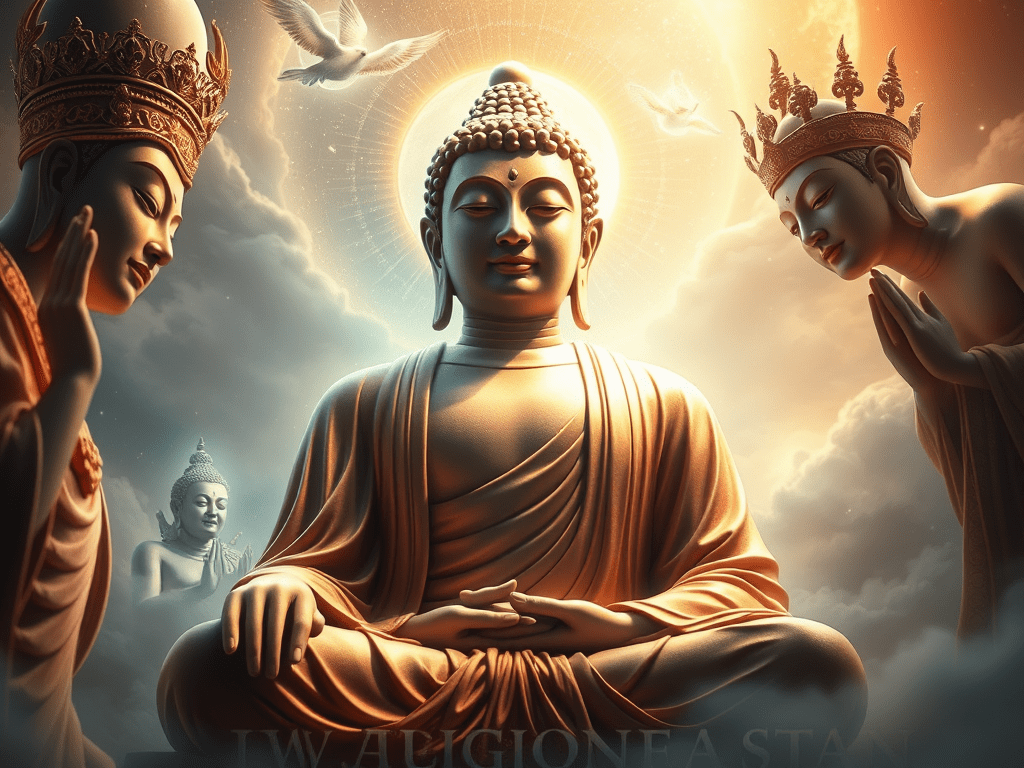
This is especially true of a short, powerful passage from Chapter Seven. The scene is cosmic: a Buddha named Great-Universal-Wisdom-Excellence has just achieved supreme enlightenment. This was no easy feat; after eons of meditation, he sat unmoving for ten small kalpas—an unimaginably long time—while the supreme truths of the Dharma “did not yet appear to him.” In response to his final awakening, powerful celestial beings called Heavenly-King Brahmas appear before him. They are not there to celebrate their own good fortune, but to sing a verse that is both a lament for all suffering beings and a desperate plea for the Buddha to teach.
This post unpacks five surprisingly modern and counter-intuitive ideas about suffering, its causes, and its ultimate cure, all packed within these few ancient lines. It is a profound diagnosis of why we get stuck in cycles of unhappiness and a road map for how we can finally get free.
1. “Sin” Isn’t a Crime, It’s an “Unskillful” Action
The Brahmas begin their diagnosis with a familiar-sounding line:
Because they did sinful karmas,
Right away, we encounter a concept that requires a radical reframing. The Buddhist idea of “sinful karmas” is fundamentally different from the Abrahamic concept of sin. It does not mean violating a divine law or being punished by a celestial judge. The Buddhist worldview does not include a divine lawgiver who sits in judgment.
Instead, the original term, akusala kamma, is better translated as “unskillful” or “unwholesome” action. In Buddhism, the morality of any action—whether of body, speech, or mind—is based entirely on the intention (cetanā) behind it. Unskillful actions are those motivated by what are known as the “three poisons”:
- Greed (rāga): Craving, attachment, and grasping.
- Hatred (dveṣa): Anger, aversion, and ill will.
- Delusion (moha): Fundamental ignorance about the true nature of reality.
This reframes morality entirely. It is not a system of external rules and punishments, but an internal practice of cultivating skillful intentions. Suffering isn’t a penalty handed down from on high; it is the natural, intrinsic consequence of unskillful thoughts and actions. It is an impersonal, natural law, operating with the same predictability as a law of physics.
2. The Root of Suffering Isn’t What You Do, But How You See
While unskillful actions are the direct cause of suffering, the Brahmas’ verses identify a deeper, more insidious root: “attachment to wrong views” (mithyā-dṛṣṭi). This is considered the most dangerous of all mental states because it is the soil from which all other unwholesome actions grow.
“Wrong views” are fundamental errors in perceiving reality. These can be formal philosophical positions like nihilism (the belief that actions have no consequences) or eternalism (the belief in a permanent, unchanging soul). More commonly, it is the simple, pervasive belief that we can find lasting, permanent happiness in things that are, by their very nature, impermanent and unstable.
This creates a tragic, self-perpetuating feedback loop that is nearly impossible to break without a Buddha’s intervention. First, a being holds a wrong view, for example, “power over others brings security.” Second, this view motivates unskillful karma, such as aggression and violence. Third, the karmic result of these actions is rebirth in a state that validates the original view—such as the animal realm, defined by a constant, violent struggle for survival. Finally, this new existence physically and mentally reinforces the very worldview that led the being there, obscuring any possibility of perceiving a higher truth.
This is a critical insight: wisdom—seeing reality clearly—is the ultimate solution. Without correcting our fundamental view of the world, all our efforts to stop our own suffering will be built on unstable ground and ultimately fail.
3. The Deepest Suffering is a Form of Spiritual Amnesia
The verses continue with a haunting description of what happens to beings trapped in this cycle: “They lose pleasures and the memory of pleasures… They do not know how to do good.”
The “pleasure” being lost here is not worldly, sensual pleasure (kāma-sukha). From a Buddhist perspective, that kind of pleasure is dependent on external objects, is inherently fleeting, and is ultimately a “hidden suffering because its pleasant feeling masks a deeper structure of stress and dependence.” The tragedy described is the loss of a far greater joy: the stable, internal “Dharma pleasure” (dharma-prīti). This is the profound happiness that arises from purifying the mind, cultivating compassion, and acting for the benefit of others—an unshakable well-being independent of external conditions.
The loss of the memory of this higher pleasure is a profound spiritual amnesia. Mahayana Buddhism teaches that all beings possess an innate “Buddha-nature” (buddha-dhātu)—an intrinsic, luminous potential for enlightenment. When we are lost in the cycle of suffering, this inner light becomes completely obscured. We forget that a more authentic and lasting happiness is even possible.
This “fundamental darkness” (gampon no mumyō), which the sage Nichiren Daishonin called the “‘mother’ of all illusions,” breaks our ethical compass. We “do not know how to do good” because we have forgotten that a higher good exists. Our actions become purely reactive, driven by fear and desperation until this ignorance is severed by the “sword of wisdom” that is the Dharma itself.
4. Even Gods Need the Buddha
One of the most surprising facts about these verses is who is speaking them. They are not suffering humans or beings in hell. They are Heavenly-King Brahmas—powerful, long-lived deities who reside in blissful heavens, free from the grossest forms of suffering.
In Buddhist cosmology, however, gods like Brahma are not creators or supreme beings. They are still unenlightened and subject to the cycle of rebirth (saṃsāra). Despite their power and bliss, their state is temporary.
What is truly counter-intuitive is their reaction to the appearance of the Buddha Great-Universal-Wisdom-Excellence. It is not for their own sake. Their immediate response is an expression of immense compassion for all other beings trapped in the lower, more painful realms of existence. They lament for those who journey:
from darkness… [entering] into darkness, to the end never hearing the Buddha’s name.
This completely inverts our typical understanding of hierarchy. In the Buddhist cosmos, true status isn’t determined by power or bliss, but by the scope of one’s compassion. By pleading on behalf of others, the Brahmas establish the Buddha’s wisdom as superior to that of all beings in the cosmos and perfectly model the Bodhisattva ideal: that true spiritual nobility is measured by one’s selfless compassion for others.
5. The “Final Goal” Was a Rest Stop, Not the Destination
The desperate condition of beings as described by the Brahmas provides the ultimate justification for the Buddha’s core teaching method: “skillful means” (upāya). The profound ignorance and “spiritual amnesia” they diagnose is precisely why a gradual, compassionate pedagogy is not just helpful, but absolutely necessary. To explain this, the Sūtra uses the Parable of the Conjured City.
The parable describes a wise guide leading a group of exhausted travelers across a dangerous wilderness toward a magnificent “treasure land.” Seeing that the travelers are about to give up from exhaustion, the guide uses his powers to conjure a beautiful city in the distance and tells them it is a place they can rest. Once they have rested and regained their strength, the guide dissolves the illusionary city and reveals that the true treasure land is still ahead, but now within their reach.
The meaning is profound:
- The “conjured city” represents the provisional goal of individual liberation (Arhatship), which the Buddha taught to his early disciples.
- The “treasure land” represents the ultimate goal of full Buddhahood for the benefit of all beings.
The Buddha taught this lesser goal out of supreme compassion. He knew that if he had revealed the full, arduous length of the journey from the start, many would have despaired and given up. This leads to the ultimate teaching of the Lotus Sūtra: the doctrine of the “One Vehicle” (Ekayāna). Ultimately, there is only one path and one destination—universal Buddhahood—and all other teachings are simply skillful methods to get everyone there. The Buddha is not just a teacher of truth, but a master of compassionate pedagogy.
Conclusion: Remembering the Treasure Land
In just a few lines, the Brahmas’ verses provide a complete diagnosis of the human condition. They describe a self-perpetuating cycle of suffering, born from unskillful actions, which are themselves rooted in a fundamental ignorance of reality. In a universe without a Buddha’s teaching, beings are utterly lost. The appearance of a Buddha is the dawn, the only true cure for this endemic illness.
The ultimate promise of the Lotus Sūtra is that the “treasure land” of our own innate Buddha-nature is never truly lost, only forgotten. The entire path is a process of remembering and reclaiming this forgotten inheritance.
If the greatest suffering is a kind of forgetting, what is the most important truth about yourself that you need to remember today?
 Mr. Altig’s Overview of the Wonderful Dharma of the Lotus Sutra
Leave a comment