Introduction: Are You a Prisoner of Time?
Do you ever feel like you’re in a battle with the clock? Some days, time drags on endlessly. On others, it flies by, leaving you wondering where the hours went. We live by schedules and deadlines, constantly feeling that we are running out of time. It’s a universal human experience to feel ruled by the linear, unyielding march of moments.
But what if this perception is an illusion? A 2,000-year-old text, the Lotus Sūtra, offers a radical and liberating perspective on the nature of time through a story that is both strange and profound. It describes a gathering where an almost unimaginable length of time—fifty cosmic aeons—passes in complete silence. Yet, for everyone present, the experience lasts no longer than half a day.
This event is more than a myth; it’s a spiritual puzzle designed to shatter our most basic assumptions. This post will explore five powerful and counter-intuitive takeaways from this story that can fundamentally shift how we see reality, suffering, and our own potential.
——————————————————————————–
1. The Half-Day Aeon: When 50 Cosmic Ages Pass in an Afternoon
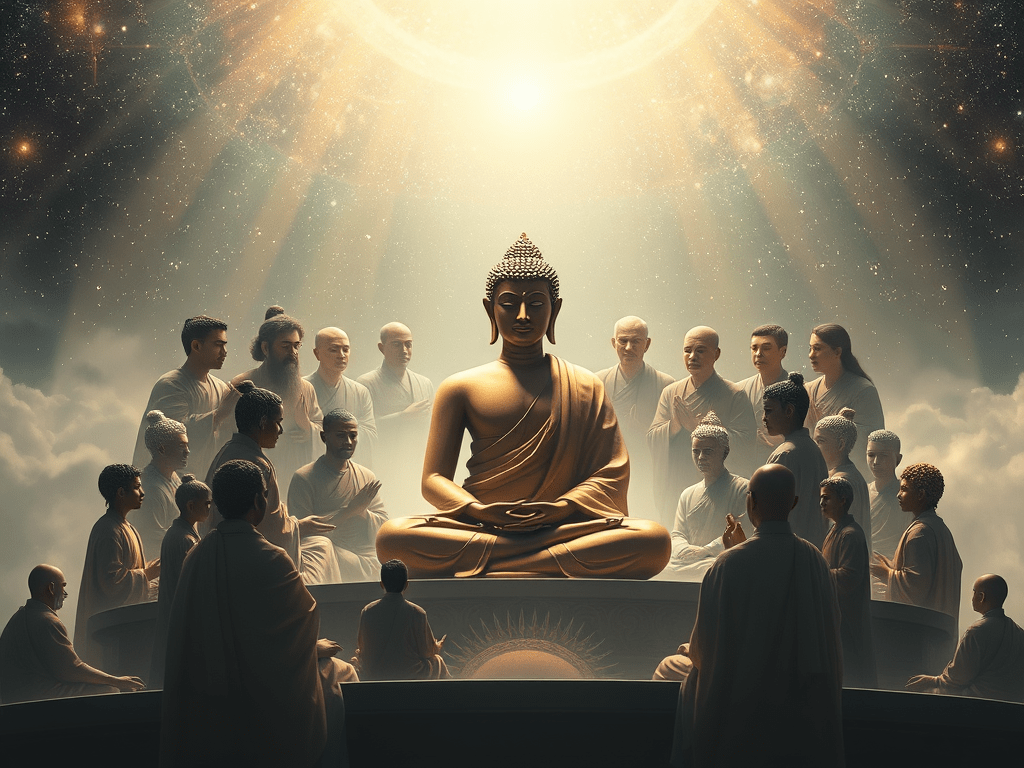
The story comes from Chapter Fifteen of the Lotus Sūtra, where a dramatic scene unfolds. The Buddha, Śākyamuni, sits in profound silence with his vast assembly of followers. As they sit, a period of fifty small kalpas—or cosmic aeons—elapses. This is a span of time so immense it defies human imagination.
Here is the central paradox: through the Buddha’s “supernatural powers,” the entire assembly perceives this incalculable duration as having lasted only “half a day.”
This extraordinary event isn’t meant to be taken as a literal historical account. Instead, it functions as a spiritual puzzle or koan—a paradoxical statement designed to exhaust the rational mind and provoke a direct, non-conceptual insight. It’s a deliberate teaching device, a supreme example of upāya (skillful means), meant to shatter our conventional, and ultimately suffering-bound, perception of time as a fixed and absolute reality.
2. An Aeon Is Longer Than You Can Possibly Imagine
To grasp the mind-bending scale of the “half-day aeon,” we first have to understand what a kalpa, or aeon, is in Buddhist thought. The ancient scriptures intentionally avoid giving a simple number of years because any number would fail to convey its true immensity. Instead, they use powerful analogies to stretch the mind to its limits.
The most famous is the Mountain Analogy. Imagine a colossal mountain of solid rock, sixteen miles in length, width, and height, without any cracks or fissures. Once every one hundred years, a celestial being flies past and gently brushes the mountain with a piece of the finest silk cloth. The Buddha explained that the entire mountain would be worn away to nothing by this soft abrasion before a single kalpa had even finished.
Another is the Mustard Seed Analogy, which asks you to picture an iron city filled to the brim with tiny mustard seeds, where one seed is removed every hundred years. The city would be empty before one kalpa was over. To illustrate the number of kalpas that have already passed, the Ganges Sand Analogy states that if you counted every grain of sand in the great River Ganges, that number would be less than the number of aeons that have already transpired.
The purpose of these analogies isn’t to provide a scientific measurement but to induce a state of awe. They are designed to decenter our limited, human-scale perspective and prepare us for a much larger view of reality.
3. Salvation Isn’t “Out There”—It’s Right Beneath Your Feet
The 50-kalpa silence doesn’t happen in a vacuum. Just before it, a group of enlightened beings, Bodhisattvas, who have traveled from other worlds, make a noble offer. They volunteer to stay in our sahā world—defined as a place of suffering that must be “endured”—to protect and teach the Buddha’s message after he is gone.
In a stunning turn, the Buddha refuses them. He states that this world already has its own protectors.
What happens next is pure cosmic drama. The earth trembles and splits open. From these fissures, “limitless thousands of tens of thousands of millions of Bodhisattvas” emerge. They are described with vibrant specificity, possessing “golden-hued bodies, the thirty-two marks, and limitless light”—the traditional signs of a highly advanced being. This immense host is led by four great Bodhisattvas whose names are allegorical, representing the cardinal virtues of the Mahāyāna path: Superior Practices, Boundless Practices, Pure Practices, and Firmly Established Practices.
The crucial detail is where they come from: they “had been dwelling beneath the Saha World.” They are indigenous to our world of suffering, not visitors from a distant paradise. The symbolism is a powerful map for spiritual life. It suggests that the potential for enlightenment, wisdom, and liberation is not an external concept to be imported from somewhere else. It is an intrinsic reality to be unearthed from the very ground of our own existence. As a Zen interpretation beautifully puts it:
“The treasures of the house do not come in through the front gate.”
4. Time Isn’t a Container; It’s a Function of Consciousness
The “half-day aeon” directly confronts the philosophical core of our relationship with time. The teaching is that time is not a fixed, objective container, but a phenomenon dependent on the consciousness that perceives it. This temporal compression was not a physical event, but a psycho-spiritual one; the text states the Buddha “caused the great multitude to think” it was so.
The Buddha’s silence during these fifty aeons is also a profound teaching. It signifies a reality beyond words (an apophatic teaching), his absorption in a deep meditative state (samādhi) where time dissolves, and an embodiment of the “groundless nature of being” from which all phenomena arise. He isn’t just waiting; he is dwelling in timeless presence.
For an ordinary mind, time is a rigid, linear sequence. But for an enlightened mind, dualities like long/short or past/present lose their absolute meaning. Time becomes elastic. An ancient commentary explains this profound state of consciousness:
“Thus, fifty small eons is not a long time, and the time it takes for a single thought is not a short time. One thought can take fifty small eons, and fifty small eons can be contained in a single thought.”
This idea finds its ultimate expression in the sophisticated Tiantai school’s doctrine of “three thousand realms in a single moment of life” (ichinen sanzen), which posits that all of reality is contained within each fleeting moment of consciousness. The prison of linear time is a construct of our own minds; a Buddha is one who has been liberated from it.
5. Seeing in “Cosmic Time” Is an Antidote to the Ego
So why does any of this matter? These complex ideas have a deeply practical and liberating purpose. In Buddhism, the root cause of suffering (dukkha) is tṛ́ṣṇā—craving or attachment to things that are impermanent. This feeling of self-importance thrives on a limited, human-scale perception of time, where our personal anxieties and desires feel all-consuming. Contemplating cosmic time—the vastness of kalpas—acts as a powerful “antidote to the ego.” When you view your personal worries against the backdrop of trillions of years, their monumental importance begins to dissolve.
But there is an even deeper purpose here. This whole temporal paradox is a “brilliant hermeneutic strategy,” a deliberate setup for the Sūtra’s ultimate revelation in the next chapter. Having witnessed the Buddha’s ancient disciples, the assembly is perplexed: how could he have taught so many beings in just forty years? Their question is logical, but their own experience—living through fifty aeons as half a day—has already shattered the foundation of that logic. This prepares them to accept the Buddha’s staggering claim in Chapter Sixteen: that he actually achieved enlightenment countless aeons ago. The temporal paradox is the key that unlocks the door to the teaching of the Eternal Buddha, by first deconstructing the very concept of time that would render it unbelievable.
——————————————————————————–
Conclusion: Awakening to the Buddha’s Wisdom
The fantastical events in the Lotus Sūtra are not just ancient stories; they are powerful contemplative tools designed to radically shift our perspective. They invite us to see the world differently, to step outside our self-imposed limitations. As one reflection on the text notes, “When we see the world on this scale of time… it opens us up to the Buddha’s wisdom.”
This wisdom is twofold: the realization that the ground beneath our feet, the very substance of our suffering world, contains an infinite host of enlightened potential, and the understanding that the tyranny of time is a product of our own minds. These are not distant, abstract ideas but keys to a more free and expansive way of being.
To end, here is a question to ponder: What one thing in your life would change if you began to see it not on a human scale, but on a cosmic one?
 Mr. Altig’s Overview of the Wonderful Dharma of the Lotus Sutra
Leave a comment