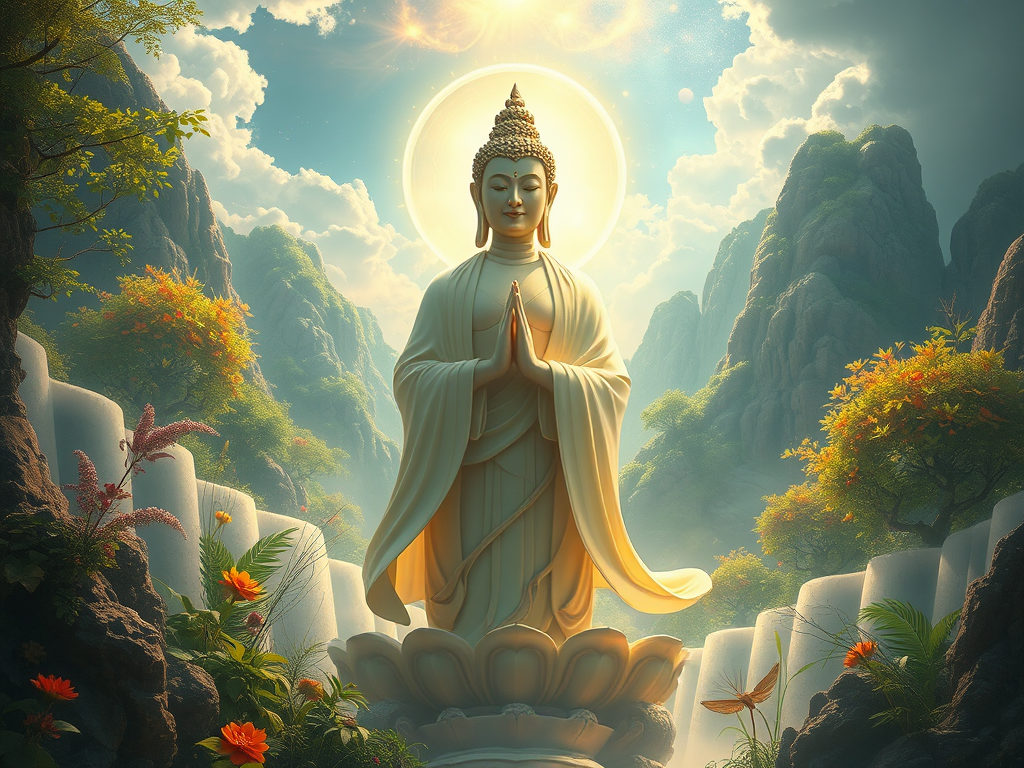
For many on a spiritual path, the ultimate goal seems clear: to escape the endless cycle of suffering. We strive to purify our minds and remove our afflictions in the hope of achieving a state of permanent peace, like Nirvāṇa, often imagined as a tranquil, higher realm far removed from the difficulties of this world. It is a quest for a final, peaceful exit.
But what if this is only half the story? What if the most profound spiritual realization doesn’t lead to an exit, but to a radical U-turn? A core teaching within the Lotus Sūtra turns the very notion of spiritual achievement on its head, suggesting that the highest enlightenment isn’t a reason to leave, but the ultimate motivation to return.
This post explores that single, powerful idea about the nature of true compassion—the choice to come back and re-engage with the world, not in spite of enlightenment, but because of it.
The Great Vow: Why Enlightened Beings Choose to Come Back
The central concept is that Bodhisattvas are beings who voluntarily appear in this world despite having already achieved the highest enlightenment (Anuttara-samyak-saṃbodhi). Their presence among us is not a result of unresolved karma or a failure to ascend. It is a deliberate choice, driven by a vow born from the very nature of their enlightenment. Their perfect wisdom reveals the indivisible, interconnected reality of all existence, making a solitary escape for oneself an incomplete, even illogical, conclusion. Compassion compels them to return.
Giving Up Privilege for Compassion
This path stands in stark contrast to the approach found in the teachings of Nirvāṇa, where the goal is often described as a way “to remove suffering so that we can be reborn in a peaceful realm.” The Bodhisattva’s action is a profound critique of this spiritual materialism—the idea that liberation is a private possession to be enjoyed in an isolated paradise. Instead, they “have given up the privilege of higher realms” for the explicit purpose of helping others, choosing to “benefit beings where we find ourselves now.”
This is not mere commentary; it is a direct teaching from the Buddha himself, who declares these lines to Medicine-King Bodhisattva at the beginning of Chapter Ten of the Lotus Sūtra:
These men and women are great Bodhisattvas. They should be considered to have appeared in this world by their vow to expound the Sūtra of the Lotus Flower of the Wonderful Dharma out of their compassion towards all living beings, although they already attained Anuttara-samyak-saṃbodhi [in their previous existence].
Fearless Compassion
The compassion that drives this choice is truly fearless. Bodhisattvas who make this vow “do not fear rebirth in lower realms.” But why are they fearless? This quality stems directly from the nature of their enlightenment. Having realized the empty nature of phenomena, an enlightened being no longer perceives a fundamental difference between a “high realm” of peace and a “low realm” of suffering in terms of ultimate reality. The conceptual basis for fear—attachment to comfort, aversion to pain, and the preservation of a separate self—has been completely dismantled by wisdom. Their compassion is therefore unhindered, taking them wherever they are needed most.
A Final Thought
In this view, the pinnacle of spiritual attainment is not a peaceful escape for oneself, but a radical and compassionate return to the heart of the world’s suffering. It reframes the ultimate purpose of enlightenment as the ultimate act of service.
What if our purpose isn’t to leave the world behind, but to find a reason to dive back into it with greater love and courage?
 Mr. Altig’s Overview of the Wonderful Dharma of the Lotus Sutra
Leave a comment