An Ancient Text on What to Do When You’re Misunderstood
It’s a uniquely human frustration. You have a profound idea, a piece of hard-won wisdom, or a helpful insight that you believe could genuinely help someone. You share it with care, hoping for a spark of connection or understanding. Instead, you’re met with a blank stare, a polite dismissal, or outright rejection. The wall goes up, and you’re left feeling unheard, disappointed, and maybe even a little foolish.
In that moment of disconnect, our instincts often scream at us to push harder, to explain better, to argue our point until it’s finally understood. We believe that if we just find the right words, the other person will surely see the light. But what if the most effective response is the exact opposite? What if the wisest path forward involves letting go?
An ancient text, the Lotus Sūtra, offers a surprising and deeply patient approach to this very problem. It teaches a form of compassionate communication that prioritizes the other person’s well-being over our own need to be right.
When Someone Isn’t Ready, Don’t Push—Pivot.
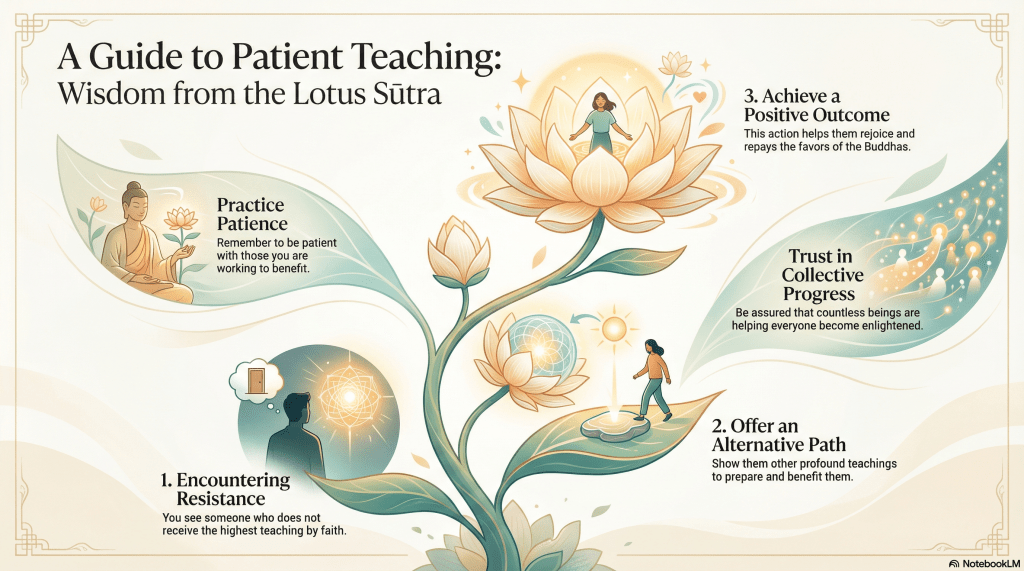
The core instruction from the Lotus Sūtra is elegantly simple: if someone cannot accept a particular teaching by faith, the response isn’t to insist or argue. Instead, the text advises that you should offer them “some other profound teachings.” This isn’t about giving up; it’s about skillfully pivoting.
This practice is part of a concept known as “Expedient Teachings.” It’s the art of meeting people exactly where they are, not where you wish they were. If someone isn’t ready for your highest, most cherished insight, you don’t force it upon them. You find another way—a different story, a simpler concept, a more accessible idea—that can help them along their path. You are preparing the ground, planting a seed that may one day make them ready for a deeper understanding. This is a radically patient approach that values the other person’s journey above our own agenda.
As the sūtra instructs:
When you see anyone who does not receive [this sūtra] by faith, you should show him some other profound teachings of mine, teach him, benefit him, and cause him to rejoice. When you do all this, you will be able to repay the favors given to you by the Buddhas.
But to pivot effectively, you need more than just a change in strategy; you need a fundamental shift in your goal, which brings us to the next point.
The Goal Is to Benefit, Not to Be Right.
Notice the specific verbs used in the passage: “teach him, benefit him, and cause him to rejoice.” The objective is not to win an argument, prove a point, or demonstrate your superior knowledge. The goal is to be of genuine service to the other person. This simple shift in focus changes everything.
When our primary intention is to benefit another, the ego falls away. A difficult conversation is no longer a battle of wills but an act of compassion. We stop asking, “How can I make them understand?” and start asking, “What does this person actually need right now?” Sometimes, what they need is not the profound truth you’re offering, but a different kind of support. By focusing on what will bring them benefit and joy, we transform a moment of potential conflict into an opportunity for connection. The text frames this as the way to “repay the favors given to you by the Buddhas”—a profound purpose that lifts us out of our personal frustration.
This compassionate release of the ego is made infinitely easier when we grasp the final piece of this ancient wisdom: you’re not acting alone.
You Can’t Be Disappointed When You Realize It’s a Team Effort.
Perhaps the most comforting piece of this wisdom is the assurance the teaching provides: that we are not in this alone, because countless beings are helping us all to become enlightened. This single idea has the power to dissolve personal disappointment.
When you feel your efforts with one person are failing, you can release the pressure by remembering that you are just one small part of a vast, collective process. You may not be the one to cause the final breakthrough, and that’s okay. Your role might simply be to offer a single, “expedient teaching” that paves the way for someone else’s later. This perspective reframes our interactions, fostering a sense of universal connection and boundless patience. The burden on any single conversation becomes lighter when you realize you’re part of a team effort.
A Final Thought on Patient Wisdom
Ultimately, the Lotus Sūtra teaches that true wisdom lies not just in what you know, but in how patiently, skillfully, and compassionately you can share it with others. It’s about recognizing that everyone is on their own path, and our role is to offer what helps, when it can be received.
So, the next time you find yourself unheard or misunderstood, perhaps you can pause and ask yourself: What “expedient teaching” could I offer someone in my life who isn’t ready for my “highest teaching”?
 Mr. Altig’s Overview of the Wonderful Dharma of the Lotus Sutra
Leave a comment