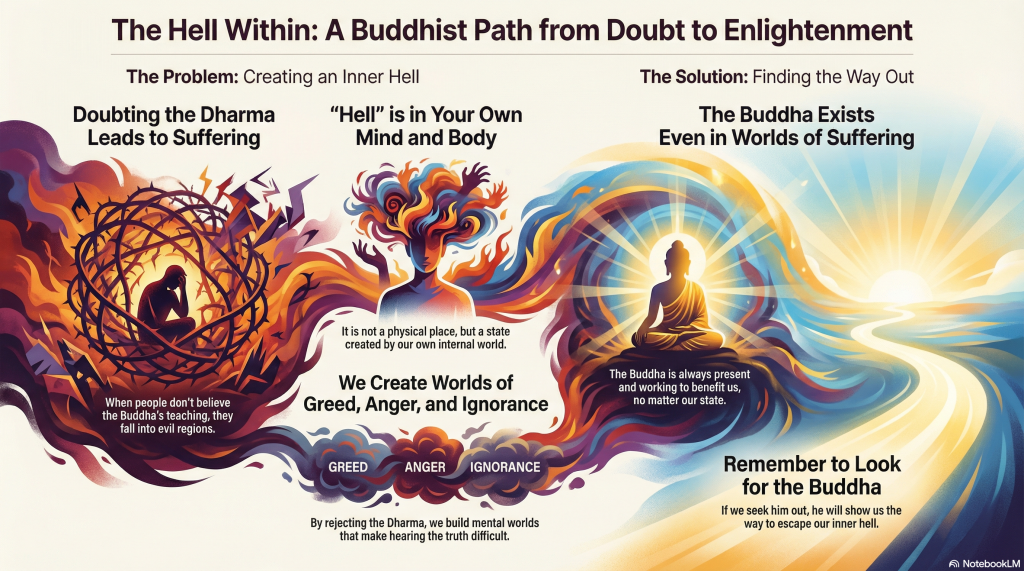
When we hear the word “hell,” our minds often conjure vivid, dramatic imagery—a subterranean realm of fire and brimstone, a place of eternal punishment for the wicked. This vision, passed down through centuries of art and theology, has become a powerful cultural shorthand for ultimate suffering. But what if this popular conception misses a more immediate and personal truth?
Ancient wisdom often provides perspectives that are both timeless and startlingly modern, inviting us to look not outward for answers, but inward. A powerful teaching from the Lotus Sūtra, as interpreted by the 13th-century Japanese monk Nichiren, offers a radical reinterpretation of “evil” and “hell.” This wasn’t just a philosophical adjustment; it was a revolutionary shift that moved the geography of salvation and damnation from a distant cosmos into the immediate landscape of the human heart. It suggests they are not destinations we go to after we die, but states we inhabit right here, right now.
Takeaway 1: Hell Isn’t a Location, It’s an Inner State
The central, counter-intuitive teaching offered by Nichiren is that hell is not a physical place located somewhere beneath the earth. Instead, it is a state of being contained entirely within our own lives. It is a psychological and spiritual condition, not a geographic one.
This perspective is captured directly in his commentary on the Lotus Sūtra:
“while some people think hell is below the earth, it is really contained in our own bodies and minds.”
This idea is powerful because it transforms hell from a distant, posthumous threat into a present-day reality we can all recognize. It’s the torment of unchecked anger, the prison of insatiable greed, or the darkness of profound ignorance. This isn’t merely an abstract thought experiment; it’s the felt experience of a body clenched with resentment, a stomach twisted by anxiety, or the physical exhaustion that comes from relentless craving. Hell is not a place we are sent to; it is a state of consciousness we can fall into at any moment.
Takeaway 2: We Forge Our Own Chains
If hell is an inner state, what is the mechanism that creates it? According to the text, we create this inner hell ourselves when we doubt or reject the Dharma—the Buddha’s teachings on the true, interconnected nature of reality.
When we are unable to believe or accept this fundamental truth, we are not seeing the world as it truly is. Instead, we begin to create separate worlds of our own, defined by what Buddhism calls the “three poisons”: greed (uncontrolled desire), anger (aversion and hatred), and ignorance (a fundamental misunderstanding of reality). A verse from the Lotus Sūtra describes this process and its consequences:
Evil people in the future will doubt the One Vehicle
When they hear it from a Buddha.
They will not believe or receive it.
They will violate the Dharma, and fall into the evil regions.
This framing places profound responsibility on the individual. In this view, to “violate the Dharma” is to act from the illusion of separateness—to pursue selfish gains at the expense of others, to nurse grievances, or to ignore the shared humanity that connects us all. These actions inevitably create suffering because they are based on a false premise. These inner worlds are not just unpleasant; they are self-perpetuating prisons. The source text notes that within them, “it is even more difficult to hear the Dharma,” meaning these states of mind actively obscure the very wisdom needed to escape.
Takeaway 3: The Buddha Is Always There (Even When You Can’t See Him)
Yet, the same mind that forges these chains of suffering also holds the key to unlocking them. While the idea of a self-created hell can seem bleak, the teaching contains a profound message of hope. Even within these difficult inner worlds built from greed, anger, and ignorance, the compassionate influence of the Buddha still exists and is actively working to help us.
The way out is not about being rescued by an external savior. Rather, it is about a fundamental shift in our own awareness. The key to unlocking our self-imposed chains is already in our possession. As the text explains, the path to freedom is always available:
“But even in these difficult worlds, the Buddha exists and works to benefit us. If we remember to look for him, he will show us the way out.”
The solution is offered with profound simplicity. Liberation isn’t found through complex rituals or by waiting for a miracle. It begins with the simple, conscious act of “remembering to look”—of turning our awareness toward the clear, compassionate reality that is always present, even when obscured by the fog of our own minds.
Final Thoughts
This ancient teaching offers a deeply psychological and empowering view of our spiritual lives. It tells us that our greatest torments and our ultimate liberation are not determined by outside forces, but are internal processes forged within our own hearts and minds. It places the source of suffering and the key to its end directly in our own hands. This ancient teaching presents us with a sobering responsibility but also a radical form of empowerment.
If the walls of our personal hell are built from our own minds, what’s the first brick you could remove today?
 Mr. Altig’s Overview of the Wonderful Dharma of the Lotus Sutra
Leave a comment