1.0 Introduction: The Echoes in Our Actions
Have you ever wondered why you are drawn to certain ideas, ethical principles, or spiritual practices? What is it within us that seeks out meaning or gravitates toward a path of kindness and wisdom? An ancient verse from the Buddhist Lotus Sūtra offers a profound perspective on this question, suggesting that the person you are today is not a blank slate, but the result of a deep causal inheritance—a connection to a past you can’t consciously remember.
2.0 Your Present Practice Is Proof of a Generous Past
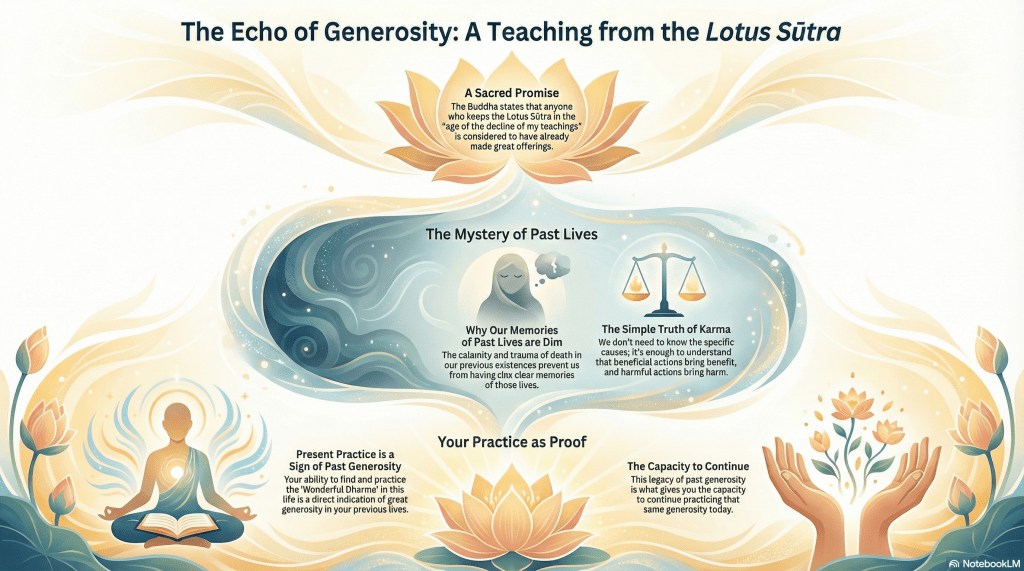
The source text explains that finding and practicing the “Wonderful Dharma”—the beneficial teachings—in this life is not an accident; it is an inheritance. It is presented as direct evidence of our great generosity in previous lives.
Many of us approach self-improvement with a sense of spiritual inadequacy, as if we are starting from scratch and must build our character from the ground up. This ancient teaching radically reframes that struggle. It suggests we are not starting over but are instead the inheritors of a deep-seated goodness that we are now re-activating. Our capacity for good today is an echo of goodness we have cultivated before. Crucially, the text confirms that this very inclination is also the proof of “our capacity to continue practicing that same generosity.” Our present practice is not only a result of the past, but the very engine for the future.
3.0 A Simple Act of Keeping a Teaching Is a Profound Offering
The teachings offer a counter-intuitive insight: the simple act of keeping or holding onto the sūtra during a difficult or unenlightened age is considered equivalent to having already made great material offerings. This idea is captured in verses sung by the Buddha to Maitreya Bodhisattva:
Anyone who keeps this sūtra in the evil world
In the age of the decline of my teachings
Should be considered
To have already made these offerings.
In a modern world that often prizes external action and visible results, this teaching offers radical validation for the quiet, internal work of preserving truth. It suggests that our internal commitment—our conviction—is not merely a private feeling but a cosmically significant act. This perspective gives ontological weight to conviction itself, elevating it to a profound offering that requires no external display.
4.0 You Don’t Need a Perfect Memory to Trust in Causality
Why can’t we remember these past lives and generous acts? The text states that our memories are “dim at best” because of the “trauma we have suffered… especially the calamity of death.”
This insight liberates us from the spiritual paralysis of trying to excavate a forgotten past. We don’t need to know the specific causes of our current condition to act wisely. Instead, the teaching encourages a pragmatic trust in moral causality: the fundamental principle that “beneficial actions bring benefit and harmful actions bring harm.” This frees us to prioritize present agency over historical forensics. We are encouraged to focus our energy on our actions in the here and now, confident that our positive efforts will continue to yield positive results.
5.0 Conclusion: Carrying the Legacy Forward
The wisdom from this ancient text offers a powerful reinterpretation of our present lives. It suggests that our spiritual practice is proof of a generous past, that the simple act of holding onto a teaching is a profound offering, and that we can trust in causality without a perfect memory of our history. Our character today is a legacy, and our present actions are proof of our capacity to build upon it.
This leaves us with a thought-provoking question. If our actions today are the echoes of a generous past, what legacy of generosity are we choosing to create for the future?
 Mr. Altig’s Overview of the Wonderful Dharma of the Lotus Sutra
Leave a comment