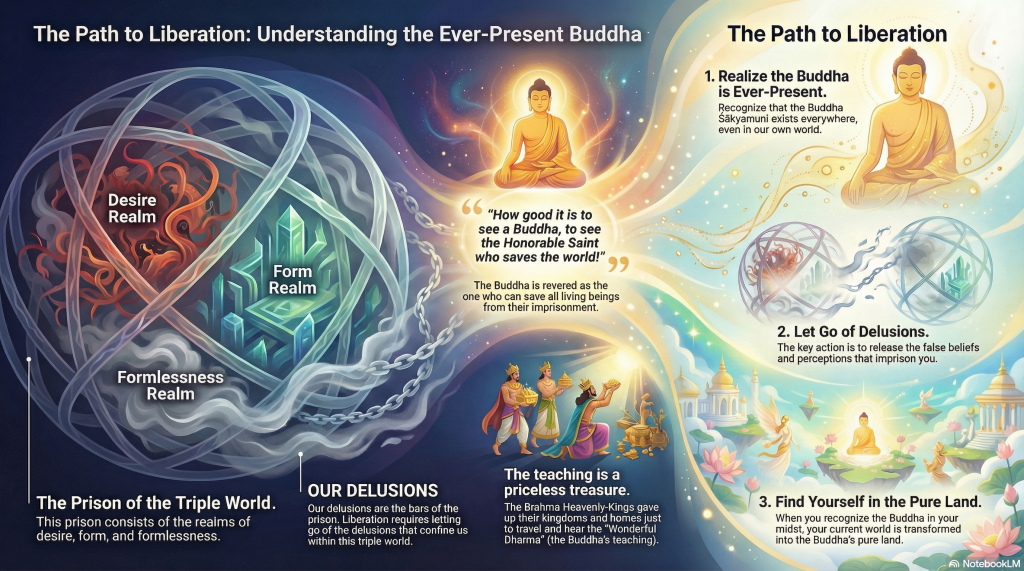
We often feel trapped by the circumstances of our daily lives, stuck in a routine or a struggle that feels like a prison. It’s a natural human impulse to search for an escape, to dream of a more peaceful, perfect place. An ancient teaching from the Lotus Sūtra, however, offers a radical alternative: freedom isn’t found by escaping our world, but by seeing it in a completely new light.
1. The Prison Isn’t a Place; It’s a State of Mind
The Lotus Sūtra speaks of being in the “prison of the triple world,” which it defines as the world of form, formlessness, and desire. This isn’t a physical location with bars and walls. The core insight is that this prison is a mental state created by our own “delusions that imprison us”—delusions like the belief that our happiness depends on external validation, that our current struggles are permanent, or that we are fundamentally separate from the world around us. This shift is profoundly empowering; it means the source of our confinement isn’t our external circumstances, but our internal perception. But if the prison is internal, what kind of ‘savior’ could possibly free us from it?
2. A Buddha Doesn’t Break You Out of Jail; He Shows You the Door is Already Open
This is powerfully illustrated in a verse sung not by mortals, but by the Brahma Heavenly-Kings of the Zenith themselves, who traveled across the cosmos to honor the Buddha:
How good it is to see a Buddha,
To see the Honorable Saint who saves the world!
He saves all living beings
From the prison of the triple world.
This act of “saving,” however, isn’t a physical rescue mission. Rather, a Buddha is a teacher who shows us how to “let go of the delusions that imprison us.” In Buddhist thought, a ‘Buddha’ represents the fully awakened potential within all beings. Therefore, to truly ‘see a Buddha’ is to see a reflection of our own capacity for freedom, making us aware that the door to our own prison is not locked from the outside.
3. You Are Already in the ‘Pure Land’
To understand the sheer power of this final insight, consider who came to hear it. The source tells us of Brahma Heavenly-Kings who willingly gave up their kingdoms, subjects, and homes, traveling across “innumerable worlds” just for the chance to receive this teaching. What truth could be so valuable that celestial royalty would abandon everything for it?
The teaching was not a complex secret or a map to a distant paradise. It was the simple, staggering revelation of the “Ever-Present Buddha Śākyamuni,” who “exists everywhere, even in our triple world.” The profound conclusion is that when we finally “recognize this Buddha in our midst,” we discover that we “find ourselves in the Buddha’s pure land.” This idea eliminates the need to seek a future paradise. The sacred and the serene are available here and now, hidden only by our own perception.
Where Do You Go From Here?
The prison, the key, and the pure land are not separate realities to be escaped from or journeyed to; they are all found within our present experience. The only thing that changes is our ability to see what is already there.
What might change if you began to look for the Buddha not in a distant heaven, but in the world directly in front of you?
 Mr. Altig’s Overview of the Wonderful Dharma of the Lotus Sutra
Leave a comment