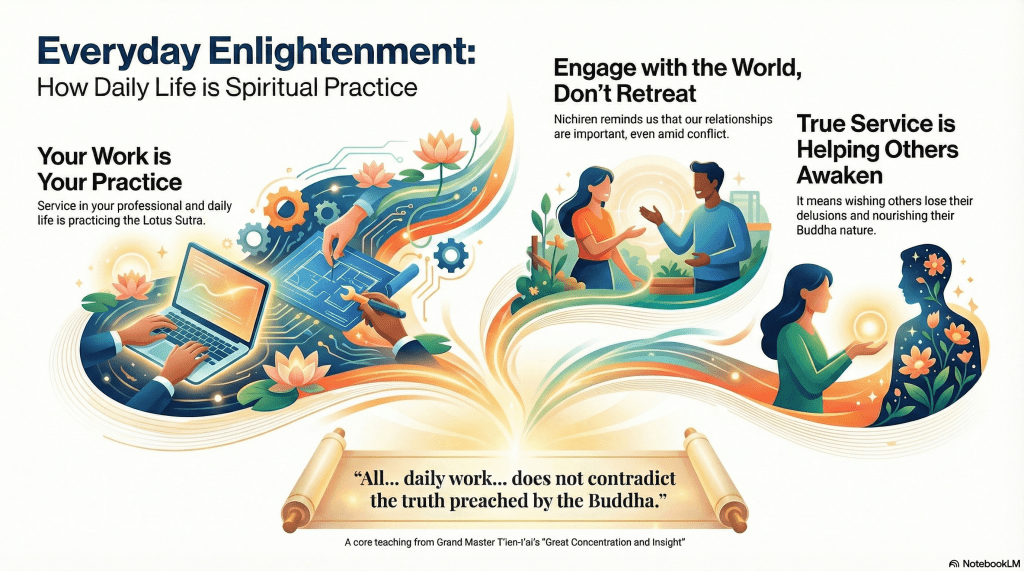
Introduction: Bridging the Gap Between Work and Worth
In our modern lives, it’s easy to feel a profound split between who we are and what we do. On one side, there is our inner world—the part of us that seeks peace, meaning, and personal growth. On the other, there is the daily grind of our secular lives—the jobs, the deadlines, the difficult colleagues, and the endless responsibilities that feel like they pull us further away from that inner peace. This constant tension can leave us feeling that our work life is an obstacle to our spiritual life.
But what if this separation is an illusion? What if the very fabric of our everyday challenges—the stress, the relationships, the mundane tasks—holds the key to a deeper practice? Imagine for a moment: What if your daily work wasn’t an obstacle to your spiritual life, but the very practice of it?
This post explores a profound perspective from Nichiren Buddhism that collapses the artificial wall between our work and our worth. It offers a way to reframe our daily activities, transforming them from a source of conflict into a field for profound spiritual cultivation.
——————————————————————————–
Your Daily Work is Your Spiritual Practice
The idea that our professional and personal responsibilities are separate from our spiritual journey is a common misconception. A powerful teaching from Nichiren, found in his “Response to a Follower,” directly challenges this view by stating that our secular work is, in itself, the practice of the Lotus Sutra. This isn’t a metaphor; it’s a direct instruction to find our practice within the reality of our lives.
This perspective is reinforced by the revered Grand Master T’ien-t’ai, who provides a clarifying and expansive statement on the matter:
All the activities and daily work of the people in the secular world do not contradict the truth preached by the Buddha.
This is a revolutionary concept. It suggests that enlightenment isn’t something to be found by retreating from the world, but by engaging with it fully. Our jobs, our family duties, and our societal roles are not distractions from the path; they are the path itself. This reframes every meeting and every project, grounding our practice not in an isolated temple, but in the complex, messy reality of our daily existence. This approach prevents spiritual bypassing, ensuring our growth is tested and integrated, not just theoretical. This means that the frustrating email chain is your meditation. The difficult client negotiation is your practice in compassion. The looming deadline is your opportunity to cultivate presence under pressure.
——————————————————————————–
True ‘Service’ Isn’t About People-Pleasing
Our work and daily lives are filled with relationships, and these can often be a source of immense frustration. When dealing with conflict or negativity, the impulse to simply withdraw can be strong. We may feel it’s best to “remove ourselves from those who are increasing the delusions of others,” seeking to protect our own peace.
However, this teaching offers a more nuanced and powerful definition of service. It suggests that true service isn’t about simply giving people what they ask for or pleasing them to avoid conflict. This can often enable their negative patterns or leave us feeling drained and resentful.
Instead, the deeper meaning of service is to wish for others to lose their delusions and to actively be “nourishing the Buddha nature within them.” Instead of seeing a difficult colleague as an obstacle to be managed, this teaching asks you to see them as a person with their own inherent wisdom, clouded by delusion. Your “service” then is not to win the argument, but to interact in a way that respects and seeks to connect with that deeper nature, even when their behavior is challenging. This transforms our interactions from transactional exchanges into opportunities for transformational support, focused on helping others connect with their own inner truth.
——————————————————————————–
Conclusion: Finding the Practice in Your Presence
The core message of this teaching is both simple and profound: your life, exactly as it is right now, is the perfect arena for spiritual practice. By viewing our work as our practice and our interactions as a form of true service, we dissolve the conflict between our spiritual goals and our daily obligations. The challenges at your job, the people you interact with, and the responsibilities you hold are not impediments to your growth. They are the very foundation of a meaningful and grounded spiritual life.
As you step into your day tomorrow, consider this: How might your perspective on its challenges change if you viewed each one not as an obstacle, but as the perfect opportunity to practice?
 Mr. Altig’s Overview of the Wonderful Dharma of the Lotus Sutra
Leave a comment