Most of us strive to be kinder and more compassionate. We want to treat people with respect and wish for their well-being. But if we’re honest, our kindness often comes with conditions. Our personal feelings—our affections and our frustrations, our likes and our dislikes—frequently dictate how we engage with the world. We are naturally warmer to friends than to strangers, and more patient with those we admire than with those who challenge us. An ancient teaching from the Buddha, however, offers a surprising and radical perspective on this very human challenge.
A Love as Unconditional as the Rain
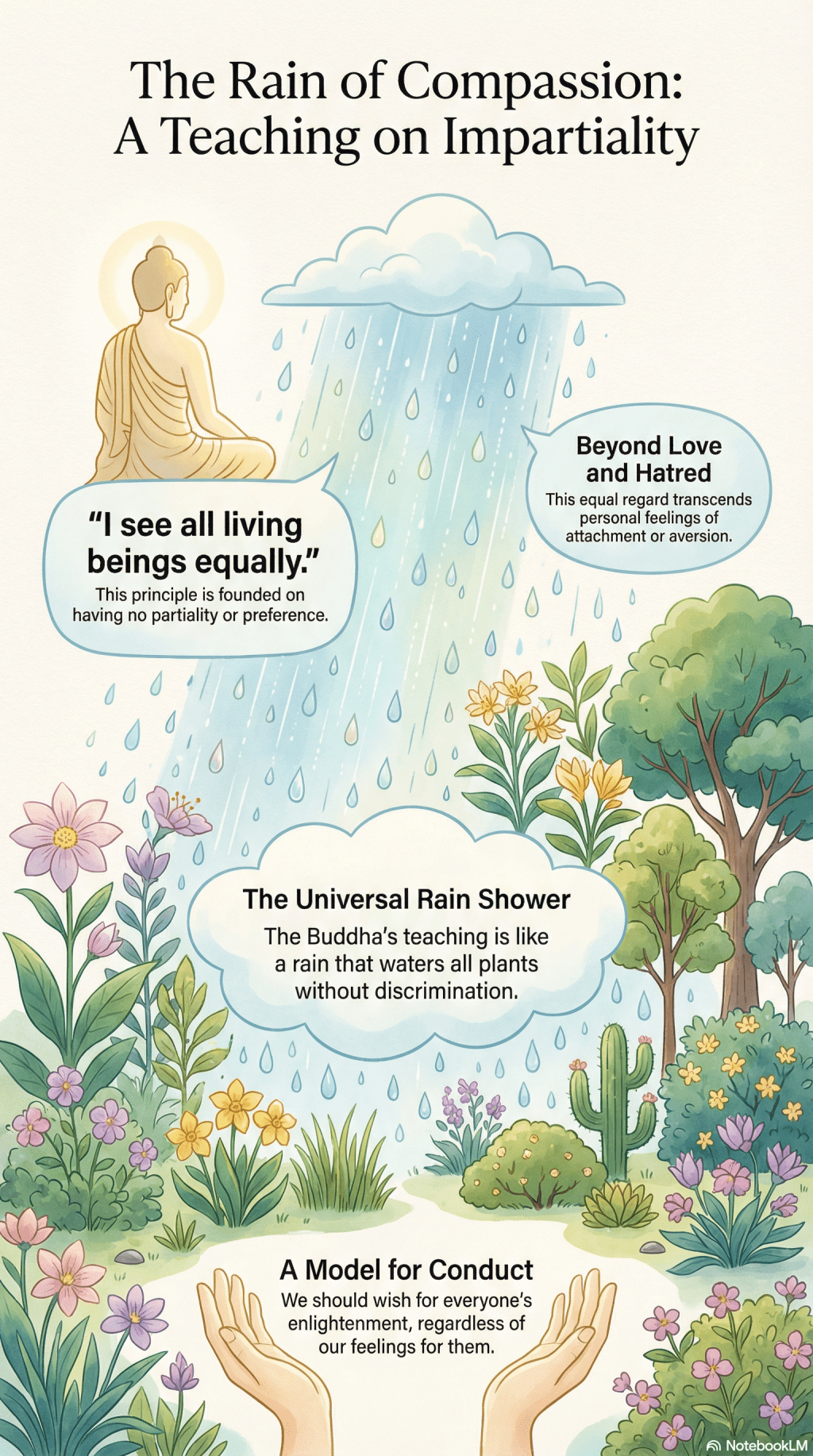
In Chapter Five of the Lotus Sūtra, the Buddha presents a powerful metaphor for true impartiality. He compares himself to a great rain shower that falls from the clouds and waters all plants equally—whether they are towering trees, humble grasses, or medicinal herbs. The rain does not pick and choose. It nourishes everything without preference.
This illustrates the Buddha’s ideal: a wish for the ultimate well-being—the enlightenment—of all living beings, a wish that cannot be swayed by our personal feelings towards them. As the Buddha declares in the text:
I see all living beings equally.
I have no partiality for them.
There is not ‘this one’ or ‘that one’ to me.
I transcend love and hatred.
The call to transcend hatred is a familiar spiritual goal. But the phrase “I transcend love” is what stops many of us in our tracks. This idea feels deeply counter-intuitive because preferential love is central to our identity. It forms the foundation of our families, friendships, and communities; our evolutionary wiring primes us to favor our own tribe for survival. How can transcending this be a virtue?
The teaching becomes clearer when we see how this same preferential love, while seemingly positive, is also the root of profound suffering. It is the seed of jealousy, the justification for nepotism, and the fuel for the nationalism and tribalism that divide our world. The love that plays favorites inherently creates an “us” and a “them,” laying the groundwork for exclusion. In this light, the Buddha’s statement isn’t a call to abandon compassion. It is a call to transcend partiality—the possessive, conditional love that says, “I care for this person, but not that one.” This teaching challenges us to cultivate a state of unshakable goodwill that extends to everyone, without exception.
This idea of radical impartiality is a profound challenge to our ordinary way of being. It asks us to develop a form of care that is as steady and unconditional as the rain, offering our best wishes to all without prejudice. It leaves us with a powerful question to ponder in our own lives:
How might our relationships and our communities change if our respect for one another was not dependent on whether we personally liked them?
 Mr. Altig’s Overview of the Wonderful Dharma of the Lotus Sutra
Leave a comment