We often experience the search for wisdom as a journey outward. We look for profound truths in ancient books, seek out teachers, or travel to distant places, hoping to find a key that will unlock some hidden clarity. There is a persistent feeling that the answers we need are elusive, something external that must be discovered and brought into our lives.
Ancient teachings, however, often present a startlingly different perspective. Traditions like Buddhism suggest that the wisdom we seek isn’t lost or far away. It is, in fact, perpetually present. This raises a crucial question that can shift our entire approach to personal growth and understanding.
What if the teachings we’re looking for are already here, and something inside us is preventing us from hearing them?
Wisdom Isn’t Lost in Time, It’s Always Present
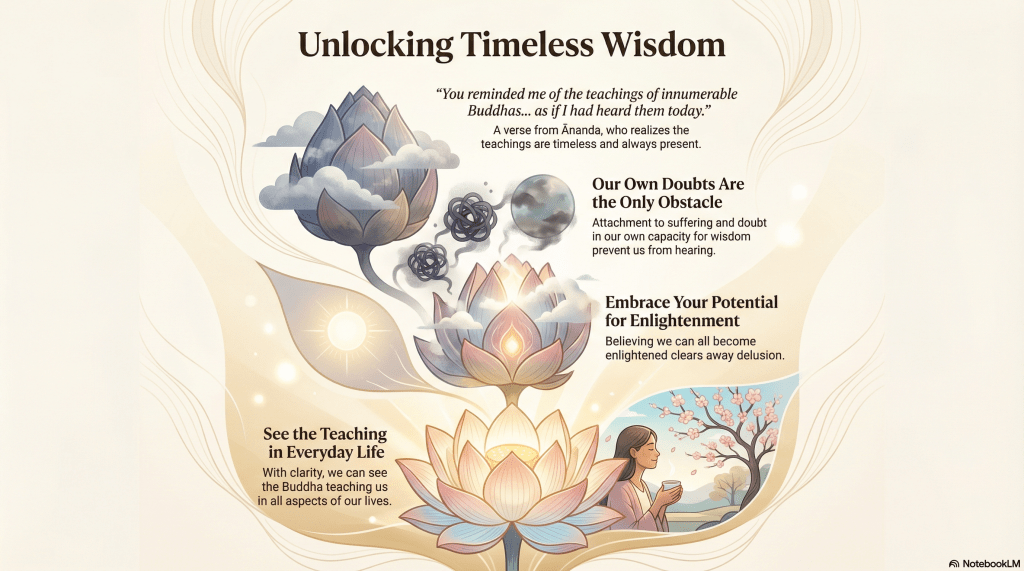
The core teachings of a figure like the Buddha are not historical artifacts that fade with time; they are considered timeless and eternally available. This concept is beautifully illustrated in verses from Chapter Nine of the Lotus Sūtra, spoken by Ānanda, the Buddha’s cousin. His profound realization was not an intellectual exercise; it was sparked by a deeply personal catalyst. Having just been personally assured by the Buddha that he, too, would one day become a Buddha himself, Ānanda was finally able to perceive a truth that had been present all along. This affirmation of his ultimate potential allowed him to declare:
You, the World-Honored One, are exceptional.
You reminded me of the teachings
Of innumerable Buddhas in the past
As if I had heard them today.
Ānanda’s words reveal that the teachings of all Buddhas are not echoes from a distant past but a living reality, always accessible. The wisdom isn’t gone; it is our capacity to receive it that must be awakened, often through the transformative power of being seen and affirmed in our highest potential.
The Real Barrier Isn’t Ignorance, It’s Attachment
If these universal teachings are always available, why do we so often feel lost? The answer offered is both simple and profoundly counter-intuitive. The source of this deafness is not external but profoundly internal: it is our own stubborn attachment to our suffering and the persistent doubts we hold about our own capacity for wisdom and compassion.
This attachment to pain can seem baffling. Yet suffering, while unwelcome, can become a familiar part of our identity; letting it go requires stepping into an unknown, more expansive version of ourselves. This internal pattern of clinging to our pain and doubting our potential acts as a filter, rendering the ever-present teachings inaudible.
The Path Forward is Radical Self-Belief
The way to clear away this internal delusion is not through a struggle but through a fundamental act of acceptance. The path forward is to take to heart the assurance that we, and all other beings, possess the inherent ability to become enlightened.
The implication of this is transformative. Believing in our own potential for wisdom is the very act that dissolves the filter of self-doubt. This shift in perspective allows us to see the Buddha teaching us in all aspects of our lives—seeing the lesson of patience in a frustrating delay, the teaching of compassion in a stranger’s kindness, or the truth of impermanence in the changing of the seasons.
A Final Thought
The journey to wisdom, then, is not an outward search for lost teachings, but an inward act of removing the single barrier that obscures them: our doubt in the enlightened potential that already resides within.
If you were to truly believe in your own capacity for wisdom, what teachings might you start to hear in your own life today?
 Mr. Altig’s Overview of the Wonderful Dharma of the Lotus Sutra
Leave a comment