Mañjuśrī’s Proclamation:
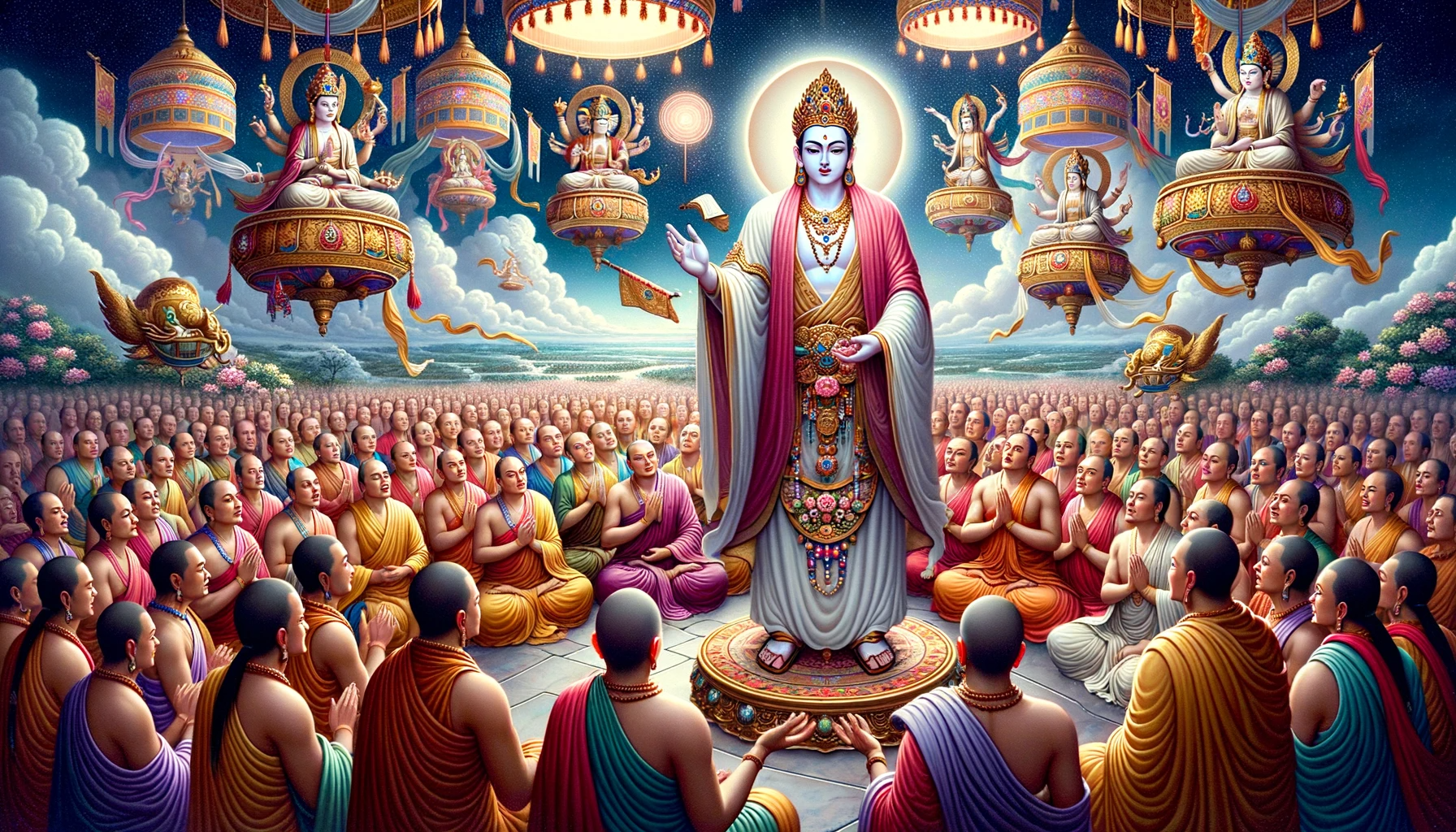
Mañjuśrī, the prince royal, stands tall before Maitreya and the assembly of Bodhisattvas, addressing them with an enthusiastic gesture. Behind him, celestial symbols like resounding drums, banners of truth, torches of knowledge, and conch trumpets float in the air, representing the grandeur of the upcoming discourse.
As Mañjuśrī, the prince royal, stood before Maitreya and the assembly of Bodhisattvas, he enthusiastically spoke: “Listen up, folks! The Tathāgata has big plans today. He’s all set to deliver a grand discourse, a teaching that’ll pour like a rain of wisdom. We’re talking about resounding drums, raising banners of truth, lighting torches of knowledge, and blowing conch trumpets of enlightenment. It’s going to be epic!”
He continued, “I’ve seen this kind of thing before, with the previous Tathāgatas, the wise and enlightened ones. When they were about to drop some serious knowledge, they emitted a brilliant ray, just like we’re seeing now. I’m convinced the Tathāgata is about to unleash a profound discourse, a speech that’ll echo far and wide, touching every corner of the world. And guess what? He’s doing all this to ensure his message is heard loud and clear, breaking through any opposition coming its way.”
Spectacle of Rays:
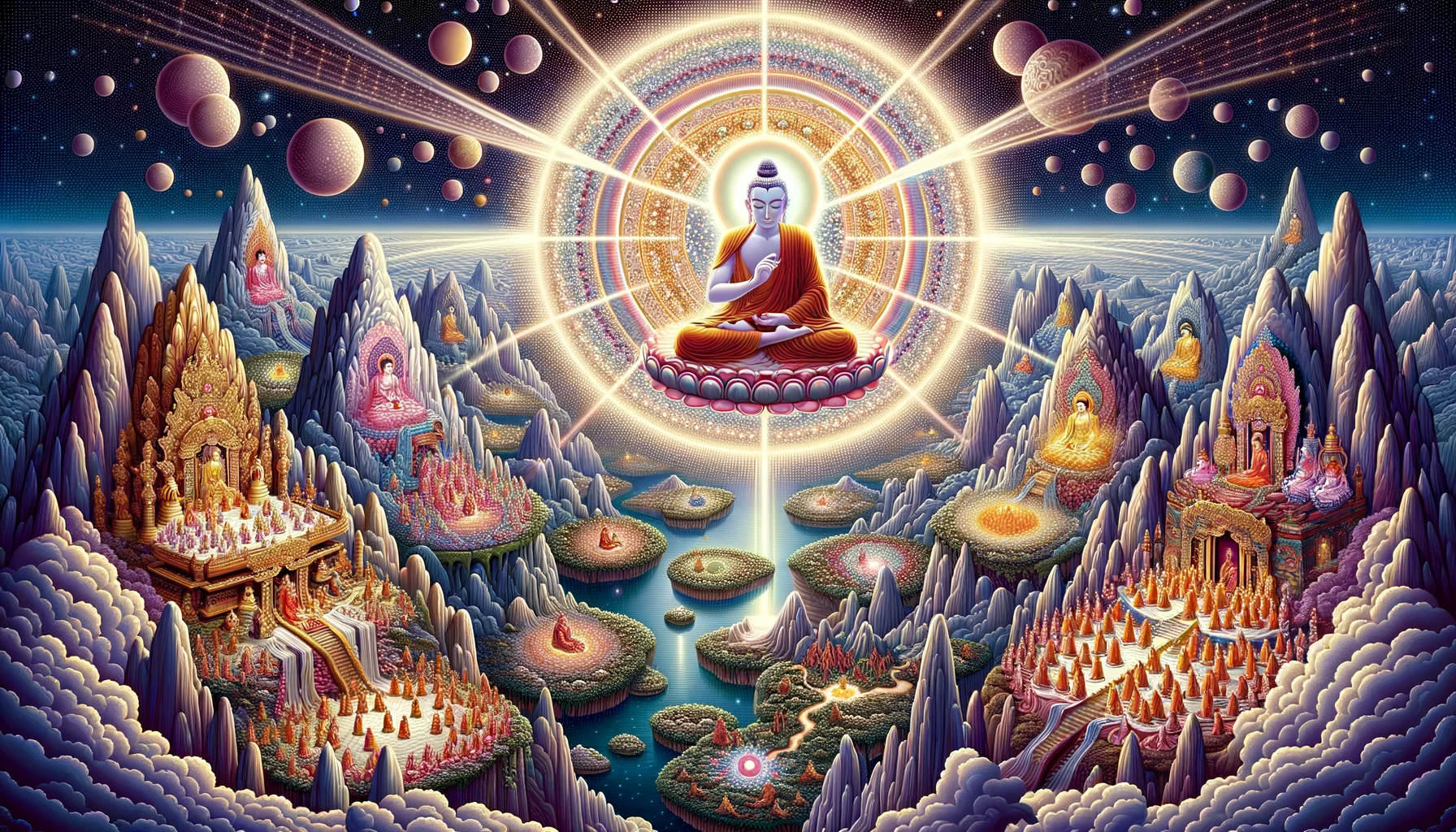
A radiant ray of light emanating from the space between the Lord’s eyebrows, casting a brilliant illumination over eighteen hundred thousand Buddha lands. The landscapes shimmer and glow, emphasizing the divine phenomenon.
With eyes full of wonder, the crowd stood ready, eager to receive the Tathāgata’s wisdom. They knew something incredible was about to happen, and they couldn’t wait to soak in the brilliance of his words, shining as brightly as that luminous ray. It was a modern-day miracle, an awe-inspiring foretoken of the profound knowledge to be shared with all.
Eager Assembly:
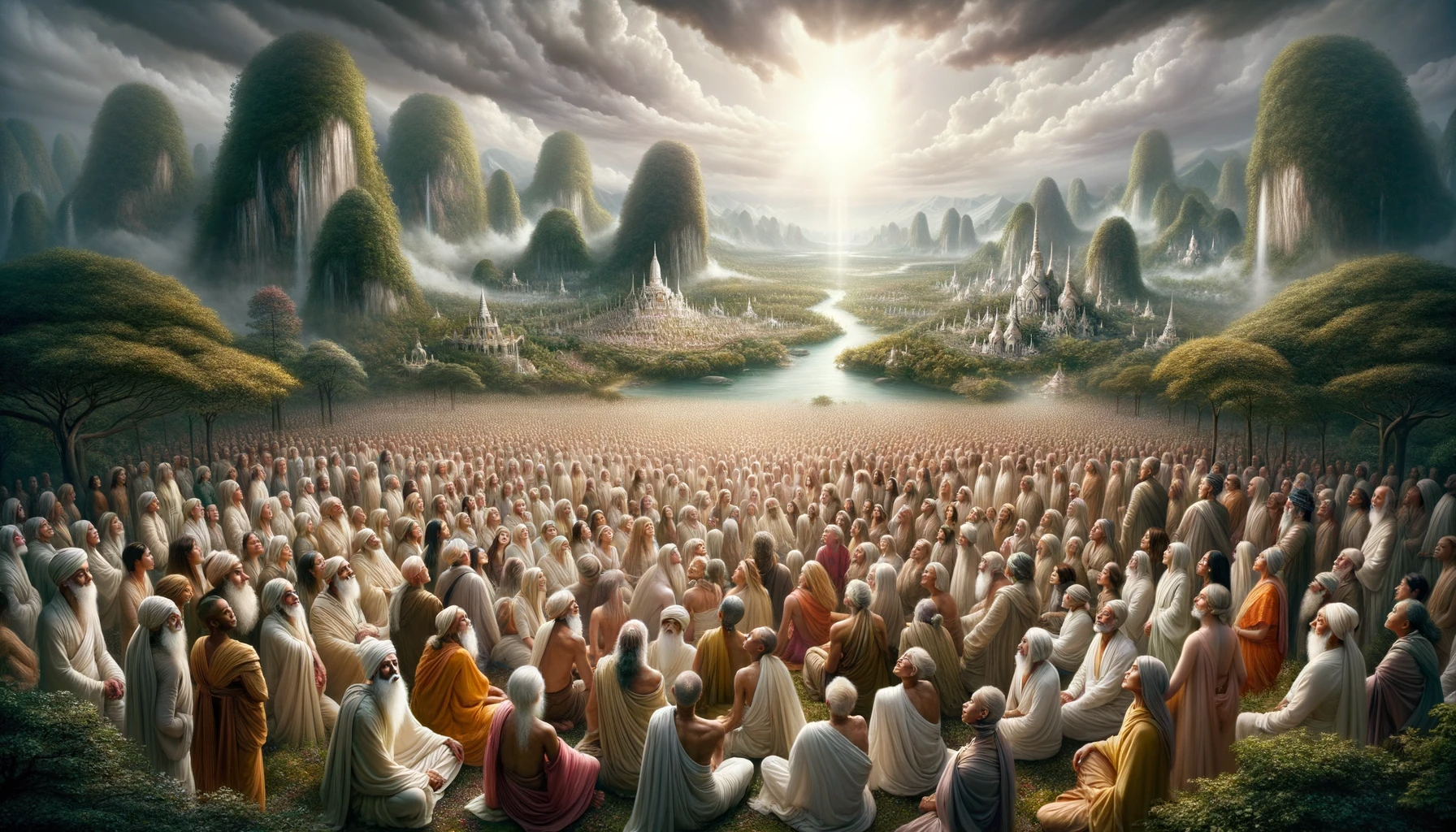
A diverse crowd with eyes filled with wonder and anticipation, looking upwards. The assembly includes monks, nuns, celestial beings, and humans, all united in their eagerness to receive wisdom.
I recall my friends, a tale from ancient times, so far back that it transcends all measure, beyond imagination or count, spanning immeasurable eons. In those days, long before our time, there was a remarkable being known as Kandrasuryapradipa (The Illuminator of Moon and Sun), a Tathāgata, an Arhat, and so much more—a true Sugata who understood the world like no other.

Illustration of Time’s Passage:
An artistic representation of time’s flow, with swirling lights and cosmic patterns, suggesting the passage of countless eons. This background serves as a backdrop to the tales of ancient Buddhas, emphasizing the timelessness of their wisdom.
He possessed profound knowledge and wisdom, a master of humanity, revered by gods and mortals alike. Kandrasuryapradipa was a compassionate teacher, guiding countless souls toward enlightenment. His teachings were a beacon of light, illuminating the path from suffering to liberation.
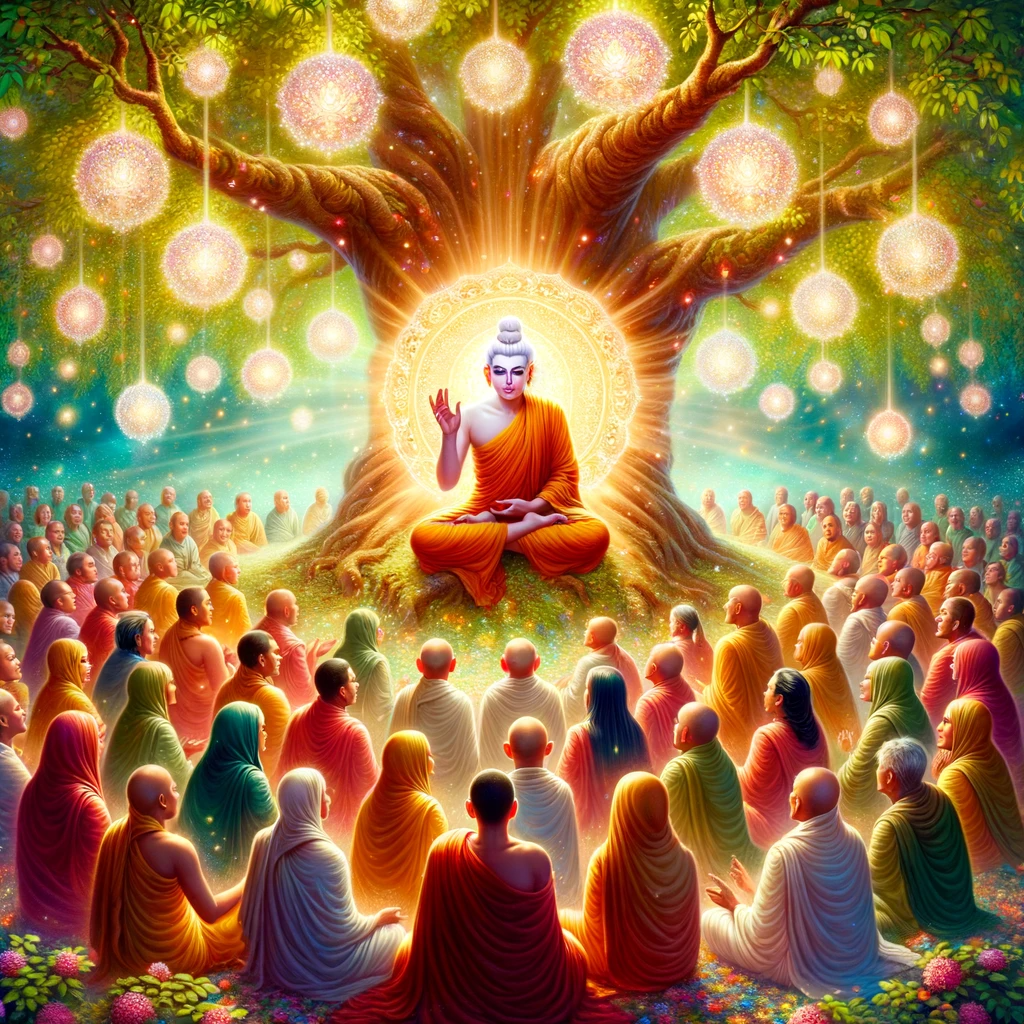
Kandrasuryapradipa’s Legacy:
A portrait of Kandrasuryapradipa, surrounded by rays of light, symbolizing his profound knowledge. Ethereal figures and symbols represent his teachings, like the Four Noble Truths and the six Perfections.
He expounded the Four Noble Truths for his disciples, laying the foundation to transcend the cycle of birth, aging, sickness, and death. He offered solace in times of sorrow, guiding them towards peace and bliss—Nirvana.
To the Bodhisattvas, those on the path to awakening, he shared the profound wisdom of the six Perfections. Their journey led to the pinnacle of enlightenment, Omniscient knowledge—the understanding of all things.
Kandrasuryapradipa’s legacy endures, a timeless example of the perfect path to follow. Even now, his teachings shine as a radiant sun, guiding us toward truth, compassion, and liberation.
Long before the time of that illustrious Buddha known as Kandrasuryapradipa (The Illuminator of Moon and Sun), another Tathāgata bore the same name, Kandrasuryapradipa. Following this first Kandrasuryapradipa, there came twenty thousand more Tathāgata, all from the Bharadvaga lineage and family name, and they, too, shared the name Kandrasuryapradipa. Like their predecessor, each of these twenty thousand Tathāgatas illuminated the path of Dharma, revealing the sacred teachings that bring holiness at every stage of life and lead towards enlightenment and liberation.
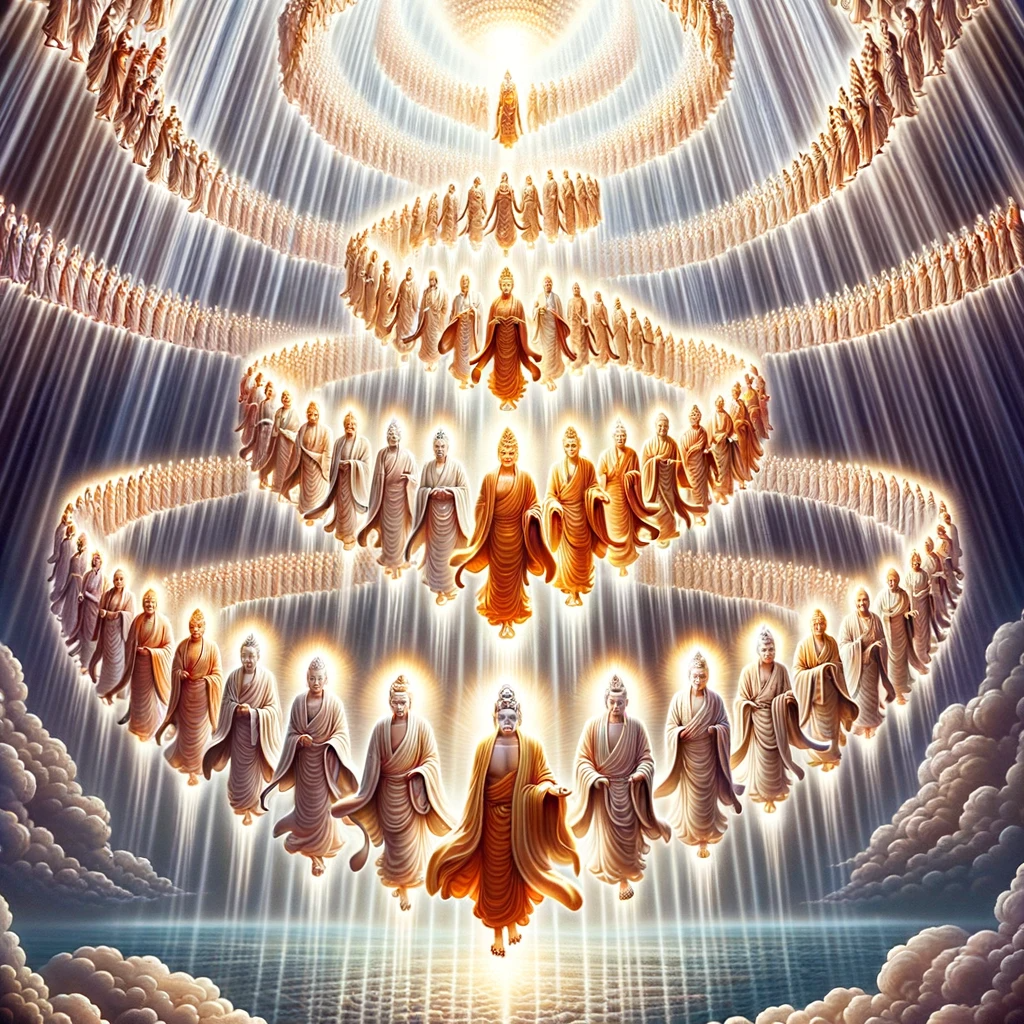
Lineage of Kandrasuryapradipa:
Multiple luminous figures, each bearing a resemblance to Kandrasuryapradipa, representing the twenty thousand Tathāgatas of the same name. They stand in a celestial realm, each illuminating a part of the Dharma.
The Lord Kandrasuryapradipa, the Tathāgata, had eight sons who were named according to their virtues:
Sumati, the young prince with a “Good Mind” and “Noble Intelligence.”
Anantamati, the prince possessing an “Infinite Mind” and “Endless Intelligence.”
Ratnamati, the prince with a “Jeweled Mind” and a mind adorned with gems.
Viseshamati, the prince of an “Exceptional Mind” and “Distinct Intelligence.”
Vimatisamudghatin, the prince known as the “Conqueror of Delusion” or “Destroyer of Illusion.”
Ghoshamati, the prince with a “Resounding Mind” that echoes far and wide.
Dharmamati, the prince whose “Righteous Mind” follows the path of Dharma, the moral principles.
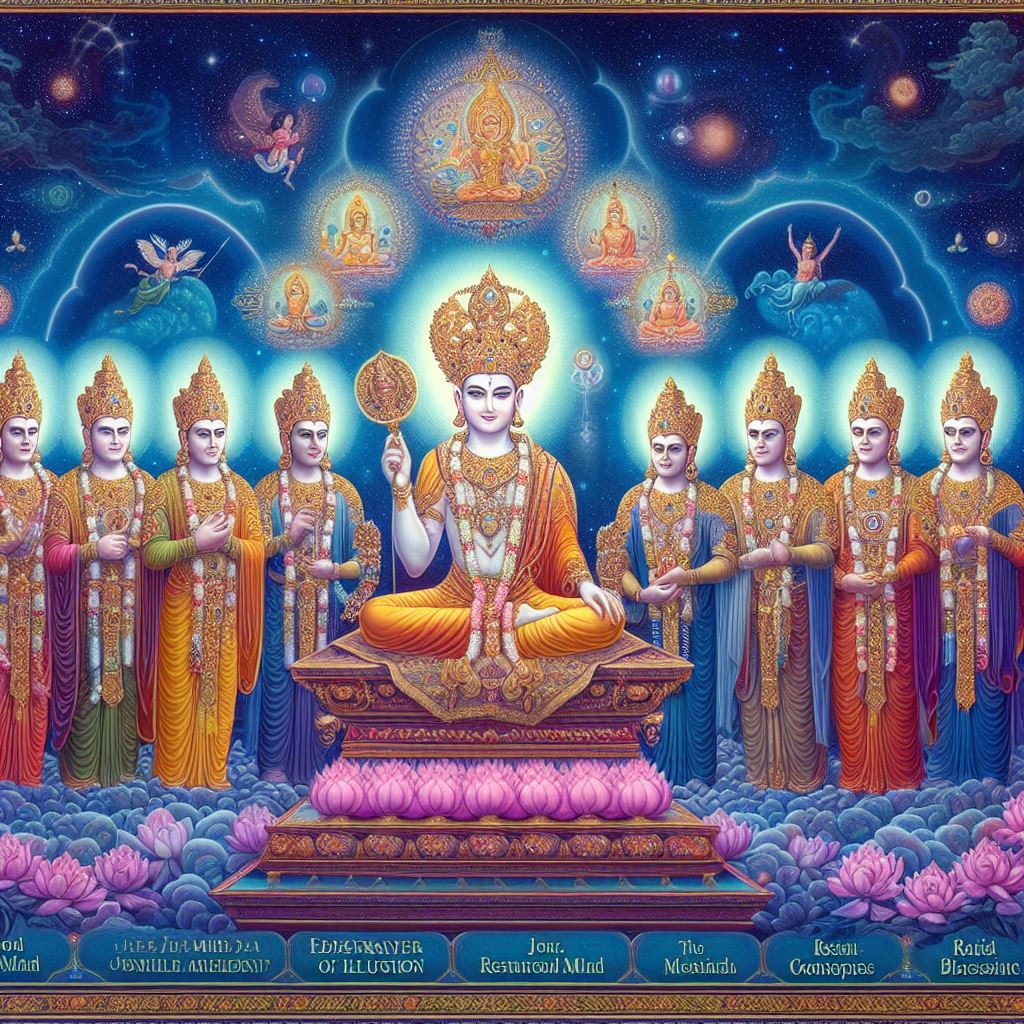
The Eight Princes:
Eight young princes, each labeled with their virtues like “Good Mind” or “Destroyer of Illusion.” They stand in a semi-circle, with the Lord Kandrasuryapradipa in the center, symbolizing their devotion and shared journey.
These young princes, blessed with immense fortune and sovereignty over four great continents, were inspired by their father’s pursuit of enlightenment. When they learned of his attainment of supreme wisdom and decision to embrace the ascetic life, they, too, renounced their princely pleasures and followed the noble path. Each embarked on the journey to attain superior enlightenment and became devout preachers of the sacred Dharma. Throughout their lives, they sowed the seeds of virtue and goodness under the guidance of thousands of Buddhas.
At that moment, Ajita (Fearless), the Lord Kandrasuryapradipa (The Illuminator of Moon and Sun), the Tathāgata, after expounding the profound teachings of the ‘Immeasurable Meanings,’ a vast discourse that imparts wisdom to Bodhisattvas and is fitting for all Buddhas, sat in a tranquil pose on the same seat of enlightenment. Engaging in the meditative state known as the ‘Samadhi of Immeasurable Meanings,’ his body remained perfectly still, and his mind attained complete serenity.
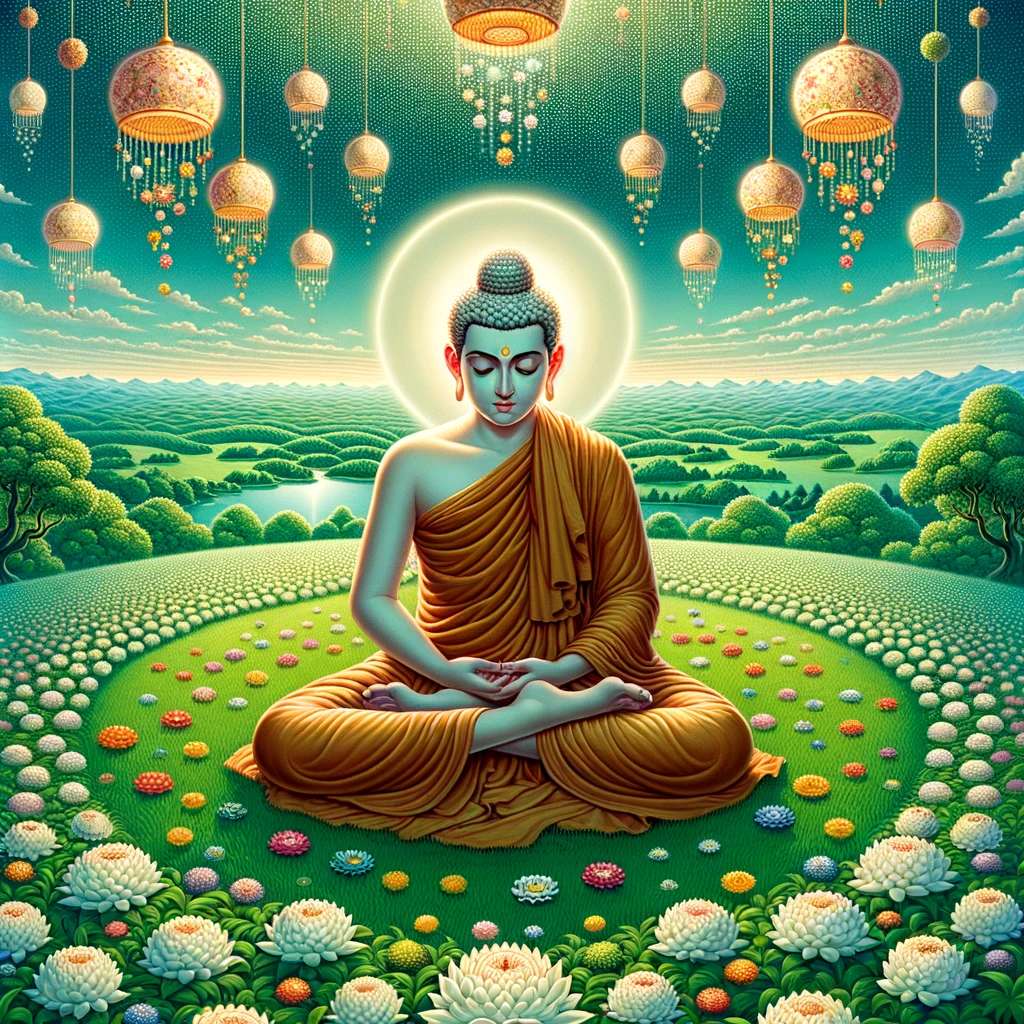
Moment of Meditation:
The Lord Kandrasuryapradipa in a deep meditative pose, surrounded by a calm aura. Divine flowers shower from the heavens, covering the serene landscape, while the Buddha-land quakes subtly, acknowledging the divine presence.
As soon as the Lord entered this profound meditation, a wondrous shower of divine flowers began to descend. Mandaravas and large Mandaravas, Manjushakas, and great Manjushakas fell from the heavens, gently covering the Lord and the entire assembly of listeners. The Buddha-land trembled in six ways, swaying, moving, and fluttering with awe-inspiring grandeur as if acknowledging the divine presence. The sacred atmosphere reverberated with extraordinary energy, manifesting the magnificence of this extraordinary moment.
In awe and wonder, all those gathered at the congregation—monks, nuns, lay devotees, both men and women, celestial beings like gods, Nagas, goblins, Gandharvas, demons, Garudas, Kinnaras, and great serpents, along with humans, as well as governors, military leaders, and rulers of the four continents—fixated their gaze upon the Lord. They were astonished and ecstatic at the magnificent sight before them.
And in that very moment, a brilliant ray of light emanated from the space between the Lord’s eyebrows, shining forth with such intensity that it spanned over eighteen hundred thousand Buddha lands in the eastern direction. All those Buddha-lands basked in the radiance of that luminous ray, just as they do today, Ajita (Fearless).
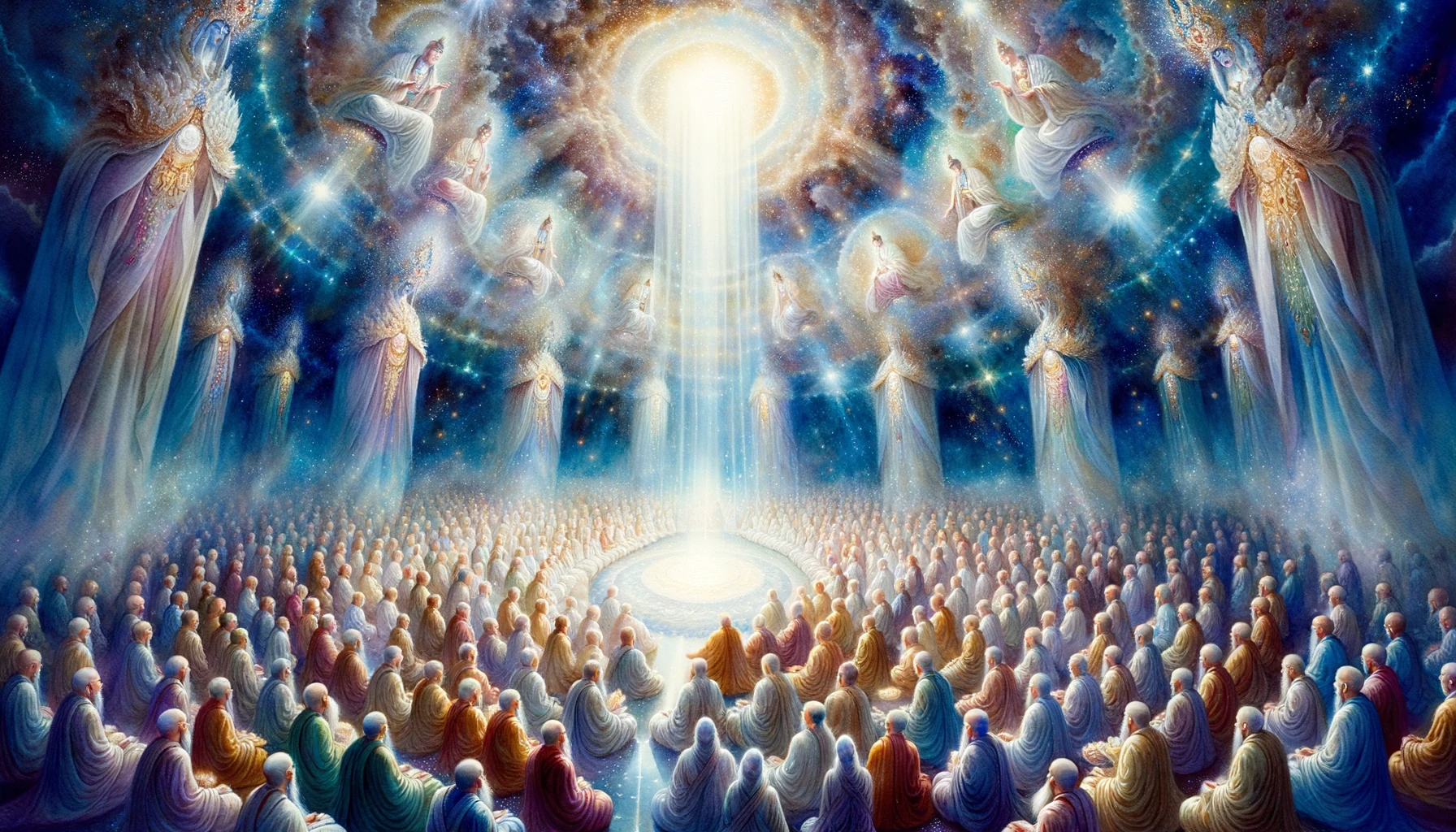
The Luminous Ray and Awe:
A powerful ray of light illuminating the assembly, with the Bodhisattvas looking on in awe. The celestial atmosphere is charged with energy, hinting at the magnificence of the forthcoming discourse.
As the assembly of Bodhisattvas witnessed the world being illuminated by the brilliance of that ray, they were filled with awe, astonishment, ecstasy, and a curious sense of wonder.
Now, during the reign of the Lord, a Bodhisattva named Varaprabha (Radiant Blessing) had eight hundred disciples. Upon arising from his deep meditation, it was to this Bodhisattva Varaprabha that the Lord imparted the teachings of this Dharma discourse known as ‘the Lotus of the True Law.’ The Lord expounded this profound discourse for a total of sixty intermediate kalpas, all the while seated on the same spot, with an unwavering body and a tranquil mind. And the entire assembly, throughout those sixty kalpas, remained seated in their places, listening to the Lord’s teachings, without experiencing any fatigue of body or mind.
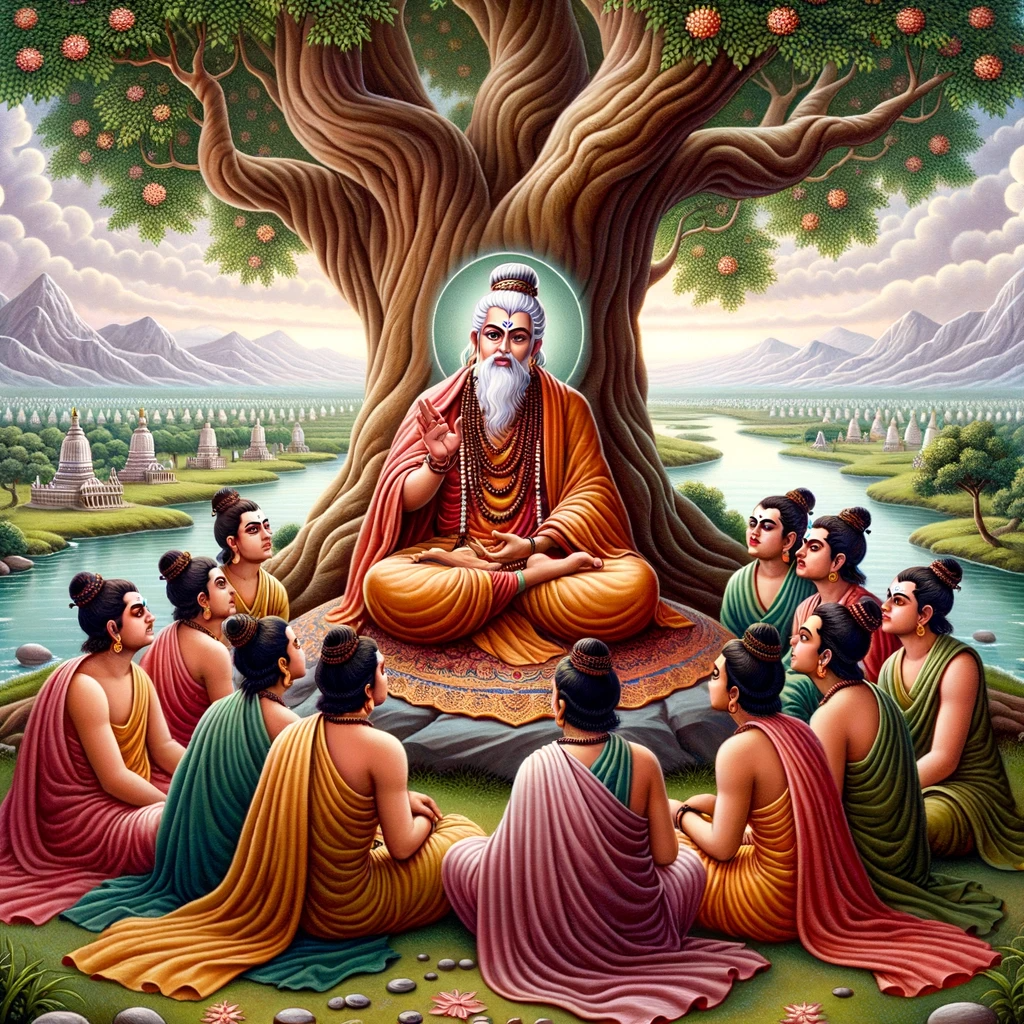
Bodhisattva Varaprabha’s Teaching:
Varaprabha, seated and teaching a gathered crowd. Among the listeners, the eight sons of Kandrasuryapradipa pay close attention, representing their dedication to learning and propagating the teachings.
After expounding the Dharma discourse ‘the Lotus of the True Law’ for sixty kalpas, the Lord Kandrasuryapradipa (The Illuminator of Moon and Sun), the Tathāgata, etc., promptly proclaimed his imminent complete Nirvana to the entire world, encompassing gods, Māras, Brahmas, all creatures, including ascetics, Brahmans, gods, humans, and demons. He declared, “Today, O monks, this very night, in the middle watch, the Tathāgata will enter the state of absolute Nirvana and attain complete extinction.”
Then, Ajita (Fearless), the Lord Kandrasuryapradipa (The Illuminator of Moon and Sun), the Tathāgata, etc., predestined the Bodhisattva, known as the Shrigarbha (Womb of Fortune), to achieve supreme, perfect enlightenment. He addressed the entire assembly, saying, “O monks, this Bodhisattva Shrigarbha will immediately follow me in attaining supreme, perfect enlightenment and become Vimalanetra (Immaculate Vision), the Tathāgata, etc.”
Afterward, on that very night, Ajita (Fearless), during that watch, the Lord, Kandrasuryapradipa (The Illuminator of Moon and Sun), the Tathāgata, entered the state of absolute Nirvana and passed away. The teachings of the Dharma discourse, known as ‘the Lotus of the True Law,’ were preserved and passed down by the Bodhisattva Mahāsattva Varaprabha for eighty intermediate kalpas. Varaprabha diligently upheld and shared the commandments of the Lord, who had attained Nirvana during that long span of time.
Now, it so happened that the eight sons of Lord Kandrasuryapradipa (The Illuminator of Moon and Sun), were disciples of the Bodhisattva Varaprabha. Under his guidance, they matured to supreme, perfect enlightenment. In the future, they would encounter and pay homage to countless Buddhas, all of whom had achieved supreme, perfect enlightenment. The last of these Buddhas was named Dipankara (The Lamp-Bearer), the Tathāgata.
Among those eight disciples, one Bodhisattva strongly desired material gains, honor, and praise. He was fond of seeking glory, but they didn’t stick in his memory whenever he was taught the sacred words and teachings. As a result, he was known as Desiring Fame, the lazy one. Despite this, he still accumulated vast merit by showing respect and devotion to innumerable Buddhas.
Ajita’s Revelation:
A depiction of the Bodhisattva Maitreya also lovingly referred to as Ajita (Fearless), with a background showing the past, present, and future. Ethereal figures and landscapes hint at his previous existence as the Bodhisattva named Desiring Fame.
Perhaps, Ajita, you may feel doubt or confusion that another Bodhisattva Mahāsattva Varaprabha preached the teachings in those ancient times. However, let not your mind be troubled, for I am the same Bodhisattva Mahāsattva Varaprabha of those times, who propagated the teachings. And that Bodhisattva named Desiring Fame, the lazy one, is none other than you, Ajita (Fearless), who existed back then as the Bodhisattva named Desiring Fame, known for his tendency to be lazy.
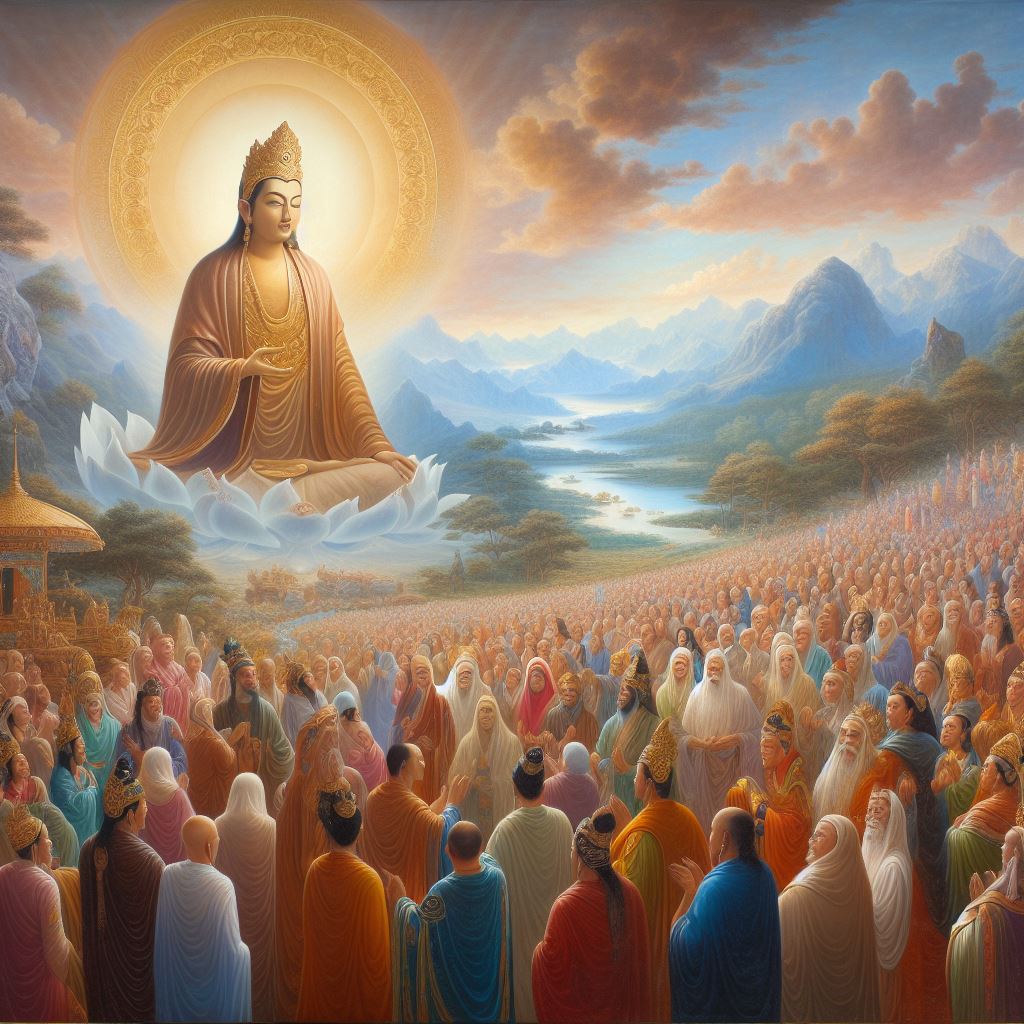
Closing Scene:
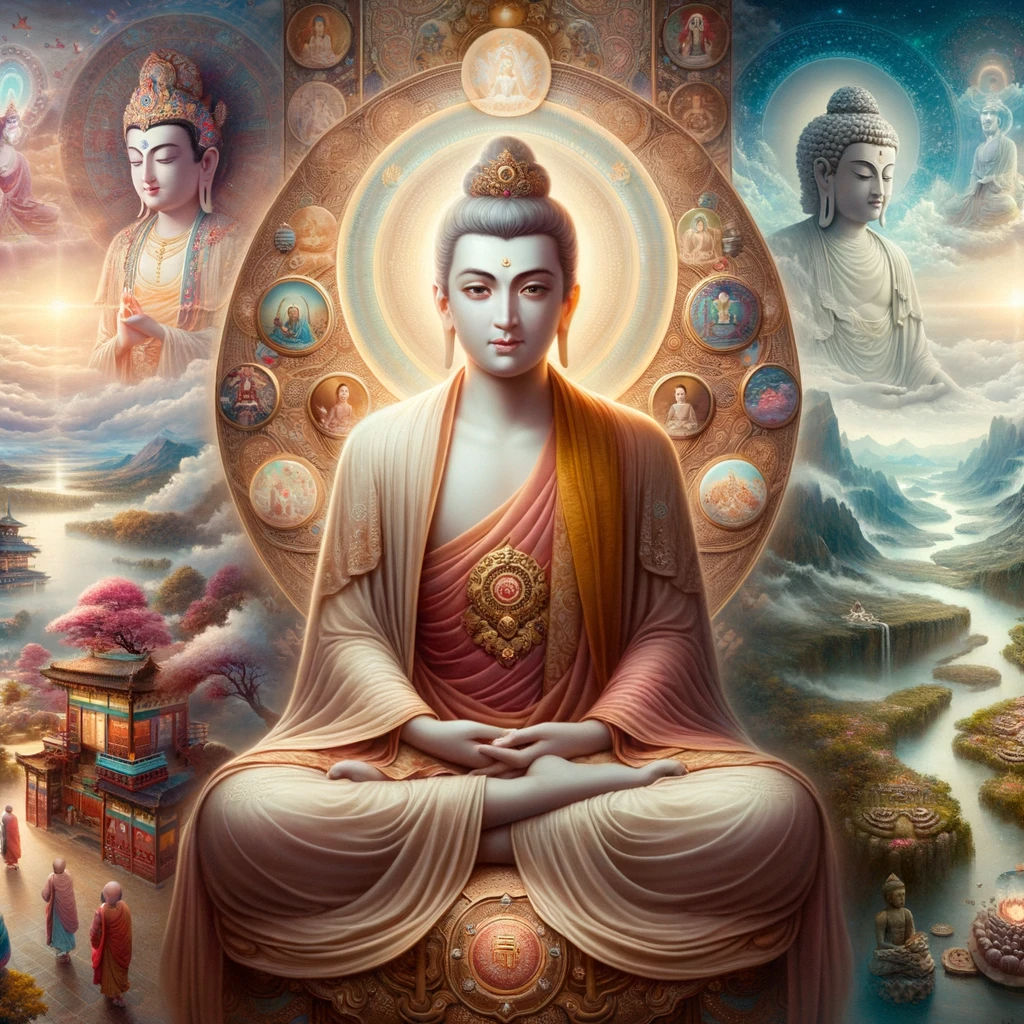
The grand assembly, with Mañjuśrī in the forefront, looking onward with hope and anticipation, symbolizing the collective eagerness to receive the teachings of the ‘Lotus of the True Law.’
And now, Ajita, having witnessed a similar foretoken of the Lord, I deduce from the emission of a similar way that the Lord is about to expound the Dharma discourse called ‘the Lotus of the True Law.’
 Mr. Altig’s Overview of the Wonderful Dharma of the Lotus Sutra
Leave a comment