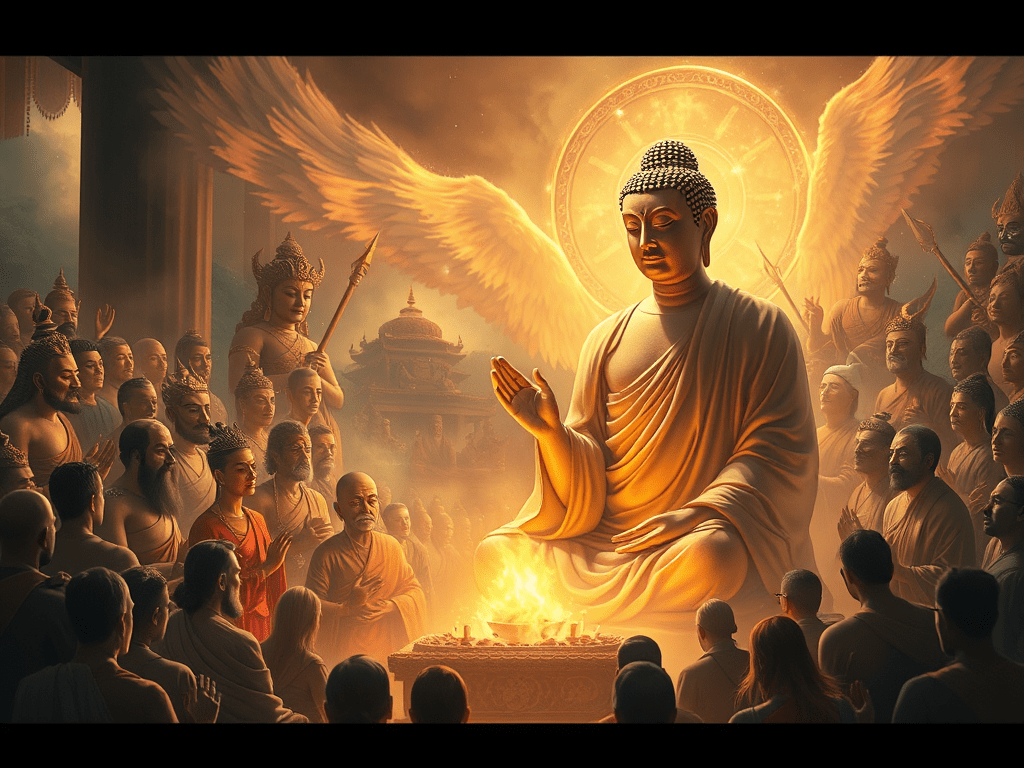

Main Theme: This excerpt details the Buddha’s first sermon. In it, he sets the “Wheel of Dharma” in motion. He reveals the Four Noble Truths and the Twelvefold Chain of Causation. The teaching highlights the interconnectedness of life, the source of suffering, and the path to liberation.
Most Important Ideas and Facts:
- The Setting: The Buddha delivers the sermon. He is referred to as the “Tathagata, Mahabhignagnanabhibhu (Great-Knowledge-and-Dominance).” The audience consists of gods, demons, celestial beings, ascetics, and scholars.
- The Four Noble Truths:Life is suffering: “Life is filled with pain…”
- Suffering has a cause: “…Pain has a source…”
- Suffering can cease: “…but it can be overcome…”
- There is a path to end suffering: “…and there’s a way to do it.”
- The Twelvefold Chain of Causation: The Buddha outlines the cyclical nature of suffering. It starts with ignorance and ends with aging, death, and sorrow. Each link in the chain fuels the next:
- Ignorance → False ideas → Understanding → Naming → Senses → Contact → Feeling → Desire → Striving → Existence → Birth → Aging, Death, and Sorrow
- Path to Liberation: Overcoming ignorance is key to breaking the chain and ending suffering.
- Impact of the Teaching: The sermon leads to profound awakening for countless beings. It demonstrates the transformative power of the Buddha’s wisdom.
- The Sixteen Princes: Inspired by the teaching, the sixteen princes renounce their royal lives to follow the path of enlightenment. Their dedication further inspires half the royal court to do the same.
Key Quotes:
- Call to Teach: “Unsurpassed wheel, roll forward. Begin the beat of the immortal drum. Release from evils’ deceit. From hundreds of sorrows set all beings free. Show the path of Nirvana, the way to eternity.”
- The Four Noble Truths: “Life is filled with pain, and here’s why. Pain has a source, but it can be overcome, and there’s a way to do it.”
- The Cycle of Suffering: “Ignorance leads to false ideas, which lead to understanding, and then to the naming of things. This gives rise to the senses, which create contact, feeling, desire, striving, and existence. From existence come birth, aging, death, and all kinds of sorrow. This is how the whole mass of suffering begins.”
- Ending Suffering: “By overcoming ignorance, we stop the false ideas. Understanding, naming, senses, contact, feeling, and desire all cease. Striving, existence, birth, aging, death, and sorrow also cease. This is how the whole mass of suffering can be ended.”
Significance: This excerpt highlights a pivotal moment in Buddhist history. It discusses the Buddha’s first teaching and the setting in motion of the “Wheel of Dharma.” It emphasizes the core tenets of Buddhism, including the nature of suffering and the path to liberation. The impact of the teaching, particularly on the sixteen princes, underscores the transformative potential of the Buddha’s message.


Leave a comment