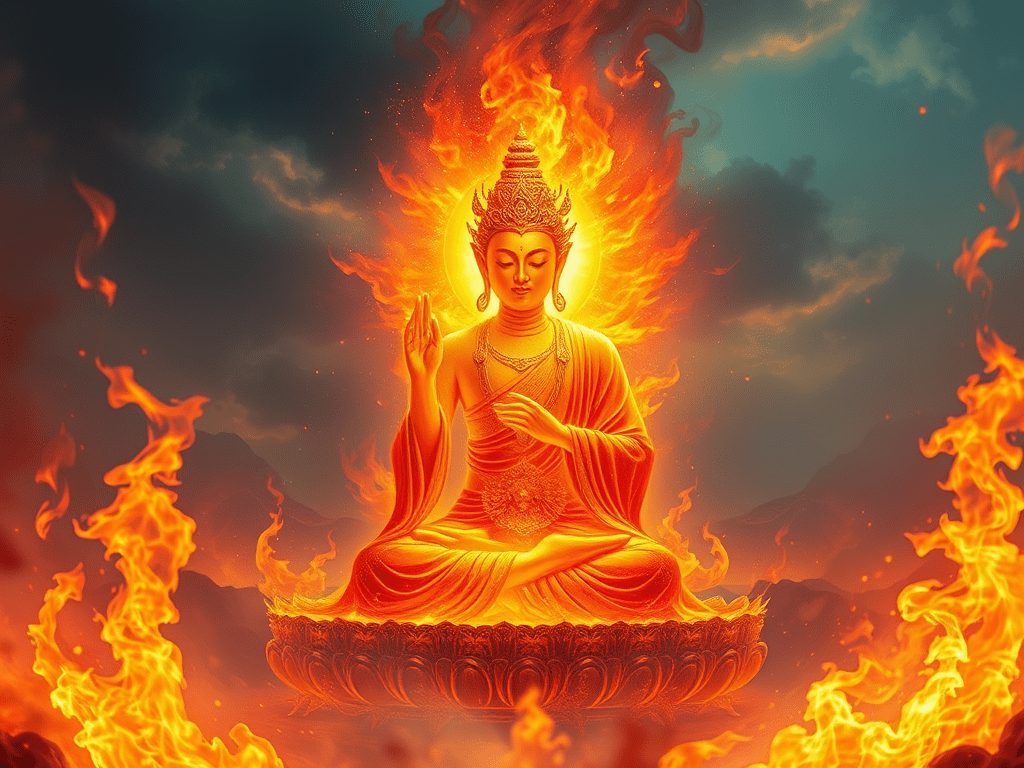
Source: Excerpts from Chapter 22b – “The Ultimate Sacrifice and Rebirth”
1. Overview
This chapter excerpt details the story of a Bodhisattva, One-who-Views-All-Beings-with-Love (also referred to as Understanding-the-Essence-of-the-Star’s-Radiance), who performs an extraordinary act of self-immolation as an ultimate offering to the Tathagata (Buddha) and the sacred teachings of the Lotus of the True Law. The excerpt then describes his subsequent rebirth, return to the Buddha, and the Buddha’s final passing, with instructions passed to the Bodhisattva. The narrative highlights themes of extreme devotion, sacrifice, the impermanence of life, and the continuity of the Dharma (Buddhist teachings) through the actions of enlightened beings.
2. Key Themes and Ideas
- The Supreme Act of Devotion: Self-Immolation
- The central act of the excerpt is the Bodhisattva’s self-immolation. This act is portrayed not as an act of destruction but as the ultimate offering and worship to the Buddha and the Law.
- The text emphasizes the unparalleled nature of this sacrifice: “This, noble seeker, is the highest gift, greater than giving up a kingdom, beloved children, or a spouse. Sacrificing one’s body is the most distinguished, the finest, the ultimate worship of the Law.”
- This is not presented as a literal requirement for all practitioners but as a demonstration of extreme devotion and commitment to the path.
- The flames from his sacrifice are said to have lit up eighty worlds, emphasizing the profound impact of such an act.
- Rebirth and the Continuity of Practice
- After his body is consumed by fire, the Bodhisattva is miraculously reborn in a royal family. This emphasizes the concept of samsara and the cycles of death and rebirth in Buddhist thought.
- This rebirth demonstrates that even an act as extreme as self-immolation does not end the cycle of seeking enlightenment, instead placing the Bodhisattva once more in a position to continue their pursuit.
- His immediate remembrance of his previous life and desire to return to the Buddha highlights the power and persistence of his spiritual commitment.
- The Impermanence of the Buddha and the Importance of Relics
- The Buddha, Radiance-of-the-Moon’s-Pure-Light, is described as being close to parinirvana (final extinction) which emphasizes the impermanence of all compounded things, even Buddhas.
- The Buddha’s instructions to the Bodhisattva before his passing are significant: he is tasked with caring for the Buddhist community and, crucially, worshipping and distributing the Buddha’s relics, building Stupas as places of remembrance.
- This emphasizes the continuing importance of the Dharma and the symbolic importance of honoring the Buddha even after physical passing.
- The Transmission of the Dharma
- The Buddha entrusts the Dharma and his community to the Bodhisattva, showing how enlightenment and responsibility are passed on to future generations.
- The Bodhisattva is charged with the task of upholding the Dharma and ensuring its continued presence in the world.
- This narrative highlights the idea of a spiritual lineage and the role of Bodhisattvas in maintaining the continuity of Buddhist teachings.
- The nature of Bodhisattvas
- The narrative directly states “This is the true heroism that Bodhisattvas should embody”. This implies that the act of supreme sacrifice and devotion to the path is a key element in understanding the path of a Bodhisattva.
- We also see how quickly the reborn Bodhisattva is able to recall their previous life and continue their devotion. This speaks to their strong commitment to the Dharma and to helping other sentient beings.
3. Significant Quotes
- “Well done, well done, noble seeker! This is the true heroism that Bodhisattvas should embody. This is the real worship of the Tathagata, the genuine reverence for the Law. No offering of flowers, incense, wreaths, ointments, powders, cloths, umbrellas, flags, or banners can compare… Sacrificing one’s body is the most distinguished, the finest, the ultimate worship of the Law.”
- This quote emphasizes the unparalleled significance of the Bodhisattva’s self-immolation as the ultimate act of devotion.
- “O exalted king, behold my path, In meditation’s glow, I found my wrath; A hero’s feat, in courage, I did body, My flesh I gave, my vow fulfilled with sturdy.”
- Here, the Bodhisattva, soon after rebirth, summarizes their previous act in poetic verses.
- “I entrust to you, young man of good family, my commandment; I entrust to you these Bodhisattvas Mahasattvas, these great disciples, this Buddha-enlightenment, this world… You should worship my relics, young man of good family, distribute them, and build thousands of Stupas.”
- These words of the Buddha highlight the Bodhisattva’s role as the keeper of the teachings and his responsibility to honor the passing of the Buddha.
4. Conclusion
This excerpt from Chapter 22b of The Great Teachings of the Lotus of the True Law, by William. Altig, provides a dramatic narrative that encapsulates core Buddhist concepts. The self-immolation of the Bodhisattva, followed by his miraculous rebirth and the Buddha’s parinirvana, underscores the themes of ultimate sacrifice, devotion, impermanence, and the continuity of the Dharma through enlightened beings. It serves as a profound teaching on the dedication required for spiritual practice and the importance of upholding and propagating the Buddha’s teachings. It presents an ideal of the Bodhisattva path, a path of profound selflessness and devotion.
 Mr. Altig’s Overview of the Wonderful Dharma of the Lotus Sutra
Leave a comment