I. Introduction: The Profound Principle of Shared Merit in the Lotus Sutra
The Lotus Sutra, revered as a cornerstone of Mahayana Buddhism, presents a comprehensive vision of the path to enlightenment, emphasizing the inherent potential for Buddhahood within all beings and advocating the compassionate path of the Bodhisattva 1. This scripture, which has profoundly influenced Buddhist thought and practice across East Asia for centuries, offers guidance on navigating the complexities of spiritual development and engaging with the world with wisdom and compassion 1. Its teachings continue to resonate with practitioners seeking to understand the deepest truths of existence and to embody the ideals of selfless service.
Chapter Twenty-Five of the Lotus Sutra, often celebrated as the “Universal Gateway” chapter, shines a particular light on the Bodhisattva World-Voice-Perceiver (known also as Avalokiteshvara, Guanyin, Kannon, and Chenrezig), a figure who embodies the very essence of boundless compassion 4. Across various Buddhist traditions, this Bodhisattva is recognized in diverse forms and under numerous names, each reflecting the universality and adaptability of compassion in addressing the myriad forms of suffering experienced by living beings 9. This adaptability underscores the Mahayana emphasis on reaching all beings in ways that are meaningful and effective for their liberation.
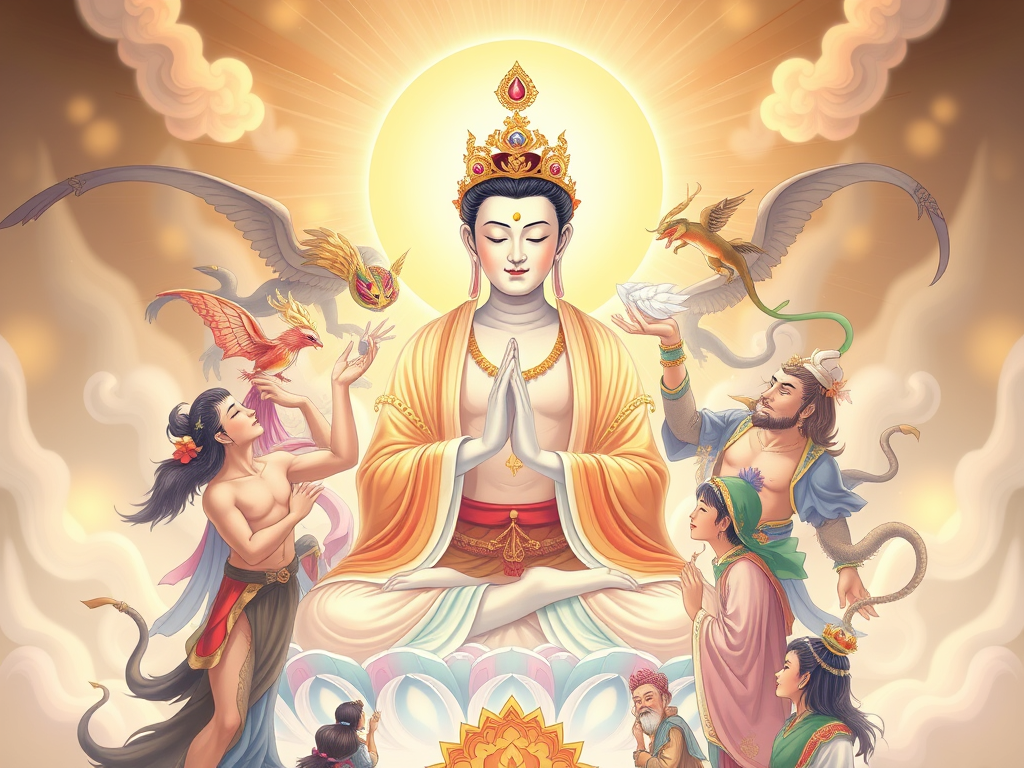
The passage from the Lotus Sutra under consideration recounts a significant moment where the Buddha instructs World-Voice-Perceiver Bodhisattva regarding a precious necklace of gems offered by Endless-Intent Bodhisattva. The Buddha’s words, “Receive it out of your compassion towards this Endless-Intent Bodhisattva, towards the four kinds of devotees, and towards the other living beings including gods, dragons, yakṣas, gandharvas, asuras, garuḍas, kiṃnaras, mahoragas, human and nonhuman beings!” [User Query], serve as a powerful illustration of the principle of transforming personal gain into a source of universal benefit. This moment, marked by the Buddha’s direct guidance, highlights the profound importance of extending one’s spiritual merit and cultivating a heart of compassion that embraces all of existence [User Query].
II. Deconstructing the Narrative of Generosity and Shared Intention
The narrative unfolds with Endless-Intent Bodhisattva offering a necklace of gems of inestimable value to World-Voice-Perceiver Bodhisattva 5. This act of generosity, prompted by deep reverence and gratitude, acknowledges the extraordinary spiritual powers and the ability of World-Voice-Perceiver to bestow fearlessness upon all living beings 5. The sheer worth of the offering underscores the profound respect and devotion that Endless-Intent Bodhisattva holds for World-Voice-Perceiver, emphasizing the significance of recognizing and honoring spiritual attainment. Such an offering reflects a deep understanding of the Bodhisattva’s role as a guide and protector on the path to enlightenment.
Initially, World-Voice-Perceiver Bodhisattva declines to accept the valuable gift 5. This initial refusal is significant, reflecting a Bodhisattva’s characteristic detachment from material possessions and a primary focus on the welfare of others. A Bodhisattva’s practice is rooted in selflessness, and the initial reluctance highlights the principle that even acts of generosity directed towards oneself should be carefully considered in terms of their potential benefit for the larger community. It is only upon the explicit instruction of the Buddha that World-Voice-Perceiver agrees to receive the necklace 5. The Buddha’s intervention is crucial, providing the rationale for acceptance: compassion for Endless-Intent Bodhisattva, the four kinds of devotees, and all other living beings 5. This divine command underscores that the ultimate aim of any act, even receiving a gift, should be oriented towards the collective good and motivated by a desire to alleviate suffering.
Following the Buddha’s directive, World-Voice-Perceiver Bodhisattva accepts the necklace but does not retain it for personal use. Instead, the Bodhisattva divides the precious offering into two equal parts, dedicating one portion to Shakyamuni Buddha and the other to the stupa of Many Jewels Buddha 5. This act is deeply symbolic, representing the transformation of a personal offering into something that honors both the present manifestation of Buddhahood and the eternal, transcendent nature of enlightenment. The division and subsequent offering to the Buddhas signify the dedication of merit not only to sentient beings but also to the very source of enlightenment. This selfless act creates a powerful cycle of giving and receiving, ultimately benefiting all within the vast expanse of the Buddhist cosmos.
III. Identifying the Recipients of Boundless Shared Merit
The name “Endless-Intent” or “Inexhaustible Mind” Bodhisattva itself carries profound meaning within the context of Mahayana Buddhism 4. The term suggests an inexhaustible wellspring of compassion and an unwavering commitment to the continuous striving for the enlightenment of all beings 3. This resonates with the Bodhisattva ideal of postponing one’s own final liberation until all sentient beings are freed from suffering 9. In the teachings of Nichiren, the name “Inexhaustible Intent” is interpreted as representing the perfect unification of the three fundamental truths of existence: non-substantiality (emptiness), temporary existence, and the Middle Way, highlighting the interconnectedness of all phenomena 15. Therefore, the very name of this Bodhisattva embodies the core Mahayana principles of boundless aspiration and the intricate nature of reality.
The phrase “the four kinds of devotees” traditionally refers to the fourfold assembly that constitutes the Buddhist community: monks (bhikshus), nuns (bhikshunis), laymen (upasakas), and laywomen (upasikas) 16. The Lotus Sutra, in its revolutionary spirit, emphasizes the equal potential for Buddhahood for all individuals, regardless of their status within the monastic or lay community 2. While the primary meaning of this term points to the established Buddhist community, it is worth noting that other interpretations exist within different Buddhist traditions. For instance, the Bhagavad Gita describes four types of individuals who seek the Divine based on their motivations: the distressed, seekers of knowledge, those desiring material gain, and the wise 20. Regardless of the specific interpretation in this context, the inclusion of the “four kinds of devotees” underscores the Lotus Sutra’s inclusive message and the understanding that the benefits of spiritual practice and the sharing of merit are intended for the entire spectrum of Buddhist practitioners.
The Buddha’s instruction extends beyond the immediate Buddhist community to encompass “other living beings,” followed by a detailed list: gods (devas), dragons (nagas), yakshas, gandharvas, asuras, garudas, kinnaras, mahoragas, human and nonhuman beings 4. This comprehensive enumeration highlights the vastness of the Buddhist cosmology and the interconnectedness of all forms of life. Understanding the significance of each of these categories provides a richer appreciation for the scope of compassion and shared merit advocated in the Lotus Sutra.
| Being | Description | Significance in Buddhist Cosmology |
| Gods (Devas) | Celestial beings residing in higher realms | While enjoying fortunate existences, they are still within the cycle of birth, death, and rebirth (samsara) and are not ultimately free from suffering 26. |
| Dragons (Nagas) | Mythical serpent-like beings, often associated with water | They are frequently depicted as guardians of Buddhist teachings and symbols of wisdom and protection 28. |
| Yakshas | Nature spirits, sometimes benevolent, sometimes malevolent | They can act as protectors of natural treasures and can also be depicted as fearsome beings 33. |
| Gandharvas | Celestial musicians and singers, associated with fragrance | They are often depicted as divine performers in the courts of the gods and are sometimes linked to the intermediate state between death and rebirth 37. |
| Asuras | Powerful beings often characterized by jealousy, pride, and conflict | They are sometimes depicted as being in constant battle with the devas 42. |
| Garudas | Mythical bird-like creatures, often depicted with immense power and speed | They are traditional enemies of the nagas and symbolize strength, protection, and the overcoming of obstacles 47. |
| Kinnaras | Mythical beings with human torsos and the lower bodies of horses or birds | Renowned for their musical talents and often associated with beauty, grace, and love 51. |
| Mahoragas | Great serpent spirits or earth dragons | Often seen as powerful protectors of the Dharma and sometimes associated with transformation 55. |
| Human and Nonhuman Beings | All other sentient life forms | This category encompasses the entirety of the living world beyond the specific classifications listed. |
The inclusion of this extensive list of beings underscores the profound universality of compassion within Buddhist teachings. The merit accrued from one’s practice is not intended solely for personal benefit or even just for the human realm. Instead, it should extend to all forms of existence within the vast and intricate tapestry of the cosmos. This reflects the fundamental Buddhist understanding of the interconnectedness of all beings and the aspiration to alleviate suffering wherever it exists.
IV. The Foundational Principle of Merit (Puñña) in Buddhism
The concept of merit, known as puñña in Pali and Sanskrit, is a cornerstone of Buddhist ethics and practice 59. Merit is understood as a beneficial and protective force that accumulates as a result of wholesome deeds, actions, and thoughts 59. This accumulated merit plays a crucial role in shaping an individual’s experiences, leading to positive outcomes in this life and favorable rebirths in the future 59. Furthermore, the cultivation of merit is intrinsically linked to spiritual progress, contributing to the purification of the mind and ultimately paving the way for enlightenment 59. Merit is not merely a passive reward but an active force that cleanses negativity and fosters inner well-being, aligning one with the principles of purity and goodness 59. Traditionally, the accumulation of merit is categorized into three primary bases: generosity or giving (dana), ethical conduct or virtue (sila), and mental development or meditation (bhavana) 59. These practices form the foundation of a virtuous life and contribute significantly to one’s spiritual journey.
The practice of the Lotus Sutra is explicitly stated within the text itself and widely understood in Buddhist traditions to be a potent source of merit 61. Activities such as reciting the sacred title, Namu Myoho Renge Kyo, reading the sutra, chanting its verses, and even making copies of the text are considered to generate immense spiritual benefit 61. The Lotus Sutra itself asserts its extraordinary power and promises significant advantages to those who embrace and uphold its teachings 1. Notably, some interpretations suggest that even a single act of reverence or offering made towards the Bodhisattva World-Voice-Perceiver, a central figure in the Lotus Sutra, can yield boundless and immeasurable merit 7. This emphasis on the profound merit derived from engaging with the Lotus Sutra indicates its unique capacity to facilitate spiritual growth and create positive conditions for benefiting others.
V. The Practice of Sharing and Extending Boundless Merit
Compassion (karuna) serves as the fundamental motivation for the act of sharing merit, a principle clearly illustrated in the interaction between the Buddha and World-Voice-Perceiver Bodhisattva within the Lotus Sutra passage 10. The initial hesitation of World-Voice-Perceiver to accept the necklace, followed by the acceptance driven by compassion at the Buddha’s urging, underscores the critical role of intention in both receiving and giving 5. Compassion, in this context, transcends a mere emotional response; it is a guiding principle that directs the accumulation and distribution of spiritual merit for the ultimate welfare of all sentient beings.
For practitioners seeking to extend the boundless merit accrued from their Lotus Sutra practice, several practical applications can be adopted:
- Formal Dedication of Merit: A significant practice in Buddhism is the “transfer of merit” (pariṇāmanā in Sanskrit, pattidāna in Pali), wherein individuals consciously dedicate the positive energy and benefits derived from their virtuous actions to others 59. Following your Lotus Sutra practice, you can engage in this dedication by mentally directing the merit you have accumulated towards specific individuals, groups, or all sentient beings. Many traditional dedication prayers exist, such as “May the merit of this practice benefit all beings,” or you can formulate your own heartfelt intentions 74. It is important to understand that in the act of sharing merit, the giver’s own store of merit is not diminished; rather, it is likened to lighting one candle from another – both flames burn brightly 71. This formal dedication serves as a powerful means of transforming individual merit into a collective resource for well-being, fostering a deep sense of interconnectedness and expanding the scope of one’s compassionate intention.
- Cultivating a Mindset of Universal Compassion in Daily Life: Beyond formal practices, actively cultivating loving-kindness (metta) and compassion towards all beings in your daily interactions is crucial 10. This includes extending feelings of care and empathy not only to those you know and like but also to those who may be suffering or whom you find challenging. By consciously practicing mindfulness of compassion throughout your day, you transform ordinary moments into opportunities for spiritual growth and the accumulation of merit that can be shared. Even seemingly small acts of kindness, performed with a genuine intention to benefit others, contribute to this positive accumulation. Integrating compassion into your daily life embodies the Bodhisattva ideal of continuous service and extends the transformative power of your practice into the world around you.
- Sharing the Teachings of the Lotus Sutra: One of the most profound ways to extend the merit of your practice is by sharing the Dharma, the teachings of the Lotus Sutra, with others 1. By introducing others to these liberating teachings, you offer them a path towards understanding, enlightenment, and freedom from suffering. This sharing can take various forms, such as engaging in discussions about the Sutra’s principles, participating in study groups, or simply living in accordance with its teachings and inspiring others through your own example and conduct. Sharing the Dharma directly helps others to cultivate their own merit and understanding, creating a ripple effect of positive change that extends far beyond your individual practice.
VI. Conclusion: Embodying Boundless Compassion and Shared Merit
The teachings of the Lotus Sutra, particularly the passage concerning the necklace offering, illuminate the profound interconnectedness of compassion, merit, and the path to enlightenment. The narrative underscores the importance of transforming personal gain into universal benefit, a principle exemplified by the actions of Endless-Intent Bodhisattva, World-Voice-Perceiver Bodhisattva, and the guiding wisdom of the Buddha. Understanding and actively practicing the sharing of merit, as taught within this sacred text, holds immense transformative power for both the individual practitioner and the wider world.
By consciously dedicating the merit of your Lotus Sutra practice to the welfare and liberation of all beings, you embody the compassionate spirit of World-Voice-Perceiver Bodhisattva. This intentional act, coupled with the cultivation of universal compassion in your daily life and the sharing of the Dharma with others, allows you to actively contribute to a world filled with greater understanding, kindness, and freedom from suffering. As you continue your practice, may you be inspired by the boundless compassion demonstrated in the Lotus Sutra and strive to extend the merit you accrue for the benefit of all.
Works cited
1. Lotus Sutra – Wikipedia, accessed March 14, 2025, https://en.wikipedia.org/wiki/Lotus_Sutra
2. Lotus Sutra | Soka Gakkai (global), accessed March 14, 2025, https://www.sokaglobal.org/about-the-soka-gakkai/buddhist-lineage/lotus-sutra.html
3. The Lotus Sutra – Bucknell Digital Commons, accessed March 14, 2025, https://digitalcommons.bucknell.edu/cgi/viewcontent.cgi?article=1126&context=fac_books
4. web.tohoku.ac.jp, accessed March 14, 2025, https://web.tohoku.ac.jp/modern-japan/wp-content/uploads/Lotus-Sutra-25-Regarder-of-Cries-of-the-World.pdf
5. Lotus Sutra – Chapter 25, accessed March 14, 2025, https://www.buddhistdoor.com/OldWeb/resources/sutras/lotus/sources/lotus25.htm
6. The Wonderful Dharma Lotus Flower Sutra with Commentary 25 – City of Ten Thousand Buddhas, accessed March 14, 2025, https://www.cttbusa.org/dfs25/dfs25.asp.html
7. The Lotus Sutra[25] – The Universal Gate of Bodhisattva Kanzeon, accessed March 14, 2025, https://nichiren.info/buddhism/lotussutra/text/chap25.html
8. The Wonderful Dharma Lotus Flower Sutra 25 – City of Ten Thousand Buddhas, accessed March 14, 2025, https://www.cttbusa.org/lotus/lotus25.asp.html
9. Avalokiteshvara | Buddhist Deity, Compassionate Bodhisattva | Britannica, accessed March 14, 2025, https://www.britannica.com/topic/Avalokiteshvara
10. Pacifier of War and Strife, Avalokiteshvara Guanyin Chenrezig — Bodhisattva delivering us from every danger; Chapter 25 Lotus Sutra – Buddha Weekly, accessed March 14, 2025, https://buddhaweekly.com/avalokiteshvara-delivering-us-from-every-danger-bodhisattva-perceiver-of-the-worlds-suffering-chapter-25-lotus-sutra/
11. Bodhisattva Avalokitesvara: Guanyin (article) – Khan Academy, accessed March 14, 2025, https://www.khanacademy.org/humanities/art-asia/beginners-guide-asian-culture/buddhist-art-culture/a/bodhisattva-avalokitesvara-guanyin
12. Avalokiteśvara: The Bodhisattva of Compassion | Oxford Research Encyclopedia of Religion, accessed March 14, 2025, https://oxfordre.com/religion/display/10.1093/acrefore/9780199340378.001.0001/acrefore-9780199340378-e-167?d=%2F10.1093%2Facrefore%2F9780199340378.001.0001%2Facrefore-9780199340378-e-167&p=emailAkAJaEUst5pP.
13. Avalokiteshvara Universal Gate Sutra Recitation (Full Sutra): Saves from every danger; Many forms of Compassion – Buddha Weekly: Buddhist Practices, Mindfulness, Meditation, accessed March 14, 2025, https://buddhaweekly.com/avalokiteshvara-universal-gate-sutra-recitation-full-sutra-saves-from-every-danger-many-forms-of-compassion/
14. Wonderful Dharma Lotus Sutra //Chapter 25, accessed March 14, 2025, https://amitabhabuddha.wordpress.com/wonderful-dharma-lotus-sutra-chapter-25-the-universal-door-of-avalokitesvara-bodhisattva/
15. “The Universal Gateway of the Bodhisattva Perceiver of the World’s Sounds” chapter: five important points | OTT | Nichiren Buddhism Library, accessed March 14, 2025, https://www.nichirenlibrary.org/en/ott/PART-2/25
16. The Lotus Sutra – all 28 chapters combined – 500 Yojanas, accessed March 14, 2025, https://www.500yojanas.org/lotus-sutra/book/
17. Devadatta’s End – NBANichiren Shu San Francisco Bay Area, accessed March 14, 2025, https://www.nichirenbayarea.org/devadattas-end
18. Lotus Sutra With Annotations – 500 Yojanas, accessed March 14, 2025, https://www.500yojanas.org/lotus-sutra/annotations/
19. Lotus Sutra Dharani – Dharma Wheel, accessed March 14, 2025, https://www.dharmawheel.net/viewtopic.php?t=10695
20. Gita Chapter 7, Verse 16 – Four types of Divine seekers, accessed March 14, 2025, https://auromere.wordpress.com/2009/03/22/gita-chapter-7-vers-16/
21. 4 TYPES OF DEVOTEES (BHAKTAS) – AS DEFINED BY BHAGVAD GITA | INDIAN ETHOS, accessed March 14, 2025, https://indianethos.com/4-types-of-devotees-bhaktas-as-defined-by-bhagvad-gita/
22. Gita chapter 7.16 Four types of devotees | PPT – SlideShare, accessed March 14, 2025, https://www.slideshare.net/slideshow/gita-chapter-716-four-types-of-devotees/80004514
23. Sutra on the Lotus Flower of the, accessed March 14, 2025, http://longbeachmonastery.org/Universal_Door_Chapter.htm
24. THE UNIVERSAL WAY OF AVALOKITESVAR BODHISATTVA – Many Roads – Bodhicharya, accessed March 14, 2025, https://bodhicharya.org/manyroads/the-universal-way-of-avalokitesvar-bodhisattva/
25. Lotus Sutra – Chapter 21, accessed March 14, 2025, https://www.buddhistdoor.com/OldWeb/resources/sutras/lotus/sources/lotus21.htm
26. Buddhist deities – Wikipedia, accessed March 14, 2025, https://en.wikipedia.org/wiki/Buddhist_deities
27. The role of deities in Buddhism – Reddit, accessed March 14, 2025, https://www.reddit.com/r/Buddhism/comments/y0b14j/the_role_of_deities_in_buddhism/
28. Hundred Dragons – Buddha Tooth Relic Temple, accessed March 14, 2025, https://www.buddhatoothrelictemple.org.sg/hundred-dragons
29. Dragon Symbolism in Buddhist Art and Tradition: A Visual Odyssey – Enlightenment Thangka, accessed March 14, 2025, https://enlightenmentthangka.com/blogs/thangka/buddhist-dragon
30. Can someone please tell me what the dragons represent in this picture? Are they friendly or evil? Thank you! : r/Buddhism – Reddit, accessed March 14, 2025, https://www.reddit.com/r/Buddhism/comments/lq5zic/can_someone_please_tell_me_what_the_dragons/
31. Dragon in Tibetan Buddhist Necklace: A Fusion of the Mystical and the Sacred – QiLing Aura, accessed March 14, 2025, https://www.qilingaura.com/blogs/unveiling-eastern-traditions/dragon-in-tibetan-buddhist-necklace-a-fusion-of-the-mystical-and-the-sacred
32. The Dragon: The Principle of Cosmos – Journal of Symbols & Sandplay Therapy, accessed March 14, 2025, https://www.e-jsst.org/upload/pdf/jsst-4-70.pdf
33. Yaksha: Significance and symbolism, accessed March 14, 2025, https://www.wisdomlib.org/concept/yaksha
34. Yaksha – Wikipedia, accessed March 14, 2025, https://en.wikipedia.org/wiki/Yaksha
35. Yakshas and Rakshasas: Significance and symbolism, accessed March 14, 2025, https://www.wisdomlib.org/concept/yakshas-and-rakshasas
36. Mythical Beings: Yakshas – The New Indian Express, accessed March 14, 2025, https://www.newindianexpress.com/lifestyle/spirituality/2023/Oct/21/mythical-beings-yakshas-2625456.html
37. Gandharva – Wikipedia, accessed March 14, 2025, https://en.wikipedia.org/wiki/Gandharva
38. Gandharva: Significance and symbolism, accessed March 14, 2025, https://www.wisdomlib.org/concept/gandharva
39. Gandharvas: Celestial Musicians and Intermediary Beings – Serenade Magazine, accessed March 14, 2025, https://serenademagazine.com/gandharvas-celestial-musicians-and-intermediary-beings/
40. Gandharva – Encyclopedia of Buddhism, accessed March 14, 2025, https://encyclopediaofbuddhism.org/wiki/Gandharva
41. Gandharva and the Buddhist Afterlife. Part I – Jayarava’s Raves, accessed March 14, 2025, http://jayarava.blogspot.com/2015/01/gandharva-and-buddhist-afterlife-part-i.html
42. Asura: Significance and symbolism, accessed March 14, 2025, https://www.wisdomlib.org/concept/asura
43. Devas and Asuras: Significance and symbolism, accessed March 14, 2025, https://www.wisdomlib.org/concept/devas-and-asuras
44. Asura – Encyclopedia of Buddhism, accessed March 14, 2025, https://encyclopediaofbuddhism.org/wiki/Asura
45. Asura – Wikipedia, accessed March 14, 2025, https://en.wikipedia.org/wiki/Asura
46. Asura (Buddhism) – Wikipedia, accessed March 14, 2025, https://en.wikipedia.org/wiki/Asura_(Buddhism)
47. Garuda: Significance and symbolism, accessed March 14, 2025, https://www.wisdomlib.org/concept/garuda
48. Garuda – Wikipedia, accessed March 14, 2025, https://en.wikipedia.org/wiki/Garuda
49. Garuda – Rigpa Wiki, accessed March 14, 2025, https://www.rigpawiki.org/index.php?title=Garuda
50. Garuda: The Divine Eagle in Hinduism and Buddhism – HD Asian Art, accessed March 14, 2025, https://www.hdasianart.com/blogs/news/garuda-the-divine-eagle-in-hinduism-and-buddhism
51. Kinnara – Wikipedia, accessed March 14, 2025, https://en.wikipedia.org/wiki/Kinnara
52. Kinnara: Significance and symbolism, accessed March 14, 2025, https://www.wisdomlib.org/concept/kinnara
53. Explore the Mythical Beings of South Asian Lore – Yakshas, Kinnaras, Nagas, and More, accessed March 14, 2025, https://www.explorehinduheritage.in/blogs/explore-the-mythical-beings-of-south-asian-lore-yakshas-kinnaras-nagas-and-more
54. Kinnara – Senshin Buddhist Temple |, accessed March 14, 2025, https://senshintemple.org/groups/kinnara/
55. Mahoraga: Significance and symbolism, accessed March 14, 2025, https://www.wisdomlib.org/concept/mahoraga
56. Who’s mahoraga? : r/Jujutsufolk – Reddit, accessed March 14, 2025, https://www.reddit.com/r/Jujutsufolk/comments/1evi9r7/whos_mahoraga/
57. Jujutsu Kaisen: The Mythology Behind the Divine General Mahoraga – Game Rant, accessed March 14, 2025, https://gamerant.com/jujutsu-kaisen-the-mythology-behind-the-divine-general-mahoraga/
58. How Jujutsu Kaisen’s Mahoraga makes the most of Hindu and Buddhist symbolism – Dailyo, accessed March 14, 2025, https://www.dailyo.in/entertainment/how-jujutsu-kaisens-mahoraga-makes-the-most-of-hindu-and-buddhist-symbolism-42599
59. Merit (Buddhism) – Wikipedia, accessed March 14, 2025, https://en.wikipedia.org/wiki/Merit_(Buddhism)
60. Buddhist Vocabulary: Merit – Sukhasiddhi Foundation, accessed March 14, 2025, https://www.sukhasiddhi.org/buddhist-vocabulary/merit
61. Our Practice | Nichiren Shu Portal, accessed March 14, 2025, https://www.nichiren.or.jp/english/buddhism/page03.php
62. The Daimoku of the Lotus Sutra | WND I – Nichiren Buddhism Library, accessed March 14, 2025, https://www.nichirenlibrary.org/en/wnd-1/Content/14
63. Teachings and Commentary on the Sutra of Infinite Meanings – Tzu Chi Dharma, accessed March 14, 2025, https://tzuchidharma.org/blog/faith_teachings-and-commentary-on-the-sutra-of-infinite-meanings
64. Lotus Sutra- Chapter 25 – Bodhi-Bowl, accessed March 14, 2025, https://bodhi-bowl.com/2018/04/04/lotus-sutra-chapter-25/
65. Part Two: The Lotus Sutra – The Guibord Center, accessed March 14, 2025, https://theguibordcenter.org/faiths/buddhism/buddhist-sacred-texts/part-two-the-lotus-sutra/
66. Compassionate Lotus Sutra – Purify Mind, accessed March 14, 2025, http://purifymind.com/Sutras21.htm
67. What does it mean to receive or dedicate merit? – Tricycle: The Buddhist Review, accessed March 14, 2025, https://tricycle.org/beginners/buddhism/what-does-it-mean-to-receive-or-dedicate-merit/
68. Transfer of Merit –The Practice of Generating a Great Mind – Dharma Drum Mountain Global Website–Special Topics, accessed March 14, 2025, https://www.dharmadrum.org/portal_d8_cnt.php?folder_id=54
69. Sharing merit: Significance and symbolism, accessed March 14, 2025, https://www.wisdomlib.org/concept/sharing-merit
70. Share merit: Significance and symbolism, accessed March 14, 2025, https://www.wisdomlib.org/concept/share-merit
71. Transfer of merit – Wikipedia, accessed March 14, 2025, https://en.wikipedia.org/wiki/Transfer_of_merit
72. Buddhist Studies: Devotion: Sharing of Merits – buddhanet.net, accessed March 14, 2025, https://www.buddhanet.net/e-learning/history/devotion/devotion05/
73. Dedication of Merit – Dharma Realm Buddhist University, accessed March 14, 2025, https://www.drbu.edu/news/dedication-of-merit/
74. Dedication of Merit – The Prairie Sangha of Urbana-Champaign, accessed March 14, 2025, https://www.prairiesangha.org/merit
75. Dedication of Merit | Focus Pocus – WordPress.com, accessed March 14, 2025, https://focuspocusnow.wordpress.com/2019/02/24/dedication-of-merit/
76. What does ‘dedicating merit’ really do? – Lion’s Roar, accessed March 14, 2025, https://www.lionsroar.com/what-does-dedicating-merit-really-do/
77. Dedication of Merit in Buddhism | by Thomas Lam | ILLUMINATION – Medium, accessed March 14, 2025, https://medium.com/illumination/dedication-of-merit-in-buddhism-9c82dd346715
78. The Four Divine Abodes – Buddhist spirituality, accessed March 14, 2025, https://buddhist-spirituality.com/meditation/four-divine-abodes
 Mr. Altig’s Overview of the Wonderful Dharma of the Lotus Sutra
Leave a comment