The Lotus Sutra, revered across East Asia, stands as a cornerstone of Mahayana Buddhism, distinguished by its profound teachings on the inherent potential for Buddhahood in all beings and the skillful means employed by Buddhas to guide them.1 This influential scripture emphasizes that the supreme state of enlightenment, characterized by boundless compassion, wisdom, and courage, is not exclusive but lies within every individual, irrespective of their background or circumstances.3 Chapter Twenty-Eight, bearing the title “The Encouragement of Universal Worthy Bodhisattva,” concludes this seminal work with a significant vow made by a prominent Bodhisattva.5 The passage in question states: “If anyone keeps, reads and recites this sūtra while he walks or stands, I will mount a kingly white elephant with six tusks, go to him together with great Bodhisattvas, show myself to him, make offerings to him, protect him, and comfort him, because I wish to make offerings to the Sūtra of the Lotus Flower of the Wonderful Dharma.” This report aims to provide a comprehensive analysis of this vow, exploring its accuracy, context within the Lotus Sutra, the identity and significance of Universal-Sage Bodhisattva, the symbolism embedded in the imagery, the meaning of the promised actions, the importance of the described practices, the broader teachings of the Sutra that illuminate this vow, interpretations from Buddhist scholars, and its connection to the Buddhist understanding of harmony with reality. The Lotus Sutra’s emphasis on the inherent Buddha nature and the active engagement with life’s challenges suggests that Universal-Sage’s vow is not merely a passive promise but an active encouragement for practitioners to realize their own potential.3 Furthermore, given its placement as the concluding chapter, the vow likely serves as a final reassurance and source of motivation for those who diligently follow the teachings contained within the Lotus Sutra.5
To ascertain the accuracy and context of the quoted passage, it is crucial to examine various translations of Chapter Twenty-Eight of the Lotus Sutra. Several versions corroborate the core elements of the vow. One translation reads, “Whether that person is walking or standing, if he reads and recites this sutra, then at that time I will mount my six-tusked kingly white elephant and with my multitude of great bodhisattvas will proceed to where he…source Another translation offers a similar account: “If there is a person reading or reciting this Sutra, whether walking or standing, I will at that time mount my royal white elephant with six tusks and together with a host of Great Bodhisattvas go to that place, manifest my body, make offerings, protect him, and comfort his mind, and also make offerings to the Dharma Flower Sutra”.6 These excerpts, along with others 6, confirm the accuracy of the user’s quotation, although slight variations in wording such as “Universal Worthy” versus “Universal-Sage” and “kingly” versus “royal” exist across different renditions. The immediate context of this vow involves the arrival of Universal-Sage Bodhisattva from the east, accompanied by an immeasurable assembly of great Bodhisattvas, signifying his spiritual power and virtue.6 Having paid homage to Shakyamuni Buddha, Universal-Sage inquires about how individuals can obtain the Lotus Sutra after the Buddha’s parinirvana.6 The vow in question is articulated as part of Universal-Sage’s response, following the Buddha’s discourse on the four conditions necessary for attaining the Sutra in the future.7 The consistency of the central components of the vow across various translations underscores its authenticity and importance within the Lotus Sutra.6 Furthermore, the elaborate description of Universal-Sage’s grand arrival before he makes this promise emphasizes the significance and power associated with his commitment.6
Universal-Sage Bodhisattva, also known as Samantabhadra or Fugen, holds a position of great reverence in Mahayana Buddhism.5 His Sanskrit name, Samantabhadra, translates to “Universal Worthy,” “Universal Virtue,” or “He Who Is All-Pervadingly Good,” reflecting his pervasive beneficence.5 He is primarily associated with Buddhist practice and meditation, embodying the crucial integration of wisdom and action.5 While Manjusri Bodhisattva is renowned for his wisdom, Universal-Sage is linked to conduct and the practical application of Buddhist principles.5 A significant aspect of Universal-Sage’s identity lies in his ten great vows, as described in the Avatamsaka Sutra, which serve as fundamental guidelines for the bodhisattva path, emphasizing the aspiration to benefit all sentient beings and dedicate all merit towards their liberation.5 Within the context of the Lotus Sutra, Universal-Sage is particularly revered as its patron and protector, a role especially prominent in the Nichiren school of Buddhism.5 He forms part of the Shakyamuni Trinity in Mahayana Buddhism, typically positioned on the right side of Shakyamuni Buddha.5 In some Vajrayana traditions, Universal-Sage is even considered the primordial Buddha, representing timeless awareness.5 Furthermore, the Gandavyuha Sutra recounts his pivotal role in guiding the student Sudhana to complete enlightenment.5 Universal-Sage’s embodiment of practical action alongside wisdom underscores the necessity of diligent practice to complement intellectual understanding of the Dharma. His ten great vows, with their focus on universal benefit and merit dedication, provide a clear motivation for his compassionate promise within the Lotus Sutra.
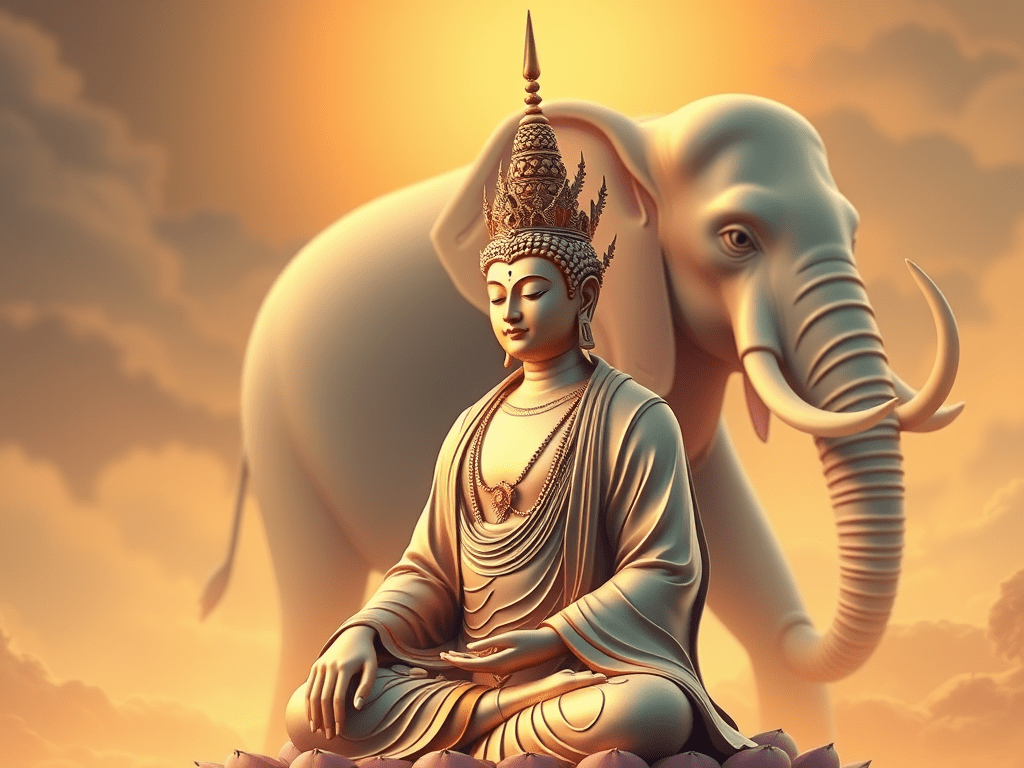
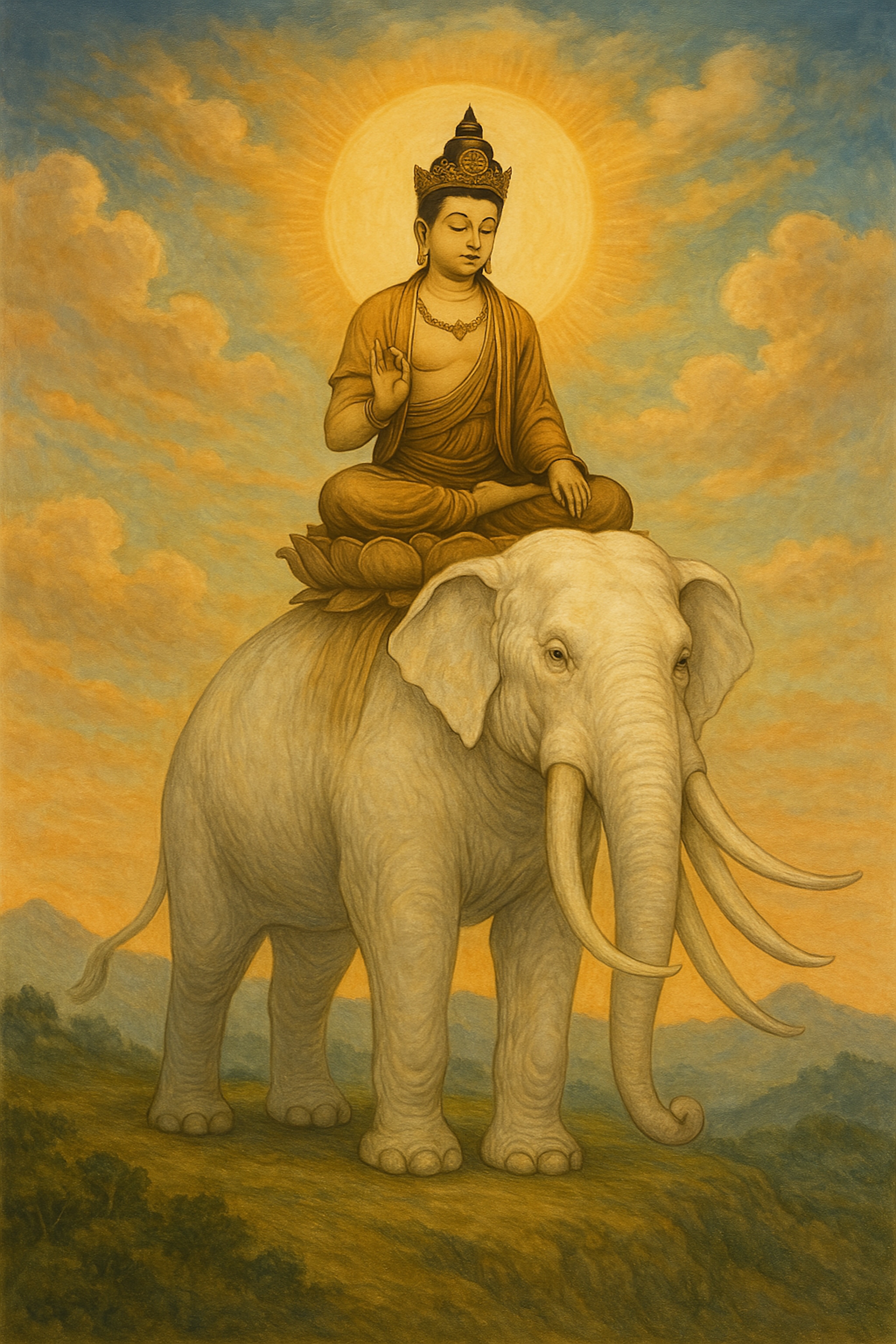
The imagery of the “kingly white elephant with six tusks” associated with Universal-Sage Bodhisattva is rich in Buddhist symbolism.5 The white elephant itself is often linked to royalty, representing majesty and auspiciousness.7 It also symbolizes the strength and power of Buddhism in overcoming obstacles.14 The six tusks hold particular significance. They are commonly interpreted as representing the Six Perfections or Paramitas: generosity, morality, patience, diligence, contemplation, and wisdom – the essential practices of a bodhisattva.5 Additionally, the six tusks are understood to symbolize the six senses (or sense organs: ear, eye, nose, tongue, body, and mind) and the overcoming of attachment to these sensory experiences, signifying purity of the senses.12 It is worth noting that Universal-Sage is sometimes depicted riding three elephants or a single elephant with three heads, each configuration carrying its own symbolic weight.5 There is also a belief that the white elephant serving as Universal-Sage’s mount is the same elephant that appeared to Queen Maya in a dream, heralding the birth of the Buddha.11 This connection to the Buddha’s birth further elevates the auspicious nature of the symbol. The symbolism inherent in the white elephant with six tusks effectively encapsulates the ideal of Buddhist practice, representing both the necessary means (the Six Perfections) and the purification achieved through that practice (overcoming sensory attachments). The association of this majestic mount with royalty and the auspicious event of the Buddha’s birth underscores the profound and benevolent nature of Universal-Sage’s promised intervention.
| Symbol | Meaning | Source Snippets |
| White Color | Purity, Auspiciousness | 7 |
| Elephant | Strength, Overcoming Obstacles, Royalty | 5 |
| Six Tusks | Six Perfections (Paramitas) | 5 |
| Six Tusks | Six Senses (Overcoming Attachment) | 12 |
The actions promised by Universal-Sage Bodhisattva – “show myself to him, make offerings to him, protect him, and comfort him” – carry significant meaning within the context of Buddhist practice.6 The promise to “show myself” can be interpreted as a manifestation of his presence, offering direct encouragement and support to the practitioner on their path.6 This aligns with the broader Mahayana concept of Bodhisattvas actively appearing to guide and assist those striving for enlightenment.21 The sight of Universal-Sage is said to bring great joy and renewed vigor to the practitioner.6 To “make offerings” signifies Universal-Sage’s deep reverence for both the practitioner and the Lotus Sutra itself.6 In Buddhist practice, making offerings is a way to cultivate generosity and establish positive connections.18 Notably, Universal-Sage expresses his own wish to make offerings to the Sutra.6 The promise to “protect him” underscores Universal-Sage’s role as a guardian of the Lotus Sutra and its devoted followers, particularly during the challenging times of the Dharma Ending Age.5 This protection extends to safeguarding practitioners from non-human entities, negative influences, and adverse karmic consequences.6 Finally, to “comfort him” implies providing solace, encouragement, and peace of mind to practitioners who may encounter difficulties in their practice.6 This comfort also includes the promise to help practitioners remember forgotten verses of the Sutra and to expound the Dharma for their benefit.6 These four promised actions together represent a comprehensive form of support for the practitioner, addressing their spiritual, emotional, intellectual, and even potential physical needs. Universal-Sage’s own aspiration to offer to the Lotus Sutra highlights the profound respect for the teachings as the very source of enlightenment and liberation.
The actions of “keeping, reading, and reciting” the Lotus Sutra hold significant importance in Buddhist practice, and numerous benefits are associated with them.2 These practices are considered fundamental for establishing a connection with the teachings and manifesting their positive effects in one’s life.2 It is believed that even the act of reciting the title of the Sutra, Nam-myoho-renge-kyo, carries immense merit.33 The research material mentions various benefits, including the attainment of samadhis (meditative states) and dharanis (mnemonic incantations), protection from negative influences, an increase in vigor and joy, the purification of the mind, and the potential for achieving enlightenment.4 The practice extends beyond mere recitation to include upholding, explaining the doctrines, and even writing the Sutra, each action contributing to a deeper engagement with the Dharma.6 The Nichiren school of Buddhism places particular emphasis on the efficacy of reciting the Daimoku, or title, as a direct path to enlightenment.33 These practices are understood to honor the Dharma, cultivate concentration, and lead to a profound understanding of Buddhist principles.34 Even within the Ch’an (Zen) tradition, where emphasis is not typically placed on written words, the recitation of Sutras is seen as a valuable tool for self-reflection, prompting practitioners to examine their actions of body, speech, and mind in light of the Sutra’s teachings.35 The multifaceted engagement with the Lotus Sutra through keeping, reading, reciting, upholding, explaining, and writing signifies a comprehensive approach to internalizing its profound teachings and realizing their associated benefits. The consistent attribution of positive outcomes to these practices, ranging from tangible worldly advantages to profound spiritual attainments, underscores the transformative power believed to be inherent in the Lotus Sutra.
To fully comprehend the context of Universal-Sage Bodhisattva’s vow, it is essential to explore the core teachings and themes of the Lotus Sutra.1 A central doctrine is that of the One Vehicle (Ekayana), which posits that all the diverse paths and practices within Buddhism ultimately lead to the singular goal of Buddhahood.1 The Sutra introduces the concept of skillful means (Upaya), highlighting the Buddha’s wisdom in adapting his teachings to suit the varying capacities and inclinations of different beings.1 Another fundamental teaching is that Buddhahood is an inherent potential within all beings, without exception.1 The Lotus Sutra also presents the Buddha as an eternal being, suggesting that the historical passing of Shakyamuni Buddha was a skillful means to encourage beings to strive for awakening.1 The Sutra itself is presented as the final and complete teaching of the Buddha, crucial for attaining salvation in the present age.1 Furthermore, the Lotus Sutra frequently employs parables and allegories to convey its profound teachings in an accessible and engaging manner.1 The core teaching of the One Vehicle provides a crucial framework for understanding Universal-Sage’s vow. It implies that all sincere efforts in Buddhist practice, particularly those centered on the Lotus Sutra, are meaningful steps towards enlightenment, thus justifying the Bodhisattva’s promised support. Moreover, the concept of skillful means suggests that Universal-Sage’s appearance and the specific promises he makes are themselves compassionate acts of skillful means, tailored to encourage and guide practitioners within their particular circumstances.
Interpretations and commentaries on Chapter Twenty-Eight of the Lotus Sutra by various Buddhist scholars and practitioners offer further insights into the significance of this passage.6 These commentaries consistently emphasize Universal-Sage’s role as a dedicated protector and supporter of the Lotus Sutra, especially during the anticipated challenges of the Dharma Ending Age.6 They often focus on the symbolism inherent in his arrival and the multitude of benefits promised to those who diligently practice the Sutra.6 From the perspective of the Nichiren school, the commentaries highlight the paramount importance of chanting Nam-myoho-renge-kyo and underscore Universal Worthy’s role in providing care and protection to those who embrace this practice.38 Some interpretations delve into the four conditions for obtaining the Sutra, elucidating how Universal-Sage’s vow aligns with and supports these prerequisites.6 Additionally, commentaries often provide detailed explanations of specific terms and events within the chapter, such as the meaning of the Saha world (the world of endurance) and the symbolic significance of the earth quaking upon Universal-Sage’s arrival.10 These various commentaries collectively portray Universal-Sage’s vow as a powerful manifestation of compassion and a testament to the profound importance of the Lotus Sutra, offering enduring reassurance to practitioners who may face difficulties in their spiritual journey. The diverse interpretations arising from different Buddhist traditions demonstrate the timeless relevance and multifaceted understanding of this pivotal passage within the Lotus Sutra.
The concept of “harmony with things as they truly are” is a fundamental aspect of Buddhist philosophy, deeply intertwined with the understanding of interconnectedness and interdependence.8 Buddhism emphasizes that all phenomena are interconnected and mutually dependent for their existence.40 Living in accordance with the Dharma and the natural order is seen as crucial for achieving inner and outer harmony.41 The cultivation of mindfulness and compassion plays a vital role in fostering both inner peace and harmonious relationships with the world.40 Universal-Sage Bodhisattva’s vow directly relates to this understanding of harmony. His promise to support those who practice the Lotus Sutra aligns with the principle of aiding individuals in their pursuit of enlightenment and their efforts to live in accordance with the Dharma as taught in the Sutra.8 The protection and comfort offered by Universal-Sage can help practitioners overcome obstacles and maintain inner tranquility, thereby fostering a state of harmony with reality.6 The Buddhist concept of the “Middle Way,” which advocates for balance and moderation, also contributes to this sense of harmony.42 Universal-Sage’s vow can be viewed as an embodiment of the interconnectedness central to Buddhist philosophy. His commitment to appear and assist practitioners demonstrates the interdependence between enlightened beings and those on the path to enlightenment. By supporting those who practice the Lotus Sutra, which reveals the inherent Buddha nature within all, Universal-Sage is effectively helping beings align themselves with the ultimate truth of existence, thus fostering a profound harmony with things as they truly are.
In conclusion, the vow made by Universal-Sage Bodhisattva in Chapter Twenty-Eight of the Lotus Sutra is a significant declaration of support and encouragement for those who embrace its teachings. The analysis confirms the accuracy and context of the quoted passage, highlighting its place within the broader narrative of Universal-Sage’s arrival and inquiry. Universal-Sage Bodhisattva emerges as an embodiment of Buddhist practice, particularly action and conduct, and his ten great vows provide a foundation for his compassionate commitment. The symbolism of the kingly white elephant with six tusks encapsulates the essence of Buddhist practice and the auspicious nature of his intervention. The fourfold promise to show himself, make offerings, protect, and comfort practitioners underscores the holistic support offered by the Bodhisattva. The practices of keeping, reading, and reciting the Lotus Sutra are shown to be vital for connecting with its transformative power. The core teachings of the Lotus Sutra, such as the One Vehicle and skillful means, illuminate the context and motivation behind Universal-Sage’s vow. Interpretations from Buddhist scholars and practitioners consistently emphasize his role as a protector and supporter. Finally, the vow aligns with the Buddhist concept of harmony with reality by supporting practitioners in their journey towards enlightenment and their efforts to live in accordance with the Dharma. The enduring significance of Universal-Sage’s vow lies in its timeless message of compassion and unwavering commitment to guide and protect those who strive for enlightenment through the teachings of the Lotus Sutra.
Works cited
- Lotus Sutra – Wikipedia, accessed April 1, 2025, https://en.wikipedia.org/wiki/Lotus_Sutra
- Lotus Sutra – Most Influential Sutra of Mahayana Buddhism – Original Buddhas, accessed April 1, 2025, https://www.originalbuddhas.com/blog/lotus-sutra
- Lotus Sutra | Soka Gakkai (global), accessed April 1, 2025, https://www.sokaglobal.org/about-the-soka-gakkai/buddhist-lineage/lotus-sutra.html
- The Lotus Sutra – SGI USA, accessed April 1, 2025, https://www.sgi-usa.org/the-humanism-of-the-lotus-sutra/the-lotus-sutra/
- Samantabhadra (Pancha Raksha): The Universal Worthy Bodhisattva, accessed April 1, 2025, https://www.termatree.com/blogs/termatree/samantabhadra-bodhisattva
- Lotus Sutra – Chapter 28, accessed April 1, 2025, https://www.buddhistdoor.com/OldWeb/resources/sutras/lotus/sources/lotus28.htm
- The Lotus Sutra[28] – The Encouragement of Bodhisattva Universally Worthy – nichiren.info, accessed April 1, 2025, https://nichiren.info/buddhism/lotussutra/text/chap28.html
- Chapter 28: The Encouragement of Universal-Sage Bodhisattva …, accessed April 1, 2025, https://www.500yojanas.org/lotus-sutra/chapter28/
- The Wonderful Dharma Lotus Flower Sutra 28 – City of Ten Thousand Buddhas, accessed April 1, 2025, https://www.cttbusa.org/lotus/lotus28.asp.html
- The Wonderful Dharma Lotus Flower Sutra … – City of 10,000 Buddhas, accessed April 1, 2025, https://www.cttbusa.org/dfs28/dfs28.asp.html
- Samantabhadra (Bodhisattva) – Wikipedia, accessed April 1, 2025, https://en.wikipedia.org/wiki/Samantabhadra_(Bodhisattva)
- Bodhisattva Samantabhadra | Foremost in Buddhist Practice and …, accessed April 1, 2025, https://www.originalbuddhas.com/blog/samantabhadra-bodhisattva
- Samantabhadra – Bodhisattvas – Ancient India History Notes – Prepp, accessed April 1, 2025, https://prepp.in/news/e-492-samantabhadra-bodhisattvas-ancient-india-history-notes
- Fugen Bosatsu (Skt. = Samantabhadra Bodhisattva) – Japanese …, accessed April 1, 2025, https://www.onmarkproductions.com/html/fugen.shtml
- Samantabhadra – The Zen Gateway, accessed April 1, 2025, https://www.thezengateway.com/teachings/the-way-of-devotion-samantabhadra
- Fugen-bosatsu – Oxford Reference, accessed April 1, 2025, https://www.oxfordreference.com/view/10.1093/oi/authority.20110803095837486
- The Vows of Bodhisattva Samantabhadra Sutra – The Huntington Archive, accessed April 1, 2025, https://huntingtonarchive.org/resources/downloads/sutras/05bodhisattvaYana/Samantabhadra%20Sutra.pdf
- Ten Great Vows of Samantabhadra Bodhisattva | by Amitabha’s Pure Land – Medium, accessed April 1, 2025, https://amitabha-pureland.medium.com/ten-great-vows-of-samantabhadra-bodhisattva-abfe8aae4bdb
- Samantabhadra’s vows – Dharmanet, accessed April 1, 2025, https://dharmanet.org/coursesM/31/bodhisattva4b.htm
- The Vow of Samantabhadra | White Wind Zen Community, accessed April 1, 2025, https://wwzc.org/dharma-text/vow-samantabhadra
- Bodhisattva vow – Wikipedia, accessed April 1, 2025, https://en.wikipedia.org/wiki/Bodhisattva_vow
- Great Vows of Samantabhadra | Berkeley Buddhist Priory, accessed April 1, 2025, https://berkeleybuddhistpriory.org/2020/03/25/great-vows-of-samantabhadra/
- Importance of Samantabhadra (Bodhisattva)? : r/Buddhism – Reddit, accessed April 1, 2025, https://www.reddit.com/r/Buddhism/comments/yc89ui/importance_of_samantabhadra_bodhisattva/
- Ten Great Vows of Samantabhadra – I – Master Hsintao-The entire universe is just a manifestation of the mind., accessed April 1, 2025, https://www.hsintao.org/en/teachings/pu-sian-shih-da-yuan-1
- The Ten Great Vows of Samantabhadra Bodhisattva – University of Hawaii System, accessed April 1, 2025, http://www2.hawaii.edu/~donnab/religion/Ten_Great_Vows_Samantabhadra_Bodhisattva-handout_October_23_2018.pdf
- Samantabhadra’s Vows – Zen River Temple, accessed April 1, 2025, https://www.zenrivertemple.org/tenkeidharmablog/2016/03/29/samantabhadras-vows/
- The Flower Adornment Sutra with Commentary, Chapter 40 New Edition – City of Ten Thousand Buddhas, accessed April 1, 2025, http://www.cttbusa.org/fas40new/fas40_13.html
- http://www.originalbuddhas.com, accessed April 1, 2025, https://www.originalbuddhas.com/blog/samantabhadra-bodhisattva#:~:text=Samantabhadra%20took%20great%20vows%20to,figure%20of%20the%20Gandavyuha%20Sutra.
- Samantabhadra Meditation Sutra – Wikipedia, accessed April 1, 2025, https://en.wikipedia.org/wiki/Samantabhadra_Meditation_Sutra
- The Bodhisattva vs the Buddha in Mahayana teachings : r/Buddhism – Reddit, accessed April 1, 2025, https://www.reddit.com/r/Buddhism/comments/18chytk/the_bodhisattva_vs_the_buddha_in_mahayana/
- dharmanet.org, accessed April 1, 2025, https://dharmanet.org/coursesM/31/bodhisattva4b.htm#:~:text=Make%20offerings%20to%20buddhas,bodhisattva’s%20humility%20and%20heartfelt%20gratitude.
- Sutra Recitation – RKUK, accessed April 1, 2025, https://www.rkuk.org/practices/sutra-recitation/
- On the Lotus Sutra. Part 1: Nichiren | by Progress & Conservation | Medium, accessed April 1, 2025, https://ekklesiagora.medium.com/on-the-lotus-sutra-ab2549fd2c95
- Sutras: Seven Benefits of Reading Sutra Daily; and 10 Ways to Learn More and “Deep Dive” into Buddhist Sutras – Buddha Weekly, accessed April 1, 2025, https://buddhaweekly.com/sutras-10-helpful-ways-to-enjoy-and-learn-more-from-reading-buddhist-sutras-tips-for-creating-your-own-sutra-sutta-reading-club/
- Reading/Reciting Sutras as a Spiritual Practice – Dharma Wheel, accessed April 1, 2025, https://www.dharmawheel.net/viewtopic.php?t=51
- The Blessings of the Lotus Sutra | WND I – Nichiren Buddhism Library, accessed April 1, 2025, https://www.nichirenlibrary.org/en/wnd-1/Content/84
- Q: What does it mean to use the strategy of the Lotus Sutra? – World Tribune, accessed April 1, 2025, https://www.worldtribune.org/2019/what-does-it-mean-to-use-the-strategy-of-the-lotus-sutra/
- “Encouragements of the Bodhisattva Universal Worthy” chapter: six …, accessed April 1, 2025, https://www.nichirenlibrary.org/en/ott/PART-2/28
- Brief Summary of Chapters 26 – 28 of The Lotus Sutra – YouTube, accessed April 1, 2025, https://www.youtube.com/watch?v=ZfkYjiEfbyc
- Buddha’s View on Peace: Finding Inner Harmony | by Hidden …, accessed April 1, 2025, https://medium.com/@hiddenmantra123/buddhas-view-on-peace-finding-inner-harmony-19ff8f9769ea
- The Buddhist Attitude Towards Nature – Access to Insight, accessed April 1, 2025, https://www.accesstoinsight.org/lib/authors/desilva/attitude.html
- Buddhism and the Enlightened Path to Harmony and Happiness – Steven Mintz, accessed April 1, 2025, https://www.stevenmintzethics.com/single-post/2017/08/02/buddhism-and-the-enlightened-path-to-harmony-and-happiness
- The Pursuit of Happiness | Dharma Wisdom, accessed April 1, 2025, https://dharmawisdom.org/the-pursuit-of-happiness/
- I don’t understand this quote from Thich Nhat Hanh: Buddha is our mindfulness. Dharma is our conscious breathing. Sangha is our Five Aggregates working in harmony. : r/Buddhism – Reddit, accessed April 1, 2025, https://www.reddit.com/r/Buddhism/comments/1bsa0mu/i_dont_understand_this_quote_from_thich_nhat_hanh/
 Mr. Altig’s Overview of the Wonderful Dharma of the Lotus Sutra
Leave a comment