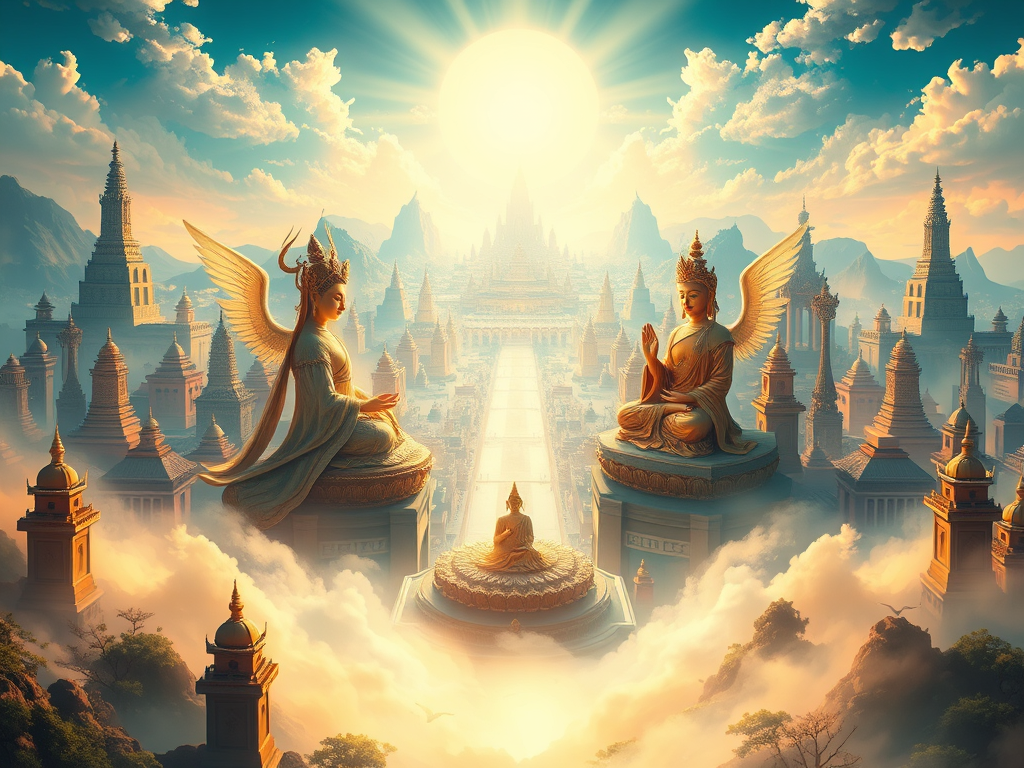
The Lotus Sūtra, revered as one of the most significant scriptures in Mahayana Buddhism, holds a central place in the spiritual lives of countless practitioners across East Asia. Its teachings, often considered the final and most complete exposition of Shakyamuni Buddha’s wisdom, articulate the profound principle of universal Buddhahood, asserting that all beings possess the inherent potential to attain enlightenment. This inclusive vision, emphasizing the One Vehicle (Ekayana) that encompasses all paths to liberation through skillful means (upaya), represents a pivotal development in Buddhist philosophical thought. Within this rich tapestry of teachings, Chapter Seven, frequently titled “A Past Buddha and the Illusory City” or “Parable of the Transformed City,” presents a compelling narrative centered on a Buddha named Great-Universal-Wisdom-Excellence. It is within this chapter that the Brahma-Heavenly-Kings of the Southwest offer verses imploring the Buddha to share his highest teaching, demonstrating their eagerness to receive the Dharma and underscoring its transformative power for all beings, including those dwelling in realms of suffering. The act of celestial beings of such high stature beseeching the Buddha for his ultimate wisdom highlights the profound importance and life-altering potential attributed to these teachings within the Lotus Sūtra. Their specific mention of beings in “evil regions” further emphasizes a deep concern for the alleviation of suffering that permeates their request. This report endeavors to provide a thorough analysis of these verses, exploring their significance within the narrative context of Chapter Seven and the broader landscape of Buddhist philosophy. It will delve into the core concepts articulated, the roles and importance of the figures involved, and the inherent symbolism within this pivotal passage, drawing upon a range of research materials to offer a comprehensive and expert-level interpretation.
To fully appreciate the verses sung by the Brahma-Heavenly-Kings, it is essential to understand their placement within the narrative of Chapter Seven. This chapter recounts the story of a Buddha known as Great-Penetrating-Wisdom-Victory, also referred to as Great-Universal-Wisdom-Excellence, who lived an immeasurably long time ago. This Buddha had sixteen sons, who, upon learning of their father’s enlightenment, chose to renounce their worldly lives and embark on the path of Buddhist practice. A key element of this chapter is the parable of a group of travelers on a quest for treasure who become weary and contemplate abandoning their journey. Their guide, a figure representing the Buddha, employs a skillful means by conjuring a transformed city where they can rest and regain their strength, knowing that the true treasure lies further ahead. This parable serves as a powerful analogy illustrating the Buddha’s compassionate approach to guiding beings towards the ultimate goal of Buddhahood, utilizing provisional teachings and stages as expedient means to facilitate their progress. This context suggests that the Brahma-Heavenly-Kings’ request for the highest teaching might stem from a desire to transcend these provisional stages and directly access the ultimate truth revealed by the Buddha.
The Brahma-Heavenly-Kings’ appearance in this chapter is marked by auspicious signs and a clear intention. These celestial beings, originating from five hundred ten thousand million lands in the eastern direction, were drawn by an extraordinary, brilliant light that illuminated their realms. Accompanied by their magnificent palaces and bearing offerings of exquisite heavenly flowers, they embarked on a journey to the west to behold the source of this radiant phenomenon. There, they beheld the Great-Universal-Wisdom-Excellence Buddha seated majestically on a lion throne beneath the sacred Bodhi tree, surrounded by a multitude of beings from various realms, all paying homage to the enlightened one. Moved by reverence and a profound understanding of the Buddha’s significance, these Brahma-Heavenly-Kings sang the verses in question, their intention being to earnestly implore the Buddha to share his teachings for the benefit of all beings throughout the cosmos, to liberate them from suffering, and to guide them towards wisdom and the eventual attainment of Buddhahood. Their journey from afar and the precious offerings they brought underscore the immense respect they held for the Buddha and the paramount importance they placed on receiving his Dharma. Furthermore, their explicit concern for all living beings, particularly those trapped in suffering, reveals a deep wellspring of compassion motivating their fervent request.
The term “Dharma” in Buddhist teachings is a cornerstone concept, rich with multifaceted meanings that extend far beyond a simple definition. At its core, Dharma signifies the universal truth that remains constant for all beings across all times, a truth that was realized and proclaimed by the Buddha. This truth is embodied in the Buddha’s teachings, most notably the Four Noble Truths, which delineate the nature of suffering and the path to its cessation, and the Noble Eightfold Path, which provides the practical framework for ethical conduct, mental discipline, and wisdom. Beyond these foundational teachings, Dharma also encompasses the very nature of reality itself, the interconnectedness of all phenomena, and the inherent cosmic order that governs existence. Engaging with the Dharma is not merely an intellectual pursuit; it involves a comprehensive practice that integrates ethical behavior (sila), the cultivation of mental concentration (samadhi), and the development of profound wisdom (panna). Therefore, the Brahma-Heavenly-Kings’ profound desire to hear the Dharma signifies their yearning for a comprehensive understanding of reality, a grasp of the path leading to liberation, and an alignment with the fundamental principles that underpin the universe.
“Enlightenment,” known as Bodhi in Mahayana Buddhism and Nirvana or Nibbana in Theravada Buddhism, represents the ultimate aspiration of Buddhist practice. It is the state of complete spiritual awakening, signifying liberation from the pervasive suffering (dukkha) that characterizes existence within the cycle of rebirth (samsara). The attainment of enlightenment entails gaining a deep and direct insight into the fundamental nature of reality, recognizing the impermanent (anicca), unsatisfactory (dukkha), and selfless (anatta) nature of all phenomena. While the ultimate goal remains the same, different Buddhist traditions articulate various stages or levels along the path to enlightenment. Theravada Buddhism describes four progressive stages: the Stream-enterer, who has just begun the irreversible journey; the Once-returner, who will only be reborn once more; the Non-returner, who will not return to the realm of desire; and the Arahant, who has achieved full liberation. Mahayana Buddhism, particularly in the context of the bodhisattva path, often outlines ten Bhumis, or stages of spiritual development, that a bodhisattva traverses on the way to Buddhahood. The primary means of achieving this profound state of awakening is through hearing, studying, and diligently practicing the Dharma, which encompasses ethical conduct, meditative discipline, and the cultivation of wisdom. The verses sung by the Brahma-Heavenly-Kings suggest that the act of hearing the Dharma possesses such transformative power that it can directly lead some individuals to enlightenment, highlighting the immediate impact of the Buddha’s teachings. For others, this exposure to the Dharma may sow the seeds for future enlightenment by guiding them towards positive rebirth and continued spiritual progress. The concept of varying levels of enlightenment further implies that the effect of hearing the Dharma can differ based on an individual’s current spiritual maturity and their readiness to fully grasp and implement the teachings.
Buddhist cosmology paints a picture of a cyclical existence (samsara) characterized by rebirth across six distinct realms. These realms are broadly categorized into three higher, more fortunate realms – the realm of gods (heavenly beings), the realm of demi-gods (asuras), and the human realm – and three lower, less fortunate realms often referred to as the “evil regions” – the animal realm, the realm of hungry ghosts (pretas), and the hell realms (narakas). The “evil regions” are characterized by various forms of suffering and are generally understood as the consequence of negative karmic actions. Conversely, “rebirth in heaven” signifies being born into one of the higher realms, where beings experience pleasure, longevity, and the enjoyment of positive karmic merit accumulated through virtuous actions. The fundamental principle governing this cycle of rebirth is karma, the law of cause and effect, which dictates that wholesome actions (kusala karma) lead to favorable rebirths, while unwholesome actions (akusala karma) result in unfavorable ones. The verses sung by the Brahma-Heavenly-Kings underscore the profound influence of hearing and practicing the Dharma on this cycle. By engaging with the Buddha’s teachings, individuals can purify the negative karma that might otherwise lead to rebirth in the “evil regions” and cultivate wholesome qualities that pave the way for positive rebirth in heavenly realms. This highlights the ethical and karmic significance of the Dharma, suggesting that it possesses the power to not only guide individuals towards enlightenment but also to alleviate suffering across the different realms of existence. The Brahma-Heavenly-Kings’ concern for the decrease of beings in the “evil regions” and the increase of those who do good patiently reflects a deep understanding of this karmic dynamic and their compassionate desire for the well-being of all sentient beings.
At the heart of Buddhist philosophy lies the figure of the Buddha, an enlightened being who has transcended the cycle of suffering and attained perfect wisdom. The primary function of a Buddha is to act as a teacher, revealing the profound truths of the Dharma and guiding sentient beings along the path towards their own liberation. To effectively reach beings with diverse capacities and inclinations, Buddhas employ skillful means (upaya), adapting their teachings to suit the specific needs of their audience. By illuminating the true nature of reality, Buddhas empower beings to recognize and ultimately shed their deeply ingrained delusions, thereby freeing themselves from the root causes of suffering. The verses sung by the Brahma-Heavenly-Kings emphasize this pivotal role of the Buddha as a revealer of truth, whose very appearance and subsequent teachings are indispensable for beings to overcome their ignorance and progress towards enlightenment. Their act of imploring the Buddha to share his highest teaching underscores their recognition of his unique ability to guide them and all other beings towards liberation. The concept of skillful means is also pertinent here, as the “highest teaching” requested by the Brahma-Heavenly-Kings can be viewed as a particularly potent and direct form of upaya aimed at leading beings to the ultimate understanding.
Within the intricate framework of Buddhist cosmology, the Brahma-Heavenly-Kings occupy a distinguished position. They reside in the Brahma heavens, which are situated within the higher realms, specifically in the Form Realm, a sphere of existence above the desire realm where humans and lower deities dwell. These beings are characterized by their power, their advanced spiritual development, and the substantial positive karma they have accumulated through countless lifetimes of virtuous conduct. In certain Buddhist traditions, Brahma is revered as a high-ranking deity, sometimes even considered the ruler of the desire realm. Across various Buddhist narratives, the Brahma-Heavenly-Kings frequently appear as respectful listeners to the Buddha’s teachings and, significantly, often initiate the request for the dissemination of the Dharma. Their elevated status within the cosmic hierarchy lends considerable weight to their imploring of the Buddha in Chapter Seven of the Lotus Sūtra. Their very presence signifies the profound respect and immense value that even beings in the higher realms place upon the wisdom and guidance offered by an enlightened Buddha. The potential variations in their precise placement within different cosmological interpretations highlight the complexity and richness of Buddhist understandings of the universe.
In Chapter Seven of the Lotus Sūtra, the Brahma-Heavenly-Kings, alongside other celestial beings and the sixteen sons of the Great-Universal-Wisdom-Excellence Buddha, play a crucial role by earnestly requesting the Buddha to share his profound teachings. Their verses articulate a deep understanding of the rarity and immense significance of a Buddha’s appearance in the world, recognizing the unparalleled benefit that their teachings bring to all sentient beings. They specifically acknowledge the pervasive suffering experienced by those trapped in the “evil regions,” highlighting their lack of guidance and the transformative potential of the Dharma to lead them towards enlightenment and more favorable rebirths. In this context, the Brahma-Heavenly-Kings act as representatives of all beings who are earnestly seeking liberation from the cycle of suffering and striving for ultimate awakening. Their collective request within the Lotus Sūtra narrative underscores the universal need for the Buddha’s wisdom, compassion, and the illuminating power of the Dharma to guide all towards the cessation of suffering and the attainment of Buddhahood.
The direction from which the Brahma-Heavenly-Kings arrive to address the Great-Universal-Wisdom-Excellence Buddha carries symbolic weight within the context of Buddhist teachings. While the user’s query specifies “Southwest,” some sources within the provided material indicate their arrival from the “West” or the “East”. This variation across different accounts suggests the possibility of differing interpretations or perhaps nuances within the specific narrative of Chapter Seven that warrant careful consideration. Generally, directions in Buddhist cosmology are imbued with particular symbolic meanings. The East is frequently associated with the rising sun, symbolizing the dawn of the Buddhist path, the initial arising of the aspiration for enlightenment, and the emergence of wisdom. The South can represent warmth, nurturing growth, and the boundless compassion that fuels the bodhisattva’s actions. The West is often linked with the setting sun, potentially signifying the cessation of suffering, the realm of the Pure Land of Amitabha Buddha, or the final stages of the spiritual journey. The Southwest, as a composite direction, might embody a combination of these symbolic connotations, or its specific significance could be unique to the narrative context of the Lotus Sūtra or the particular attributes of the Great-Universal-Wisdom-Excellence Buddha. The arrival of the Brahma-Heavenly-Kings from a specific direction is therefore likely not a random detail but rather a deliberate element intended to convey deeper symbolic meaning related to their inherent qualities, the nature of their earnest request, or the specific Buddha they are addressing. The discrepancy in the reported direction warrants further scrutiny to fully understand its implications within the broader context of the Lotus Sūtra’s teachings.
The verses sung by the Brahma-Heavenly-Kings to the Great-Universal-Wisdom-Excellence Buddha encapsulate the profound potential of the Dharma: “If they hear the Dharma, some will attain enlightenment; Others will be reborn in heaven. The living beings in the evil regions will decrease; And those who do good patiently will increase”. The first two lines highlight the immediate and long-term benefits that arise from simply hearing the Buddha’s teachings. The attainment of enlightenment represents the ultimate liberation from the cycle of suffering, the cessation of rebirth, and the realization of the true nature of reality. Rebirth in heaven, while still within the realm of samsara, signifies a temporary but nonetheless positive outcome, characterized by joy, pleasure, and a longer lifespan in one of the higher realms of existence, resulting from the accumulation of wholesome karma. The subsequent two lines emphasize the transformative power of the Dharma on a broader scale, suggesting that as more beings engage with the teachings, the number of individuals experiencing suffering in the “evil regions” – the animal realm, the realm of hungry ghosts, and the hell realms – will decrease. Simultaneously, the number of beings who diligently cultivate virtuous actions with patience will increase, indicating a positive shift in the overall karmic landscape. These verses beautifully summarize the core aspirations of Buddhist practice: the individual pursuit of enlightenment and the collective aspiration to alleviate suffering for all sentient beings. They demonstrate the Brahma-Heavenly-Kings’ deep understanding of the Dharma’s efficacy in achieving these noble goals. The specific mention of patiently doing good underscores the gradual and persistent nature of spiritual cultivation, emphasizing that progress on the path often requires sustained effort and unwavering dedication over time.
The very name of the Buddha being addressed, Great-Universal-Wisdom-Excellence (Mahābhijñānābhibhū), is rich with symbolic significance. “Wisdom” (prajna) stands as a cornerstone of the Buddhist path to enlightenment, representing the profound understanding of emptiness and the true nature of reality that liberates beings from suffering. The qualifiers “Great” and “Universal” suggest the vast, all-encompassing, and immeasurable quality of this wisdom, extending to all phenomena without limitation. “Excellence” further emphasizes the supreme and unsurpassed nature of this wisdom, highlighting its ultimate value in the pursuit of liberation. The narrative surrounding this particular Buddha in Chapter Seven, including his extensive period of dedicated practice and the eventual enlightenment of his sixteen sons, further reinforces his symbolic representation of profound wisdom and the inherent potential for all beings, regardless of their current circumstances, to achieve this same transformative understanding through diligent effort. Therefore, the Brahma-Heavenly-Kings’ choice to address this specific Buddha with their imploring verses underscores the paramount importance of wisdom in the Buddhist path and serves as a powerful reminder that even those who may appear far from enlightenment possess the capacity to attain it through unwavering dedication to the Dharma.
The actions undertaken by the Brahma-Heavenly-Kings serve as profound demonstrations of the importance of respect in receiving Buddhist teachings. Their arduous journey from distant celestial realms, the precious offerings of heavenly flowers they carried as tokens of reverence, and the very act of singing verses in praise of the Buddha all underscore their deep admiration and honor for the enlightened one and his wisdom. Furthermore, the traditional Buddhist gestures they employ, such as bowing in reverence, circumambulating the Buddha as a sign of veneration, and joining their palms in anjali mudra, are all deeply ingrained expressions of respect within the Buddhist tradition. This attitude of respect (apaciti, gàrava) is not merely a matter of etiquette; it is considered a fundamentally vital quality in Buddhist practice, creating a conducive atmosphere for learning, fostering a receptive state of mind, and nurturing spiritual growth. The Brahma-Heavenly-Kings, through their exemplary conduct, embody the ideal of devoted disciples, showcasing the appropriate demeanor and actions for approaching a Buddha and requesting the precious teachings of the Dharma. Their profound respect highlights the deep value placed on the sacred teacher-student relationship within the Buddhist path, emphasizing that a humble and reverent attitude is essential for truly benefiting from the wisdom imparted by an enlightened guide.
The Brahma-Heavenly-Kings’ actions also strongly imply a state of readiness, a crucial prerequisite for effectively receiving Buddhist teachings. Their long journey undertaken with determination and their respectful demeanor upon reaching the Buddha suggest that they have diligently prepared themselves to listen attentively and comprehend the profound wisdom about to be shared. This state of readiness involves cultivating an open mind, free from rigid preconceptions, biases, and aversions, and fostering a sincere and unwavering desire to learn and actively practice the Dharma. In Buddhist teachings, the concept of a “fit vessel” (bhājana) is often used to describe a disciple who has developed the necessary qualities – such as impartiality, intelligence, and diligence – to receive and fully benefit from the transformative power of the Dharma. The Brahma-Heavenly-Kings, through their actions and the verses they sing, exemplify the characteristics of such a “fit vessel,” demonstrating that a state of receptivity, marked by humility, respect, and a genuine thirst for knowledge, is indispensable for truly understanding and internalizing the Buddha’s teachings. Their example serves as a timeless reminder of the importance of approaching the Dharma with a prepared heart and an open mind, ready to embrace the wisdom that leads to liberation.
In conclusion, the verses sung by the Brahma-Heavenly-Kings in Chapter Seven of the Lotus Sūtra offer a profound glimpse into the core tenets and aspirations of Buddhist practice. Their imploring of the Great-Universal-Wisdom-Excellence Buddha underscores the immense value and transformative potential of the Dharma, capable of leading some to immediate enlightenment and others to positive rebirth in heavenly realms. The verses also highlight the power of the Dharma to diminish suffering in the “evil regions” and to encourage the growth of virtuous conduct among beings. The Brahma-Heavenly-Kings themselves, through their respectful journey, their precious offerings, and their earnest request, serve as exemplary figures, embodying the crucial importance of respect and readiness in approaching spiritual teachings. Their actions and words resonate with Buddhist practitioners across time, reminding them of the profound benefits that arise from engaging with the Dharma and the ideal attitude with which to seek wisdom. Ultimately, this episode within the Lotus Sūtra, centered on the universal Buddha and the imploring Brahma-Heavenly-Kings, beautifully exemplifies the Mahayana ideal of universal Buddhahood, offering a message of hope and the potential for liberation to all beings who sincerely seek it.
Table: The Six Realms of Rebirth in Buddhist Cosmology
| Realm | Characteristics | Cause of Rebirth |
|---|---|---|
| Gods (Deva) | Pleasure, contentment, long life, fulfillment of desires, but prone to boredom. | Accumulation of significant wholesome karma. |
| Demi-gods (Asura) | Well-off but dissatisfied, constant struggle for power, jealousy, and anger. | Combination of virtuous actions with underlying jealousy and competitiveness. |
| Humans (Manushya) | Mixture of suffering and joy, opportunity for spiritual practice and enlightenment. | Mixed karma from past actions. |
| Animals (Tiryag) | Driven by instinct, suffering from predation and human exploitation, ignorance. | Predominantly ignorance and less wholesome karma. |
| Hungry Ghosts (Preta) | Tormented by insatiable hunger and thirst, often associated with greed. | Greed, miserliness, and strong attachments. |
| Hells (Naraka) | Intense suffering, torment, and punishment for negative actions. | Accumulation of significant unwholesome karma and harmful actions. |
Works cited
1 2 3 4 5 6 7 8 9 10 11 12 13 14 15 16 17 18 19 20 21 22 23 24 25 26 27 28 29 30 31 32 33 34 35 36 37 38 39 40 41 42 43 44 45 46 47 48 49 50 51 52 53 54 55 56 57 58 59 60 61 62 63 64 65 66 67 68 69 70 71 72 73 74 75 76 77 78 79 80 81 82 83
 Mr. Altig’s Overview of the Wonderful Dharma of the Lotus Sutra
Leave a comment