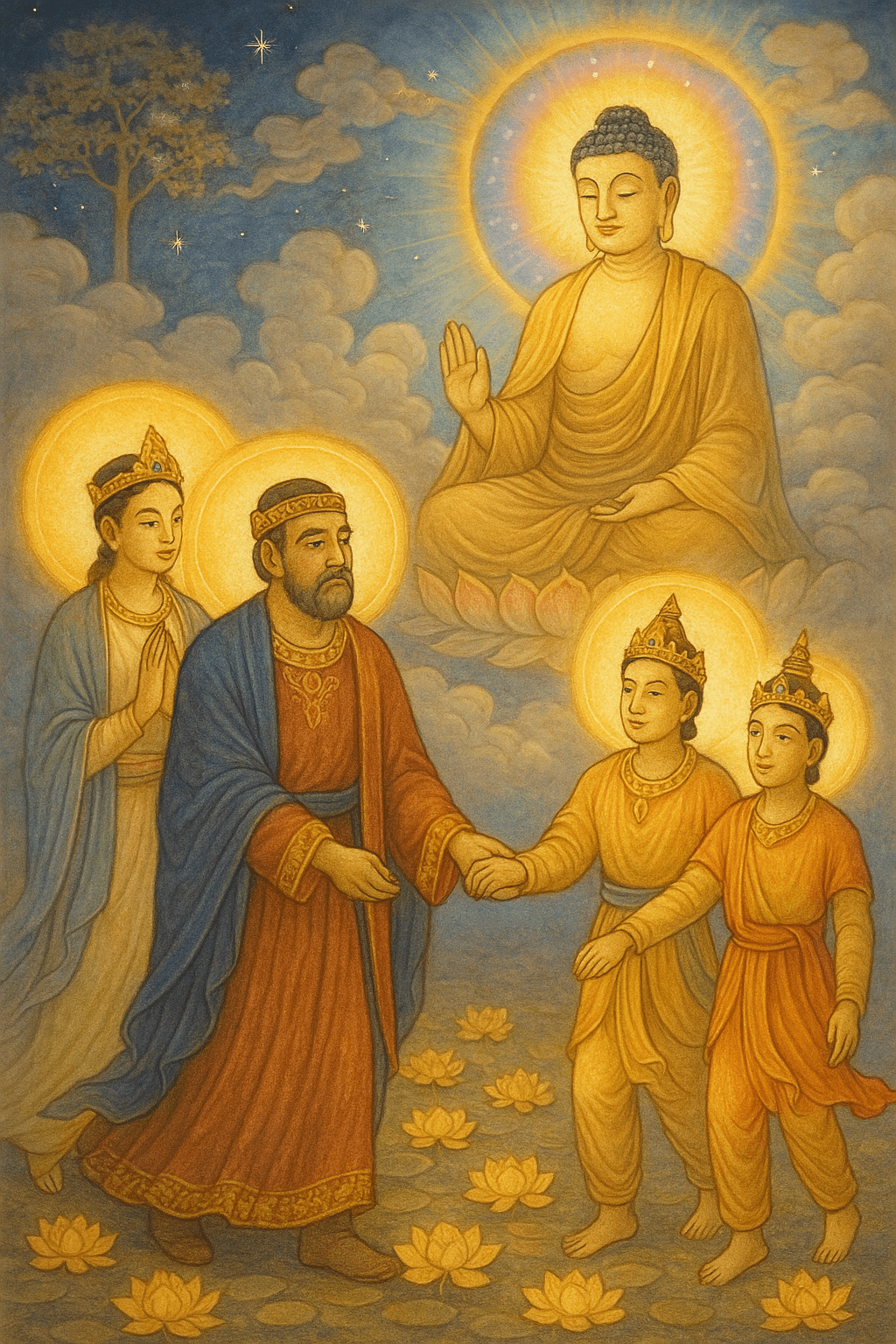
The Lotus Sūtra, revered as one of the most influential scriptures in Mahayana Buddhism, holds a significant place in the spiritual landscape of East Asia.1 For many, it represents the culmination of Shakyamuni Buddha’s teachings, offering a path to complete and sufficient salvation.1 This venerated text presents a profound re-evaluation of the Buddhist path and the very nature of the Buddha himself, with the central doctrine of the One Vehicle asserting that all Buddhist practices ultimately lead to Buddhahood.1 Within this rich tapestry of teachings, Chapter Twenty-Seven, titled “Former Affairs of King Wonderful Adornment,” stands out for its exploration of crucial themes such as the indispensable role of good teachers, the transformative power of faith and practice within familial bonds, and the intricate interconnectedness of past and present existences.2 This chapter recounts how a king, initially entrenched in non-Buddhist beliefs, is guided towards the Buddhist path through the dedicated efforts of his wife and two sons, illustrating the profound impact of family in spiritual awakening.3 The narrative sets the stage for the profound statement by the Buddha Cloud-Thunderpeal-Star-King-Flower-Wisdom, addressing King Wonderful-Adornment, emphasizing the pivotal role of benevolent teachers who arise from the cultivation of good will.6 This pivotal quote underscores the immense benefit bestowed upon individuals by these spiritual guides who illuminate the path towards Perfect Enlightenment, known as Anuttara-samyak-saṃbodhi.
To fully appreciate the significance of this passage, it is essential to examine the broader narrative context provided by Chapter Twenty-Seven.2 The chapter introduces King Wonderful Adornment, who resides in a world named Light-Adornment during the Gladly-Seen kalpa, alongside his wife Pure Virtue and their two sons, Pure Storehouse and Pure Eye.6 These sons are depicted as beings of remarkable spiritual prowess.6 Already advanced on the Bodhisattva path, they recognize the profound value of the teachings being expounded by the Buddha Cloud-Thunderpeal-Star-King-Flower-Wisdom, particularly the Dharma Flower Sutra, and encourage their mother to seek his wisdom.6 However, King Wonderful Adornment adheres to externalist beliefs and remains deeply attached to Brahmanical doctrines, creating an obstacle to the family’s spiritual aspirations.6 Demonstrating their deep compassion and advanced spiritual attainment, the two sons manifest extraordinary spiritual transformations, performing wonders such as levitating, emitting water and fire from their bodies, and altering their size at will.6 These displays are intended to purify their father’s mind, dispel his erroneous views, and ultimately secure his permission for the family to visit the Buddha.6 Witnessing these miraculous events, King Wonderful Adornment experiences profound joy and a dawning faith.2 He inquires about the source of his sons’ power and expresses a fervent desire to meet their teacher.2 Recognizing their father’s shift in perspective, the sons then seek and obtain their mother’s blessing to renounce their worldly lives and dedicate themselves to cultivating the Way under the guidance of the Buddha.2 Subsequently, the entire family, accompanied by their respective retinues, embarks on a journey to meet the Buddha, offering their reverence and making generous offerings.2 During this auspicious encounter, the Buddha bestows a prophecy upon King Wonderful Adornment, foretelling his future enlightenment as a Buddha named Sala Tree King.2 Inspired by this profound experience, the king makes the momentous decision to abdicate his throne and, together with his wife and sons, renounces the secular world to diligently practice the Buddha’s teachings.2 Having progressed significantly on the spiritual path, the former King Wonderful Adornment expresses his deep gratitude towards his two sons, acknowledging them as the guiding force behind his conversion and his introduction to the Buddhadharma.2 In response, the Buddha affirms the crucial role of such “Good and Wise Advisors” in leading beings towards enlightenment.2 The chapter culminates with the Buddha revealing the past identities of this remarkable family: King Wonderful Adornment was in fact Bodhisattva Flower Virtue, Queen Pure Virtue was Bodhisattva Mark of Shining Adornment, and their sons were the esteemed Bodhisattvas Medicine King and Medicine Superior, highlighting the enduring nature of their spiritual commitments across lifetimes.2 The narrative flow of Chapter Twenty-Seven underscores the transformative potential of spiritual influence within families, demonstrating how children, through their unwavering faith and skillful actions, can guide their parents towards the path of enlightenment.3 The story emphasizes the rarity and immense value of encountering a Buddha and the liberating power of the Buddhadharma.2 The sons’ extraordinary displays of supernatural abilities serve as a potent example of skillful means (upaya), effectively awakening faith and understanding in their father.2 King Wonderful Adornment’s eventual embrace of the Dharma, despite his initial deep-seated beliefs, illustrates that even those with firmly held views can be led to profound spiritual awakening through the compassionate guidance of wise individuals.
The name of the Buddha who appears in this chapter, Cloud-Thunderpeal-Star-King-Flower-Wisdom, is rich with symbolic meaning within the context of Buddhist cosmology.7 Examining its individual components offers insights into the Buddha’s enlightened qualities and the nature of his teachings. “Cloud-Thunderpeal” can be interpreted as symbolizing the powerful and far-reaching impact of the Buddha’s teachings, akin to thunder that resonates across vast distances and a cloud that encompasses all beings with its potential for rain.9 This aspect of the name might also suggest the transformative and awakening nature of the Dharma, much like a storm can clear the sky, dispelling ignorance and illusion. “Star-King” likely represents the Buddha’s preeminence and his role as a guiding light for all beings, similar to a king among stars who offers direction and hope in the darkness of ignorance.9 Stars are often associated with purity, brilliance, and constancy, suggesting the unwavering nature of the Buddha’s wisdom. “Flower-Wisdom” signifies the blossoming of wisdom through the Buddha’s teachings, as beautiful, fragrant, and profound as a flower.9 In Buddhist symbolism, flowers often represent purity, enlightenment, and the impermanent nature of reality. The combination of “Flower” and “Wisdom” suggests an enlightenment that is not only deeply insightful but also manifests with grace and beauty. Finally, “Wisdom” explicitly denotes the enlightened understanding and profound knowledge possessed by the Buddha. This elaborate name, therefore, evokes a sense of immense spiritual power, profound wisdom, and the remarkable ability of this Buddha to guide countless beings towards enlightenment.9 The juxtaposition of natural phenomena with concepts of kingship and wisdom implies a Buddha who embodies both a form of spiritual authority and transcendent understanding. Ultimately, the name underscores the transformative capacity of the Buddha’s teachings to awaken individuals from the slumber of ignorance and lead them to the radiant light of wisdom.
| Component | Potential Symbolic Meaning | Section |
| Cloud-Thunderpeal | Powerful and far-reaching impact of teachings; transformative and awakening nature of Dharma. | 3 |
| Star-King | Preeminence and guiding light; offering direction and hope; associated with purity and brilliance. | 3 |
| Flower-Wisdom | Blossoming of wisdom; beauty, fragrance, and profundity of teachings; symbolism of purity, enlightenment, and impermanence. | 3 |
| Wisdom | Explicitly denotes enlightened understanding and profound knowledge. | 3 |
The character of King Wonderful-Adornment is central to the narrative of Chapter Twenty-Seven, illustrating a profound journey of spiritual transformation.2 Initially, he is depicted as a devout follower of Brahmanism, firmly holding “deviant views” and deeply attached to non-Buddhist doctrines.4 This adherence to externalist beliefs creates a stark contrast with his wife, Pure Virtue, and his sons, Pure Storehouse and Pure Eye, who are already devoted practitioners of the Buddhadharma.6 The turning point in King Wonderful-Adornment’s spiritual trajectory occurs when his sons, through their remarkable display of supernatural powers, manage to pierce through his deeply ingrained beliefs.2 Witnessing these extraordinary feats leads him to a state of purity, belief, and a nascent understanding of the power of the Buddhist path.2 He experiences an unprecedented sense of joy and wonder, prompting him to inquire about the origin of his sons’ abilities and express a sincere desire to meet their teacher, the Buddha Cloud-Thunderpeal-Star-King-Flower-Wisdom.2 As a testament to his growing faith, King Wonderful-Adornment, along with his wife, offers valuable pearl necklaces to the Buddha, which miraculously transform into a jeweled dais, symbolizing his increasing devotion.6 His spiritual progress is further affirmed when he receives a prophecy of future Buddhahood, destined to become known as Sala Tree King.2 This profound encounter inspires him to take the radical step of abdicating his royal responsibilities and renouncing the world, embracing a life of dedicated practice alongside his family.2 Significantly, King Wonderful-Adornment comes to recognize his own sons as his “Good and Wise Advisors,” acknowledging their pivotal role in guiding him towards the Buddhadharma.2 His eventual attainment of the Samadhi of the Adornment with All Pure Merit and Virtue underscores the transformative power of diligently practicing the teachings of the Lotus Sutra.6 Moreover, the revelation of his past identity as Bodhisattva Flower Virtue serves to connect the narrative to the assembly present during the Buddha’s discourse, emphasizing the continuity of spiritual practice across countless lifetimes.2 King Wonderful-Adornment’s journey serves as a powerful illustration of how even individuals deeply rooted in alternative belief systems can be led to the path of the Buddhadharma through skillful means and the compassionate influence of virtuous individuals.3 His recognition of his sons as his spiritual mentors underscores the profound impact of spiritual guidance, even within the context of familial relationships.2
The concept of “roots of good will” (kusala-mula) is fundamental to Buddhist teachings, representing the foundational virtues cultivated through positive actions and intentions that are essential for spiritual growth and the eventual attainment of enlightenment.6 These roots, when nurtured, foster positive karmic outcomes and contribute to a virtuous life.12 In the Theravada tradition, the three roots of good are identified as non-attachment (alobha), absence of aversion (adosa), and wisdom (amoha).12 These qualities are crucial for moral development and for cultivating the capacity for enlightenment.12 Similarly, in Mahayana Buddhism, the “roots of good” encompass the absence of desire, hatred, and delusion.12 Cultivating these wholesome roots naturally leads to positive actions such as generosity, loving-kindness, and the development of wisdom.14 The passage from the Lotus Sutra highlights a significant implication of planting these roots of good will: the attainment of helpful teachers in successive lives.2 The Buddha states that individuals who diligently cultivate these positive qualities will, as a result, encounter spiritual guides in their future existences.2 This suggests a direct causal link between our present actions and intentions and the blessings of wise guidance that we may receive in the future. The narrative itself provides an example of this principle, as the deep and abundant blessings accumulated by King Wonderful-Adornment’s sons in their past lives enabled them to encounter the Buddhadharma in their current existence.6 Furthermore, their intention in displaying miraculous powers was to awaken the dormant good roots that their father had planted in previous lifetimes.2 This underscores the enduring impact of our positive actions, which continue to bear fruit across the cycle of rebirth, shaping our future circumstances and influencing our encounters with those who can guide us on the path to enlightenment.
The role of a spiritual teacher (“teacher”) is paramount in the Buddhist tradition, serving as a guiding light for those seeking liberation.6 As emphasized in the Lotus Sutra, teachers perform the essential work of the Buddha, illuminating the Way, imparting knowledge, offering benefit, inspiring joy, and ultimately leading individuals towards Perfect Enlightenment.2 A teacher is described as a significant catalyst for enlightenment, guiding disciples, enabling them to perceive a Buddha, and inspiring the aspiration for Anuttara-samyak-saṃbodhi.2 In essence, teachers act as mentors, skillfully guiding students along the intricate path of spiritual development and awakening.19 They are entrusted with the vital task of transmitting the profound teachings, assisting students in recognizing their inherent Buddha-nature, and navigating the myriad challenges posed by the ego.19 The Buddhist tradition employs a rich tapestry of terms to denote these spiritual guides, each carrying its own nuances, including Guru, Lama, Rinpoche, Bhikkhu, Bhikkuni, Acharya, Ajahn, Sayadaw, Sensei, Roshi, and Kalyanamitra.19 Within the Vajrayana tradition, the relationship between guru and disciple holds a particularly central and indispensable position for those engaged in advanced practices.19 To effectively guide others, Buddhist teachers are expected to embody a range of essential qualities, including impeccable ethical conduct, unwavering concentration, profound wisdom, boundless compassion, and the ability to communicate the Dharma in a clear and accessible manner.20 Their ultimate aim is to empower students to discover their own innate wisdom and to cultivate self-reliance on their spiritual journey.20 Furthermore, the Sangha, the community of practitioners, can also serve as a valuable teacher, offering collective support and guidance along the path.26 The Lotus Sutra specifically highlights the importance of a “Good and Wise Advisor” (kalyanamitra), a role exemplified by King Wonderful-Adornment’s sons.2 These advisors are capable of performing the Buddha’s work, providing instruction, bestowing benefit and joy, and ultimately leading others towards enlightenment.2 A Kalyanamitra acts as a cherished spiritual friend, offering steadfast support, compassionate understanding, and honest encouragement to help one remain steadfast on the path.19
| Role/Responsibility | Description | Snippet IDs |
| Do the work of the Buddha | Guide, teach, benefit, and lead to enlightenment. | 2 |
| Show the Way | Illuminate the path to spiritual understanding. | 2 |
| Teach | Impart the principles and practices of Buddhism. | 2 |
| Benefit | Provide guidance and support for spiritual growth. | 2 |
| Cause Rejoicing | Inspire joy and enthusiasm in the Dharma. | 2 |
| Lead to Anuttara-samyak-saṃbodhi | Guide towards Perfect Enlightenment. | 2 |
| Mentor | Offer personal guidance and support. | 19 |
| Transmit Teachings | Share the wisdom of the Buddhist tradition. | 19 |
| Help Realize True Nature | Guide students to understand their inherent Buddha-nature. | 19 |
| Guide Through Ego Challenges | Assist in overcoming obstacles created by the ego. | 24 |
| Embody Ethical Conduct | Serve as an example of moral behavior. | 20 |
| Cultivate Concentration | Guide in developing meditative focus. | 20 |
| Possess Wisdom | Demonstrate deep understanding of Buddhist philosophy. | 20 |
| Exhibit Compassion | Show empathy and care for students. | 20 |
| Communicate Effectively | Convey teachings clearly and accessibly. | 20 |
| Foster Self-Sufficiency | Empower students to find their own inner wisdom. | 20 |
| Act as a Spiritual Friend (Kalyanamitra) | Offer support, encouragement, and honest feedback. | 19 |
The term “Anuttara-samyak-saṃbodhi,” frequently appearing in Buddhist scriptures, signifies “unsurpassed, complete, and perfect enlightenment”.6 This Sanskrit phrase denotes the supreme enlightenment of a Buddha, a state considered far superior to all other forms of awakening.27 It represents the ultimate enlightened state of Buddhahood, characterized by a perfect awakening and a complete understanding of the true nature of reality.29 This is the comprehensive and flawless enlightenment that Bodhisattvas aspire to achieve through their dedicated practice.29 It entails a profound and thorough realization of the fundamental truths that govern existence.29 Notably, Anuttara-samyak-saṃbodhi is distinguished from the enlightenment attained by an Arhat. While Arhats achieve liberation from suffering (Nirvana), the enlightenment of a Buddha encompasses the complete eradication of both afflictive obstructions and the more subtle obstructions to omniscience.31 The attainment of Anuttara-samyak-saṃbodhi is often associated with the culmination of the Bodhisattva path, a journey that may span countless lifetimes of dedicated practice and compassionate action.32 It stands as the ultimate goal for practitioners within both the Mahayana and Vajrayana traditions of Buddhism.31 This supreme form of enlightenment signifies not only personal liberation from the cycle of suffering but also the attainment of boundless wisdom and compassion, enabling a Buddha to effectively guide all sentient beings towards their own awakening.32 The pursuit of Anuttara-samyak-saṃbodhi embodies the Mahayana ideal of striving for the enlightenment of all beings, reflecting the expansive scope of a Buddha’s wisdom and compassion in contrast to the individual liberation sought by an Arhat.
“Seeing the world with the eyes of the Buddha” is a profound metaphor that describes an enlightened perspective, also known as the Buddha-eye or Buddhacakshus, which allows one to perceive the true nature of reality and existence with clarity and wisdom.6 This enlightened viewpoint transcends ordinary perception, characterized by wisdom, compassion, and the absence of ignorance and delusion.39 It involves a deep understanding of fundamental Buddhist principles such as interdependence, impermanence, and the inherent nature of suffering within the cycle of Samsara.41 This perspective enables one to perceive deeper truths about the nature of beings and their suffering, and in some traditions, even the past actions of sentient beings and their potential for enlightenment.39 It aligns closely with the concept of “right view” in the Noble Eightfold Path, which emphasizes seeing things as they truly are, without the distortions of our habitual biases and attachments.41 The “eyes of wisdom” are often depicted as representing the omnipotent ability of a Buddha to see in all directions and across all times.40 By cultivating this enlightened perspective, individuals can begin to recognize the presence and guidance of the Buddha in various forms throughout their lives, including through the wisdom and support offered by their teachers. This way of seeing is rooted in the understanding of wisdom (prajna), which allows one to perceive the interconnectedness of all phenomena and the illusory nature of a separate, independent self.41 Recognizing the pervasive nature of impermanence and suffering naturally cultivates compassion for all beings who are caught within the cycle of rebirth.41 Therefore, to see the world with the eyes of the Buddha ultimately means to recognize the inherent potential for Buddhahood within every being and to understand the profound interconnectedness that makes all beings potential sources of learning and guidance.
Gratitude towards teachers holds a significant place in Buddhist practice, stemming from the recognition that they are instrumental in guiding individuals towards spiritual awakening.6 Buddhists understand that they rely on their teachers to receive the authentic transmission of the Buddha’s teachings, making the encounter with a qualified teacher a rare and precious blessing.50 The cultivation of gratitude is not merely a matter of polite acknowledgement but is considered a fundamental prerequisite for spiritual advancement, so much so that it is even linked to the ability to enter and abide in the first Jhana, a state of deep meditative absorption.54 Gratitude can be expressed in numerous ways, both through tangible actions and through one’s inner disposition. Diligent practice of the teachings, dedicated study of the Dharma, and a sincere effort to embody kindness in one’s life are all considered profound expressions of thankfulness towards one’s teachers.52 Offering service, providing practical support, and making financial contributions (dana) are also traditional ways of showing appreciation for the guidance received.51 Perhaps the most profound way to express gratitude is by diligently following the teacher’s instructions and dedicating oneself to working for the benefit of Buddhism and all living beings.51 Honoring the lineage of teachers and striving to preserve the purity of the teachings are also seen as vital ways to repay their immense kindness.53 Developing a deep sense of connection and profound respect for the teacher, recognizing them as an indispensable guide on the path to enlightenment, is crucial.54 The teacher-student relationship in Buddhism is often likened to that of a parent and child, emphasizing the nurturing guidance and unwavering support provided by the teacher.20 In certain traditions, particularly within Vajrayana Buddhism, the teacher is revered as the very embodiment of the Buddha and the entire lineage of enlightened beings.22 A healthy and fruitful teaching relationship is characterized by mutual respect, deep trust, and open and honest communication.25 Ultimately, the central aim of this sacred relationship is to empower the student to uncover their own inherent wisdom and to become a self-reliant and compassionate practitioner on the path to liberation.20
In conclusion, the passage from Chapter Twenty-Seven of the Lotus Sutra offers profound insights into the crucial role of spiritual guidance in the pursuit of Buddhist enlightenment. The narrative beautifully illustrates the transformative power of the Buddhadharma within a family, guided by the wisdom of the Buddha Cloud-Thunderpeal-Star-King-Flower-Wisdom. The symbolic richness of this Buddha’s name reflects the depth and power of his enlightened qualities. King Wonderful-Adornment’s journey from entrenched beliefs to dedicated practice underscores the potential for awakening in all beings through skillful guidance. The concept of “roots of good will” highlights the enduring impact of positive actions in creating conditions for future spiritual support. Buddhist teachers, in their diverse roles, serve as indispensable guides towards the ultimate goal of Anuttara-samyak-saṃbodhi. “Seeing the world with the eyes of the Buddha” signifies the adoption of an enlightened perspective characterized by wisdom and compassion, enabling the recognition of guidance in myriad forms. Finally, the cultivation of gratitude towards teachers is presented as a fundamental aspect of Buddhist practice, fostering receptivity and deepening one’s connection to the path. The timeless wisdom contained within the Lotus Sutra continues to offer invaluable guidance for spiritual seekers, emphasizing the enduring importance of recognizing and appreciating the teachers who illuminate the path towards liberation and enlightenment.
Works cited
- Lotus Sutra – Wikipedia, accessed April 6, 2025, https://en.wikipedia.org/wiki/Lotus_Sutra
- The Wonderful Dharma Lotus Flower Sutra 27 – City of Ten Thousand Buddhas, accessed April 6, 2025, https://www.cttbusa.org/lotus/lotus27_1.asp.html
- Wisdom of the Lotus Sutra 51 – Angelfire, accessed April 6, 2025, https://www.angelfire.com/va2/tamsui/kofuheart/lotus/51.htm
- “Former Affairs of King Wonderful Adornment” chapter | Dictionary of …, accessed April 6, 2025, https://www.nichirenlibrary.org/en/dic/Content/F/122
- The Future Division—My Young Successors, I Entrust Everything to …, accessed April 6, 2025, https://www.worldtribune.org/2020/the-future-division-my-young-successors-i-entrust-everything-to-you/
- Lotus Sutra – Chapter 27, accessed April 6, 2025, https://www.buddhistdoor.com/OldWeb/resources/sutras/lotus/sources/lotus27.htm
- Chapter 27: King Wonderful-Adornment as the Previous Life of a …, accessed April 6, 2025, https://www.500yojanas.org/lotus-sutra/chapter27/
- The Lotus Sutra[27] – The Former Deeds of King Wondrous Splendor – nichiren.info, accessed April 6, 2025, https://nichiren.info/buddhism/lotussutra/text/chap27.html
- LS31 | 500 Yojanas, accessed April 6, 2025, https://www.500yojanas.org/tag/ls31/
- Chapter XII – Devadatta, accessed April 6, 2025, https://www.wisdomlib.org/buddhism/book/the-lotus-sutra/d/doc62788.html
- The Lotus Sutra – Threefold Lotus Kwoon Core Teachings of Buddha, accessed April 6, 2025, http://threefoldlotus.com/sutra/chapter27.htm
- Roots of good: Significance and symbolism, accessed April 6, 2025, https://www.wisdomlib.org/concept/roots-of-good
- Kushalamula, Kusalamūla, Kushala-mula: 8 definitions – Wisdom Library, accessed April 6, 2025, https://www.wisdomlib.org/definition/kushalamula
- kuśalamūla [kusala-mūla] – Dictionary | Buddhistdoor, accessed April 6, 2025, https://www2.buddhistdoor.net/dictionary/details/kusalamula-kusala-mula
- 13. Three Wholesome Roots (Kusala Mula) – Buddhism: Path To Wellbeing, accessed April 6, 2025, http://buddhismpathtowellbeing.blogspot.com/2017/11/3-wholesome-roots-kusala-mula.html
- Kusala-mula – Dhamma Wiki, accessed April 6, 2025, https://www.dhammawiki.com/index.php/Kusala-mula
- http://www.bps.lk, accessed April 6, 2025, https://www.bps.lk/olib/wh/wh251_Nyanaponika_Roots-of-Good-and-Evil.pdf
- Akusala-mula – (Intro to Buddhism) – Vocab, Definition, Explanations | Fiveable, accessed April 6, 2025, https://fiveable.me/key-terms/introduction-buddhism/akusala-mula
- Guru | Lion’s Roar, accessed April 6, 2025, https://www.lionsroar.com/buddhism/guru/
- The Teacher – The Guru – View on Buddhism, accessed April 6, 2025, https://viewonbuddhism.org/spiritual_teacher_guru.html
- What is a teacher in Buddhism? What does yours do? – Reddit, accessed April 6, 2025, https://www.reddit.com/r/Buddhism/comments/17zrp82/what_is_a_teacher_in_buddhism_what_does_yours_do/
- The Role of the Teacher in Tibetan Buddhism: A Reader’s Guide to the Teacher-Student Relationship – Shambhala Publications, accessed April 6, 2025, https://www.shambhala.com/teacher-student-relationship-in-tibetan-buddhism/
- The Traditional Meaning of a Spiritual Teacher – Study Buddhism, accessed April 6, 2025, http://studybuddhism.com/en/advanced-studies/lam-rim/student-teacher-relationship/spiritual-teachers-and-spiritual-students/the-traditional-meaning-of-a-spiritual-teacher
- The role of a Buddhist teacher – Diamond Way Buddhism of the Karma Kagyu lineage, accessed April 6, 2025, https://www.diamondway-buddhism.org/buddhist-teachers/role-buddhist-teacher/
- Teaching Relationships – Order of Buddhist Contemplatives, accessed April 6, 2025, https://obcon.org/about-us/our-ethical-intentions-and-resolving-a-concern/teaching-relationships/
- Sangha as Teacher – The Mindfulness Bell – Parallax Press, accessed April 6, 2025, https://www.parallax.org/mindfulnessbell/article/sangha-as-teacher/
- http://www.nichirenlibrary.org, accessed April 6, 2025, https://www.nichirenlibrary.org/en/dic/Content/A/85
- Anuttarasamyaksaṃbodhi – Oxford Reference, accessed April 6, 2025, https://www.oxfordreference.com/abstract/10.1093/acref/9780190681159.001.0001/acref-9780190681159-e-274
- Anuttara-Samyak-Sambodhi: Significance and symbolism, accessed April 6, 2025, https://www.wisdomlib.org/concept/anuttara-samyak-sambodhi
- anuttarā samyak-saṃbodhi – Dictionary | Buddhistdoor, accessed April 6, 2025, https://www2.buddhistdoor.net/dictionary/details/anuttara-samyak-sambodhi
- What does samyaksambodhi mean? : r/Buddhism – Reddit, accessed April 6, 2025, https://www.reddit.com/r/Buddhism/comments/wfkmaq/what_does_samyaksambodhi_mean/
- An Auspicious Gathering | UnbornMind Zen, accessed April 6, 2025, https://unbornmind.com/2014/02/23/auspicious-gathering/
- Sūtra of Perfect Enlightenment: Gihwa’s Edition – Charles Muller, accessed April 6, 2025, http://www.acmuller.net/bud-canon/sutra_of_perfect_enlightenment.html
- What is the Sūtra of Perfect Enlightenment about? – Vajrayana Buddhism Association, accessed April 6, 2025, https://www.vbatoronto.org/en/2022/09/06/perfect-enlightenment-3-what-is-the-sutra-of-perfect-enlightenment-about/
- Enlightenment in Buddhism – Wikipedia, accessed April 6, 2025, https://en.wikipedia.org/wiki/Enlightenment_in_Buddhism
- Sutra of Perfect Enlightenment – Wikipedia, accessed April 6, 2025, https://en.wikipedia.org/wiki/Sutra_of_Perfect_Enlightenment
- unsurpassed enlightenment | Dictionary of Buddhism, accessed April 6, 2025, https://www.nichirenlibrary.org/en/dic/Content/U/28
- http://www.originalbuddhas.com, accessed April 6, 2025, https://www.originalbuddhas.com/blog/omnipotent-of-buddha-eyes#:~:text=The%20eyes%20of%20Buddha%20also,Buddha%20attained%20after%20entering%20Nirvana.
- Buddha-eye: Significance and symbolism, accessed April 6, 2025, https://www.wisdomlib.org/concept/buddha-eye
- Omnipotent of Buddha Eyes, accessed April 6, 2025, https://www.originalbuddhas.com/blog/omnipotent-of-buddha-eyes
- Seeing the World through the Eyes of the Buddha. | elephant journal, accessed April 6, 2025, https://www.elephantjournal.com/2018/02/seeing-the-world-through-the-eyes-of-the-buddha/
- Meaning of Buddha eye, Eyes of the Stupa – Handmade Handicraft, accessed April 6, 2025, https://www.handmadeexpo.com/client/index.php?action=showiconographySingle&icon_id=253
- Eyes of Buddha – Wikipedia, accessed April 6, 2025, https://en.wikipedia.org/wiki/Eyes_of_Buddha
- Cosmic design from a Buddhist perspective – PubMed, accessed April 6, 2025, https://pubmed.ncbi.nlm.nih.gov/11797750/
- Buddhist cosmology – Wikipedia, accessed April 6, 2025, https://en.wikipedia.org/wiki/Buddhist_cosmology
- Understanding the Buddhist Worldview – OMF, accessed April 6, 2025, https://omf.org/us/understanding-the-buddhist-worldview/
- What Buddhists Believe – The Origin of the World, accessed April 6, 2025, https://www.budsas.org/ebud/whatbudbeliev/297.htm
- A Buddhist Perspective on the Problems in the World | Buddho.org, accessed April 6, 2025, https://buddho.org/a-buddhist-look-at-the-problems-in-the-world/
- Recognising a teacher/guru with integrity – Dharma Wheel, accessed April 6, 2025, https://www.dharmawheel.net/viewtopic.php?t=15582
- The Gift of Our Teachers – Sravasti Abbey – A Buddhist Monastery, accessed April 6, 2025, https://sravastiabbey.org/the-gift-of-our-teachers/
- The Grace of Buddha, Teachers, and Parents – Tzu Chi Merit …, accessed April 6, 2025, https://www.tzuchimerit.org.sg/en/masters-teachings/wisdom-for-life/the-grace-of-buddha-teachers-and-parents/
- Gratitude for Teachers’ Kindness – Sravasti Abbey – A Buddhist Monastery, accessed April 6, 2025, https://sravastiabbey.org/gratitude-for-teachers-kindness/
- The Buddha and the Teacher Disciple Tradition | Vipassana Research Institute, accessed April 6, 2025, https://www.vridhamma.org/discourses/The-Buddha-and-the-Teacher-Disciple-Tradition
- Gratitude : r/Buddhism – Reddit, accessed April 6, 2025, https://www.reddit.com/r/Buddhism/comments/1gcgbiz/gratitude/
- How to find a teacher? : r/Buddhism – Reddit, accessed April 6, 2025, https://www.reddit.com/r/Buddhism/comments/9b4mp0/how_to_find_a_teacher/
- In the Eyes of the Wise : The Buddha’s Teachings on Honor & Shame | dhammatalks.org, accessed April 6, 2025, https://www.dhammatalks.org/books/uncollected/Shame.html
- “My life is my teaching” – honoring our ancestor Thay | Plum Village, accessed April 6, 2025, https://plumvillage.org/articles/my-life-is-my-teaching-honoring-our-ancestor-thay
 Mr. Altig’s Overview of the Wonderful Dharma of the Lotus Sutra
Leave a comment