1. Introduction: The Pivotal Eleventh Chapter of the Lotus Sūtra
The Saddharma Puṇḍarīka Sūtra, or Lotus Sūtra, stands as a foundational text within Mahāyāna Buddhism, profoundly shaping the religious landscape of East Asia.1 Revered as containing the final and complete teachings of Śākyamuni Buddha, it is particularly central to the Tiāntāi (Tendai), Cheontae, and Nichiren schools.1 Its enduring influence stems from its radical re-envisioning of the Buddhist path and the nature of the Buddha himself.1 Core doctrines articulated within its chapters include the teaching of the One Vehicle (Ekayāna), asserting that all divergent Buddhist paths are ultimately skillful means (upāya) leading to the single goal of universal Buddhahood; the concept of the Buddha’s immeasurable lifespan, revealing his eternal nature beyond historical confines; and the affirmation that all sentient beings possess the inherent potential for enlightenment.1
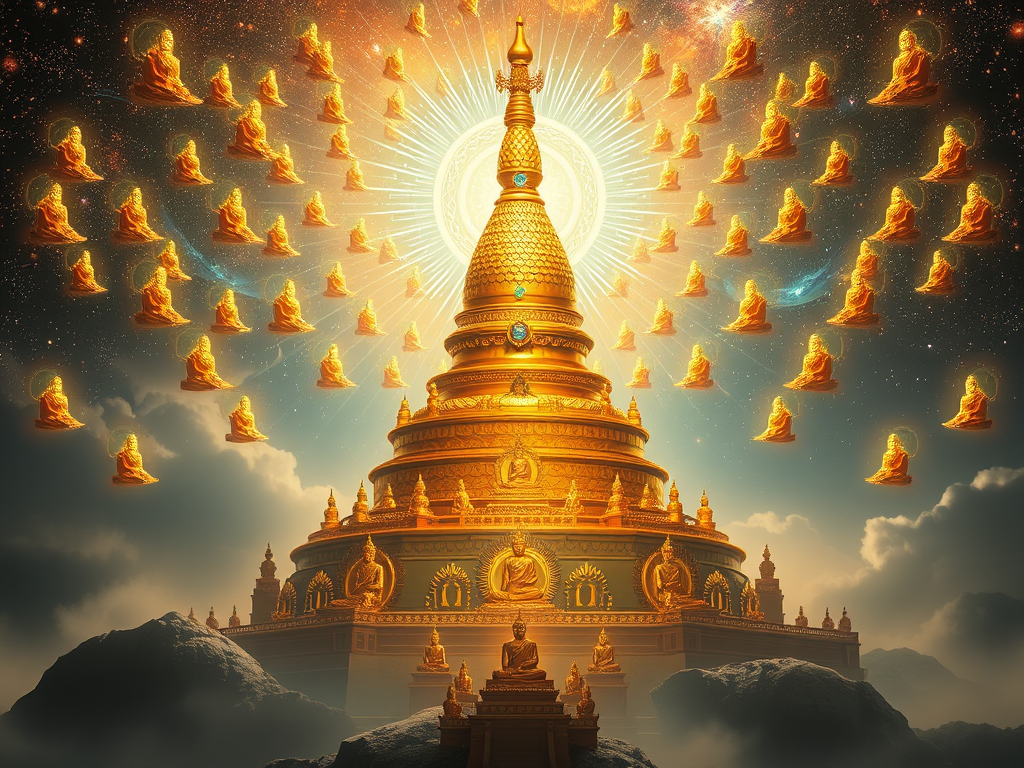
Within this seminal scripture, Chapter Eleven, titled “The Emergence of the Treasure Stupa” (Skt. Stūpasaṃdarśana-parivarta; Jp. Hōtōbon), marks a dramatic and pivotal moment.9 It serves as a narrative hinge, transitioning the setting from the familiar earthly realm of Vulture Peak to a cosmic stage suspended in mid-air—the commencement of the “Ceremony in the Air”.9 This chapter introduces extraordinary figures and events: the miraculous appearance of a colossal jeweled stupa containing the ancient Buddha Prabhūtaratna (Many Treasures) and the subsequent gathering of innumerable “emanation Buddhas” summoned by Śākyamuni from across the universe. These spectacular occurrences are not mere literary flourishes; they visually and symbolically underscore the Lotus Sūtra’s most profound themes.
This report aims to provide an in-depth analysis of a key passage within Chapter Eleven concerning the arrival of these emanation Buddhas, exploring its context, meaning, and implications. It will achieve this by: locating the specific verses and detailing the surrounding narrative sequence; defining the crucial concepts of emanation Buddhas, Prabhūtaratna Tathāgata, the Wonderful Dharma (Saddharma), and Mahāyāna cosmology’s Buddha-fields; analyzing the story and significance of Prabhūtaratna and his stupa; interpreting the meaning behind the emanation Buddhas leaving their own realms; elaborating on how the passage illustrates the supreme value of the Wonderful Dharma; examining the theme of preserving the Dharma; synthesizing scholarly and traditional interpretations, particularly from Tiāntāi, Tendai, and Nichiren perspectives; and situating the chapter’s teachings within the broader philosophical and soteriological framework of the Lotus Sūtra and Mahāyāna Buddhism. The analysis draws upon a range of textual translations and secondary commentaries provided in the source materials.2
2. The Grand Assembly: Locating the Verses and Setting the Scene
Chapter Eleven unfolds with a series of increasingly wondrous events, establishing a cosmic context for the revelation of the Lotus Sūtra’s deeper truths. The narrative sequence leading to the arrival of the emanation Buddhas is crucial for understanding the significance of their gathering.
The Emergence of the Treasure Stupa:
The chapter commences dramatically as Śākyamuni Buddha preaches on Vulture Peak. Suddenly, a magnificent stupa, constructed from seven precious substances—gold, silver, lapis lazuli, musāragalva/seashell, emerald/agate, red coral/pearl, and karketana-stone/carnelian—emerges from the earth directly before the Buddha and the assembled congregation.12 This is no ordinary monument; it is described as immense, measuring five hundred yojanas in height and two hundred and fifty yojanas in width and depth, reaching towards the heavens.9 Its appearance is a dazzling spectacle: adorned with thousands of railings, millions of chambers or alcoves, countless banners and streamers, jewel-garlands, and ringing bells, it hangs suspended in the sky, radiating light and fragrance.18 From within this resplendent structure, a great voice issues forth, proclaiming: “Excellent, excellent, Lord Śākyamuni! Thou hast well expounded this Dharmaparyāya of the Lotus of the True Law. So it is, Lord; so it is, Sugata”.18
The Mystery and the Revelation:
The fourfold assembly—monks, nuns, laymen, and laywomen—are filled with joy and wonder at this unprecedented event, questioning its meaning.13 Bodhisattva Mahāpratibhāna (Great Eloquence or Great Joy of Preaching) voices their curiosity, asking Śākyamuni the cause of the stupa’s appearance.9 Śākyamuni reveals that the stupa contains the complete, uncorrupted body of a Tathāgata from the distant past, a Buddha named Prabhūtaratna (Many Treasures).9 He explains that long ago, in a world called Ratnaviśuddha (Treasure Purity) located countless worlds to the east, Prabhūtaratna made a profound vow before entering final nirvāṇa: wherever and whenever in the ten directions the Lotus Sūtra might be preached, his stupa, containing his body, would well up from the earth to listen, certify its truth, and offer praise.9 The stupa’s current appearance is the fulfillment of that ancient vow, triggered by Śākyamuni’s preaching of the Wonderful Dharma.
The Condition for Revelation:
Inspired by this revelation, Bodhisattva Mahāpratibhāna expresses the assembly’s earnest wish to behold the form of this ancient Buddha.18 Śākyamuni explains that Prabhūtaratna has set a further condition stemming from his vow: his body can only be shown to the assembly if the Buddha currently preaching the Lotus Sūtra first gathers together all of his own emanation bodies (replica Buddhas, division bodies, funjin) who are simultaneously preaching the Dharma in innumerable worlds throughout the ten directions of the cosmos.9
The Cosmic Summons:
To fulfill this condition, Śākyamuni performs a cosmic feat. He emits a ray of light from the white tuft of hair between his eyebrows (the ūrṇā-keśa), a characteristic mark of a Buddha signifying great power and wisdom.12 This light instantly illuminates countless worlds in the eastern direction, described as being “equal in number to hundreds, thousands, ten thousands, millions of nayutas of Ganges sands”.12 The assembly perceives these distant realms, seeing their ground made of crystal or lapis lazuli, adorned with jeweled trees and filled with innumerable Bodhisattvas listening to the Buddhas presiding there.18 This vision extends progressively through all ten directions: south, west, north, the intermediate directions, the nadir, and the zenith.18 Each Buddha in these myriad worlds then instructs their own vast assembly of Bodhisattvas, announcing their intention to travel to the Sahā world to pay homage to Prabhūtaratna’s stupa and to Śākyamuni Buddha.12
Purification of the Worlds:
The imminent arrival of such an inconceivable number of Buddhas necessitates a transformation of the Sahā world, Śākyamuni’s own “impure” Buddha-field. Śākyamuni employs his transcendental powers to purify the Sahā world, instantly changing it into a realm of pristine beauty: the ground becomes lapis lazuli, adorned with jeweled trees, marked by golden cords, and cleansed of all impurities like oceans, rivers, mountains (including the central Mount Sumeru), villages, and thickets.9 Precious incense burns, celestial flowers cover the ground, and jeweled nets and banners hang overhead.18 Significantly, all beings normally inhabiting this world—humans, gods, and beings of the lower realms—are temporarily moved to other lands, leaving only the assembly gathered for the Lotus Sūtra.9
This purification extends far beyond the Sahā world itself. As the emanations begin to arrive, even the transformed Sahā world proves insufficient. Śākyamuni therefore purifies vast tracts of the surrounding universe in stages. First, he transforms “two hundred ten thousand million nayutas of lands in each of the eight directions,” removing all beings of the four evil paths (hell, hungry spirits, animals, asuras) and relocating the humans and heavenly beings elsewhere, rendering these lands pure Buddha-fields.9 When even this proves inadequate, he repeats the process, purifying another two hundred ten thousand million nayutas of lands in each direction in the same manner.9 These newly purified lands are described similarly: lapis lazuli ground, towering jeweled trees (five hundred yojanas high), lion seats beneath them, and the absence of geographical features like oceans or mountains.9 The result is the amalgamation of countless worlds into a single, immense, perfectly pure Buddha-land prepared for the cosmic assembly.9
This act of purification carries profound symbolic weight beyond mere spatial accommodation. The removal of geographical features like Mount Sumeru and the Iron Encircling Mountains, which define the structure of a standard single world-system (cakravāla), along with the temporary relocation of all beings trapped in the cycle of rebirth (the six paths), signifies a transcendence of the ordinary, conditioned world.9 It creates a sacred space, a manifest Pure Land, appropriate for the revelation of the ultimate, unconditioned Dharma of the Lotus Sūtra. This transformation suggests that the very practice and realization engendered by the Lotus Sūtra possess the power to alter perception, revealing the inherent purity underlying the seemingly impure phenomenal world, aligning the cosmological narrative with the sutra’s soteriological promise.17
The Arrival of the Emanation Buddhas (The Specific Verses):
Into this vast, purified space, the emanation Buddhas arrive. Each Buddha, accompanied by a great Bodhisattva attendant, travels from their respective world-system in the ten directions and takes their place upon a magnificent lion seat beneath one of the jeweled trees.12 The scale of this gathering defies imagination. The text emphasizes that the emanations arriving from just one direction were enough to fill the initial thousand-million-fold world, necessitating the further purifications.12 Finally, the Buddhas from all ten directions assemble, seated in the eight directions, filling the newly unified Buddha-land. The text states: “At this time each of the directions was filled with Buddhas, Thus Come Ones, in four hundred ten thousand million nayutas of lands”.12
In verses occurring slightly later in the chapter (as rendered in the Kern translation, following the opening of the stupa), Śākyamuni refers to this assembly:
“And all these (you here see) are my proper bodies, by thousands of koṭis, like the sands of the Ganges; they have appeared that the law may be fulfilled I and in order to see this extinct Master.” 13
This verse explicitly identifies the arriving Buddhas as Śākyamuni’s own manifestations (“proper bodies”) and states their dual purpose: to ensure the fulfillment (or preservation) of the Dharma and to witness the ancient Buddha Prabhūtaratna. The sheer number invoked—”thousands of koṭis, like the sands of the Ganges”—serves a crucial rhetorical purpose. Such deliberately incomprehensible figures visually and conceptually represent the boundless extent of Śākyamuni’s spiritual power, now revealed not as a historical figure limited to India, but as a cosmic being whose influence permeates the entire universe.12 This immensity aims to inspire awe and faith in the audience, reinforcing the unparalleled authority and cosmic significance of the Lotus Sūtra itself. It starkly contrasts with the more localized settings of earlier Buddhist scriptures, dramatically illustrating the expanded horizons of Mahāyāna Buddhology and cosmology.
3. Decoding the Dharma: Key Concepts Explained
The dramatic events of Chapter Eleven are interwoven with key Mahāyāna concepts that require elucidation to grasp the chapter’s full significance. These include the nature of the arriving Buddhas, the identity of Prabhūtaratna, the meaning of the “Wonderful Dharma” they come to hear, and the cosmological framework of multiple worlds.
Buddhas of Replicas (Emanation Buddhas / Funjin Buddhas):
The countless Buddhas summoned by Śākyamuni are referred to as his “emanations” (funjin), “replica bodies,” or “division bodies”.18 In Mahāyāna doctrine, particularly through the lens of the Trikāya (Three Bodies) theory, these figures can be understood as Nirmāṇakāya, or “Transformation Bodies”.25 The Trikāya doctrine posits that a Buddha possesses: the Dharmakāya (Dharma Body), the ultimate, formless essence of reality and enlightenment; the Sambhogakāya (Enjoyment Body), a radiant, celestial form visible to advanced Bodhisattvas in Pure Lands; and the Nirmāṇakāya, a physical manifestation appearing in the ordinary world (like the historical Śākyamuni) or in various forms adapted to the needs of beings.25 The emanation Buddhas in Chapter Eleven are thus presented as countless skillful manifestations of Śākyamuni, projected across the cosmos to teach the Dharma in innumerable world-systems.18
Their relationship to Śākyamuni is central. Within the specific context of the Lotus Sūtra, these emanations are explicitly depicted as originating from Śākyamuni, underscoring the sutra’s revelation of his true identity as the eternal, primordial Buddha whose activity pervades the universe.7 This raises questions, debated within Mahāyāna traditions, about whether all other Buddhas, such as Amitābha or Bhaiṣajyaguru (Medicine Buddha), are considered emanations of Śākyamuni.25 Some interpretations, particularly those influenced by the Lotus Sūtra, lean towards this view, seeing Śākyamuni (as the eternal Buddha) as the ultimate referent for the Dharmakāya.25 However, other traditions, like the Tiāntāi and Shingon schools, posit a universal Dharmakāya, often identified with Vairocana Buddha (Dainichi Nyorai), from which all Buddhas, including Śākyamuni, manifest.25 Tiāntāi philosophy further complicates this with a non-linear view of time, suggesting all Buddhas emanate simultaneously from the Dharmakāya or “One Mind,” existing eternally in the present moment.22 Regardless of the specific interpretation, the core idea is that these emanations are expressions of the one fundamental Buddhahood.
The concept of innumerable emanation Buddhas teaching across the cosmos is deeply intertwined with the Mahāyāna doctrine of skillful means (upāya). Buddhas are understood to possess boundless compassion and wisdom, allowing them to adapt their teachings and appearances precisely to the capacities, inclinations, and circumstances of diverse beings in myriad worlds.1 The teeming multitude of replica Buddhas arriving in Chapter Eleven thus represents the ultimate expression of upāya: the one eternal Buddha-reality manifesting in countless forms, each delivering tailored guidance, all ultimately aimed at leading beings towards the single destination of the One Vehicle. This cosmic display reinforces the Lotus Sūtra’s message that the apparent diversity of Buddhist teachings stems from a unified, compassionate intent.
Many-Treasures Tathāgata (Prabhūtaratna):
Prabhūtaratna (Many Treasures or Abundant Treasures) is introduced as a Buddha from an extraordinarily remote past, dwelling eons ago in a Buddha-field named Ratnaviśuddha (Treasure Purity), situated far to the east.9 His defining characteristic is his Great Vow, made before his parinirvāṇa (final passing away): he pledged that his stupa, containing his undecayed body, would miraculously appear wherever the Lotus Sūtra was being preached, in order to bear witness to its truth and express praise.9 His role in the narrative is therefore primarily one of validation. His dramatic appearance serves to authenticate Śākyamuni’s exposition of the Lotus Sūtra, lending the authority of antiquity and Buddhahood itself to teachings that might otherwise seem radical or unprecedented within the broader Buddhist tradition.9
Wonderful Dharma (Saddharma):
The term Saddharma (Ch: Miàofǎ; Jp: Myōhō) translates literally as the “True,” “Fine,” “Sublime,” “Good,” or “Wonderful” Dharma (Law or Teaching).7 In the context of the Saddharma Puṇḍarīka Sūtra, it refers specifically to the teachings contained within the Lotus Sūtra itself. This “Wonderful Dharma” represents the ultimate and most profound truth of reality, the very principle to which Śākyamuni Buddha awakened.6 It encapsulates the core messages that distinguish the Lotus Sūtra: the doctrine of the One Vehicle (Ekayāna) unifying all paths to Buddhahood; the universal potential for all sentient beings, without exception, to attain enlightenment (inherent Buddha-nature); the revelation of the Buddha’s true, eternal lifespan and nature; and the sophisticated use of skillful means (upāya) to guide beings.1 It is hailed as the “king of sutras,” the final and complete exposition of the Buddha’s intent.7
The narrative presentation suggests that the Wonderful Dharma is more than just a collection of doctrines; it functions as an active, potent principle in the cosmos. The mere act of preaching this Dharma is shown to have the power to summon a Buddha from the distant past (Prabhūtaratna) and cause his immense stupa to manifest across vast distances.18 Hearing the Dharma compels countless other enlightened Buddhas to abandon their own blissful realms and undertake a cosmic journey to listen.18 Furthermore, the Lotus Sūtra repeatedly emphasizes that engaging with the text itself—preserving, reading, reciting, copying, teaching it—is a core spiritual practice imbued with salvific power.3 This implies that the Saddharma is conceived not merely as information or philosophy, but as a living reality, the very essence of enlightenment, whose presence and active engagement transforms both beings and the universe they inhabit.
Worlds and Buddha-fields (Buddhakṣetra):
Mahāyāna Buddhism posits a vastly expanded cosmology compared to earlier Buddhist traditions. Instead of a single world-system (cakravāla), Mahāyāna envisions an asaṃkhyeya cosmology—a universe containing literally innumerable world-systems (lokadhātu) distributed throughout the ten directions of space.39 Within this infinite expanse, many worlds are designated as Buddha-fields (buddhakṣetra). A Buddha-field is essentially the sphere of influence of a particular Buddha, a realm emanated, purified, or presided over by them, where they teach the Dharma and guide beings towards liberation.24 These fields are considered ideal environments for spiritual practice, often described as being free from the sufferings (duḥkha) of saṃsāra.24
Buddha-fields are broadly categorized as “pure” (viśuddha) or “impure” (aviśuddha), with some sources also mentioning “mixed” (miśraka) fields.24 The most famous Pure Land is Sukhāvatī (“Land of Bliss”), the western paradise presided over by Amitābha Buddha, rebirth into which is a central goal in Pure Land Buddhism.24 Our own world is typically designated as the Sahā world (“World of Endurance”), considered an impure field associated with Śākyamuni Buddha, characterized by suffering and the presence of the “three poisons” (greed, hatred, delusion).24 However, some Mahāyāna texts, including the Lotus Sūtra and the Vimalakīrti Sūtra, challenge this simple dichotomy, suggesting that the perceived impurity of a world like Sahā stems from the impure minds of its inhabitants, and that from an enlightened perspective, all realms are inherently pure.17 Chapter Eleven’s dramatic purification of the Sahā world and surrounding realms visually enacts this potential for transformation, turning the impure into the pure to host the assembly of Buddhas. Within any given world-system, Buddhist cosmology also describes a vertical structure, typically centered around Mount Meru, encompassing various planes of existence from the hells below, through the human and animal realms, up to multiple heavens inhabited by gods (devas) in the realms of desire (kāmadhātu), form (rūpadhātu), and formlessness (arūpyadhātu).26
4. The Jeweled Stupa and the Ancient Buddha: Story and Significance
The appearance of Prabhūtaratna Buddha within his magnificent jeweled stupa is the central catalyst for the extraordinary events of Chapter Eleven. Understanding the narrative details and their symbolic interpretations reveals much about the Lotus Sūtra’s core messages.
Narrative Recap:
As recounted earlier, the stupa, embodying Prabhūtaratna’s ancient vow, emerges from the earth upon hearing Śākyamuni preach the Lotus Sūtra.18 Its voice confirms the truth of the teaching.18 However, Prabhūtaratna’s form remains hidden until Śākyamuni fulfills the condition of gathering his countless emanation Buddhas from across the universe.9 Once the vast assembly of emanations is complete, Śākyamuni approaches the stupa and, with his right finger, opens its central door.9 Inside, Prabhūtaratna is revealed, seated cross-legged on a lion throne, his body appearing perfectly preserved, “as if absorbed in meditation”.9 He again praises Śākyamuni, declaring “Excellent, excellent! World-Honored One Śākyamuni! You have preached this Lotus Sūtra well!”.12 Crucially, Prabhūtaratna then offers half of his seat within the stupa to Śākyamuni, inviting him to sit beside him.9 Śākyamuni accepts, entering the stupa and taking his place next to the ancient Buddha. At this point, Śākyamuni uses his transcendent powers to lift the entire vast assembly—including all the gathered Buddhas, Bodhisattvas, disciples, humans, and non-humans—into the air, allowing them all to clearly witness the two Buddhas seated together within the stupa high above.9 This marks the formal beginning of the “Ceremony in the Air,” which continues for several subsequent chapters.
Significance as Validation:
The most immediate significance of Prabhūtaratna’s appearance is its powerful validation of Śākyamuni’s teaching.9 By emerging from the depths of time and space specifically to attest to the truth of the Lotus Sūtra, this ancient, fully enlightened Buddha lends immense credibility to its doctrines. This is particularly important given the sutra’s claims to supremacy over previous teachings and its introduction of potentially controversial ideas like the One Vehicle and the eternal nature of the Buddha.3 Prabhūtaratna acts as an objective, cosmic witness, confirming that Śākyamuni is indeed revealing the ultimate Dharma.
Symbolism of the Stupa:
The stupa itself is rich with symbolic meaning, interpreted variously across different traditions:
- Embodiment of Buddha-Nature: A prevalent interpretation, especially within the Tiāntāi/Tendai and Nichiren schools, sees the stupa as a symbol of the inherent Buddha-nature (buddhadhātu) dormant within all sentient beings.11 Its emergence from the “earth”—representing the mundane world or the defiled consciousness of ordinary beings—symbolizes the potential for this innate enlightenment to be discovered and manifested through practice.11 The stupa’s adornment with seven treasures can further symbolize the virtues and practices necessary for realizing this potential, such as faith, precepts, meditation, and wisdom.47
- Manifestation of Living Truth: Unlike traditional stupas which primarily house physical relics of deceased Buddhas, Prabhūtaratna’s stupa contains his living body.20 This signifies that the ultimate Truth (Dharma) and the reality of Buddhahood are not merely historical artifacts but are eternally present, vibrant, and accessible realities.17 The truth validated by Prabhūtaratna is a living, dynamic principle.
- The Practitioner and the Gohonzon (Nichiren Buddhism): Nichiren Daishonin radically reinterpreted the treasure tower for practitioners in the Latter Day of the Law (mappō). He taught that the treasure tower is not an external object but manifests within the lives of those who embrace the Lotus Sūtra by chanting its title, Nam-myoho-renge-kyo, before the object of devotion, the Gohonzon.11 He stated, “those who chant Nam-myoho-renge-kyo are themselves the treasure tower, and, likewise, are themselves the Thus Come One Many Treasures… The daimoku [title] of the Lotus Sutra is the treasure tower, and the treasure tower is Nam-myoho-renge-kyo”.14 The Gohonzon itself is considered the embodiment of the treasure tower, depicting Śākyamuni and Prabhūtaratna seated together, representing the fusion of objective truth and subjective wisdom within the practitioner’s life.11
Significance of the Two Buddhas Seated Together:
The image of Śākyamuni and Prabhūtaratna seated side-by-side within the stupa is one of the most iconic in Lotus Sūtra imagery and carries multiple layers of meaning:
- Unity of Truth and Teacher: It symbolizes the essential unity and equal importance of the timeless, objective Truth or Dharma (represented by the ancient Prabhūtaratna) and the compassionate Teacher who reveals that Truth in the present world (Śākyamuni).17 The Dharma requires a Buddha to expound it, and the Buddha’s value lies in revealing the Dharma.
- Non-Duality of Ultimate and Historical: The scene visually represents the Mahāyāna concept of non-duality. Prabhūtaratna can be seen as symbolizing the ultimate, eternal aspect of Buddhahood (Dharmakāya), while Śākyamuni represents the historical, manifest Buddha (Nirmāṇakāya).20 Their sitting together signifies that the ultimate and the historical are not separate; the eternal truth can be encountered and realized within the phenomenal world through the teachings of the manifest Buddha. This powerfully foreshadows the later revelation in Chapter Sixteen (“Life Span of the Thus Come One”) where Śākyamuni explicitly declares his own eternal attainment.
- Validation and Transmission: Prabhūtaratna sharing his seat is the ultimate gesture of validation and acceptance, confirming Śākyamuni’s authority and the veracity of his teachings.11 It establishes the legitimate transmission of the supreme Dharma from the Buddhas of the past to the Buddha of the present, setting the stage for its further entrustment to the Bodhisattvas for the future.
- Challenging Temporal Succession: The simultaneous presence of a living Buddha from the distant past and the Buddha of the present era fundamentally challenges conventional, linear understandings of time and the traditional notion, prevalent in some earlier Buddhist schools, that only one Buddha appears in a world-system at any given time. Prabhūtaratna, though described as having entered parinirvāṇa eons ago 13, is manifestly present and active.20 His ability to interact with Śākyamuni demonstrates the Mahāyāna perspective on the transcendent and eternal nature of Buddhahood, which operates beyond the ordinary constraints of birth and death.1 This cosmic meeting ground prepares the audience to accept the Lotus Sūtra’s later explicit teachings on the Buddha’s immeasurable lifespan.1
5. The Cosmic Gathering: Meaning of the Emanation Buddhas’ Arrival
The assembly of countless emanation Buddhas from every corner of the universe is perhaps the most visually stunning element of Chapter Eleven. Analyzing the purpose and implications of their journey reveals the profound value attributed to the Wonderful Dharma.
The Journey from Myriad Worlds:
As established, fulfilling Prabhūtaratna’s condition requires Śākyamuni to summon his emanations. These are Buddhas actively engaged in teaching the Dharma within their own respective Buddha-fields, spread across an infinite number of world-systems in all ten directions.9 Their journey to the transformed Sahā world represents a convergence of the entire cosmic manifestation of Buddhahood upon a single point for a singular purpose.
Abandoning Their Realms:
A significant detail, highlighted in the user’s initial query text based on the Kern translation 13, is that these Buddhas willingly leave behind their own privileged positions:
The Buddhas of my replicas
As innumerable
As there are sands in the River Ganges
Also came here
From their wonderful worlds,
Parting from their disciples,
And giving up the offerings made to them
By gods, men and dragons,
In order to hear the Dharma,
See Many-Treasures Tathāgata,
Who passed away [a long time ago],
And have the Dharma preserved forever. 13
These Buddhas preside over their own realms, likely Pure Lands or purified fields, where they are revered, receive offerings, and guide their own disciples.12 Their status is that of fully enlightened beings enjoying the fruits of their Buddhahood. Yet, they readily abandon these circumstances to travel to Śākyamuni’s location.
Analysis: Why Do They Come?
The text provides several overlapping reasons for this cosmic migration:
- To Hear the Dharma: The primary motivation explicitly stated in the verses is “in order to hear the Dharma”.13 They come specifically to listen to Śākyamuni’s exposition of the Saddharma Puṇḍarīka Sūtra.
- To Witness Prabhūtaratna: They also come “to see Many-Treasures Tathāgata” 13 and pay homage to his stupa, acknowledging the significance of his presence and validation.12
- To Fulfill the Condition: Their collective presence is the necessary prerequisite for Prabhūtaratna to reveal his form, thus enabling the full unfolding of the chapter’s events.9
- To Validate the Event: The sheer scale of the gathering—Buddhas from every conceivable world assembling—serves as a powerful, universe-wide endorsement of the Lotus Sūtra’s importance and authenticity.17 Their presence confirms that this teaching is not merely a local event but one of cosmic significance, recognized by all Buddhas.
- To Ensure Dharma Preservation: The verses also mention the goal to “have the Dharma preserved forever”.13 Their participation establishes a powerful context for the transmission and future safeguarding of the teaching.
Interpretation: The Supreme Value of the Dharma:
The most profound implication arises from the fact that these enlightened beings leave their own blissful states and positions of honor simply to hear the Lotus Sūtra. This narrative choice powerfully illustrates the supreme value placed upon the Wonderful Dharma. If even fully realized Buddhas, enjoying the peace and reverence of their own realms, consider hearing this specific teaching to be of paramount importance, it suggests that the Lotus Sūtra contains a truth or perspective that transcends even the conventional understanding and experience of Buddhahood.13
This scene subtly implies a hierarchy, not necessarily among Buddhas themselves, but in the depth or completeness of the Dharma being expressed. The emanation Buddhas, while fully enlightened and active teachers in their own right 12, are drawn to Śākyamuni’s exposition of the Lotus Sūtra. The Lotus Sūtra consistently presents itself as the final, ultimate, and all-encompassing teaching—the One Vehicle that reveals the entirety of the Buddha’s enlightenment and the universal path to it.1 Their arrival suggests that this particular expression of the Dharma holds a unique and supreme value, representing the ultimate realization or the most complete understanding of the truth, towards which even other Buddhas gravitate. This serves to dramatically reinforce the Lotus Sūtra’s central claim to be the pinnacle of all Buddhist teachings.
6. The Supreme Value of the Wonderful Dharma
The cosmic gathering in Chapter Eleven serves as a dramatic testament to the unparalleled value attributed to the Wonderful Dharma (Saddharma) embodied in the Lotus Sūtra. This theme permeates the sutra and is brought into sharp focus by the actions of the emanation Buddhas.
Elaboration on Dharma’s Transcendence:
The Lotus Sūtra consistently positions itself as the culmination of Śākyamuni’s teachings, the revelation of the ultimate truth for which all previous doctrines were merely preparatory skillful means (upāya).1 The assembly of countless Buddhas in Chapter Eleven provides a vivid, cosmic-scale illustration of this proclaimed supremacy. Their willingness to travel across universes underscores the unique importance of the Dharma being expounded. It is presented not just as a teaching, but as the definitive teaching, the final word on the path to enlightenment.
Dharma vs. Buddhahood’s Pleasures:
The interpretive statement, “As our pleasures seem small compared to those of a Buddha, so a Buddha’s pleasures seem small compared to the Wonderful Dharma”, captures the essence of this narrative element. The emanation Buddhas already possess the status and bliss associated with Buddhahood in their respective realms.12 Yet, the opportunity to hear, witness, and participate in the full revelation of the Saddharma compels them to leave those states behind. This suggests that the Wonderful Dharma offers something even more profound than the localized peace and enjoyment of an individual Buddha-field. It offers access to the universal principle of liberation itself, the key to the enlightenment of all beings and the complete understanding of the nature of reality.13 Its value is therefore presented as transcending individual attainment, encompassing the ultimate soteriological potential of the entire cosmos.
Connection to the One Vehicle (Ekayāna):
The supreme value of the Wonderful Dharma is inextricably linked to its content, primarily the doctrine of the One Vehicle (Ekayāna).1 Unlike previous teachings that seemed to outline separate paths and destinies for different types of practitioners (śrāvakas, pratyekabuddhas, bodhisattvas), the Lotus Sūtra reveals that these are all provisional aspects of a single, universal path leading directly to full Buddhahood. The Saddharma is precisely this teaching of universal access to supreme enlightenment. Its unparalleled value stems from this radical inclusivity—the promise that all sentient beings, without exception, regardless of their capacity, past actions, or current status (even women or those deemed “evil” in other contexts), possess the potential for Buddhahood and will eventually attain it through the One Vehicle.1 This ultimate promise of universal salvation makes the Dharma that reveals it supremely precious.
Connection to Bodhisattva Ideal:
The Wonderful Dharma also perfectly embodies the Mahāyāna Bodhisattva ideal. This ideal shifts the focus from individual liberation (nirvāṇa) to the compassionate aspiration to attain Buddhahood for the sake of liberating all other beings.1 The Lotus Sūtra, as the expression of the Saddharma, provides the blueprint for this universal liberation. Hearing, understanding, preserving, and propagating this Dharma are therefore essential activities for anyone treading the Bodhisattva path. Its value lies not only in its promise but also in its function as the essential guide for compassionate action in the world.
The narrative structure itself—where past, present, and future Buddhas converge around the preaching of the Saddharma—implies that the Dharma is, in a sense, logically prior to and the very source of Buddhahood itself. Prabhūtaratna, a Buddha of the past, exists primarily within the narrative to validate the Dharma.20 The emanation Buddhas of the present come specifically to hear the Dharma.13 And the Lotus Sūtra itself is presented as the teaching that reveals the path for and predicts the attainment of future Buddhas.1 This positions the Saddharma not merely as something that Buddhas teach, but as the fundamental, timeless truth and reality that makes Buddhahood possible across all times. Buddhas, in this view, are the supreme manifestations and expositors of this eternal Dharma. Its value is supreme because it is the very fount from which all enlightenment flows.
7. Preserving the Dharma Forever
The aspiration “to have the Dharma preserved forever” 13 is explicitly mentioned in the verses describing the purpose of the emanation Buddhas’ gathering. This theme of ensuring the continuity and perpetuation of the Wonderful Dharma is woven throughout the Lotus Sūtra and finds particular resonance in Chapter Eleven.
Prabhūtaratna’s Role in Preservation:
Prabhūtaratna’s entire existence within the sutra’s narrative framework serves the cause of Dharma preservation. His ancient vow was specifically to appear and validate the Lotus Sūtra whenever it was preached, thereby ensuring its authenticity would be recognized across time and space.20 His presence acts as a timeless anchor, connecting the present preaching with the eternal truth and guaranteeing its veracity for future generations. According to Nichiren’s interpretation, the interaction between Śākyamuni and Prabhūtaratna seated together in the stupa represents a profound agreement or pledge for the perpetuation of the Law, especially into the challenging era of the Latter Day.20
The Assembly’s Role in Transmission:
The gathering of an inconceivable number of Buddhas and their accompanying Bodhisattvas creates an unparalleled context for the transmission of the Dharma. This assembly represents the entire universal body of enlightened beings acknowledging and receiving the teaching. While Chapter Eleven sets the stage, later chapters, particularly Chapter Twenty-Two (“Entrustment,” Anuparīndanā), describe Śākyamuni formally entrusting the Lotus Sūtra to the assembled Bodhisattvas, charging them with the crucial mission of upholding, protecting, and propagating it vigorously in the ages after his apparent parinirvāṇa.9 The cosmic scale of the assembly in Chapter Eleven emphasizes the weight and importance of this future transmission.
Practices for Preservation:
The Lotus Sūtra itself repeatedly advocates specific practices as means of preserving the Dharma. Believers are enjoined to engage actively with the sutra through the “five practices”: receiving and keeping (juji), reading (doku), reciting (ju), explaining (gesetsu), and copying (shosha).3 These actions are presented not merely as scholarly activities but as devotional acts infused with merit, ensuring that the teaching remains a living force rather than a forgotten text. By engaging in these practices, individuals become active participants in the Dharma’s perpetuation.
Significance in the Latter Day of the Law (Mappō):
The theme of Dharma preservation gains particular urgency in the context of the Buddhist concept of the Three Ages of the Dharma: the Former Day (shōbō), Middle Day (zōbō), and Latter Day (mappō). The Latter Day of the Law is prophesied as a future degenerate age when the Buddha’s teachings become obscured, practice declines, and enlightenment becomes difficult to attain.11 For schools like Nichiren Buddhism, which situate themselves firmly within mappō, the preservation and propagation of the Lotus Sūtra—believed to be the essential teaching for this specific age—becomes the most critical religious task.14 Upholding the Saddharma in the face of anticipated decline is seen as the key to individual salvation and societal transformation.
Furthermore, the act of preserving the Dharma is presented not merely as passively safeguarding a text or doctrine, but as an active process that simultaneously realizes its inherent power. Nichiren’s interpretation of the Treasure Tower manifesting in the practitioner who chants Nam-myoho-renge-kyo exemplifies this.11 Practices like reciting, chanting, and embodying the sutra’s principles are understood as ways to internalize the Dharma and make its transformative potential manifest in one’s own life and the world.3 In this view, preservation is inseparable from practice and realization. Keeping the Dharma alive means actively embodying its truth and sharing its power, ensuring its continued efficacy as a path to enlightenment for oneself and others.
8. Scholarly and Traditional Perspectives
The dramatic events of Chapter Eleven, particularly the emergence of the Treasure Stupa and the gathering of countless Buddhas, have been the subject of extensive commentary and interpretation within Mahāyāna Buddhism for centuries. Scholarly analysis and traditional lineages, especially those directly based on the Lotus Sūtra like Tiāntāi/Tendai and Nichiren, offer diverse perspectives on the significance of this cosmic assembly.
General Scholarly and Mahāyāna Views:
Across various Mahāyāna traditions and modern scholarship, the assembly in Chapter Eleven is generally understood to serve several key functions:
- Validation: It provides incontrovertible validation for the profound teachings of the Lotus Sūtra, particularly its central claim of the One Vehicle leading all to Buddhahood, through the testimony of the ancient Buddha Prabhūtaratna and the convergence of all of Śākyamuni’s emanations.8
- Universality: The gathering demonstrates the universal scope and significance of the Lotus Sūtra, showing its relevance extends across all worlds and times, acknowledged by all Buddhas.11
- Revelation of Cosmic Buddhahood: The events dramatically showcase Śākyamuni’s cosmic stature, revealing him not merely as a historical teacher but as a transcendent being capable of summoning Buddhas from across the universe, purifying worlds, and interacting with past Buddhas. This prepares the ground for the explicit revelation of his eternal nature in Chapter Sixteen.9
- Transition Point: The chapter marks the transition from the “theoretical teaching” (shakumon) focused on the historical Buddha’s skillful means to the “essential teaching” (honmon) revealing the eternal Buddha and the ultimate reality.10 The Ceremony in the Air, initiated here, becomes the setting for these deeper revelations.
Tiāntāi/Tendai Interpretations:
The Tiāntāi school (and its Japanese transmission, Tendai), founded by Zhiyi (538–597 CE), holds the Lotus Sūtra as the pinnacle of Buddhist teachings and developed sophisticated philosophical frameworks based upon it.1 Key Tiāntāi/Tendai interpretations relevant to Chapter Eleven include:
- Stupa as Symbol of Truth/Buddha-Nature: The Treasure Stupa is often interpreted allegorically. It represents the ultimate truth (Dharma), the inherent Buddha-nature within all phenomena, or the Dharmakāya.11 Its emergence signifies the manifestation or realization of this inherent reality from within the mundane world.
- Integration with Core Doctrines: The events are understood through core Tiāntāi doctrines like the “Three Thousand Realms in a Single Thought Moment” (ichinen sanzen) and the “Threefold Truth” (sandai). The assembly of Buddhas from myriad worlds within a single space illustrates the interpenetration of all phenomena and the simultaneous presence of all potential states (the Ten Worlds) within each moment of consciousness. The stupa and the Buddhas embody the Threefold Truth: their ultimate nature is emptiness (kū), their phenomenal appearance is provisional existence (ke), and their reality encompassing both is the Middle Way (chū).22
- Reconciliation via the One Vehicle: The chapter powerfully illustrates the One Vehicle doctrine, showing how the ultimate truth revealed by Śākyamuni draws together all manifestations of Buddhahood, unifying the diverse expressions of the Dharma.37
- Cosmic Buddha (Vairocana): While centering on Śākyamuni as depicted in the Lotus Sūtra, Tendai (influenced by esoteric Buddhism) sometimes identifies the ultimate cosmic Buddha, the source of all emanations, with Vairocana (Dainichi Nyorai).2
Nichiren Interpretations:
Nichiren (1222–1282), founder of the Japanese school bearing his name, based his teachings exclusively on the Lotus Sūtra, viewing it as the sole efficacious teaching for the degenerate age of the Latter Day of the Law (mappō).1 His interpretations of Chapter Eleven are distinct and practice-oriented:
- Focus on Mappō: The events of Chapter Eleven, particularly the interaction between Śākyamuni and Prabhūtaratna, are seen as establishing the basis for the transmission and practice of the Lotus Sūtra specifically for the Latter Day.20
- Treasure Tower as Practitioner/Gohonzon: Nichiren’s most characteristic interpretation equates the Treasure Tower not with an abstract principle but with the very life of the person who chants Nam-myoho-renge-kyo (the daimoku, or title of the sutra) and with the Gohonzon, the mandala Nichiren inscribed as the object of devotion.11 The emergence of the stupa symbolizes the manifestation of Buddhahood within the practitioner’s life through faith and practice. Prabhūtaratna represents the objective reality of Buddhahood (or the Dharma Realm), while Śākyamuni represents the subjective wisdom to perceive it; their union in the stupa/Gohonzon signifies the fusion of reality and wisdom in the practitioner’s enlightenment (jōbutsu).
- Śākyamuni as Primordial Buddha: Nichiren strongly emphasized the identity of Śākyamuni revealed in the Lotus Sūtra (particularly the essential teaching) as the “Primordial Buddha” or “Original Buddha” (honbutsu) who attained enlightenment in the remote past.28 All other Buddhas, including the historical Śākyamuni prior to this revelation and potentially figures like Amitābha, are viewed as provisional emanations or functions of this Original Buddha.28 He criticized other schools, particularly Pure Land practices focused solely on Amitābha, for allegedly obscuring this fundamental truth revealed in the Lotus Sūtra.28
Other Interpretations:
Other commentators offer related perspectives. Thich Nhat Hanh interprets Prabhūtaratna as symbolizing the “ultimate Buddha” and Śākyamuni the “historical Buddha,” their union signifying the non-duality of the timeless and the temporal, accessible in the present moment.20 Nikkyō Niwano, founder of Risshō Kōsei Kai, echoes the interpretation of the stupa as Buddha-nature and its emergence as the discovery of this potential within oneself.20
Comparative Interpretations Table:
To clarify these diverse perspectives, the following table summarizes key interpretations of the major symbolic elements in Chapter Eleven:
| Element | General Mahayana Symbolism | Tiāntāi/Tendai Interpretation | Nichiren Interpretation | Key Sources |
| Treasure Stupa | Validation of Dharma; Eternal Truth; Buddha’s presence | Inherent Buddha-nature (Busshō); Dharmakāya; Ultimate Truth (Middle Way); Interpenetration of Realms (Ichinen Sanzen) | Practitioner chanting Nam-myoho-renge-kyo; The Gohonzon; Manifestation of inherent Buddhahood | 11 |
| Prabhūtaratna | Ancient Buddha validating current teaching; Timelessness of Dharma | Objective Truth; Dharmakāya aspect; Eternal Buddhahood | Objective Reality/Dharma Realm aspect of Buddhahood (Kyōchi Myōgō); Represents past validation for future (Mappō) propagation; Sometimes related to Mahāvairocana 54 | 9 |
| Emanation Buddhas | Manifestations (Nirmāṇakāya) of Śākyamuni; Universality of Buddha’s power; Skillful Means | Manifestations of the One Eternal Buddha/Dharmakāya; Embodiment of Three Thousand Realms; Non-linear existence of all Buddhas | Emanations of the Original Buddha (Śākyamuni of the Essential Teaching); Their gathering confirms Lotus Sūtra’s supremacy | 7 |
| Two Buddhas Together | Unity of Truth & Teacher; Non-duality (Ultimate/Historical); Dharma Transmission | Union of Objective Truth (Prabhūtaratna) & Subjective Wisdom (Śākyamuni); Non-duality of Reality and Wisdom; Embodiment of Middle Way | Fusion of Objective Reality & Subjective Wisdom (Kyōchi Myōgō) within practitioner’s life; Central motif of Gohonzon; Pledge for Mappō propagation | 9 |
| World Purification | Creating sacred space; Transcending the mundane; Power of the Buddha | Manifestation of inherent purity; Mind-dependent nature of reality (purity/impurity); Potential for transforming Sahā world into Pure Land (Jōdo) | Power of the Mystic Law (Myōhō) to purify life and environment; Buddhahood manifests in the reality of this world | 9 |
This table highlights how the same narrative elements are interpreted through the distinct doctrinal lenses of major traditions, enriching the understanding of Chapter Eleven’s multifaceted significance.
9. Chapter 11 in the Mahayana Landscape
Chapter Eleven, “The Emergence of the Treasure Stupa,” does not exist in isolation. Its dramatic events and profound symbolism are deeply integrated with the core doctrines of the Lotus Sūtra itself and contribute significantly to the broader philosophical and soteriological landscape of Mahāyāna Buddhism.
Relation to Core Lotus Sūtra Doctrines:
- One Vehicle (Ekayāna): Chapter Eleven provides a powerful, visual enactment of the One Vehicle doctrine.1 The convergence of innumerable Buddhas from countless worlds, all drawn by Śākyamuni’s preaching of the Lotus Sūtra, underscores the teaching’s universal appeal and ultimate authority. Prabhūtaratna’s validation from the distant past further solidifies the Saddharma as the single, unifying truth towards which all paths and all Buddhas ultimately lead. The gathering itself embodies the unification of the diverse manifestations of Buddhahood under the banner of the One Vehicle.
- Eternal Buddha: While the explicit revelation of Śākyamuni’s attainment of Buddhahood in the inconceivably remote past occurs later, primarily in Chapter Sixteen (“Life Span”) 1, Chapter Eleven lays crucial groundwork for this revelation. Śākyamuni’s demonstrated ability to command cosmic forces—emitting light that penetrates infinite worlds, summoning countless emanations, purifying vast sections of the universe, and interacting on equal terms with a long-extinct Buddha—points to a being whose nature far transcends that of a mere historical figure who attained enlightenment under the Bodhi tree.9 The chapter showcases powers consistent with an eternal, omnipresent Buddha, making the later explicit statement of his immeasurable lifespan more plausible and impactful for the audience.
- Skillful Means (Upāya): The entire spectacle of Chapter Eleven can be understood as a masterful display of skillful means (upāya).1 The Buddha employs astonishing visual phenomena—the rising stupa, the cosmic light, the purified worlds, the assembly of Buddhas—not merely for show, but as pedagogical tools. These dramatic events serve to capture the assembly’s attention, inspire faith and awe, and convey profound truths about the Dharma’s value, the Buddha’s true nature, and the universality of the path in a way that transcends purely intellectual explanation. The purification of worlds and the very act of gathering the emanations are themselves compassionate means employed by the Buddha to prepare the assembly for receiving and accepting the highest, most difficult-to-comprehend teachings.
Contribution to Mahayana Philosophy and Soteriology:
- Expanded Buddhology: Chapter Eleven is a cornerstone text for the development of Mahāyāna Buddhology. It vividly portrays a universe populated by countless Buddhas existing simultaneously across space and time, interacting with each other, and manifesting in myriad forms (emanations).1 This moves decisively beyond earlier Buddhist conceptions that often emphasized a single Buddha per world-system or era. The chapter contributes significantly to the Mahāyāna vision of cosmic Buddhas and the eternal, transcendent nature of Buddhahood itself.
- Enhanced Cosmology: The chapter provides a dramatic illustration of the vast, multi-world cosmology characteristic of Mahāyāna (asaṃkhyeya cosmology).24 The narrative operates on an infinite stage, depicting innumerable Buddha-fields and the dynamic interaction between them, solidifying this expanded cosmic view within the Mahāyāna imagination.
- Universal Salvation: By validating the One Vehicle teaching and showcasing Buddhahood as the ultimate goal accessible through the Lotus Sūtra, Chapter Eleven powerfully reinforces the Mahāyāna emphasis on universal liberation.1 The presence of Prabhūtaratna and the assembly of all Buddhas underscores that this path is open to all beings across all times and worlds.
- Foundation for Practice: The sheer wonder and authority conveyed in Chapter Eleven serve to inspire deep faith (śraddhā) and devotion towards the Lotus Sūtra. This devotional aspect is crucial, as the sutra itself emphasizes faith and engagement with the text (reciting, copying, upholding) as vital practices.3 The chapter provides a compelling narrative foundation for the development of specific practice traditions centered on the Lotus Sūtra in schools like Tiāntāi, Tendai, and Nichiren.
Moreover, Chapter Eleven exemplifies a distinctive feature of the Lotus Sūtra: its performative nature. The text does not merely describe past or potential events; it narrates events that unfold because the sutra itself is being preached. The preaching causes the stupa to appear.18 Śākyamuni’s actions of emitting light and purifying worlds occur within the narrative flow triggered by the sutra’s exposition.9 The Lotus Sūtra frequently refers to its own power and the merit derived from engaging with it.3 This suggests the sutra presents itself not just as a record of a teaching, but as a powerful, world-altering event enacted through its own narration. Consequently, the act of reading, reciting, or hearing the sutra becomes, for the believer, a form of participation in that original cosmic drama, directly linking the textuality of the scripture with the potential for profound soteriological transformation.
10. Conclusion: The Enduring Message of the Treasure Stupa
Chapter Eleven, “The Emergence of the Treasure Stupa,” stands as a monumental chapter within the Lotus Sūtra, marking a decisive shift in the scripture’s scope and depth. The analysis presented here, based on textual evidence and interpretive traditions, reveals the multifaceted significance of the events described, particularly the arrival of the emanation Buddhas.
The emergence of Prabhūtaratna’s stupa serves as an undeniable validation of the Wonderful Dharma being preached by Śākyamuni. This ancient Buddha’s presence, along with the subsequent gathering of countless emanation Buddhas—Śākyamuni’s own manifestations from across the universe—confirms the supreme authority and universal relevance of the Lotus Sūtra. These emanations, defined within the Mahāyāna framework of the Trikāya and multiple Buddha-fields, represent the boundless reach of the eternal Buddha’s compassionate activity. Their willingness to abandon their own blissful realms to hear the Dharma dramatically underscores its unparalleled value, suggesting it holds the key to a reality transcending even conventional Buddhahood.
The stupa itself, and the image of the two Buddhas—Prabhūtaratna (representing eternal Truth) and Śākyamuni (representing the Teacher who reveals it)—seated together within, carry profound symbolic weight. Interpretations range from seeing the stupa as the inherent Buddha-nature within all beings (Tiāntāi/Tendai) to identifying it with the dedicated practitioner and the Gohonzon (Nichiren). The shared seat symbolizes the non-duality of the ultimate and the historical, the unity of truth and wisdom, and the legitimate transmission of the Dharma through time, challenging linear notions of Buddhahood.
The explicit theme of preserving the Dharma forever finds potent expression in this chapter. Prabhūtaratna’s vow, the cosmic assembly establishing a transmission context, and the later emphasis on practices like reciting and upholding the sutra all point to the critical importance of ensuring the Saddharma‘s continuity, especially in anticipation of future challenging times like the Latter Day of the Law. Preservation, in this context, is revealed as an active realization, a means by which the Dharma’s power is continually manifested.
Situated within the broader Mahayana landscape, Chapter Eleven powerfully embodies and advances core doctrines. It provides a cosmic visualization of the One Vehicle, foreshadows the revelation of the eternal Buddha, and exemplifies the sophisticated use of skillful means. It contributes significantly to Mahāyāna Buddhology and cosmology and reinforces the ideal of universal salvation. The chapter’s performative nature, where the narration itself enacts transformation, highlights the unique power attributed to the Lotus Sūtra as more than just scripture, but as a living event.
In conclusion, the gathering of Buddhas in Chapter Eleven of the Lotus Sūtra is far more than a fantastical interlude. It is a carefully constructed narrative event, rich in symbolism and doctrinal significance. It serves to validate the sutra’s ultimate claims, illustrate the supreme value of the Wonderful Dharma, reveal the cosmic nature of Buddhahood, and emphasize the crucial importance of preserving the teaching for the future enlightenment of all beings. Its dramatic imagery and profound implications have resonated through centuries of Buddhist thought and practice, cementing the Lotus Sūtra‘s position as a cornerstone of the Mahāyāna tradition.
Works cited
- Lotus Sutra – Wikipedia, accessed April 10, 2025, https://en.wikipedia.org/wiki/Lotus_Sutra
- LOTUS SUTRA – Facts and Details, accessed April 10, 2025, https://factsanddetails.com/asian/cat64/sub416/entry-8812.html
- Lotus Sutra, accessed April 10, 2025, http://jamesshields.blogs.bucknell.edu/files/2012/12/Lotus-Sutra.pdf
- Lotus Sutra – Most Influential Sutra of Mahayana Buddhism – Original Buddhas, accessed April 10, 2025, https://www.originalbuddhas.com/blog/lotus-sutra
- The Wonderful Dharma Lotus Sutra: New Edition (English and Chinese Edition), accessed April 10, 2025, https://www.amazon.com/Wonderful-Dharma-Lotus-Sutra-English/dp/1642171018
- Lotus Sutra | Soka Gakkai (global), accessed April 10, 2025, https://www.sokaglobal.org/about-the-soka-gakkai/buddhist-lineage/lotus-sutra.html
- What You Should Know – NBA Nichiren Shu San Francisco Bay Area, accessed April 10, 2025, https://www.nichirenbayarea.org/what-you-should-know-lotus-sutra
- Lotus Sutra : The King of Sutras – Exotic India Art, accessed April 10, 2025, https://www.exoticindiaart.com/article/lotus-sutra-the-king-of-sutras/
- “Emergence of the Treasure Tower” chapter | Dictionary of Buddhism, accessed April 10, 2025, https://www.nichirenlibrary.org/en/dic/Content/E/60
- Lotus Sutra of the Wonderful Law | Dictionary of Buddhism, accessed April 10, 2025, https://www.nichirenlibrary.org/en/dic/Content/L/59
- The Treasure Tower Within – World Tribune, accessed April 10, 2025, https://www.worldtribune.org/2019/the-treasure-tower-within/
- The Lotus Sutra[11] – The Emergence of the Treasure Tower, accessed April 10, 2025, https://nichiren.info/buddhism/lotussutra/text/chap11.html
- The Lotus Sutra: Chapter 11 – Sacred Texts, accessed April 10, 2025, https://sacred-texts.com/bud/lotus/lot11.htm
- treasure tower | Dictionary of Buddhism, accessed April 10, 2025, https://www.nichirenlibrary.org/en/dic/Content/T/227
- Lotus Sutra – Chapter 11 – Shurangama Temple, accessed April 10, 2025, https://langnghiem.com/en/lotus-sutra-chapter-11/
- Chapter 11: Beholding the Stupa of Treasures – 500 Yojanas, accessed April 10, 2025, https://www.500yojanas.org/lotus-sutra/chapter11/
- Zen and the Lotus Sutra: Chapters 11-22, accessed April 10, 2025, https://pounceatron.dreamhosters.com/nichirenscoffeehouse.net/Ryuei/Zen-LS-3.html
- Lotus Sutra – Chapter 11, accessed April 10, 2025, https://www.buddhistdoor.com/OldWeb/resources/sutras/lotus/sources/lotus11.htm
- The Wonderful Dharma Lotus Flower Sutra with Commentary 11 – City of Ten Thousand Buddhas, accessed April 10, 2025, https://www.cttbusa.org/dfs11/dfs11.asp.html
- Prabhutaratna – Wikipedia, accessed April 10, 2025, https://en.wikipedia.org/wiki/Prabhutaratna
- Tathagata Prabhutaratna: Significance and symbolism, accessed April 10, 2025, https://www.wisdomlib.org/concept/tathagata-prabhutaratna
- Lotus Sutra: Buddha Prabhutaratna – Dharma Wheel, accessed April 10, 2025, https://www.dharmawheel.net/viewtopic.php?t=26718
- The Fantasy of the Lotus Sutra | 500 Yojanas, accessed April 10, 2025, https://www.500yojanas.org/the-fantasy-of-the-lotus-sutra/
- Pure Land – Wikipedia, accessed April 10, 2025, https://en.wikipedia.org/wiki/Pure_Land
- What’s an emanation? – Dharma Wheel, accessed April 10, 2025, https://www.dharmawheel.net/viewtopic.php?t=26717
- Buddhist Cosmology – webspace.ship.edu, accessed April 10, 2025, https://webspace.ship.edu/cgboer/buddhacosmo.html
- Pure Land Buddhism and the Lotus Sutra – Dharma Wheel, accessed April 10, 2025, https://www.dharmawheel.net/viewtopic.php?t=21346
- Nichiren on Pure Land – Dharma Wheel, accessed April 10, 2025, https://www.dharmawheel.net/viewtopic.php?t=22184
- expedient means | Dictionary of Buddhism, accessed April 10, 2025, https://www.nichirenlibrary.org/en/dic/Content/E/106
- The Lotus Sutra, accessed April 10, 2025, https://www.mnzencenter.org/uploads/2/9/5/8/29581455/lotus.pdf
- The White Lotus of the Good Dharma / 84000 Reading Room, accessed April 10, 2025, https://84000.co/translation/toh113
- The Lotus Sutra: The Sutra of the Wonderful Dharma – Deus Today, accessed April 10, 2025, https://www.deustoday.com/lotus-sutra/
- The Lotus Sutra – SGI USA, accessed April 10, 2025, https://www.sgi-usa.org/the-humanism-of-the-lotus-sutra/the-lotus-sutra/
- http://www.amazon.com, accessed April 10, 2025, https://www.amazon.com/Wonderful-Dharma-Lotus-Sutra-English/dp/1642171018#:~:text=The%20Saddharmapu%E1%B9%87%E1%B8%8Dar%C4%ABka%2Ds%C5%ABtra%20(The%20Wonderful,teach%20and%20liberate%20living%20beings.
- Lotus Sutra: Significance and symbolism, accessed April 10, 2025, https://www.wisdomlib.org/concept/lotus-sutra
- The Seven Great Parables of the Lotus Sutra; some of the most important teachings of Buddha for the Mahayana Buddhist path, accessed April 10, 2025, https://buddhaweekly.com/the-seven-great-parables-of-the-lotus-sutra-some-of-the-most-important-teachings-of-buddha-for-the-mahayana-buddhist-path/
- DHAAMA WORLD 26 (Sept/Oct 1999) – ESSAYS – Inclusive and Exclusive Perspectives on the One Vehicle – Princeton University, accessed April 10, 2025, http://www.princeton.edu/~jstone/Articles%20on%20the%20Lotus%20Sutra%20Tendai%20and%20Nichiren%20Buddhism/Inclusive%20and%20Exclusive%20Perspectives%20on%20the%20One%20Vehicle%20(199.pdf
- The Lotus Sutra as a Source for Dogen’s Discourse Style – Ancient Dragon Zen Gate, accessed April 10, 2025, https://www.ancientdragon.org/the-lotus-sutra-as-a-source-for-dogens-discourse-style/
- Buddhist Cosmology | Encyclopedia.com, accessed April 10, 2025, https://www.encyclopedia.com/environment/encyclopedias-almanacs-transcripts-and-maps/cosmology-buddhist-cosmology
- Cosmology – Tibetan Buddhist Encyclopedia, accessed April 10, 2025, https://tibetanbuddhistencyclopedia.com/en/index.php?title=Cosmology:_Buddhist_Cosmology
- Buddhist Cosmology | Oxford Research Encyclopedia of Religion, accessed April 10, 2025, https://oxfordre.com/religion/display/10.1093/acrefore/9780199340378.001.0001/acrefore-9780199340378-e-1050?p=emailA6EV4A7IyrwXc&d=/10.1093/acrefore/9780199340378.001.0001/acrefore-9780199340378-e-1050
- Buddhist cosmology – Wikipedia, accessed April 10, 2025, https://en.wikipedia.org/wiki/Buddhist_cosmology
- Buddha-kṣetra – Oxford Reference, accessed April 10, 2025, https://www.oxfordreference.com/display/10.1093/oi/authority.20110810104524361
- World Cycles and Cosmic Systems – Dhamma Wheel Buddhist Forum, accessed April 10, 2025, https://www.dhammawheel.com/viewtopic.php?t=6759
- Dissemination of the Lotus Sutra from India to East Asia, accessed April 10, 2025, https://www.totetu.org/assets/media/paper/j028_150.pdf
- The Symbolism of Chapter 11 – 500 Yojanas, accessed April 10, 2025, https://www.500yojanas.org/the-symbolism-of-chapter-11/
- The Many Treasures Group—Your Brilliant Contributions Will Shine in the History of Kosen-rufu – World Tribune, accessed April 10, 2025, https://www.worldtribune.org/2019/the-many-treasures-group-your-brilliant-contributions-will-shine-in-the-history-of-kosen-rufu/
- Is the Lotus Sutra authentic? | Sujato’s Blog – WordPress.com, accessed April 10, 2025, https://sujato.wordpress.com/2011/10/18/is-the-lotus-sutra-authentic/
- Lotus Sutra | Mahayana Buddhism, Saddharma, Parable of Burning House | Britannica, accessed April 10, 2025, https://www.britannica.com/topic/Lotus-Sutra
- Dogen’s Appropriation of Lotus Sutra Ground and Space – Ancient Dragon Zen Gate, accessed April 10, 2025, https://www.ancientdragon.org/dogens-appropriation-of-lotus-sutra-ground-and-space/
- Tendai – Wikipedia, accessed April 10, 2025, https://en.wikipedia.org/wiki/Tendai
- “‘Not Mere Written Words’: Perspectives on the Language of the Lotus Sutra in Medieval Japan” (2006) – Princeton University, accessed April 10, 2025, https://www.princeton.edu/~jstone/Articles%20on%20the%20Lotus%20Sutra%20Tendai%20and%20Nichiren%20Buddhism/’Not%20Mere%20Written%20Words’%20-%20Perspectives%20on%20the%20Language%20of%20the.pdf
- Tiantai zong – Encyclopedia of Buddhism, accessed April 10, 2025, https://encyclopediaofbuddhism.org/wiki/Tiantai_zong
- Primordial Amitābha? – Page 2 – Dharma Wheel, accessed April 10, 2025, https://www.dharmawheel.net/viewtopic.php?t=24304&start=20
 Mr. Altig’s Overview of the Wonderful Dharma of the Lotus Sutra
Leave a comment