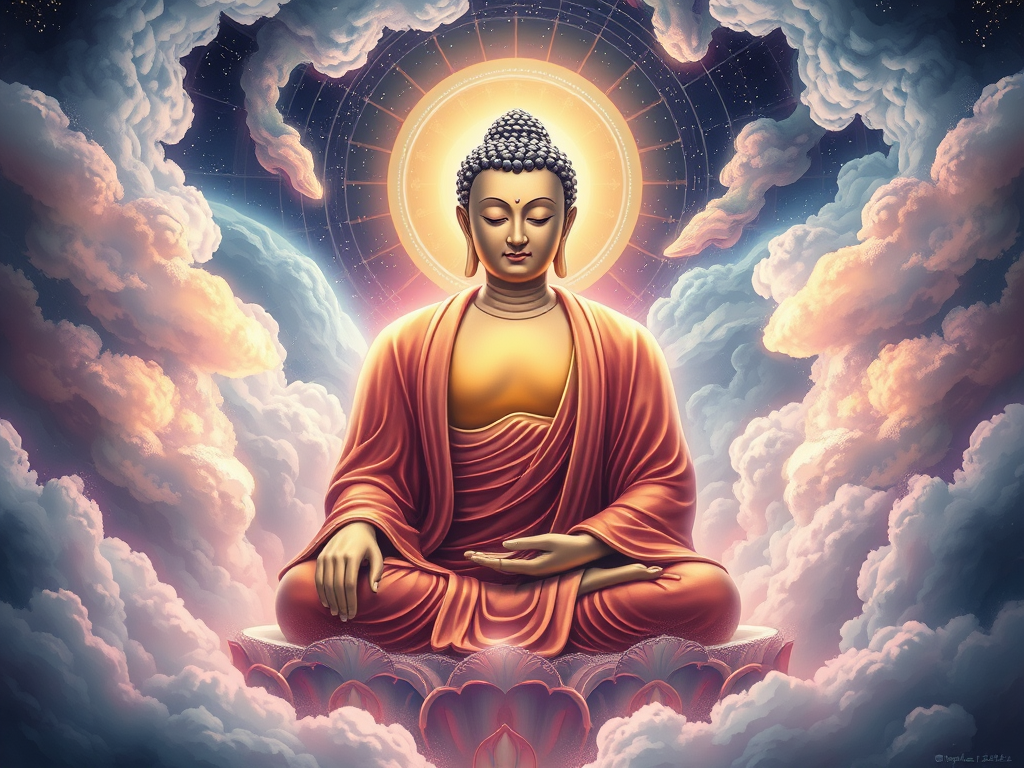
I. Introduction: The Pinnacle of the Lotus – Unveiling the Eternal Buddha
A. Significance of the Lotus Sūtra in Mahāyāna Buddhism
The Saddharma Puṇḍarīka Sūtra, or Lotus Sūtra, stands as a monument within Mahāyāna Buddhist literature, widely regarded as one of the most famous, influential, and revered scriptures.1 It presents what many scholars consider a radical re-visioning of both the ultimate goal of the Buddhist path and the very nature of the Buddha himself.1 Its enduring appeal stems not only from its profound doctrinal pronouncements but also from its masterful use of parables, allegories, and vivid imagery to convey complex truths.2 Two central teachings, in particular, have profoundly shaped the landscape of Mahāyāna thought and practice: the doctrine of the One Vehicle (Skt: Ekayāna), which posits that all diverse Buddhist paths ultimately converge towards the single goal of supreme Buddhahood, and the revelation of the Buddha’s immeasurable lifespan, suggesting his eternal presence and ongoing activity in the world.1 The Sūtra is renowned for its extensive exposition on the concept of skillful means (Skt: upāya-kauśalya or upāya), the manifold strategies Buddhas employ to adapt their teachings to the varying capacities and needs of sentient beings.1 This text has served as a cornerstone for major East Asian Buddhist schools, including Tiantai (in China), Tendai (in Japan), Cheontae (in Korea), and Nichiren Buddhism, and has also exerted considerable influence on Chan/Zen traditions.3
B. Chapter Sixteen (“The Lifespan of the Thus Come One”) as the Sutra’s Climax
Within the intricate tapestry of the Lotus Sūtra, Chapter Sixteen, titled “The Lifespan of the Thus Come One” (Jpn: Nyorai Juryō Hon), occupies a position of paramount importance. In the influential classification system of the Tiantai school, founded by Zhiyi (538–597 CE), this chapter is designated as the very heart of the honmon, or “essential teaching,” comprising the latter fourteen chapters of the Sūtra.6 Its central function is to unveil a truth that dramatically overturns previous understandings: Shakyamuni Buddha did not first attain enlightenment (anuttara-samyak-saṃbodhi) under the Bodhi tree in Gaya during his historical lifetime in India, as was commonly believed. Instead, his Buddhahood was realized in the inconceivably remote past, an immense expanse of time measured in “immeasurable, boundless hundreds, thousands, ten thousands, millions of nayutas of kalpas“.6 This temporal immensity is vividly illustrated through the famous dust-particle analogy, where countless worlds are ground to dust, and particles are dropped across an equally countless number of worlds, with the time elapsed since the Buddha’s enlightenment surpassing even the number of kalpas represented by each particle.6
This revelation represents a pivotal moment in the Sūtra’s narrative and doctrinal unfolding. Tiantai commentators described this shift using phrases like “opening the near and revealing the distant” (kai gon ken non) or “casting off the transient and revealing the true” (hosshaku kempon).6 The “near” or “transient” refers to the historical Shakyamuni, the figure born as Prince Siddhartha who lived and taught in India. The “distant” or “true” refers to the eternal, primordial Buddha (Honbutsu or Origin Buddha, in some Lotus traditions 9), whose existence transcends the limitations of a single human lifespan. Chapter Sixteen, therefore, marks the point where the Sūtra moves beyond the historical manifestation to reveal the fundamental, enduring nature of Buddhahood itself.
C. Overview of the Report’s Scope and Argument
This report undertakes a comprehensive analysis of Chapter Sixteen of the Lotus Sūtra, addressing the multifaceted dimensions of its core revelation. It will examine the context and primary teachings of the chapter, focusing on the unveiling of the Buddha’s eternal nature and the related doctrine of skillful means. A detailed analysis of the specific verse, “The duration of my life is immeasurable,” will explore its textual meaning and broader significance. The report will investigate various interpretations regarding the perception and accessibility of this eternal Buddha, including the view that specific qualities like merit and gentleness are required, as well as alternative perspectives involving inherent Buddha Nature, meditative insight, and devotional faith. Furthermore, it will explore the relationship between the eternal Buddha concept and the Mahāyāna doctrine of the Trikāya (Three Bodies), analyzing how later traditions employed this framework to understand the Sūtra’s message. Finally, the report will assess the profound implications of this teaching for Buddhist practice, faith, and the perceived relationship between practitioners and the Buddha, particularly within traditions that place central emphasis on the Lotus Sūtra. The aim is to provide a rigorous, multi-faceted exploration grounded in textual evidence and scholarly interpretation, illuminating the doctrinal depth and enduring impact of the eternal Buddha concept as presented in this pivotal chapter.
II. The Eternal Lifespan: Context and Core Teachings of Chapter Sixteen
A. The Revelation: Attainment in the Remotest Past
Chapter Sixteen commences after dramatic anticipation, with the Buddha exhorting the assembly three times to believe his words and the assembly four times entreating him to preach.6 He then declares the central, startling message: his attainment of Buddhahood occurred not merely forty-odd years prior in India, but “immeasurable, boundless hundreds, thousands, ten thousands, millions of nayutas of kalpas” ago.6 To convey the sheer magnitude of this timeframe, which defies conventional human comprehension, the Buddha employs a powerful analogy. He asks his audience to imagine taking an immense number of worlds—five hundred, a thousand, ten thousand, a million nayuta asaṃkhya thousand-million-fold worlds—and grinding them into fine dust. Then, traveling eastward, one drops a single particle of this dust only after passing another equally vast number of worlds, continuing until all the dust is deposited. Finally, all the worlds traversed, whether they received a dust particle or not, are themselves ground into dust. The Buddha declares that the time elapsed since his actual enlightenment surpasses the number of kalpas represented by these combined dust particles by “a hundred, a thousand, ten thousand, a million nayuta asaṃkhya kalpas“.6 This cosmically immense period, referred to in commentaries as “numberless major world system dust particle kalpas” (gohyaku jintengō), serves to shatter limited, historical conceptions of the Buddha.6
This revelation is the cornerstone of the Tiantai interpretive principle of “opening the near and revealing the distant” (kai gon ken non) or “casting off the transient and revealing the true” (hosshaku kempon).6 The “near” or “transient” identity is that of Shakyamuni, the historical Buddha who appeared in India. The “distant” or “true” identity is the Buddha who attained enlightenment in the primordial past and remains eternally present. The presentation itself—the initial exhortations to believe, followed by the almost inconceivable scale of the timeframe—functions as a pedagogical strategy. It prepares the audience for a truth that transcends ordinary understanding, requiring a leap of faith and a willingness to abandon conventional frameworks of time and existence. The very difficulty of grasping the analogy underscores the profundity of the teaching and the limitations of unenlightened perception, thereby functioning as a form of skillful means (upāya) to break down preconceived notions about the Buddha’s nature.
B. The Doctrine of Skillful Means (Upāya) in Chapter Sixteen
Integral to understanding the revelation of the eternal Buddha is the Mahāyāna doctrine of skillful means (upāya), which the Lotus Sūtra extensively elaborates.1 Chapter Sixteen explicitly frames the historical life of Shakyamuni Buddha—his birth, renunciation, austerities, enlightenment under the Bodhi tree, forty-plus years of teaching, and eventual entry into Parinirvāṇa—as a manifestation of upāya.6 The Buddha states that although his lifespan is immeasurable and he constantly abides in the world, he appears to enter extinction (“adopt the course of extinction”).7 This seeming death is not an actual cessation but an expedient device employed out of compassion.7
The stated purpose of this skillful means is multi-fold: primarily, “to teach and convert living beings and cause them to enter the Buddha way”.7 By appearing to pass away, the Buddha aims to prevent living beings from becoming complacent or taking his presence for granted, thinking he is always easily available.12 His apparent absence is intended to arouse in them a sense of urgency, longing, and reverence—a “yearning heart”—which makes them more receptive to the Dharma and motivates them to seek enlightenment earnestly.6 He explains that for beings “meager in virtue and heavy with defilement” who delight in lesser teachings, he describes his recent enlightenment in India, but this is merely an upāya to lead them gradually towards the ultimate truth.7 This resonates with the broader theme of the Lotus Sūtra, where the earlier teachings, including the Three Vehicles (triyāna) of the Śrāvaka (voice-hearer), Pratyekabuddha (solitary realizer), and Bodhisattva, are revealed to be skillful means leading ultimately to the One Vehicle (Ekayāna) of Buddhahood.1
C. The Parable of the Skilled Physician
Immediately following the explanation of his apparent Parinirvāṇa as an expedient means, the Buddha relates the parable of the skilled physician and his sick children to illustrate the principle.6 In the story, a wise physician returns home from afar to find his children have accidentally ingested poison. He prepares an excellent medicine, perfect in color, fragrance, and flavor. Some of his children, whose minds are still sound, recognize the medicine’s quality and take it immediately, recovering fully. Others, however, have become delirious due to the poison’s effects (“poison has penetrated deeply and their minds no longer function as before”) and refuse the cure, despite begging their father for help.7 Seeing this, the physician employs another skillful means: he leaves home again and sends back a messenger to report that he has died.6
Shocked and grief-stricken, feeling orphaned and unprotected, the delirious children lament their father’s absence. This profound sense of loss awakens their minds (“at last come to their senses”). They finally recognize the excellence of the medicine their father left behind, take it, and are completely cured.7 The symbolism is clear: the Buddha is the wise physician, sentient beings are the children afflicted by the “poison” of delusion and suffering, the Dharma is the excellent medicine, and the Buddha’s apparent entry into nirvana is the father’s feigned death—an expedient employed out of compassion to awaken those lost in delusion.6 This parable offers a compelling insight into the nature of the Buddha’s compassion and the sophisticated, sometimes seemingly paradoxical, nature of his skillful means. The act of feigning death might appear deceptive by conventional standards, yet it is presented as a necessary and compassionate strategy motivated solely by the desire to save beings who are otherwise unable to accept the help offered directly. It underscores the pragmatic and adaptive pedagogy central to the Lotus Sūtra, where the ultimate aim of liberation may necessitate methods that challenge ordinary expectations.1
D. The Buddha’s Constant Presence and Activity
Crucially, Chapter Sixteen asserts that the Buddha, having attained enlightenment eons ago, is always present and active in this sahā world—the world characterized by suffering that must be endured.6 He declares, “I have always remained in the Saha World, speaking the Dharma to teach and transform beings. Also, in other places… I have guided and benefited living beings”.10 He employs his “Buddha eye” to observe the faith and faculties of beings and appears in different places, under different names, and in different forms (sometimes appearing old, sometimes young) appropriate to their needs.7 This teaching radically departs from earlier Buddhist conceptions, particularly within the Sthaviravāda lineage, which viewed the Buddha primarily as a historical human being who, upon Parinirvāṇa, entered complete cessation, beyond any further interaction with the world.15 The Lotus Sūtra had already challenged the notion of only one Buddha existing at a time through the dramatic appearance of the ancient Buddha Prabhūtaratna in Chapter Eleven, who emerges to validate Shakyamuni’s teaching of the Lotus.1 Chapter Sixteen solidifies this by revealing Shakyamuni himself as eternally present and active.
This eternal presence is grounded in the Buddha’s profound perception of reality. The text states: “The Thus Come One perceives the true aspect of the threefold world exactly as it is. There is no ebb or flow of birth and death, and there is no existing in this world and later entering extinction. It is neither substantial nor empty, neither consistent nor diverse”.7 This description points towards a non-dual understanding of reality, transcending the conventional dichotomies of existence and non-existence, birth and death. It is from this enlightened perspective, which sees the ultimate nature (dharmatā) beyond phenomenal appearances, that the Buddha’s timeless existence and ceaseless compassionate activity arise.
III. “The Duration of My Life is Immeasurable”: Analyzing the Verse and Its Significance
A. Textual Placement and Context
The verse containing the declaration, “The duration of my life is immeasurable” (Jpn: Setsu butsu ju mu ryō), appears in the latter section of Chapter Sixteen.16 It typically follows the Buddha’s explanation of his skillful means (upāya) of appearing to enter nirvana and his description of the qualities required for beings to perceive his true, enduring presence.7 The verse is often embedded within a passage where the Buddha addresses those who possess specific virtues and aspirations:
“To those who have accumulated merits,
And who are gentle and upright,
And who see me living here,
Expounding the Dharma,
I say:
‘The duration of my life is immeasurable.’
To those who see me after a long time,
I say: ‘It is hard to see a Buddha.’” 16
This context highlights that the revelation of the immeasurable lifespan is particularly directed towards, or perceivable by, those who have cultivated certain spiritual qualities and possess a sincere desire to encounter the Buddha.7
B. Deconstructing the Verse
- “The duration of my life”: This phrase does not refer to the eighty-year physical lifespan of the historical figure Siddhartha Gautama, the Nirmāṇakāya or manifestation body.15 Instead, it signifies the lifespan of the enlightened Buddha revealed in this chapter—the Buddha who attained enlightenment in the remote past, sometimes referred to as the Honbutsu (Original Buddha) or the true, eternal Buddha.6 It pertains to the existence of the Buddha in his fundamental, enlightened state.
- “is immeasurable” (Skt: apramāṇa): The term apramāṇa denotes a quantity or duration that is beyond calculation, limitless, and boundless.6 It transcends conventional human frameworks of time and measurement.17 While some discussions debate whether this implies literally infinite or simply inconceivably vast but finite time 11, the overwhelming sense conveyed is one of eternity or timelessness (nitya).11 It points to an existence not bound by the normal constraints of temporal beginning and end.
C. Significance within Chapter Sixteen
This concise verse encapsulates the central and most revolutionary message of Chapter Sixteen: the radical shift in understanding the Buddha’s nature from a finite, historical teacher to an eternal, ever-present reality.1 It serves as the definitive statement of the Buddha’s primordial enlightenment and enduring existence, distinguishing the “true” Buddha from the “transient” manifestation.6 Furthermore, it reinforces the ontological perspective articulated earlier in the chapter, where the Buddha perceives reality as free from the conventional “ebb or flow of birth and death”.7 The immeasurable lifespan is thus intrinsically linked to the Buddha’s transcendence of saṃsāra, the cycle of birth, death, and rebirth, as ordinarily understood.14
D. Significance within the Lotus Sūtra and Mahāyāna
The declaration of the Buddha’s immeasurable lifespan holds profound significance for the Lotus Sūtra as a whole and for the development of Mahāyāna Buddhism. It provides the ontological foundation for the Ekayāna (One Vehicle) doctrine; if the Buddha is eternally present and compassionate, then his salvific activity to guide all sentient beings towards the single goal of Buddhahood is also ceaseless and unwavering.1 This teaching fostered the development of devotional practices directed towards an ever-present, accessible Buddha, rather than solely venerating a revered historical figure who had passed into extinction.4 It offered a powerful counterpoint to earlier Buddhist schools (often categorized by Mahāyānists as Hīnayāna) that primarily emphasized the historical Shakyamuni as a human teacher who attained final cessation (parinirvāṇa).15
The concept signifies more than just an extraordinarily long duration; it implies a fundamental shift in understanding the Buddha’s ontological status. The Buddha is revealed not merely as a being existing within time, however long, but as a reality that transcends time, or perhaps embodies time and eternity in a way that collapses conventional distinctions. This is deeply connected to the Buddha’s realization of the “true aspect” of phenomena, which is unborn, undying, and non-dual.7 The “immeasurable life” thus reflects the timeless, unconditioned nature (often associated with the Dharmakāya, the Body of Truth, as discussed later) that the Buddha embodies or has realized.11 This revelation fundamentally redefines the nature of Buddhahood itself within the Mahāyāna framework.
IV. Conditions for Perceiving the Eternal Buddha: Virtue, Faith, and Interpretation
A. The Role of Virtue and Mental Qualities (Query Interpretation)
Chapter Sixteen explicitly links the ability to perceive the eternal Buddha, or at least to hear the teaching of his immeasurable lifespan, to the cultivation of specific virtues and mental states within the practitioner. The text states that the Buddha reveals himself or his true nature to those “who practice meritorious ways, who are gentle, peaceful, honest and upright”.7 Elsewhere, similar qualities are listed: “truly faithful, honest and upright, gentle in intent, single-mindedly desiring to see the Buddha not hesitating even if it costs them their lives”.7
These qualities represent key aspects of the Buddhist path:
- Merit (puṇya): The accumulation of positive karmic potential through virtuous actions of body, speech, and mind. It creates the foundation for spiritual progress.7
- Gentleness (maitrī, mṛdu, śānta): Encompassing kindness, compassion, peacefulness, and freedom from malice or ill will towards others.7 It signifies an open and receptive heart.
- Uprightness / Honesty (ārjava, ṛju): Moral integrity, truthfulness, adherence to ethical principles (śīla), freedom from deceit and hypocrisy.7
- Faith (śraddhā): Deep trust, confidence, and conviction in the Buddha, the Dharma (his teachings), and the Sangha (the community), serving as a driving force for practice.7
- Single-minded Desire / Seeking Mind: An intense, focused aspiration (adhimukti) to encounter the Buddha and attain enlightenment, demonstrating profound commitment.7
- Willingness to Sacrifice Life: The ultimate expression of devotion and commitment to the path.7
The clear implication of these passages is that the perception of the eternal Buddha is not an automatic or universally accessible experience for unprepared minds. It is contingent upon the practitioner’s spiritual maturity, ethical purity, and devotional intensity.7 Conversely, the chapter suggests that beings engrossed in “evil actions,” lacking these qualities, may spend countless eons without even hearing the names of the Three Treasures (Buddha, Dharma, Sangha), let alone perceiving the Buddha’s eternal nature.7
B. Diverse Interpretations of Perception and Accessibility
While Chapter Sixteen emphasizes virtue and faith as conditions for perceiving the eternal Buddha, the history of interpretation within Mahāyāna reveals a broader spectrum of views on how this perception or realization occurs. These interpretations often reflect the specific doctrinal orientations and practical emphases of different schools and traditions.
- 1. Perception as Conditional (Virtue/Faith-Based): This interpretation adheres closely to the explicit statements in Chapter Sixteen, emphasizing that ethical cultivation (śīla), accumulation of merit (puṇya), development of virtues like gentleness and uprightness, and deep faith (śraddhā) are necessary prerequisites to “see” the Buddha or fully grasp the teaching of his eternal life.7 This perspective underscores the importance of gradual practice and purification. Traditions like Nichiren Buddhism place a particularly strong emphasis on faith as the fundamental cause for attaining enlightenment and perceiving the true nature of the Buddha revealed in the Lotus Sūtra.20
- 2. Perception as Inherent Realization (Buddha Nature): Drawing connections to the Mahāyāna doctrine of Buddha Nature (tathāgatagarbha), some interpretations posit that the eternal Buddha is not an external entity to be perceived, but rather the inherent, true nature of one’s own mind or life.1 The Soka Gakkai International (SGI), following the teachings of Nichiren Daishonin as interpreted by Daisaku Ikeda, strongly advocates this view: “We are all ‘eternal Buddhas’”.24 Chapter Sixteen is seen as revealing the “original life” inherent in all beings across the Ten Worlds.24 Perception, in this context, becomes synonymous with awakening to this innate Buddhahood. The practice, primarily chanting Nam-myoho-renge-kyo with faith in the Gohonzon (mandala), is understood as the direct means to manifest this inherent potential.19 This view shifts the focus from perceiving an external Buddha to realizing the Buddha within.
- 3. Perception through Meditative Insight/Vision: Although the Lotus Sūtra itself places less overt emphasis on specific meditation techniques compared to some other scriptures, Mahāyāna traditions have developed complex systems of contemplation (guan) aimed at realizing profound truths and achieving visions of Buddhas and Pure Lands.27 Texts like the Samādhi Sea Sutra detail practices involving contemplation of Buddha images (xiang 像) to generate mental images (xiang 想) or visions, blurring the line between physical representation and mental realization.27 Some practitioners report experiential dimensions while engaging with sutras, including “vistas, visions, feelings of bliss, sometimes even a trance,” suggesting that encountering the Dharma can involve non-conceptual, potentially visionary states.23 Within the Tiantai school, sophisticated meditative practices like the contemplation of “three thousand realms in a single moment of life” (ichinen sanzen) are employed to directly perceive the ultimate reality embodied by the eternal Buddha.23 This approach emphasizes cognitive and experiential insight achieved through structured contemplation.
- 4. Perception as Encountering the Buddha’s Activity/Vow (Zen/Action-Oriented): Certain perspectives, particularly those informed by Zen Buddhism, interpret the eternal Buddha’s presence not as a static entity but as dynamic activity and compassionate vow, accessible in the present moment through one’s own engagement with the world.12 The eternal Buddha (identified in some Zen commentaries on the Lotus Sutra with the Sambhogakāya) declares “I am always here, preaching the Law,” and this presence is accessed not by seeking an external figure, but through activating the Bodhisattva vows to liberate all beings.12 Maezumi Roshi’s pointed response, “It’s you, stupid!” when asked about the Sambhogakāya, highlights the immediacy and inherent nature of this reality.12 Similarly, the Chan master Linji located the Trikāya (the three bodies of the Buddha) within the “pure light of your own heart [mind] at this instant”.12 This interpretation emphasizes embodied practice, compassionate action, and the realization of Buddhahood through engagement with the world, seeing the Buddha’s presence manifest in the vow to save others.29
- 5. Perception as Understanding Non-Duality (Philosophical/Scholarly): From a philosophical standpoint, “perceiving” the eternal Buddha can be understood as grasping the profound non-dual teachings presented in Chapter Sixteen and related Mahāyāna doctrines. This involves comprehending the statements that there is “no ebb or flow of birth and death,” “no existence in the world or passage into quiescence,” and that reality is “neither substantial nor empty”.7 It requires understanding the implications of emptiness (śūnyatā) and dependent origination (pratītyasamutpāda), which reveal that phenomena lack inherent, independent existence.30 The realization that saṃsāra (the cycle of suffering) and nirvāṇa (liberation) are not ultimately separate realities is central to this understanding.9 The intellectual struggle reflected in debates about whether the Buddha’s lifespan is finite or infinite, or how the Nirmāṇakāya relates to the Dharmakāya 11, represents attempts to conceptually penetrate this non-dual view. The seeming “double-speak” in the text might itself be an upāya designed to push the listener beyond the limitations of dualistic thought.11
C. Comparative Analysis of Interpretations on Perceiving the Eternal Buddha
The diverse ways of understanding how one perceives or accesses the eternal Buddha revealed in Chapter Sixteen can be summarized as follows:
| Interpretive Lens | Basis of Perception | Key Supporting Snippets | Core Argument/Emphasis |
| Textual Literal (Ch 16) | Accumulated Merit, Virtue (Gentleness, Uprightness), Faith | 7 | Perception is conditional upon ethical purity, positive karma, and devotional aspiration explicitly stated in the text. |
| Devotional/Faith (Nichiren) | Deep Faith (śraddhā), Seeking Mind, Chanting Daimoku | 19 | Unwavering faith in the Lotus Sūtra and the practice of chanting its title are paramount for accessing Buddhahood. |
| Inherent Nature (Buddha Nature/SGI) | Awakening to Innate Buddhahood, Practice (Chanting) | 19 | The eternal Buddha is one’s own true nature; perception is realization of this inherent potential through practice. |
| Meditative/Visionary (Tiantai/Viz.) | Meditative Samādhi, Contemplation (Guan), Visions | 23 | Perception occurs through specific contemplative practices leading to insight, realization, or visionary experiences. |
| Action/Vow (Zen) | Bodhisattva Vow, Compassionate Action, Present Moment | 12 | The eternal Buddha is encountered dynamically through committed action, vow, and presence in the here-and-now. |
| Philosophical/Non-Dual | Understanding Emptiness (Śūnyatā), Non-Duality | 7 | Perception is achieved through intellectual and experiential grasp of non-dual reality, transcending concepts. |
These varied interpretations do not necessarily represent mutually exclusive categories but rather a spectrum of approaches to accessing the profound reality revealed in Chapter Sixteen. This spectrum ranges from views emphasizing conditional access based on earned merit and cultivated faith, reflecting a more gradual path, to perspectives highlighting the unconditional inherence of Buddhahood (Buddha Nature), realizable immediately through specific practices or insights. This diversity itself can be understood as reflecting the Lotus Sūtra’s core principle of upāya, or skillful means – the understanding that different approaches and pedagogical emphases are necessary to guide beings of varying capacities and inclinations towards the ultimate goal.1 The Sūtra’s message proves adaptable, resonating within devotional, meditative, philosophical, and action-oriented frameworks within Mahāyāna Buddhism.
V. Doctrinal Context: The Eternal Buddha and the Trikāya
A. Introduction to the Trikāya (Three Bodies) Doctrine
To fully appreciate the doctrinal implications of the eternal Buddha revealed in Lotus Sūtra Chapter Sixteen, it is helpful to consider the Mahāyāna doctrine of the Trikāya, or Three Bodies of the Buddha. Although developed more systematically in schools like Yogācāra and later Mahāyāna thought, the Trikāya provides a crucial framework used by many traditions to interpret the multifaceted nature of Buddhahood presented in scriptures like the Lotus Sūtra.2 The doctrine posits that Buddhahood manifests in three distinct, yet ultimately inseparable, aspects or “bodies” (kāya) 30:
- Dharmakāya (Dharma Body / Body of Essence): This represents the ultimate, absolute aspect of Buddhahood. It is equated with ultimate reality (dharmatā), truth itself, emptiness (śūnyatā), the unmanifested essence, and the fundamental Buddha Nature inherent in all things.15 Often described as formless, unborn, undying, and transcending all conceptualization and dualities 33, the Dharmakāya is considered the fundamental ground or basis from which the other two bodies arise.33 It represents the Buddha’s wisdom and realization of the true nature of phenomena.
- Sambhogakāya (Body of Enjoyment / Reward Body): This is a subtle, blissful, and radiant body, often described as quasi-divine.30 It is the “reward” body resulting from the immense merit accumulated over countless eons of Bodhisattva practice.28 The Sambhogakāya typically appears in celestial Pure Lands, adorned with the characteristic marks of a Buddha, preaching the Mahāyāna Dharma to assemblies of advanced Bodhisattvas.15 It can manifest in countless forms according to the needs of beings and possesses vast powers.33 While glorious and long-lasting, its existence is sometimes viewed as having a beginning (resulting from practice) in contrast to the beginningless Dharmakāya.12
- Nirmāṇakāya (Manifestation Body / Transformation Body): This is the physical, manifest body that appears in the ordinary world (saṃsāra) to teach the Dharma to sentient beings, including humans and gods.15 The historical Buddha, Siddhartha Gautama, is considered a prime example of a Nirmāṇakāya. This body is an expedient means (upāya), a compassionate manifestation adapted to the capabilities of ordinary beings.1 It undergoes apparent birth, aging, sickness, and death, though Mahāyāna views this as a skillful display rather than an ultimate reality.33
Mahāyāna sources consistently emphasize that these three bodies are not separate entities but rather different functions, modes (vṛṭṭis), or aspects of a single, non-dual Buddhahood.28 They represent the way Buddhahood is simultaneously transcendent (Dharmakāya), gloriously manifest to advanced beings (Sambhogakāya), and compassionately active in the mundane world (Nirmāṇakāya).33
B. Relating Chapter Sixteen’s Eternal Buddha to the Trikāya
The relationship between the eternal Buddha revealed in Lotus Sūtra Chapter Sixteen and the Trikāya doctrine is complex and subject to interpretation. Some scholars and traditional sources note that the explicit, systematized Trikāya theory, particularly with the distinct Sambhogakāya, is not found in the Lotus Sūtra itself.2 The Sūtra tends to operate more with a distinction between the Rūpakāya (Form Body, akin to Nirmāṇakāya) and the Dharmakāya (Dharma Body, representing the teachings or ultimate reality).2 The full Trikāya framework achieved prominence later, particularly within the Yogācāra school.2
Despite the lack of explicit terminology, many Mahāyāna traditions, especially those centered on the Lotus Sūtra like Tiantai/Tendai and Nichiren, have retrospectively interpreted the profound implications of Chapter Sixteen through the lens of the Trikāya.9 The eternal Buddha described in the chapter exhibits characteristics that resonate with different aspects of the Trikāya:
- Correlation with Dharmakāya: The emphasis on the Buddha’s timelessness, his transcendence of birth and death (“no ebb or flow of birth and death”), his attainment in the remotest past, and his identity with ultimate truth strongly aligns with descriptions of the Dharmakāya.11 The Dharmakāya represents the unconditioned, absolute nature of Buddhahood, which the eternal Buddha of Chapter Sixteen clearly embodies.7
- Correlation with Sambhogakāya: The depiction of the Buddha constantly residing in his Pure Land (“this, my land, remains safe and tranquil”), eternally preaching the Dharma from a state of bliss, and possessing inconceivable powers aligns well with the Sambhogakāya.12 The “immeasurable lifespan” itself could be seen as characteristic of the vast, though perhaps not absolutely beginningless, existence of a Sambhogakāya, the fruit of eons of practice.12
- Correlation as an Integrated Whole: Many interpretations view the eternal Buddha of Chapter Sixteen not as corresponding solely to one body, but as representing the integration of all three.9 From this perspective, the historical Shakyamuni (Nirmāṇakāya) is revealed as merely one manifestation (upāya) of this primordial Buddha, who possesses both the ultimate, unconditioned nature (Dharmakāya) and the blissful, meritorious qualities (Sambhogakāya) resulting from his original enlightenment and practice. Nichiren schools, for example, assert that the Original Buddha’s three bodies are without beginning or end.9 The Chan master Linji’s interpretation radically internalizes this, finding the Dharmakāya, Sambhogakāya, and Nirmāṇakāya all present within one’s own mind at the present moment.28
C. Nuances and Interpretive Flexibility
The application of the Trikāya framework to Chapter Sixteen is not without its ambiguities, leading to ongoing discussion and varied interpretations.11 Is the “immeasurable lifespan” primarily a characteristic of the Dharmakāya’s timelessness, or the Sambhogakāya’s vast reward, or even an inconceivably extended Nirmāṇakāya manifestation? Is the eternal Buddha fundamentally the Dharmakāya, with the other bodies as its expressions, or is it a primordial Sambhogakāya from which Nirmāṇakāyas emanate?
One specific interpretation found within Lotus-based schools posits that after the revelation in Chapter Sixteen, the Dharmakāya can be understood as the Lotus Sūtra itself (the ultimate teaching), the Sambhogakāya as the Buddha’s original enlightenment attained in the remote past, and the Nirmāṇakāya as all the myriad forms the Buddha has taken, takes, and will take throughout time to teach beings the essential Dharma.9
The very fact that Chapter Sixteen predates the fully codified Trikāya doctrine allows for this interpretive flexibility. The Sūtra’s powerful depiction of a Buddha transcending historical limitations undoubtedly influenced the subsequent development and understanding of the Trikāya doctrine, particularly enriching the conceptions of the Dharmakāya’s timelessness and the Sambhogakāya’s glorious, enduring nature. The eternal Buddha of the Lotus Sūtra provided fertile ground for later Mahāyāna thinkers seeking to articulate the comprehensive, multi-dimensional reality of Buddhahood. The application of the Trikāya framework, in turn, provided later traditions with a sophisticated vocabulary to unpack the profound implications of Chapter Sixteen’s revelation. This interplay demonstrates how Buddhist doctrine evolves through the interaction between foundational scriptures and later interpretive frameworks.
VI. Enduring Legacy: Implications for Buddhist Faith and Practice
The revelation of the Buddha’s eternal nature in Chapter Sixteen of the Lotus Sūtra has had far-reaching and transformative consequences for Mahāyāna Buddhist faith, practice, and worldview. Its impact resonates across numerous traditions, fundamentally reshaping the understanding of the Buddha, the path to enlightenment, and the nature of reality itself.
A. Transforming the Practitioner-Buddha Relationship
Perhaps the most immediate impact of Chapter Sixteen’s teaching is the radical transformation of the relationship between the practitioner and the Buddha. The focus shifts away from relating primarily to a revered historical teacher, Shakyamuni, who lived in India and entered Parinirvāṇa centuries ago 15, towards engaging with an eternally present, living, and accessible Buddha.1 This fosters a sense of intimacy, immediacy, and potential encounter. The Buddha is not a distant figure confined to the past, but is declared to be “always here” (jō zai shi, 常在此), constantly abiding in this world and actively involved in the liberation of beings.12
Interpretations that locate the eternal Buddha within one’s own inherent nature or mind further deepen this intimacy, collapsing the distance between practitioner and ultimate reality.12 Faith (śraddhā) is thus directed not only towards the historical Buddha’s past teachings but also towards his ongoing compassionate presence and activity, and potentially towards the Buddhahood latent within oneself.19 This perspective provides immense hope, encouragement, and courage to practitioners, assuring them that Buddhahood is a potential available to all beings without exception 1, and that the eternal Buddha’s power and wisdom are constantly available to aid them in transforming suffering and realizing their highest potential.14
B. Impact on Practice Across Traditions
The concept of the eternal Buddha has profoundly shaped the devotional and practical landscape of various Mahāyāna schools, particularly those centered on the Lotus Sūtra:
- Tiantai/Tendai: For these schools, Chapter Sixteen is the doctrinal apex. Practice is intricately linked to understanding and realizing the truths revealed therein. Complex meditative and contemplative practices, such as the visualization of “three thousand realms in a single moment of life” (ichinen sanzen), are employed to directly apprehend the non-dual reality embodied by the eternal Buddha.23 The Lotus Sūtra itself becomes the central object of devotion, study, recitation, and copying, seen as the direct expression of the eternal Buddha’s enlightenment.4 Tiantai/Tendai emphasizes the harmonious integration of doctrinal study (kyō) and meditative practice (kan) based on the Lotus Sūtra’s ultimate teaching.
- Nichiren Buddhism: This tradition places exclusive devotion on the Lotus Sūtra, viewing it as the sole efficacious teaching for the current degenerate age (the Latter Day of the Law, mappō).38 Chapter Sixteen’s revelation of the eternal Buddha is paramount. The primary practice, established by Nichiren (1222–1282), is the chanting of the Sūtra’s title, the daimoku—Namu Myoho Renge Kyo—with deep faith.4 This act is not seen merely as preparatory but as the direct cause and effect of Buddhahood, allowing the practitioner to immediately tap into the life-state of the eternal Buddha and manifest their own inherent Buddhahood.19 The Gohonzon, a calligraphic mandala devised by Nichiren, serves as the object of devotion, embodying the eternal Buddha, the Law (Myoho Renge Kyo), and the interconnectedness of all life states within the ultimate reality revealed in the Lotus Sūtra.20 For Nichiren, “embracing the Gohonzon is in itself observing one’s mind” and attaining Buddhahood.26 Furthermore, Nichiren Buddhism strongly emphasizes “bodily reading” the Sūtra, which involves not just recitation and faith, but also courageous action in society to establish the “true Dharma” and create a peaceful world (risshō ankoku).4 Faith is considered the indispensable element for activating the power of the practice.20
- Zen Buddhism: While Zen traditions generally prioritize direct, non-conceptual experience and meditation over scriptural reliance, the philosophical and pedagogical insights of the Lotus Sūtra, such as skillful means (upāya) and the universal potential for Buddhahood, have been influential.3 Some Zen interpretations engage with the eternal Buddha concept by relating it to the timeless nature of the present moment, the inherent luminosity of mind (Buddha Nature), or the dynamic expression of the Bodhisattva vow in action.12 The emphasis shifts from devotional reliance on an external Buddha figure towards the immediate realization of one’s own true nature through meditative practice (zazen) and mindful engagement with life.
- General Mahāyāna: Across the broader Mahāyāna landscape, the concept of an eternal, cosmic Buddha reinforces the Bodhisattva ideal. The Bodhisattva’s vow to delay personal nirvana and work tirelessly for the liberation of all beings mirrors the eternal Buddha’s ceaseless compassionate activity described in Chapter Sixteen.3 This teaching provides a powerful justification and inspiration for the arduous Bodhisattva path. It also supports the development of rich devotional traditions centered on various cosmic Buddhas (like Amitābha, Vairocana) and Bodhisattvas (like Avalokiteśvara, Kṣitigarbha), who are seen as accessible embodiments of the eternal compassionate wisdom revealed in texts like the Lotus Sūtra.30
C. Implications for Understanding Life, Death, and Reality
The teaching of the eternal Buddha carries profound implications for the fundamental understanding of existence:
- Life and Death: It challenges conventional, linear views of life and death, suggesting an underlying continuity and eternity that transcends individual birth and demise.7 The Buddha’s apparent death is revealed as an expedient means, implying that death itself, from the ultimate perspective, may not be the absolute cessation it appears to be. Death is repositioned within the larger, more essential context of eternal life.14
- Saṃsāra and Nirvāṇa: The teaching contributes significantly to the Mahāyāna understanding that saṃsāra (the cycle of suffering and rebirth) and nirvāṇa (liberation) are not fundamentally separate or opposed realities.9 If the eternal Buddha is always present in the sahā world, then this world of suffering itself possesses the potential to be the Pure Land, the realm of enlightenment.4 Liberation is not necessarily about escaping this world, but about transforming one’s perception and realizing the ultimate reality inherent within it.
- Inherent Potential: The concept strongly reinforces the Mahāyāna doctrine of inherent Buddha Nature (tathāgatagarbha or buddhadhātu)—the teaching that all sentient beings possess the innate potential for enlightenment.1 If the Buddha is eternal and fundamentally represents the true nature of reality, and if this Buddha declares that his purpose is to make all beings equal to himself 39, it implies that this eternal nature is accessible or inherent within everyone.
Across the diverse interpretations and practices inspired by Chapter Sixteen, a consistent theme emerges: a radical affirmation of immanence. The ultimate, the eternal, the enlightened reality—the Buddha—is not confined to a transcendent realm separate from this world. Instead, it is fully present and accessible within this sahā world 7, within the lives of ordinary, suffering beings 24, and within the very practices undertaken for liberation, whether chanting, meditation, or compassionate action.12 This shift away from seeking salvation solely in a distant future or realm towards realizing the ultimate within the immediate, phenomenal reality constitutes one of the most profound and enduring legacies of the Lotus Sūtra’s revelation of the eternal Buddha.
VII. Conclusion: The Enduring Resonance of the Eternal Buddha
A. Synthesis of Findings
Chapter Sixteen, “The Lifespan of the Thus Come One,” stands as the doctrinal heart of the Lotus Sūtra, unveiling the revolutionary teaching of Shakyamuni Buddha’s eternal nature. The chapter reveals that his attainment of enlightenment occurred not in his historical lifetime but in the inconceivably remote past, and that his apparent life, death, and Parinirvāṇa were skillful means (upāya) employed out of profound compassion to guide sentient beings. The verse “The duration of my life is immeasurable” encapsulates this core message, signifying a reality that transcends conventional limitations of time and the cycle of birth and death. This eternal Buddha is described as ever-present in the sahā world, constantly working for the liberation of all beings.
The perception or realization of this eternal Buddha, however, is presented through diverse interpretive lenses across Mahāyāna traditions. While Chapter Sixteen itself emphasizes the importance of accumulated merit, ethical virtues (gentleness, uprightness), deep faith, and a sincere seeking mind as conditions for perception, other interpretations highlight different pathways. Some traditions, particularly those influenced by Buddha Nature thought and certain Nichiren schools, emphasize realizing the eternal Buddha as one’s own inherent nature through faith and dedicated practice like chanting. Others, like Tiantai, focus on achieving insight through sophisticated meditative contemplations. Zen perspectives often point towards encountering the Buddha’s dynamic presence in the immediate moment through vow and compassionate action. Philosophical interpretations focus on grasping the non-dual nature of reality described in the text. Later Mahāyāna traditions often utilized the Trikāya doctrine (Dharmakāya, Sambhogakāya, Nirmāṇakāya) as a framework to understand the multifaceted nature of this eternal Buddha, correlating his timeless essence, blissful reward body, and manifest forms with the three bodies, despite the doctrine not being explicit in the Sūtra itself.
B. The Transformative Power of the Teaching
The revelation presented in Chapter Sixteen fundamentally transformed the understanding of Buddhahood within Mahāyāna Buddhism. It shifted the primary focus from veneration of a historical figure who had passed away to faith in and engagement with a living, eternal, and universally accessible principle or presence. This had profound implications for understanding the nature of reality, suggesting the non-duality of saṃsāra and nirvāṇa, and the potential for this world itself to be the Buddha Land. Crucially, it powerfully affirmed the Mahāyāna vision of universal liberation, grounding the Ekayāna (One Vehicle) teaching in the eternal Buddha’s ceaseless compassionate activity and underscoring the inherent potential for Buddhahood within all sentient beings.
C. Continuing Relevance
The teaching of the eternal Buddha, as articulated in Chapter Sixteen of the Lotus Sūtra, continues to hold immense significance for millions of Buddhists worldwide. It serves as a deep wellspring of faith, offering solace and encouragement through the assurance of the Buddha’s constant presence and unwavering compassion.24 It inspires dedicated practice, whether through chanting, meditation, study, or acts of service, by holding out the promise of attaining the same enlightened state. It provides a philosophical foundation for understanding life and death within a larger, eternal context, and fuels the Bodhisattva aspiration to work for the happiness and liberation of all beings, mirroring the eternal Buddha’s own vow.3 The radical immanence suggested by the teaching—that the ultimate reality is accessible here and now, within oneself and within this world—remains a potent and transformative message. The enduring resonance of Chapter Sixteen lies in its profound capacity to awaken practitioners to the boundless potential of life and the ever-present possibility of enlightenment.
Works cited
- Lotus Sutra – Wikipedia, accessed April 13, 2025, https://en.wikipedia.org/wiki/Lotus_Sutra
- The Rain of the Dharma | Text – Free Buddhist Audio, accessed April 13, 2025, https://www.freebuddhistaudio.com/texts/read?num=181&at=text&q=zen&p=4
- The Seven Great Parables of the Lotus Sutra; some of the most important teachings of Buddha for the Mahayana Buddhist path, accessed April 13, 2025, https://buddhaweekly.com/the-seven-great-parables-of-the-lotus-sutra-some-of-the-most-important-teachings-of-buddha-for-the-mahayana-buddhist-path/
- Nichiren’s Activist Heirs – Princeton University, accessed April 13, 2025, http://princeton.edu/~jstone/Articles%20on%20the%20Lotus%20Sutra%20Tendai%20and%20Nichiren%20Buddhism/Nichiren%20Activist%20Heirs.pdf
- Just A Stupid Question,But Can Tendai And Zen Be Syncretically Combined? – Reddit, accessed April 13, 2025, https://www.reddit.com/r/Buddhism/comments/1ac07ap/just_a_stupid_questionbut_can_tendai_and_zen_be/
- “Life Span of the Thus Come One” chapter | Dictionary of Buddhism, accessed April 13, 2025, https://www.nichirenlibrary.org/en/dic/Content/L/34
- The Lotus Sutra[16] – The Life Span of the Tathagata – nichiren.info, accessed April 13, 2025, https://nichiren.info/buddhism/lotussutra/text/chap16.html
- LS21 – 500 Yojanas, accessed April 13, 2025, https://www.500yojanas.org/tag/ls21/
- The Trikaya in Nichiren Buddhism – Dharma Wheel, accessed April 13, 2025, https://www.dharmawheel.net/viewtopic.php?t=17426
- Lotus Sutra – Chapter 16, accessed April 13, 2025, https://www.buddhistdoor.com/OldWeb/resources/sutras/lotus/sources/lotus16.htm
- lotus sutra – lifespan of the tathagata..??? – Dharma Wheel, accessed April 13, 2025, https://www.dharmawheel.net/viewtopic.php?t=26758
- I Am Always Here! – Zen Center of Los Angeles, accessed April 13, 2025, https://zcla.org/i-am-always-here/
- My Difficulties with the Lotus Sutra – Tea House, accessed April 13, 2025, https://teahouse.buddhistdoor.net/my-difficulties-with-the-lotus-sutra/
- Key Passages From The Record of the Orally Transmitted Teachings (Part 12), accessed April 13, 2025, https://www.worldtribune.org/2024/key-passages-from-the-record-of-the-orally-transmitted-teachings-part-12/
- The Doctrine of Kaya (Trikaya), accessed April 13, 2025, https://www.repository.cam.ac.uk/bitstreams/05035204-bd79-4bea-b5e0-02ac940b831b/download
- Materialien zum Neobuddhismus: Japanischer Buddhismus in Amerika – Payer.de, accessed April 13, 2025, http://www.payer.de/neobuddhismus/neobud04041.htm
- I read the Lotus Sutra. I didn’t understand it. – Forums – Treeleaf Zendo, accessed April 13, 2025, https://forum.treeleaf.org/forum/treeleaf/treeleaf-community-topics-about-zen-practice/archive-of-older-threads/11505-i-read-the-lotus-sutra-i-didn-t-understand-it
- Question about the Lotus Sutra : r/Buddhism – Reddit, accessed April 13, 2025, https://www.reddit.com/r/Buddhism/comments/khntwr/question_about_the_lotus_sutra/
- Nichiren Buddhism – Wikipedia, accessed April 13, 2025, https://en.wikipedia.org/wiki/Nichiren_Buddhism
- The Daimoku, the Honzon and the Kaidan – Buddhism: The Way of Emptiness, accessed April 13, 2025, https://buddhism-thewayofemptiness.blog.nomagic.uk/the-daimoku-the-honzon-and-the-kaidan/
- A Handbook for Members of the Nichiren Sect, accessed April 13, 2025, https://sacramentonichirenchurch.org/home/about-nichiren-shu/a-handbook-for-members-of-the-nichiren-sect/
- Questions and Answers about Embracing the Lotus Sutra | WND I, accessed April 13, 2025, https://www.nichirenlibrary.org/en/wnd-1/Content/8
- Practice of the Lotus Sutra? – Dharma Wheel, accessed April 13, 2025, https://www.dharmawheel.net/viewtopic.php?t=13650
- Buddhism: The Wisdom of the Lotus Sutra | Daisaku Ikeda Official …, accessed April 13, 2025, https://www.daisakuikeda.org/main/philos/essays-on-buddhism/buddh-lotus.html
- true Buddha | Dictionary of Buddhism, accessed April 13, 2025, https://www.nichirenlibrary.org/en/dic/Content/T/262
- three thousand realms in a single moment of life | Dictionary of Buddhism, accessed April 13, 2025, https://www.nichirenlibrary.org/en/dic/Content/T/176
- Visualization/Contemplation Sutras (Guan Jing) | Oxford Research Encyclopedia of Religion, accessed April 13, 2025, https://oxfordre.com/religion/display/10.1093/acrefore/9780199340378.001.0001/acrefore-9780199340378-e-770?d=%2F10.1093%2Facrefore%2F9780199340378.001.0001%2Facrefore-9780199340378-e-770&p=emailA%2FRUqHC2SjSjU
- Trikaya (Buddha’s 3 Bodies), Pure Land – Dharma Wheel, accessed April 13, 2025, https://www.dharmawheel.net/viewtopic.php?t=17376
- Buddhism and the Lotus Sutra | Daisaku Ikeda Official Website, accessed April 13, 2025, https://www.daisakuikeda.org/main/philos/buddhist/buddh-02.html
- Trikaya | Three Bodies, Three Jewels, Mahayana | Britannica, accessed April 13, 2025, https://www.britannica.com/topic/trikaya
- Trikaya (Buddha’s 3 Bodies), Pure Land – Page 2 – Dharma Wheel, accessed April 13, 2025, https://www.dharmawheel.net/viewtopic.php?t=17376&start=20
- What is the Lotus Sutra? – Dharma Wheel, accessed April 13, 2025, https://www.dharmawheel.net/viewtopic.php?t=44921
- Trikaya – Wikipedia, accessed April 13, 2025, https://en.wikipedia.org/wiki/Trikaya
- Mahayana, Dharma, Sutras – Buddhism – Britannica, accessed April 13, 2025, https://www.britannica.com/topic/Buddhism/Mahayana
- Need help understanding the three Buddha bodies, the Trikaya doctrine. Mahayana Buddhism. – Reddit, accessed April 13, 2025, https://www.reddit.com/r/Buddhism/comments/5rxjni/need_help_understanding_the_three_buddha_bodies/
- Eternal Buddha in the 16th chapter of the Lotus-Sutra – Dharma Wheel, accessed April 13, 2025, https://www.dharmawheel.net/viewtopic.php?t=45502
- Shakyamuni as the Eternal Buddha – Dharma Wheel, accessed April 13, 2025, https://www.dharmawheel.net/viewtopic.php?t=26553
- Nichiren | Oxford Research Encyclopedia of Religion, accessed April 13, 2025, https://oxfordre.com/religion/viewbydoi/10.1093/acrefore/9780199340378.013.575
- Chapter 4: Nichiren Daishonin and the Lotus Sutra | Soka Gakkai (global), accessed April 13, 2025, https://www.sokaglobal.org/resources/study-materials/buddhist-study/the-basics-of-nichiren-buddhism-for-the-new-era-of-worldwide-kosen-rufu/chapter-4.html
 Mr. Altig’s Overview of the Wonderful Dharma of the Lotus Sutra
Leave a comment