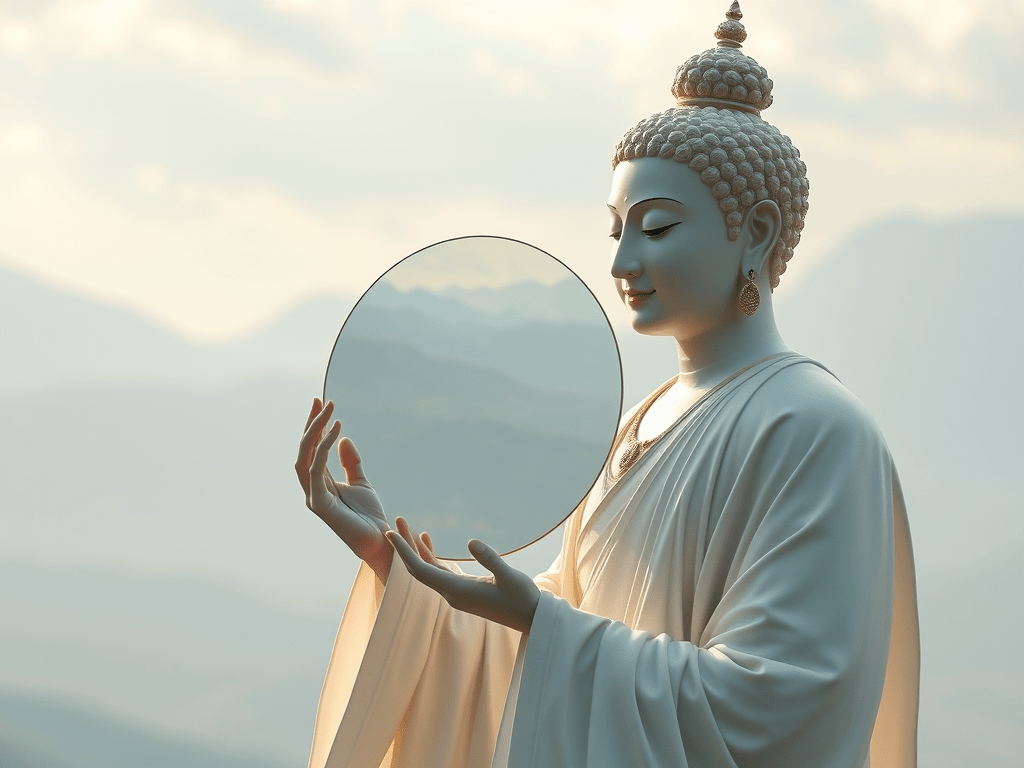
The Lotus Sūtra, revered across East Asia, stands as a cornerstone of Mahayana Buddhism, celebrated for its profound teachings that illuminate the inherent potential for Buddhahood within all beings.1 Its central doctrine of the One Vehicle (ekayāna) posits that despite the myriad paths and practices, the ultimate destination for all is the attainment of Buddhahood.1 Within this influential scripture, Chapter Nineteen, titled “The Benefits of the Teacher of the Law,” occupies a significant place, detailing the merits and virtues accrued by those who dedicate themselves to upholding, reading, reciting, explaining, preaching, or transcribing the Lotus Sūtra.8 It is within this chapter that the Buddha addresses Constant-Endeavor Bodhisattva, employing the powerful analogy of the clear mirror to illustrate the profound clarity of perception attained by those who embrace the Sutra.8 This report will delve into the rich layers of this passage, exploring its immediate context within Chapter Nineteen, the fundamental Buddhist concepts it invokes, its philosophical resonance with emptiness and non-self, its practical applications in daily life, and its ultimate message regarding the understanding of the true nature of beings.
Chapter Nineteen of the Lotus Sūtra, in its exploration of the merits of a Dharma Master, outlines a series of extraordinary benefits bestowed upon those who diligently engage with its teachings.8 The chapter commences with the Buddha addressing the Bodhisattva Constant Exertion (also known as Ever-Vigorous), declaring that individuals who accept and uphold the Lotus Sūtra through various means will obtain a multitude of benefits across their six sense organs.8 These benefits are described in detail, including eight hundred merits of the eye, twelve hundred of the ear, eight hundred of the nose, twelve hundred of the tongue, eight hundred of the body, and twelve hundred of the mind.8 This purification and enhancement of the senses enable the practitioner to perceive the world with exceptional clarity, extending their vision and hearing far beyond ordinary human capabilities.8 The specific verses containing the “clear mirror” analogy illustrate this enhanced perception, stating that the pure body of the Bodhisattva who keeps the Sutra will reflect all things in the world as a clear mirror reflects images.8 This imagery suggests an unmediated and accurate perception of reality, devoid of the usual filters of expectation and delusion. The chapter consistently emphasizes the profound merit and virtue of a Dharma Master, someone dedicated to explaining and propagating the Lotus Sūtra, highlighting the significance of both personal practice and the active dissemination of the Dharma.9
In the context of Mahayana Buddhism, a Bodhisattva is defined by their profound aspiration for enlightenment, not merely for personal liberation but for the sake of all sentient beings.18 This altruistic motivation, known as bodhicitta, is coupled with a deep and unwavering compassion for the suffering of others.18 The Lotus Sūtra particularly emphasizes the role of the Bodhisattvas of the Earth, who emerge in vast numbers in Chapter Fifteen with a specific mission to propagate the Sutra’s teachings during the challenging era of the Latter Day of the Law (mappō).28 These Bodhisattvas, embodying the very essence of the Lotus teachings, strive tirelessly to awaken the inherent Buddha-nature within all individuals.29 Furthermore, the Lotus Sūtra presents exemplary figures like Bodhisattva Never Disparaging in Chapter Twenty, whose unwavering reverence for the Buddha-nature in every person, even in the face of persecution, serves as a powerful model for practitioners.29 The ideal of the Bodhisattva, therefore, is not a remote concept but an active engagement with the world, driven by compassion and the commitment to guide all beings towards enlightenment, a path intrinsically linked to the practice and propagation of the Lotus Sūtra.
“Keeping the Lotus Sūtra” as a practice encompasses a range of activities, each contributing to the accumulation of merit and the purification of the practitioner.8 These practices include accepting the Sutra with faith, upholding its teachings in one’s life, diligently reading and reciting its verses, explaining its meaning to others, fearlessly preaching its wisdom, and even transcribing its sacred text.8 Chapter Nineteen meticulously details the extraordinary benefits that arise from these dedicated engagements, particularly the purification and enhancement of the six sense organs, leading to an unprecedented clarity in perceiving the myriad phenomena of the world.8 Beyond these immediate benefits, the Lotus Sūtra is revered as containing the very essence of the Buddha’s enlightenment, a direct path to attaining Buddhahood in this very lifetime for those who embrace its teachings.3 This path, however, is not without its challenges, particularly in the degenerate age of the Latter Day of the Law, where upholding the Sutra may be met with difficulties and opposition.45 Yet, the unwavering commitment to the “strategy of the Lotus Sūtra,” which involves grounding one’s life in faith and practice, is presented as the most effective means to navigate these challenges and achieve a victorious and fulfilling existence.47
Constant-Endeavor Bodhisattva, also known as Ever-Vigorous or Satatasamitabhiyukta, occupies a significant position in Chapter Nineteen of the Lotus Sūtra as the primary interlocutor to whom the Buddha reveals the profound merits of a Dharma Master.8 This Bodhisattva is also listed among the eighty thousand Bodhisattva-mahāsattvas present in the vast assembly during the Buddha’s preaching in the introductory chapter of the Sutra.52 The very name “Constant-Endeavor” (or its variations) suggests a being characterized by persistent effort, unwavering diligence, and an unyielding commitment to the path of the Bodhisattva.15 This quality of constant striving is particularly relevant in the context of upholding the Lotus Sūtra, a practice that, as noted earlier, may encounter obstacles.45 Therefore, Constant-Endeavor Bodhisattva serves as a powerful exemplar for all practitioners who aspire to realize the transformative benefits of the Lotus Sūtra, highlighting the necessity of sustained and vigorous effort in one’s spiritual journey.16 While perhaps not as widely recognized as some other prominent Bodhisattvas, their direct reception of these crucial teachings in Chapter Nineteen underscores the importance of dedication and perseverance for all those who engage with the Dharma, regardless of their perceived prominence or status.8
The analogy of the “clear mirror” holds deep significance in Buddhist philosophy, serving as a potent symbol for the mind’s capacity to reflect reality with accuracy and purity when free from the obscurations of defilement.57 In the Lotus Sūtra, particularly within the context of Chapter Nineteen, this analogy is used to describe the purified vision of the Bodhisattva who diligently upholds the Sutra.8 The pure body of such a Bodhisattva becomes like a flawless mirror, capable of reflecting all phenomena of the world without distortion.8 Commentaries, such as those by Nichiren Daishonin, elaborate on this, suggesting that the Lotus Sūtra itself acts as a profound mirror, reflecting not only outward appearances but also the inner workings of the mind, the karmic imprints of past actions, and even the potential for future enlightenment.57 This contrasts with the concept of a “tarnished mirror,” which symbolizes a mind obscured by illusions, attachments, and the inherent darkness of life.46 The practice of Buddhism, particularly the chanting of Nam-myoho-renge-kyo in the Nichiren tradition, is often likened to the process of “polishing the mirror” of one’s life, gradually removing these defilements to reveal the innate clarity and Buddha-nature within.46
The ability to see “all things clearly” without the filter of expectations, as described in the Lotus Sūtra, finds profound resonance with the core Buddhist principles of emptiness (sunyata) and non-self (anatman).6 Emptiness, a central tenet of Mahayana philosophy, teaches that all phenomena, including beings, lack inherent, independent existence.6 Understanding emptiness allows one to transcend fixed notions and preconceived ideas, recognizing the interconnected and impermanent nature of reality.76 Similarly, the principle of non-self (anatman) asserts the absence of a permanent, unchanging self or essence in any phenomenon.85 Expectations, often rooted in ego-driven desires and attachments to a perceived self, can cloud our judgment and distort our perception of others and the world. The realization of emptiness and non-self helps to dismantle these attachments, fostering a more open and unbiased way of seeing.84 This clear seeing, informed by wisdom (prajna), aligns with the purified senses described in Chapter Nineteen, enabling the Bodhisattva to perceive the true nature of phenomena, their emptiness, and their interconnectedness, free from the limitations imposed by ego and expectation.96
The “clear mirror” teaching from the Lotus Sūtra holds profound practical implications for navigating the complexities of daily life.40 By striving to see ourselves and others without the filters of preconceived notions and expectations, we can cultivate a more mindful and compassionate approach to our interactions.46 This clear seeing is intrinsically linked to the development of compassion (karuna), as recognizing the shared nature of suffering and the interconnectedness of all beings fosters empathy and the desire to alleviate that suffering.112 Furthermore, wisdom (prajna) guides our actions when we perceive reality clearly, enabling us to respond to situations with greater skill and benefit.97 By consciously observing our thoughts and emotions without judgment, akin to looking into a clear mirror, we can gain deeper self-awareness and identify the root causes of our own suffering and the suffering we inflict upon others.46 This practice cultivates a more open and receptive attitude towards others, allowing us to see their potential for enlightenment and respond with greater understanding and kindness.
Understanding the “true natures” of beings, as opposed to their perceived or conditioned natures, is a cornerstone of Buddhist philosophy and a key to fostering more harmonious interactions and reducing conflict.1 In Buddhism, the “true nature” often refers to the inherent Buddha-nature present within all sentient beings, or their fundamental emptiness of inherent existence.34 Recognizing this inherent potential for enlightenment in everyone, as emphasized in the Lotus Sūtra, fosters a deep sense of respect and understanding, transcending the superficial differences and conditioned behaviors that often lead to conflict.6 Interactions based on perceived or conditioned natures are often filtered through our own ego, expectations, and biases, leading to misunderstandings, judgments, and ultimately, conflict. However, by cultivating the ability to see the “true nature” – the potential for Buddhahood – we can approach others with greater empathy, patience, and a willingness to understand their perspectives, even when they differ from our own. This aligns with the concept of skillful means (upaya), where interactions are tailored to the individual’s capacity and aimed at guiding them towards enlightenment.1
In conclusion, the Buddha’s declaration to Constant-Endeavor Bodhisattva in Chapter Nineteen of the Lotus Sūtra, particularly the analogy of the clear mirror, encapsulates a profound teaching on the transformative power of embracing and propagating the Lotus Dharma. This teaching underscores that dedicated practice leads to a purified state of being, enabling a clear and undistorted perception of reality, free from the filters of ego and expectation. This clear seeing is deeply intertwined with the core Buddhist principles of emptiness and non-self, fostering wisdom and compassion in the practitioner. The practical applications of this teaching extend to our daily interactions, encouraging mindfulness, empathy, and a recognition of the inherent Buddha-nature within all beings, ultimately paving the way for more harmonious relationships and a reduction in conflict. The wisdom embedded in the “clear mirror” analogy serves as a timeless guide, urging us to transcend our limited perceptions and embrace the true potential for enlightenment that resides within ourselves and all those we encounter.
Works cited
- Lotus Sutra – Wikipedia, accessed April 29, 2025, https://en.wikipedia.org/wiki/Lotus_Sutra
- Lotus sutra pdf – GM Binder, accessed April 29, 2025, https://www.gmbinder.com/share/-OFoA1aZbNWVGzhXLuR6
- The Humanism of the Lotus Sutra – SGI USA, accessed April 29, 2025, https://www.sgi-usa.org/the-humanism-of-the-lotus-sutra/
- Tiantai Lotus Texts – dBET PDF Version © 2017, accessed April 29, 2025, https://bdkamerica.org/download/1901
- The Essence of the “Medicine King” Chapter | WND I – Nichiren Buddhism Library, accessed April 29, 2025, https://www.nichirenlibrary.org/en/wnd-1/Content/12
- The Lotus Sutra, accessed April 29, 2025, https://www.bdk.or.jp/document/dgtl-dl/dBET_T0262_LotusSutra_2007.pdf
- What exactly is “the lotus sutra” all about? And why does it make Nichiren different? – Reddit, accessed April 29, 2025, https://www.reddit.com/r/Buddhism/comments/7vn4h5/what_exactly_is_the_lotus_sutra_all_about_and_why/
- The Lotus Sutra[19] – The Benefits of the Teacher of the Law – nichiren.info, accessed April 29, 2025, https://nichiren.info/buddhism/lotussutra/text/chap19.html
- Lotus Sutra – Chapter 19 – Shurangama Temple, accessed April 29, 2025, https://langnghiem.com/en/lotus-sutra-chapter-19/
- The Wonderful Dharma Lotus Flower Sutra with Commentary 19 – City of Ten Thousand Buddhas, accessed April 29, 2025, https://www.cttbusa.org/dfs19/dfs19.asp.html
- Lotus Sutra – Chapter 19, accessed April 29, 2025, https://www.buddhistdoor.com/OldWeb/resources/sutras/lotus/sources/lotus19.htm
- Chapter 19: Benefits – Xuanfa Institute, accessed April 29, 2025, https://xuanfa.net/buddha-dharma/tripitaka/sutras/lotus-sutra/chapter-19-benefits/
- The Lotus Sutra: Chapter 19 – Sacred Texts, accessed April 29, 2025, https://sacred-texts.com/bud/lotus/lot19.htm
- The Wonderful Dharma Lotus Flower Sutra 19 – City of Ten Thousand Buddhas, accessed April 29, 2025, https://www.cttbusa.org/lotus/lotus19.asp.html
- The Lotus Sutra: Chapter 18 – Sacred Texts, accessed April 29, 2025, https://sacred-texts.com/bud/lotus/lot18.htm
- Benefits of the Teacher of the Law | LSOC | Nichiren Buddhism Library, accessed April 29, 2025, https://www.nichirenlibrary.org/en/lsoc/Content/19
- The Wonderful Dharma Lotus Flower Sutra – City of 10,000 Buddhas, accessed April 29, 2025, https://www.cttbusa.org/lotus/lotus_contents.asp.html
- The Bodhisattva Ideal in Mahayana Buddhism – Dhamma Wheel Buddhist Forum, accessed April 29, 2025, https://www.dhammawheel.com/viewtopic.php?t=29567
- What is a Bodhisattva? – Gleanings in Buddha-Fields, accessed April 29, 2025, https://nembutsu.cc/2022/01/20/what-is-a-bodhisattva/
- Bodhisattvas in the Lotus and Other Sutras, accessed April 29, 2025, http://buddhism.lib.ntu.edu.tw/FULLTEXT/JR-JOS/jos94089.htm
- The Bodhisattva Ideal – Dharmanet, accessed April 29, 2025, https://dharmanet.org/coursesM/31/bodhisattva1.htm
- Bodhisattva | EBSCO Research Starters, accessed April 29, 2025, https://www.ebsco.com/research-starters/social-sciences-and-humanities/bodhisattva
- Bodhisattva – Wikipedia, accessed April 29, 2025, https://en.wikipedia.org/wiki/Bodhisattva
- What is a bodhisattva? – Tricycle: The Buddhist Review, accessed April 29, 2025, https://tricycle.org/beginners/buddhism/what-is-a-bodhisattva/
- Bodhisattva | Buddhist Ideal & Path to Enlightenment | Britannica, accessed April 29, 2025, https://www.britannica.com/topic/bodhisattva
- Bodhisattva | Lion’s Roar, accessed April 29, 2025, https://www.lionsroar.com/buddhism/bodhisattva/
- What is A Bodhisattva? Mahayana Buddhism & Meditation | Mindworks, accessed April 29, 2025, https://mindworks.org/blog/what-is-a-bodhisattva/
- http://www.worldtribune.org, accessed April 29, 2025, https://www.worldtribune.org/2024/the-cluster-of-blessings-brought-by-thebodhisattvas-of-the-earth/#:~:text=Revitalizing%20all%20people%20from%20the,are%20Bodhisattvas%20of%20the%20Earth.
- The Cluster of Blessings Brought by the Bodhisattvas of the Earth – World Tribune, accessed April 29, 2025, https://www.worldtribune.org/2024/the-cluster-of-blessings-brought-by-thebodhisattvas-of-the-earth/
- Bodhisattvas of the Earth – Wikipedia, accessed April 29, 2025, https://en.wikipedia.org/wiki/Bodhisattvas_of_the_Earth
- Bodhisattvas of the Earth – Dharma Wheel, accessed April 29, 2025, https://www.dharmawheel.net/viewtopic.php?t=29242
- Bodhisattvas of the Earth | Dictionary of Buddhism, accessed April 29, 2025, https://www.nichirenlibrary.org/en/dic/Content/B/45
- The Bodhisattva Opens the Way to Happiness for All – World Tribune, accessed April 29, 2025, https://www.worldtribune.org/2021/bodhisattva/
- Chapter 4: Nichiren Daishonin and the Lotus Sutra | Soka Gakkai (global), accessed April 29, 2025, https://www.sokaglobal.org/resources/study-materials/buddhist-study/the-basics-of-nichiren-buddhism-for-the-new-era-of-worldwide-kosen-rufu/chapter-4.html
- Part 3: Kosen-rufu and World Peace Chapter 22: The Mission and Vow of the Bodhisattvas of the Earth [22.1] – Soka Gakkai, accessed April 29, 2025, https://www.sokaglobal.org/resources/study-materials/buddhist-study/the-wisdom-for-creating-happiness-and-peace/chapter-22-1.html
- Living the Bodhisattva Ideal: A Conversation with Prof. em. Helwig Schmidt-Glintzer, accessed April 29, 2025, https://www.sokaglobal.org/resources/expert-perspectives/helwig-schmidt-glintzer-living-the-bodhisattva-ideal.html
- The Gist of Practicing The Lotus Sutra – NBA Nichiren Shu San Francisco Bay Area, accessed April 29, 2025, https://www.nichirenbayarea.org/the-gist-of-practicing-the-lotus-sutra
- Embodying the Spirit of “True Cause” – World Tribune, accessed April 29, 2025, https://www.worldtribune.org/2019/embodying-the-spirit-of-true-cause/
- Key Passages From The Record of the Orally Transmitted Teachings (Part 14), accessed April 29, 2025, https://www.worldtribune.org/2024/key-passages-from-the-record-of-the-orally-transmitted-teachings-part-14/
- Resolving Conflicts as Buddhists – SGI USA, accessed April 29, 2025, https://www.sgi-usa.org/2022/08/01/resolving-conflicts-as-buddhists/
- The Lotus Sutra – SGI USA, accessed April 29, 2025, https://www.sgi-usa.org/the-humanism-of-the-lotus-sutra/the-lotus-sutra/
- What is the Lotus Sutra? – Dharma Wheel, accessed April 29, 2025, https://www.dharmawheel.net/viewtopic.php?t=44921
- Questions and Answers about Embracing the Lotus Sutra | WND I, accessed April 29, 2025, https://www.nichirenlibrary.org/en/wnd-1/Content/8
- 134 – Lotus Sutra 1: What Is Devotion, and How Does It Fulfill the Buddha Way?, accessed April 29, 2025, https://zenstudiespodcast.com/devotion-as-path-in-the-lotus-sutra/
- benefits from chanting – Dharma Wheel, accessed April 29, 2025, https://www.dharmawheel.net/viewtopic.php?t=34743
- Chapter 3: Faith and Practice | Soka Gakkai (global), accessed April 29, 2025, https://www.sokaglobal.org/resources/study-materials/buddhist-study/the-basics-of-nichiren-buddhism-for-the-new-era-of-worldwide-kosen-rufu/chapter-3.html
- ‘The Strategy of the Lotus Sutra’ – World Tribune, accessed April 29, 2025, https://www.worldtribune.org/2023/buddhist-studythe-strategy-of-the-lotus-sutra/
- Q: What does it mean to use the strategy of the Lotus Sutra? – World Tribune, accessed April 29, 2025, https://www.worldtribune.org/2019/what-does-it-mean-to-use-the-strategy-of-the-lotus-sutra/
- Chapter 19: The Merits of the Teacher of the Dharma | 500 Yojanas, accessed April 29, 2025, https://www.500yojanas.org/lotus-sutra/chapter19/
- Lotus Sutra | The Dōgen Institute, accessed April 29, 2025, https://dogeninstitute.wordpress.com/tag/lotus-sutra/
- Shakyamuni as the Eternal Buddha – Dharma Wheel, accessed April 29, 2025, https://www.dharmawheel.net/viewtopic.php?t=26553
- Lotus Sutra With Annotations – 500 Yojanas, accessed April 29, 2025, https://www.500yojanas.org/lotus-sutra/annotations/
- The Lotus Sutra[1] – Introduction – nichiren.info, accessed April 29, 2025, https://nichiren.info/buddhism/lotussutra/text/chap01.html
- Lotus Sutra (Saddharma-Pundarika): Chapter 18, accessed April 29, 2025, https://www.wisdomlib.org/buddhism/book/lotus-sutra-saddharma-pundarika/d/doc1460872.html
- Bodhisattva’s exertion: Significance and symbolism, accessed April 29, 2025, https://www.wisdomlib.org/concept/bodhisattvas-exertion
- A Brave and Vigorous Spirit – World Tribune, accessed April 29, 2025, https://www.worldtribune.org/2021/a-brave-and-vigorous-spirit/
- Part 1: Happiness; Chapter 3: The Practice for Transforming Our State of Life [3.5] – Soka Gakkai, accessed April 29, 2025, https://www.sokaglobal.org/resources/study-materials/buddhist-study/the-wisdom-for-creating-happiness-and-peace/chapter-3-5.html
- Buddhism Is the Clear Mirror That Reflects Our Lives – World Tribune, accessed April 29, 2025, https://www.worldtribune.org/2025/buddhism-is-the-clear-mirror-that-re%EF%AC%82ects-our-lives/
- Buddhism is the Clear Mirror That Reflects Our Lives – World Tribune, accessed April 29, 2025, https://www.worldtribune.org/2023/buddhism-is-the-clear-mirror-that-reflects-our-lives/
- The Gohonzon – SGI USA, accessed April 29, 2025, https://www.sgi-usa.org/2022/08/12/the-gohonzon/
- Clear mirror: Significance and symbolism, accessed April 29, 2025, https://www.wisdomlib.org/concept/clear-mirror
- What does the Zen concept “polishing the mirror” mean? – Reddit, accessed April 29, 2025, https://www.reddit.com/r/zen/comments/kreueg/what_does_the_zen_concept_polishing_the_mirror/
- Buddhist mirror – Green Shinto -, accessed April 29, 2025, https://www.greenshinto.com/2012/05/29/buddhist-mirror/
- A Good Hard Look in the Mirror – The Dewdrop, accessed April 29, 2025, https://thedewdrop.org/2024/11/05/a-look-in-the-mirror-nelson-foster/
- What does the Zen concept “polishing the mirror” mean? : r/Buddhism – Reddit, accessed April 29, 2025, https://www.reddit.com/r/Buddhism/comments/kreyl1/what_does_the_zen_concept_polishing_the_mirror/
- 19 On the Ancient Mirror – thezensite, accessed April 29, 2025, https://www.thezensite.com/ZenTeachings/Dogen_Teachings/Shobogenzo/019kokyo.pdf
- The Mirror of the Mind – Sravasti Abbey – A Buddhist Monastery, accessed April 29, 2025, https://sravastiabbey.org/the-mirror-of-the-mind/
- Mirror – Columbia tibetan studies, accessed April 29, 2025, https://blogs.cuit.columbia.edu/ajw2203/2019/07/23/mirror/
- Wipe the Mirror – Cameron Trimble, accessed April 29, 2025, https://camerontrimble.com/2022/08/09/wipe-the-mirror/
- Mirror Allegory in Japanese Buddhism (Zeho Miwa), accessed April 29, 2025, https://www.min.ac.jp/img/pdf/labo-sh06_01L.pdf
- Buddhism Is The Clear Mirror That Reflects Our Lives – Lotus Flower, accessed April 29, 2025, http://lotusflowersgi.blogspot.com/2010/11/buddhism-is-clear-mirror-that-reflects.html
- http://www.sokaglobal.org, accessed April 29, 2025, https://www.sokaglobal.org/resources/study-materials/buddhist-study/the-wisdom-for-creating-happiness-and-peace/chapter-3-5.html#:~:text=%E2%80%9CA%20bronze%20mirror%20will%20reflect,and%20future%20as%20well.%E2%80%9D%20(
- Holding Up the Mirror to Buddha-nature: Discerning the Ghee in the Lotus Sūtra, accessed April 29, 2025, https://www.researchgate.net/publication/225349680_Holding_Up_the_Mirror_to_Buddha-nature_Discerning_the_Ghee_in_the_Lotus_Sutra
- Śūnyatā – Wikipedia, accessed April 29, 2025, https://en.wikipedia.org/wiki/sunyata
- Sunyata: Beyond Emptiness : r/Buddhism – Reddit, accessed April 29, 2025, https://www.reddit.com/r/Buddhism/comments/1h1w6n3/sunyata_beyond_emptiness/
- Emptiness (Sunyata) – Lion’s Roar, accessed April 29, 2025, https://www.lionsroar.com/buddhism/emptiness-sunyata/
- Four Teachings on Sunyata (Emptiness in Buddhism) – Tricycle: The Buddhist Review, accessed April 29, 2025, https://tricycle.org/article/sunyata-emptiness/
- Śūnyam and Śūnyatā | Encyclopedia.com, accessed April 29, 2025, https://www.encyclopedia.com/environment/encyclopedias-almanacs-transcripts-and-maps/sunyam-and-sunyata
- The Power Of Emptiness | Shunyata | Buddha Wisdom – YouTube, accessed April 29, 2025, https://www.youtube.com/watch?v=2__uCIoUxD4
- Buddhist Emptiness Explained – SEEKER TO SEEKER, accessed April 29, 2025, https://www.seekertoseeker.com/buddhist-emptiness-explained/
- Buddhist Emptiness Explained – YouTube, accessed April 29, 2025, https://www.youtube.com/watch?v=wcc_qdzpeDY
- What do Buddhists mean when they talk about emptiness?, accessed April 29, 2025, https://tricycle.org/beginners/buddhism/what-do-buddhists-mean-when-they-talk-about-emptiness/
- I am unclear on the concept of Sunyata/emptiness : r/Buddhism – Reddit, accessed April 29, 2025, https://www.reddit.com/r/Buddhism/comments/g8707c/i_am_unclear_on_the_concept_of_sunyataemptiness/
- A simple analogy to understand emptiness : r/streamentry – Reddit, accessed April 29, 2025, https://www.reddit.com/r/streamentry/comments/1hd4ilb/a_simple_analogy_to_understand_emptiness/
- Anattā – Wikipedia, accessed April 29, 2025, https://en.wikipedia.org/wiki/Anatt%C4%81
- The Buddha’s skillful use of a self view while affirming anatta – No Unchanging Self, accessed April 29, 2025, https://www.dhammawheel.com/viewtopic.php?t=48599
- Anātman, the Buddhist Doctrine of No-Self: Why ‘You’ Do Not Really Exist, accessed April 29, 2025, https://philosophybreak.com/articles/anatman-buddhist-doctrine-of-no-self-why-you-do-not-really-exist/
- Against No-A¯ tman Theories of Anatta¯ – PhilArchive, accessed April 29, 2025, https://philarchive.org/archive/MIRANT
- Why continue to live if there is no self? : r/Buddhism – Reddit, accessed April 29, 2025, https://www.reddit.com/r/Buddhism/comments/1h1wg4p/why_continue_to_live_if_there_is_no_self/
- Anātman, the Buddhist Doctrine of No-Self – Dharma Wheel, accessed April 29, 2025, https://www.dharmawheel.net/viewtopic.php?t=43093
- Often misunderstood as denying personhood, the Buddhist doctrine of no-self (anātman) simply aims to deflate the grasping ego. By seeing ourselves for what we really are — bundles of ever-changing processes — we can undermine anxiety, and live more peaceful lives. : r/philosophy – Reddit, accessed April 29, 2025, https://www.reddit.com/r/philosophy/comments/12p7px2/often_misunderstood_as_denying_personhood_the/
- Not Self, No Self, Non Self: Interpretations of Anatta – Still Mountain, accessed April 29, 2025, https://stillmountainmeditation.org/anatta-no-self/
- How is “no self” (Anatta) supposed to be a good outcome from the practice?, accessed April 29, 2025, https://philosophy.stackexchange.com/questions/121503/how-is-no-self-anatta-supposed-to-be-a-good-outcome-from-the-practice
- Impermanent self – anatman – Buddhism Stack Exchange, accessed April 29, 2025, https://buddhism.stackexchange.com/questions/22750/impermanent-self
- “There is no self.”: The Concept of No Self in Buddhism – Tricycle: The Buddhist Review, accessed April 29, 2025, https://tricycle.org/magazine/there-no-self/
- Lotus Sutra – Buddhism Network, accessed April 29, 2025, https://buddhismnetwork.com/2020/03/28/lotus-sutra/
- Clear seeing: Significance and symbolism, accessed April 29, 2025, https://www.wisdomlib.org/concept/clear-seeing
- Cultivating Clear Comprehension – Dharma Wisdom, accessed April 29, 2025, https://dharmawisdom.org/cultivating-clear-comprehension/
- Wisdom | Lion’s Roar, accessed April 29, 2025, https://www.lionsroar.com/buddhism/wisdom/
- Illumination: Seeing Clearly to Our True Nature – The Tattooed Buddha, accessed April 29, 2025, https://thetattooedbuddha.com/2019/04/16/illumination-seeing-clearly-to-our-true-nature/
- Discovering your Buddha Nature with Jack Kornfield, accessed April 29, 2025, https://jackkornfield.com/sp/discovering-your-buddha-nature-with-jack-kornfield/
- Buddha’s wisdom | Buddho.org, accessed April 29, 2025, https://buddho.org/buddhas-wisdom/
- Simply Rest in Knowing – Barre Center for Buddhist Studies, accessed April 29, 2025, https://www.buddhistinquiry.org/article/simply-rest-in-knowing/
- Practicing the Perfection of Wisdom – Namchak Community, accessed April 29, 2025, https://www.namchak.org/community/blog/practicing-the-perfection-of-wisdom/
- Buddha Nature in Zen – Dharma Wheel, accessed April 29, 2025, https://www.dharmawheel.net/viewtopic.php?t=30844
- Dhamma as a Mirror – Dhamma Wheel Buddhist Forum, accessed April 29, 2025, https://www.dhammawheel.com/viewtopic.php?t=44656
- The Buddha in Your Mirror: Practical Buddhism and the Search for Self – Amazon.com, accessed April 29, 2025, https://www.amazon.com/Buddha-Your-Mirror-Practical-Buddhism/dp/0967469716
- Use the dharma as a mirror, not as a window. : r/Buddhism – Reddit, accessed April 29, 2025, https://www.reddit.com/r/Buddhism/comments/5ggkni/use_the_dharma_as_a_mirror_not_as_a_window/
- Part 1: Happiness; Chapter 3: The Practice for Transforming Our State of Life [3.15] – Soka Gakkai, accessed April 29, 2025, https://www.sokaglobal.org/resources/study-materials/buddhist-study/the-wisdom-for-creating-happiness-and-peace/chapter-3-15.html
- The Entity of the Mystic Law | WND I – Nichiren Buddhism Library, accessed April 29, 2025, https://www.nichirenlibrary.org/en/wnd-1/Content/47
- The Lotus Sutra as Rhetorical Doctrine: Toward a Spiritual Paradigm Shift in Academia – ScholarWorks @ UTRGV, accessed April 29, 2025, https://scholarworks.utrgv.edu/cgi/viewcontent.cgi?article=1065&context=jostes
- The Nature of Compassion – Barre Center for Buddhist Studies, accessed April 29, 2025, https://www.buddhistinquiry.org/article/the-nature-of-compassion/
- Clearing the Waters Within: A Meditation for Clarity and Compassion, accessed April 29, 2025, https://www.drkarenwalant.com/blog/2021/10/26/clearing-the-waters-within-a-meditation-for-clarity-and-compassion
- Wisdom & Compassion: The Two Wings of Meditation Practice, accessed April 29, 2025, https://www.meditationmag.com/blog/wisdom-compassion-two-wings-meditation-practice/
- Is there something special about compassion in Buddhism? – Reddit, accessed April 29, 2025, https://www.reddit.com/r/Buddhism/comments/5ci39u/is_there_something_special_about_compassion_in/
- The near enemy of compassion (sadness & karuna) – Q & A – SuttaCentral, accessed April 29, 2025, https://discourse.suttacentral.net/t/the-near-enemy-of-compassion-sadness-karuna/36103
- Unfolding the Wings of Acceptance – Tara Brach, accessed April 29, 2025, http://blog.tarabrach.com/2012/05/unfolding-wings-of-acceptance.html
- Wisdom x Compassion = Freedom | Lion’s Roar, accessed April 29, 2025, https://www.lionsroar.com/wisdom-x-compassion-freedom/
- Why is compassion necessary to eliminate suffering? : r/Buddhism – Reddit, accessed April 29, 2025, https://www.reddit.com/r/Buddhism/comments/wpv227/why_is_compassion_necessary_to_eliminate_suffering/
- Near Enemy of Compassion: Sadness or Pity? – Dhamma Wheel Buddhist Forum, accessed April 29, 2025, https://www.dhammawheel.com/viewtopic.php?t=43635
- Radical Acceptance of Desire – Tara Brach, accessed April 29, 2025, http://blog.tarabrach.com/2012/07/radical-acceptance-of-desire.html
- Conflict Management by Buddhist Peaceful Means of Loving-kindness (metta) – ThaiJo, accessed April 29, 2025, https://so06.tci-thaijo.org/index.php/Jiabu/article/download/208965/144852/
- [:en]Awaken the Mind to See Its True Nature; Seeing the True Nature, One Becomes a Buddha.[:], accessed April 29, 2025, https://buddhagate.org/awaken-the-mind-to-see-its-true-nature-seeing-the-true-nature-one-becomes-a-buddha/
- Buddha-Nature and the Clear Light Mind – Study Buddhism, accessed April 29, 2025, http://studybuddhism.com/en/advanced-studies/lam-rim/buddha-nature/buddha-nature-and-the-clear-light-mind
- Buddha-nature – Wikipedia, accessed April 29, 2025, https://en.wikipedia.org/wiki/Buddha-nature
- Buddha Nature: Our Underlying Wholeness – Insight Timer Blog, accessed April 29, 2025, https://insighttimer.com/blog/buddha-nature-reflection-and-meditation-on/
- Why Buddhanature Matters | Lion’s Roar, accessed April 29, 2025, https://www.lionsroar.com/why-buddhanature-matters/
- Can someone help me understand Buddha nature? : r/Buddhism – Reddit, accessed April 29, 2025, https://www.reddit.com/r/Buddhism/comments/sllf2/can_someone_help_me_understand_buddha_nature/
- 204 – Buddha-Nature: What the Heck is It and How Do We Realize It? Part 2, accessed April 29, 2025, https://zenstudiespodcast.com/buddha-nature-awakening/
- Chapter 4 – Understanding The Lotus Sutra – Wisdom Library, accessed April 29, 2025, https://www.wisdomlib.org/buddhism/article/a-house-on-fire/d/doc1869.html
- The True Aspect of All Phenomena | WND I – Nichiren Buddhism Library, accessed April 29, 2025, https://www.nichirenlibrary.org/en/wnd-1/Content/40
- Beginner’s questions: Where are the teachings actually located in the Lotus sutra? (split), accessed April 29, 2025, https://www.dharmawheel.net/viewtopic.php?t=45354
- I read the Lotus Sutra. I didn’t understand it. – Forums – Treeleaf Zendo, accessed April 29, 2025, https://forum.treeleaf.org/forum/treeleaf/treeleaf-community-topics-about-zen-practice/archive-of-older-threads/11505-i-read-the-lotus-sutra-i-didn-t-understand-it
- The Lotus Sutra – Chapter Two – Skillful Means | Celestial Drum Tendai Buddhist Sangha, accessed April 29, 2025, https://www.adirondacktendai.org/the-lotus-sutra/the-lotus-sutra-%E2%80%93-chapter-two-%E2%80%93-skillful-means/
- Struggling With Lotus Sutra – Dharma Wheel, accessed April 29, 2025, https://www.dharmawheel.net/viewtopic.php?t=43812
- Question about the Lotus Sutra : r/Buddhism – Reddit, accessed April 29, 2025, https://www.reddit.com/r/Buddhism/comments/khntwr/question_about_the_lotus_sutra/
- The Exoteric Perspective on Buddha-Nature – Tsadra Foundation, accessed April 29, 2025, https://buddhanature.tsadra.org/index.php/Books/Mind_at_Ease/The_Exoteric_Perspective_on_Buddha-Nature
- The Threefold Lotus Sutra, accessed April 29, 2025, https://rksabuddhistcenter.org/wp-content/uploads/2019/03/ThreefoldLotusSutra.pdf
- Sutra of Innumerable Meanings – 500 Yojanas, accessed April 29, 2025, https://www.500yojanas.org/lotus-sutra/full-text/sutra-of-innumerable-meanings/
- DHARMA EYE – SOTOZEN.COM, accessed April 29, 2025, https://www.sotozen.com/eng/dharma/pdf/22e.pdf
- Huayan Buddhism – Stanford Encyclopedia of Philosophy, accessed April 29, 2025, https://plato.stanford.edu/archIves/sum2020/entries/buddhism-huayan/
- The Object of Devotion for Observing the Mind Established in the Fifth Five-Hundred-Year Period after the Thus Come One’s Passing | WND I | Nichiren Buddhism Library, accessed April 29, 2025, https://www.nichirenlibrary.org/en/wnd-1/Content/39
- Ichinen Sanzen Pt4 – Buddhastate, accessed April 29, 2025, https://www.buddhastate.com/2012/05/ichinen-sanzen-pt4/
- THE WAY TO PEACE: A BUDDHIST PERSPECTIVE Theresa Der-lan Yeh, accessed April 29, 2025, https://www3.gmu.edu/programs/icar/ijps/vol11_1/11n1Yeh.pdf
- Buddhism & Conflict – Tibetan Conflict Resolution Centre, accessed April 29, 2025, https://tccr.org/buddhism-conflict/
- Cultivating Compassion Over Conflict: A Reminder for Our Buddhist Community – Reddit, accessed April 29, 2025, https://www.reddit.com/r/Buddhism/comments/1gqnzir/cultivating_compassion_over_conflict_a_reminder/
- Toward a Buddhist Theory of Conflict Transformation: From Simple Actor-Oriented Conflict to Complex Structural Conflict – NSUWorks, accessed April 29, 2025, https://nsuworks.nova.edu/cgi/viewcontent.cgi?referer=&httpsredir=1&article=1450&context=pcs
- The Buddha Taught Nonviolence, Not Pacifism – Barre Center for Buddhist Studies, accessed April 29, 2025, https://www.buddhistinquiry.org/article/the-buddha-taught-nonviolence-not-pacifism/
- What is the Buddhist approach to world conflicts? : r/Buddhism – Reddit, accessed April 29, 2025, https://www.reddit.com/r/Buddhism/comments/1d9vsn6/what_is_the_buddhist_approach_to_world_conflicts/
- The Buddhist Concept of Reality – Study Buddhism, accessed April 29, 2025, https://studybuddhism.com/en/tibetan-buddhism/path-to-enlightenment/emptiness-voidness/the-buddhist-concept-of-reality
- Relatively speaking – truth, diversity & wellbeing – Secular Buddhist Network, accessed April 29, 2025, https://secularbuddhistnetwork.org/relatively-speaking-truth-diversity-wellbeing/
- Resolving Conflicts as Buddhists – World Tribune, accessed April 29, 2025, https://www.worldtribune.org/2022/resolving-conflicts-as-buddhists/
- A MIND TO FIGHT: CONFLICT RESOLUTION AND BUDDHIST PRACTICES Ray Parchelo, MSW, RSW Social Worker, Whitewater Bromley Community H, accessed April 29, 2025, http://www.spiritualityandsocialwork.ca/uploads/2/5/8/0/25806130/rayparchelo-amindtofight_001.pdf
- Cultivating Peace: Buddhist-Inspired Approaches to Conflict Resolution – Buddhistdoor Global, accessed April 29, 2025, https://www.buddhistdoor.net/features/cultivating-peace-buddhist-inspired-approaches-to-conflict-resolution/
- CONFLICT RESOLUTION WITHIN A BUDDHIST CONTEXT – – MURAL – Maynooth University Research Archive Library, accessed April 29, 2025, https://mural.maynoothuniversity.ie/id/eprint/7920/7/MMT-conflict-2016.pdf
- Buddhism and Peace Theory: Exploring a Buddhist Inner Peace Juichiro Tanabe, accessed April 29, 2025, https://www3.gmu.edu/programs/icar/ijps/vol21_2/Tanabe%20FINAL.pdf
- Buddhist Way of Conflict Resolution Methods in Peacebuilding: A Critical Study Giving Special Reference to Sāmagāmasutta – ResearchGate, accessed April 29, 2025, https://www.researchgate.net/publication/384573584_Buddhist_Way_of_Conflict_Resolution_Methods_in_Peacebuilding_A_Critical_Study_Giving_Special_Reference_to_Samagamasutta
- Lotus Sutra – Part 7, accessed April 29, 2025, https://www.buddhistdoor.com/OldWeb/bdoor/0112/sources/lotus7.htm
- Translation of a mirror analogy for clinging/grasping (upādāna) in SN 22.83 and SA 261 – Q & A – Discuss & Discover – SuttaCentral, accessed April 29, 2025, https://discourse.suttacentral.net/t/translation-of-a-mirror-analogy-for-clinging-grasping-upadana-in-sn-22-83-and-sa-261/5147
- On Repaying Debts of Gratitude | WND I – Nichiren Buddhism Library, accessed April 29, 2025, https://www.nichirenlibrary.org/en/wnd-1/Content/88
- Conversation between a Sage and an Unenlightened Man | WND I | Nichiren Buddhism Library, accessed April 29, 2025, https://www.nichirenlibrary.org/en/wnd-1/Content/13
- A Guide to the Threefold Lotus Sutra By Nikkyo Niwano Copyright by Rissho Kosei-kai. All rights reserved. 1, accessed April 29, 2025, https://rksabuddhistcenter.org/wp-content/uploads/2019/03/GuideLotusSutra.pdf
- How Those Initially Aspiring to the Way Can Attain Buddhahood through the Lotus Sutra | WND I | Nichiren Buddhism Library, accessed April 29, 2025, https://www.nichirenlibrary.org/en/wnd-1/Content/110
- Lotus Sutra – Part 7, accessed April 29, 2025, https://www.buddhistdoor.com/OldWeb/bdoor/archive/sutra_comm/lotus/lotus7.htm
- Lotus Sutra – Buddha Rebirth? – Dharma Wheel, accessed April 29, 2025, https://www.dharmawheel.net/viewtopic.php?t=39839
- Pure Land and the Lotus Sutra – Dharma Wheel, accessed April 29, 2025, https://www.dharmawheel.net/viewtopic.php?t=20504
- DHAAMA WORLD 26 (Sept/Oct 1999) – ESSAYS – Inclusive and Exclusive Perspectives on the One Vehicle – Princeton University, accessed April 29, 2025, http://www.princeton.edu/~jstone/Articles%20on%20the%20Lotus%20Sutra%20Tendai%20and%20Nichiren%20Buddhism/Inclusive%20and%20Exclusive%20Perspectives%20on%20the%20One%20Vehicle%20(199.pdf
- Excerpt from Lotus Sutra, Ease of Practice : r/Buddhism – Reddit, accessed April 29, 2025, https://www.reddit.com/r/Buddhism/comments/ukbx11/excerpt_from_lotus_sutra_ease_of_practice/
- The Lotus Sutra: Literally the work of Gautama Buddha? – Dharma Wheel, accessed April 29, 2025, https://www.dharmawheel.net/viewtopic.php?t=10061
- Upaya, accessed April 29, 2025, http://individual.utoronto.ca/jlindstrom/coursework/upaya_essay_2002_05_08.htm
 Mr. Altig’s Overview of the Wonderful Dharma of the Lotus Sutra
Leave a comment