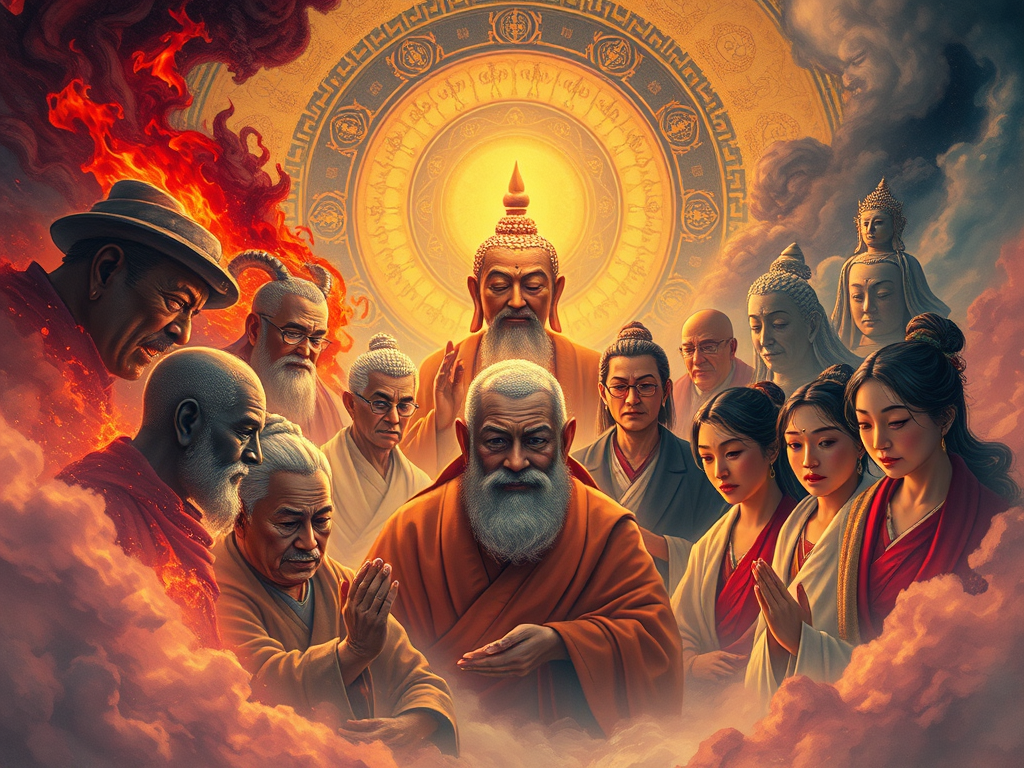
Nichiren Buddhism, a significant school within the landscape of East Asian Buddhist thought, holds the Lotus Sutra in paramount esteem, considering it the ultimate and complete teaching of Shakyamuni Buddha.1 Among its core tenets is the doctrine of the “mutual possession of ten realms” (jikkai gogu), a concept that, while originating in the philosophical system of the Chinese T’ien-t’ai school of Buddhism, finds a unique and profound interpretation within Nichiren’s teachings.12 This report aims to explore Nichiren’s exposition of this complex doctrine as presented in his important treatise, the Kanjin Honzon-Shō (“Spiritual Contemplation and the Most Venerable”). By examining the historical roots of this principle in T’ien-t’ai’s thought, Nichiren’s specific understanding and application of it, the illuminating role of the similes he employs, and its fundamental connection to the Buddhist principle of inherent Buddha nature, this analysis seeks to provide a comprehensive understanding for serious students and practitioners of Nichiren Buddhism.
The principle of the “mutual possession of the Ten Worlds” was first articulated by the influential Chinese Buddhist scholar T’ien-t’ai (智顗, 538–597 CE) as a key insight derived from his extensive study and interpretation of the Lotus Sutra.12 The Ten Worlds (jikkai) represent ten distinct categories or potential states of existence that sentient beings experience throughout their lives.13 These worlds, ranging from the depths of suffering in Hell to the absolute freedom of Buddhahood, were initially understood within ancient Indian cosmology as actual physical realms. However, T’ien-t’ai, drawing from the Lotus Sutra’s emphasis on the universality of enlightenment, reconceptualized them as inherent and fluctuating states of consciousness or life conditions present within each individual, experienced moment by moment.13 These ten worlds are often categorized into the six lower worlds – Hell, Hungry Spirits, Animals, Asuras (fighting demons), Human Beings, and Heavenly Beings – representing states of delusion and suffering driven by external influences and karmic forces, and the four noble worlds – Voice-hearers, Cause-awakened Ones, Bodhisattvas, and Buddhas – signifying states of wisdom and liberation attained through Buddhist practice.16
At the heart of this doctrine lies the concept of “mutual possession” (gogu), which asserts that each of the Ten Worlds inherently possesses the potential for all ten within itself.12 This implies that even in the most painful state of Hell, the potential for the enlightened state of Buddhahood exists, and conversely, even a Buddha retains the capacity to experience the conditions of the lower realms. Life, therefore, is not fixed within a single world but is a dynamic interplay, capable of manifesting any of these ten states at any given time, influenced by both internal thoughts and external circumstances.17 While one world manifests in a particular moment, the other nine remain latent within the individual’s life.19 This understanding leads to the theoretical possibility of one hundred (10 x 10) distinct life-states existing within a single individual.15 Furthermore, the mutual possession of the Ten Worlds forms a crucial component of T’ien-t’ai’s comprehensive philosophy of “three thousand realms in a single moment of life” (ichinen sanzen).4 This broader concept elaborates on the interconnectedness of all phenomena, suggesting that a single moment of life encompasses not only the 100 worlds derived from mutual possession but also the “ten factors” of life and the “three realms of existence” (san-seken), ultimately resulting in three thousand potential realms within a fleeting instant of consciousness.4 T’ien-t’ai’s groundbreaking contribution was the internalization of these realms, shifting the focus from external locations to internal states of being, thereby providing a novel framework for comprehending spiritual transformation.14 The intricate mathematical framework of ichinen sanzen, while seemingly complex, serves as a powerful illustration of the vast potential and interconnectedness inherent in each moment of life.4
Nichiren (日蓮, 1222–1282), a towering figure in Japanese Buddhism, deeply resonated with the teachings of the Lotus Sutra and, in his seminal work Kanjin Honzon-Shō (観心本尊抄), written in 1273 during his exile on Sado Island, extensively discusses the principle of the mutual possession of the Ten Worlds.2 The title of this treatise, which can be translated as “Spiritual Contemplation and the Most Venerable,” indicates its focus on both the inner awakening to the truth of life and the ultimate object of devotion that enables this awakening.4 Nichiren commences his discourse in Kanjin Honzon-Shō by introducing and affirming T’ien-t’ai’s profound doctrine of ichinen sanzen, thereby laying the essential philosophical foundation for his subsequent exploration of the mutual possession of the Ten Realms.39 Within this treatise, Nichiren underscores the critical importance of the mutual possession of the Ten Worlds for a proper understanding of the Lotus Sutra’s core message: the inherent Buddha nature within all beings and the potential for universal enlightenment.32 He asserts that kanjin (contemplation of the mind), particularly within the context of the Latter Day of the Law, signifies recognizing and firmly believing in the existence of the ten worlds, including the sublime state of Buddhahood, within the depths of one’s own being, a concept directly aligned with T’ien-t’ai’s teaching of the presence of three thousand realms in a single moment of thought.32 Nichiren extensively employs the principle of the mutual possession of the ten realms to elucidate and validate the Lotus Sutra’s profound declaration that Buddha nature is intrinsically contained within all sentient beings, without any exception.32 He provides detailed explanations, supported by scriptural evidence drawn from various chapters of the Lotus Sutra, demonstrating how beings in each of the lower nine worlds inherently possess the world of Buddhahood within themselves. For instance, he cites the prediction of future Buddhahood for Devadatta, even within the realm of hell, as a powerful example.32 Furthermore, Nichiren emphasizes the significant point that even Buddhas continue to possess and manifest the other nine worlds, thereby highlighting that Buddhahood is not a detached or static state separate from the realities of ordinary existence but rather an encompassing condition that includes all possibilities of life.32 Nichiren’s genius lies in his ability to translate T’ien-t’ai’s intricate theoretical framework into a practical and accessible path to enlightenment specifically suited for the capabilities of ordinary individuals living in the challenging era of the Latter Day of the Law.4 He redefined kanjin not primarily as a form of silent, introspective meditation, but as the unwavering act of embracing faith in the truth of the Lotus Sutra and actively engaging in the practice of chanting its sacred title, Nam-myoho-renge-kyo, with profound conviction in the Gohonzon.4 This transformation underscores Nichiren’s direct and practical approach to enabling individuals to realize the mutual possession of the Ten Worlds and manifest their inherent Buddhahood in their daily lives.4
Within Kanjin Honzon-Shō, Nichiren masterfully employs vivid and relatable similes to illuminate the often-abstract concept of the mutual possession of the Ten Worlds, rendering it more comprehensible and impactful for his followers.57 Among these, the similes of “fire in a rock” and “flowers in wood” stand out as particularly illustrative of the seemingly paradoxical yet ultimately real potential for Buddhahood inherent in all beings, regardless of their current circumstances or perceived limitations.58 The simile of “fire in a rock” conveys that just as fire, though not immediately visible, resides within a rock and can be produced by striking it, the enlightened state of Buddhahood lies dormant within all sentient beings, even those presently experiencing the deepest suffering in the lowest realms of existence.58 This highlights the dynamic potential for transformation and the emergence of the highest state of life from seemingly inert or challenging situations, suggesting that Buddha nature is an ever-present possibility awaiting the right catalyst for manifestation. This catalyst, in Nichiren Buddhism, is often understood as the dedicated practice of faith and chanting.59 Similarly, the simile of “flowers in wood” emphasizes that just as a tree, appearing lifeless in winter, possesses the intrinsic potential to bloom with vibrant flowers in the spring, all beings, even those who seem far removed from enlightenment, possess the inherent capacity for Buddhahood.55 This beautifully illustrates the cyclical nature of life, the principle of impermanence, and the eventual, inevitable unfolding of inherent potential given the appropriate time and conditions, offering a message of hope and assurance that even in the darkest of times, spiritual awakening and flourishing are possible. This resonates deeply with the Buddhist understanding of impermanence (anicca) and the inherent dynamism of life, suggesting that even in seemingly stagnant or suffering states, the potential for positive change and the blossoming of enlightenment is always present.55
Nichiren also employs the seemingly paradoxical similes of “fire in water” and “water in fire”.67 These images, while counter-intuitive as fire and water are traditionally seen as mutually exclusive, profoundly illustrate the non-duality, mutual inclusion, and ultimate interconnectedness of all realms within the framework of the Ten Worlds.67 “Fire in water” suggests that the enlightened realm of Buddhahood, often associated with wisdom and serenity (symbolized by water), is not separate from the passions, desires, and sufferings of the lower realms (symbolized by fire). The potential for enlightenment exists even within the midst of delusion and suffering.67 Conversely, “water in fire” implies that even within the enlightened state of Buddhahood, the potential to experience the conditions and emotions of the lower realms is not entirely absent, emphasizing that a Buddha is not fundamentally different or detached from ordinary existence but rather possesses mastery over these states.67 These seemingly impossible similes challenge dualistic thinking and underscore the profound interconnectedness of all life states, highlighting that ultimate reality transcends simple binary oppositions.67
The doctrine of the “mutual possession of ten realms” is inextricably linked to the Lotus Sutra’s core teaching of the inherent Buddha nature (tathāgatagarbha) present within all sentient beings.19 Because each of the Ten Worlds inherently contains the potential for Buddhahood, it logically follows that every individual, regardless of their current life condition, possesses this innate Buddha nature.19 Nichiren powerfully asserts that this inherent Buddhahood can be manifested and realized in this very lifetime through unwavering faith in the Lotus Sutra and the dedicated practice of chanting Nam-myoho-renge-kyo.11 This contrasts sharply with pre-Lotus Sutra teachings that often depicted enlightenment as a distant and arduous goal attainable only after countless lifetimes.16 Nichiren’s interpretation of the mutual possession of the Ten Worlds offers a profoundly encouraging message of hope and inherent empowerment, asserting that Buddhahood is not an external ideal but an intrinsic potential readily accessible to all in the present moment through dedicated practice.6
Scholarly perspectives on Nichiren’s engagement with the mutual possession of the Ten Realms highlight his unique adaptation and application of this T’ien-t’ai doctrine within the specific context of his teachings and the religious landscape of his era.7 While rooted in T’ien-t’ai’s philosophy, Nichiren’s interpretation places a distinct emphasis on the exclusive power of the Lotus Sutra and the practice of chanting Nam-myoho-renge-kyo as the direct path to enlightenment in the Latter Day of the Law.4 Scholars also recognize the crucial connection between this doctrine and Nichiren’s concept of ichinen sanzen as the fundamental basis for achieving Buddhahood within this world.4 Furthermore, academic analysis suggests that Nichiren strategically utilized the principle of the mutual possession of the ten realms to underscore the inherent Buddha nature in all beings, thereby validating the universality of the Lotus Sutra and critiquing other Buddhist schools that he believed offered incomplete teachings.11 Ultimately, Nichiren’s deployment of this doctrine represents a deliberate and nuanced adaptation, providing a robust philosophical foundation for his exclusive focus on the Lotus Sutra and the empowerment of his followers with the conviction of their own inherent Buddhahood.11
In conclusion, the doctrine of the mutual possession of ten realms stands as a cornerstone of Nichiren Buddhism, providing a profound framework for understanding the inherent potential for Buddhahood within all life. Nichiren’s exposition of this doctrine in his Kanjin Honzon-Shō, while drawing upon the foundational insights of T’ien-t’ai, offers a unique and empowering interpretation specifically tailored for practitioners in the Latter Day of the Law. His masterful use of similes, such as “fire in a rock,” “flowers in wood,” and the seemingly paradoxical “fire in water” and “water in fire,” effectively conveys the latent potential for enlightenment and the interconnectedness of all life states. Ultimately, Nichiren’s understanding of the mutual possession of the Ten Worlds serves to instill in ordinary individuals a deep conviction in their own inherent Buddha nature and the transformative power of faith and practice centered on the Lotus Sutra, enabling them to achieve enlightenment in this very lifetime.
Works cited
- Nichiren | Oxford Research Encyclopedia of Religion, accessed May 4, 2025, https://oxfordre.com/religion/display/10.1093/acrefore/9780199340378.001.0001/acrefore-9780199340378-e-575?p=emailA6Fqg1h66CWcg&d=/10.1093/acrefore/9780199340378.001.0001/acrefore-9780199340378-e-575
- [Dear Colleagues: This entry appears in Brill’s Encylopedia of Buddhism, vol. II: Lives (pp. 1076-1087). My contract prohibits – Jacqueline I. Stone, accessed May 4, 2025, https://jstone.mycpanel2.princeton.edu/wp-content/uploads/2022/08/Nichiren-Brill-Encyclopia-2021.pdf
- Nichiren | Oxford Research Encyclopedia of Religion, accessed May 4, 2025, https://oxfordre.com/religion/display/10.1093/acrefore/9780199340378.001.0001/acrefore-9780199340378-e-575?d=%2F10.1093%2Facrefore%2F9780199340378.001.0001%2Facrefore-9780199340378-e-575&p=emailAeurGviJcSqOI
- PENGUIN BOOKS, accessed May 4, 2025, http://www.princeton.edu/~jstone/Articles%20on%20the%20Lotus%20Sutra%20Tendai%20and%20Nichiren%20Buddhism/Finding%20Enlightenment%20in%20the%20Final%20Age%20(translations%20from%20Ka.pdf
- The Odyssey of the Lotus: The Evolution and Journey of Buddhism’s Most Egalitarian Teaching from Asia to America – UAB Digital Commons – University of Alabama at Birmingham, accessed May 4, 2025, https://digitalcommons.library.uab.edu/cgi/viewcontent.cgi?article=2477&context=etd-collection
- What You Should Know – NBA Nichiren Shu San Francisco Bay Area, accessed May 4, 2025, https://www.nichirenbayarea.org/what-you-should-know-lotus-sutra
- ‘Opening of the Eyes’—A Call to Open Our Eyes to Nichiren, To Open Our Eyes to the People – World Tribune, accessed May 4, 2025, https://www.worldtribune.org/2025/opening-of-the-eyes-a-call-to-open-our-eyes-to-nichiren-to-open-our-eyes-to-the-people/
- The Daishonin’s Path: Applying Nichiren’s Buddhist Principles to American Legal Education – Digital Commons at St. Mary’s University, accessed May 4, 2025, https://commons.stmarytx.edu/context/facarticles/article/1307/viewcontent/Teeter_30.McGeorge.271.pdf
- OnTheOpeningOfTheEyes – 500 Yojanas, accessed May 4, 2025, https://www.500yojanas.org/ontheopeningoftheeyes/
- Essays on the Buddha Teaching | DHARMA FLOWER SUTRA, accessed May 4, 2025, https://dharmagateway.org/dharma00.htm
- Nichiren.Oxford-Encyclopedia-of-Buddhism-2020.pdf – Jacqueline I. Stone, accessed May 4, 2025, https://jstone.mycpanel2.princeton.edu/wp-content/uploads/2022/08/Nichiren.Oxford-Encyclopedia-of-Buddhism-2020.pdf
- http://www.nichirenlibrary.org, accessed May 4, 2025, https://www.nichirenlibrary.org/en/dic/Content/M/143#:~:text=mutual%20possession%20of%20the%20Ten%20Worlds%20%EF%BC%BB%E5%8D%81%E7%95%8C%E4%BA%92%E5%85%B7,for%20all%20ten%20within%20itself.
- Ten Worlds | Dictionary of Buddhism, accessed May 4, 2025, https://www.nichirenlibrary.org/en/dic/Content/T/82
- Tiantai – Wikipedia, accessed May 4, 2025, https://en.wikipedia.org/wiki/Tiantai
- Elementary Study – The Ten Worlds – nichiren.info, accessed May 4, 2025, https://nichiren.info/buddhism/library/SokaGakkai/Study/Elementary/Text3.htm
- A Hope-Inspiring Life Philosophy for the Real World – World Tribune, accessed May 4, 2025, https://www.worldtribune.org/2023/a-hope-inspiring-life-philosophy-for-the-real-world/
- http://www.nichirenlibrary.org, accessed May 4, 2025, https://www.nichirenlibrary.org/en/dic/Content/M/143#:~:text=One%20of%20the%20component%20principles,Buddhahood%2C%20at%20any%20given%20moment.
- Three Thousand Worlds in a Single Thought-Moment – NBANichiren Shu San Francisco Bay Area, accessed May 4, 2025, https://www.nichirenbayarea.org/three-thousand-worlds-in-a-single-thoughtmoment
- mutual possession of the Ten Worlds | Dictionary of Buddhism, accessed May 4, 2025, https://www.nichirenlibrary.org/en/dic/Content/M/143
- T’ien-t’ai – SGI-UK, accessed May 4, 2025, https://sgi-uk.org/Philosophy/History/T-ien-t-ai
- Chapter 10: Three Thousand Worlds in a Single Thought-Moment – NBA Nichiren Shu San Francisco Bay Area, accessed May 4, 2025, https://www.nichirenbayarea.org/chapter-10-three-thousand-worlds-in-a-single-thoughtmoment
- Summary of the Ten Realms | 500 Yojanas, accessed May 4, 2025, https://www.500yojanas.org/summary-of-the-ten-realms/
- The Mutual Possession of the Ten Worlds – World Tribune, accessed May 4, 2025, https://www.worldtribune.org/2019/the-mutual-possession-of-the-ten-worlds/
- The Ten Worlds and their mutual possession – Ichinen Sanzen Pt 1 – Buddhastate, accessed May 4, 2025, https://www.buddhastate.com/2012/04/the-ten-worlds-and-their-mutual-possession/
- Life Manifesting the Ten Worlds – Dharma Wheel, accessed May 4, 2025, https://www.dharmawheel.net/viewtopic.php?t=35253
- Chapter 5: Three Thousand Realms in a Single Moment of Life | Soka Gakkai (global), accessed May 4, 2025, https://www.sokaglobal.org/resources/study-materials/buddhist-study/the-basics-of-nichiren-buddhism-for-the-new-era-of-worldwide-kosen-rufu/chapter-5.html
- Ten realms – Wikipedia, accessed May 4, 2025, https://en.wikipedia.org/wiki/Ten_realms
- The Ten Worlds – SGI USA, accessed May 4, 2025, https://www.sgi-usa.org/2022/08/11/the-ten-worlds/
- The Ten Worlds | Myoshinji Temple, accessed May 4, 2025, https://nstmyoshinji.org/ten-worlds/
- The Ten Worlds | Soka Gakkai (global), accessed May 4, 2025, https://www.sokaglobal.org/resources/study-materials/buddhist-concepts/ten-worlds.html
- Chapter 2: The Ten Worlds | Soka Gakkai (global), accessed May 4, 2025, https://www.sokaglobal.org/resources/study-materials/buddhist-study/the-basics-of-nichiren-buddhism-for-the-new-era-of-worldwide-kosen-rufu/chapter-2.html
- Mutual Possession of the Ten Worlds – NBANichiren Shu San …, accessed May 4, 2025, https://www.nichirenbayarea.org/mutual-possession-of-the-ten-worlds
- The Mutual Possession of the Ten Realms Doctrine | 500 Yojanas, accessed May 4, 2025, https://www.500yojanas.org/the-mutual-possession-of-the-ten-realms-doctrine/
- Ten worlds – SGI-UK, accessed May 4, 2025, https://sgi-uk.org/Philosophy/Principles/Ten-worlds
- Mutual Possession of the Ten Worlds – Realizing our Buddhahood Potential – Kiran Joshi, accessed May 4, 2025, https://www.kiranjoshiauthor.com/post/mutual-possession-of-the-ten-worlds-realizing-our-buddhahood-potential
- ‘Mutually-Possessed Characteristics of the Ten Realms’ | 500 Yojanas, accessed May 4, 2025, https://www.500yojanas.org/mutually-possessed-characteristics-of-the-ten-realms/
- “3000 realms in a single moment of life.” Only in Nichiren Buddhism? – Reddit, accessed May 4, 2025, https://www.reddit.com/r/Buddhism/comments/1ez5sq/3000_realms_in_a_single_moment_of_life_only_in/
- Each Instant Contains Incredible Possibilities – World Tribune, accessed May 4, 2025, https://www.worldtribune.org/2021/each-instant-contains-incredible-possibilities/
- Kanjin Honzon-sho | Nichiren Shu UK, accessed May 4, 2025, https://nichiren-shu.org.uk/kanjin-honzon-sho
- The True Object of Worship – Gosho – nichiren.info, accessed May 4, 2025, http://nichiren.info/gosho/TrueObjectWorship.htm
- three thousand realms in a single moment of life | Dictionary of Buddhism, accessed May 4, 2025, https://www.nichirenlibrary.org/en/dic/Content/T/176
- Ichinen Sanzen Pt4 – Buddhastate, accessed May 4, 2025, https://www.buddhastate.com/2012/05/ichinen-sanzen-pt4/
- Nichiren explains the 3000 Realms in a moment of existence and the Three Buddha bodies, accessed May 4, 2025, https://www.dharmawheel.net/viewtopic.php?t=35128
- Object of Devotion for Observing the Mind, The | Dictionary of Buddhism, accessed May 4, 2025, https://www.nichirenlibrary.org/en/dic/Content/O/3
- Study Group: Kanjin no Honzon sho – Dharma Wheel, accessed May 4, 2025, https://www.dharmawheel.net/viewtopic.php?t=23156
- Kanjin Honzon Sho – 500 Yojanas, accessed May 4, 2025, https://www.500yojanas.org/kanjin-honzon-sho/
- Who’s Who on the Gohonzon? The Lineage Chart, accessed May 4, 2025, https://pounceatron.dreamhosters.com/nichirenscoffeehouse.net/ShuteiMandala/lineage.html
- WONS | 500 Yojanas | Page 81, accessed May 4, 2025, https://www.500yojanas.org/wons/page/81/?share=linkedin&nb=1&
- ten major writings | Dictionary of Buddhism, accessed May 4, 2025, https://www.nichirenlibrary.org/en/dic/Content/T/58
- Rev. Ryuei Michael McCormick’s Writings and Essays – NBA Nichiren Shu San Francisco Bay Area, accessed May 4, 2025, https://www.nichirenbayarea.org/library
- Spiritual Contemplation and the Jewel of Odaimoku – NBA Nichiren Shu San Francisco Bay Area, accessed May 4, 2025, https://www.nichirenbayarea.org/spiritual-contemplation-and-the-jewel-of-odaimoku
- The Buddhism of Sowing – NBA Nichiren Shu San Francisco Bay Area, accessed May 4, 2025, https://www.nichirenbayarea.org/the-buddhism-of-sowing
- Chapter 11: The Three Great Secret Dharmas – NBA Nichiren Shu San Francisco Bay Area, accessed May 4, 2025, https://www.nichirenbayarea.org/chapter-11-the-three-great-secret-dharmas
- Meditation in Nichiren Buddhism – Buddhastate, accessed May 4, 2025, https://www.buddhastate.com/2012/08/meditation-in-nichiren-buddhism/
- Chapter 3: Faith and Practice | Soka Gakkai (global), accessed May 4, 2025, https://www.sokaglobal.org/resources/study-materials/buddhist-study/the-basics-of-nichiren-buddhism-for-the-new-era-of-worldwide-kosen-rufu/chapter-3.html
- The True Object of Worship – nichiren.info, accessed May 4, 2025, http://nichiren.info/buddhism/library/SokaGakkai/Study/SelLectGosho/Object01.htm
- Nichiren S N 158, accessed May 4, 2025, https://news.nichiren-shu.org/cmswp/wp-content/uploads/2007/02/Nichiren158e.pdf
- April | 2021 | 500 Yojanas | Page 9, accessed May 4, 2025, https://www.500yojanas.org/2021/04/page/9/
- Two kinds of faith – Buddhastate, accessed May 4, 2025, https://www.buddhastate.com/2012/02/two-kinds-of-faith/
- How do we respond to people who discredit Nichiren Buddhism, accessed May 4, 2025, https://www.dharmawheel.net/viewtopic.php?t=30262
- Sending Forth a Spring Breeze of Encouragement – World Tribune, accessed May 4, 2025, https://www.worldtribune.org/2019/sending-forth-a-spring-breeze-of-encouragement/
- What Do Cherry Blossoms Represent in Japanese Culture? – JAPAN AIRLINES (JAL), accessed May 4, 2025, https://www.jal.co.jp/in/en/guide-to-japan/experiences/cherry-blossom/what-do-cherry-blossoms-represent/index.html
- Winter Never Fails to Turn to Spring – World Tribune, accessed May 4, 2025, https://www.worldtribune.org/2019/winter-never-fails-turn-spring/
- The National Cherry Blossom Festival – SGI USA, accessed May 4, 2025, https://www.sgi-usa.org/2025/03/21/the-national-cherry-blossom-festival/
- Higan – Nichiren Buddhist Church, accessed May 4, 2025, https://sacramentonichirenchurch.org/home/about-nichiren-shu/nichiren-shu-brochures/higan/
- Simile of Herbs – 500 Yojanas, accessed May 4, 2025, https://www.500yojanas.org/simile-of-herbs/
- Faith Like Fire, Faith Like Water – NBA Nichiren Shu San Francisco Bay Area, accessed May 4, 2025, https://www.nichirenbayarea.org/faith-like-fire-faith-like-water
- Fire and water: Significance and symbolism, accessed May 4, 2025, https://www.wisdomlib.org/concept/fire-and-water
- The Cluster of Blessings Brought by the Bodhisattvas of the Earth – World Tribune, accessed May 4, 2025, https://www.worldtribune.org/2024/the-cluster-of-blessings-brought-by-thebodhisattvas-of-the-earth/
- The Unanimous Declaration by the Buddhas of the Three Existences regarding the Classification of the Teachings and Which Are to Be Abandoned and Which Upheld | WND II | Nichiren Buddhism Library, accessed May 4, 2025, https://www.nichirenlibrary.org/en/wnd-2/Content/315
- Why Your Faith Should Flow Like Water, Not Burn Like Fire – YouTube, accessed May 4, 2025, https://www.youtube.com/watch?v=dhTREbaaKYE
- Everything Begins With Prayer Infused With the Shared Vow of Mentor and Disciple, accessed May 4, 2025, https://www.worldtribune.org/2021/everything-begins-with-prayer-infused-with-the-shared-vow-of-mentor-and-disciple/
- Ceremonies – Nichiren Shoshu, accessed May 4, 2025, https://www.nichirenshoshu.or.jp/eng/ceremonies.html
- Wheels of Fire: The Buddha’s Radical Teaching on Process – Barre Center for Buddhist Studies, accessed May 4, 2025, https://www.buddhistinquiry.org/article/wheels-of-fire-the-buddhas-radical-teaching-on-process/
- All People Possess the Life State of Buddhahood – World Tribune, accessed May 4, 2025, https://www.worldtribune.org/2020/all-people-possess-the-life-state-of-buddhahood/
- Namu Myōhō Renge Kyō – Wikipedia, accessed May 4, 2025, https://en.wikipedia.org/wiki/Namu_My%C5%8Dh%C5%8D_Renge_Ky%C5%8D
- The Basics of Nichiren Buddhism | SGI USA, accessed May 4, 2025, https://cms.sgi-usa.org/wp-content/uploads/2024/02/Intro_Exam_Material_Basics_of_Nichiren_Buddhism.pdf
- Explaining the Causation of the Ten Worlds | WND II | Nichiren Buddhism Library, accessed May 4, 2025, https://www.nichirenlibrary.org/en/wnd-2/Content/185
- On the Ten Worlds – Nichiren Buddhism Library, accessed May 4, 2025, https://nichirenlibrary.org/en/wnd-2/PDF/en-wnd2-writ-1820.pdf
- Nenhutsu Leads to the Avid Hell: Nichiren’s Critique of the Pure Land Teachings – Princeton University, accessed May 4, 2025, https://www.princeton.edu/~jstone/Articles%20on%20the%20Lotus%20Sutra%20Tendai%20and%20Nichiren%20Buddhism/Nenbutsu%20Leads%20to%20the%20Avici%20Hell–Nichiren’s%20Critique%20of%20the%20Pure%20Land%20Teachings%20%20(2013).pdf
- The Doctrine of Three Thousand Realms in a Single Moment of Life | WND II, accessed May 4, 2025, https://www.nichirenlibrary.org/en/wnd-2/Content/180
- (PDF) Criticism and Appropriation Nichiren’s Attitude toward Esoteric Buddhism, accessed May 4, 2025, https://www.researchgate.net/publication/242487080_Criticism_and_Appropriation_Nichiren’s_Attitude_toward_Esoteric_Buddhism
- Key Passages From The Record of the Orally Transmitted Teachings (Part 3), accessed May 4, 2025, https://www.worldtribune.org/2023/key-passages-from-the-record-of-the-orally-transmitted-teachings-part-3/
- Placing Nichiren in the Big Picture: Some Ongoing Issues in Scholarship – Princeton University, accessed May 4, 2025, https://www.princeton.edu/~jstone/Articles%20on%20the%20Lotus%20Sutra%20Tendai%20and%20Nichiren%20Buddhism/Placing%20Nichiren%20in%20the%20Big%20Picture%20-%20Some%20Ongoing%20Issues%20in%20S.pdf
- IntroductoryStudy Course – Study Course Ichinen Sanzen, accessed May 4, 2025, https://www.sgiaust.org.au/wp-content/uploads/2014/05/1280886795307-9185.pdf
- The Ten Factors – Ichinen Sanzen Pt 2 – Buddhastate, accessed May 4, 2025, https://www.buddhastate.com/2012/04/the-ten-factors-ichinen-sanzen-part-2/
- Key Passages From The Record of the Orally Transmitted Teachings (Part 12), accessed May 4, 2025, https://www.worldtribune.org/2024/key-passages-from-the-record-of-the-orally-transmitted-teachings-part-12/
- The True Aspect of All Phenomena | WND I – Nichiren Buddhism Library, accessed May 4, 2025, https://www.nichirenlibrary.org/en/wnd-1/Content/40
- Nichiren as the True Buddha – Page 2 – Dharma Wheel, accessed May 4, 2025, https://www.dharmawheel.net/viewtopic.php?t=17660&start=20
- Key Passages From The Record of the Orally Transmitted Teachings (Part 5), accessed May 4, 2025, https://www.worldtribune.org/2023/key-passages-from-the-record-of-the-orally-transmitted-teachings-part-5/
 Mr. Altig’s Overview of the Wonderful Dharma of the Lotus Sutra
Leave a comment