1. Executive Summary
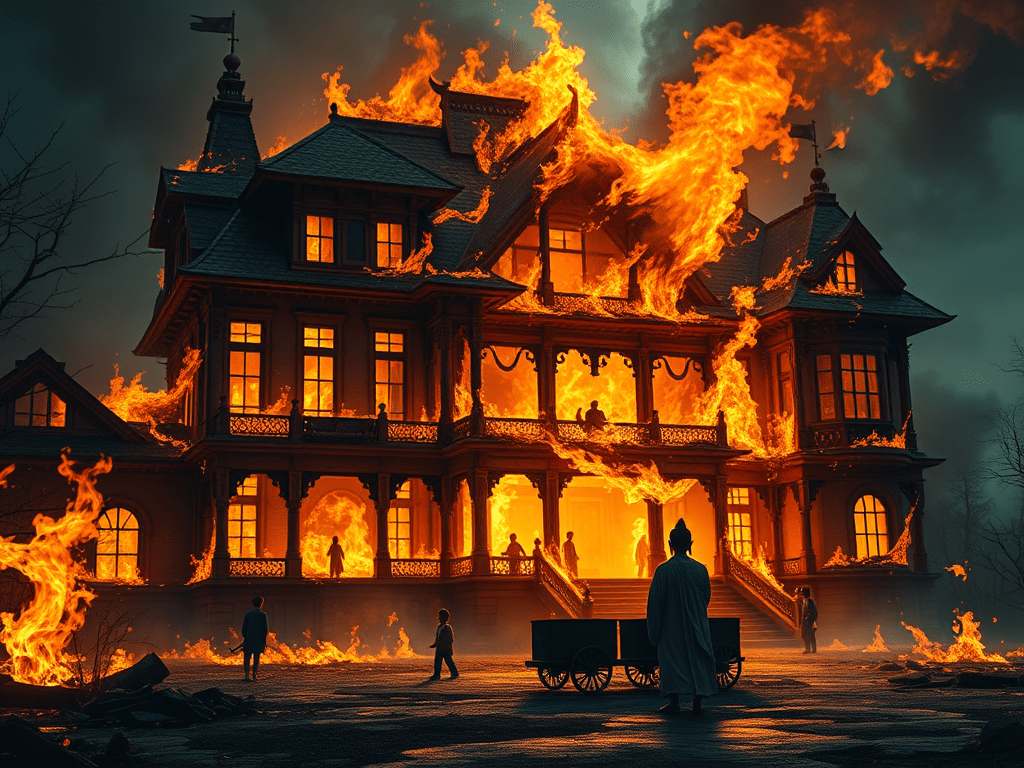
The Parable of the Burning House, found in Chapter Three of the Lotus Sūtra, is a central Mahayana Buddhist allegory illustrating the nature of suffering, the Buddha’s compassionate “skillful means” (upaya), and the doctrine of universal liberation. It depicts samsara (the world of suffering) as a decaying, fire-engulfed mansion, where sentient beings, symbolized by children, are oblivious to their peril due to their engrossment in worldly distractions. The Buddha, as the wealthy father, employs upaya by promising enticing, yet provisional, “three vehicles” (carts) to lure the children to safety, ultimately providing the magnificent “One Vehicle” – the unified path to universal Buddhahood. The parable emphasizes the urgency of liberation, the pervasive nature of human attachment and denial, and the revolutionary Mahayana assertion of inherent Buddha-nature in all beings. Its contemporary relevance extends to understanding modern societal distractions, psychological barriers to self-reflection, and collective responses to global challenges like climate change.
2. Introduction: Context of the Parable
2.1. The Lotus Sūtra and Mahayana Buddhism
The Lotus Sūtra (Saddharma Puṇḍarīka Sūtra), composed between the 1st century BCE and 150 CE, is a “seminal text within Mahayana Buddhism” that profoundly influenced Buddhist philosophy across Asia. Its “defining characteristic” is its inclusive message that “enlightenment is accessible to all beings, irrespective of gender, social standing, or prior spiritual attainment.” Central to its doctrine is the “One Vehicle (ekayāna),” which posits that “all diverse Buddhist paths…are ultimately unified,” serving as “skillful means (upaya) that converge upon the singular, supreme goal of Buddhahood.” The Sūtra also introduces the concept of the Buddha’s “immeasurable lifespan,” asserting that his apparent death was an “illusory manifestation, a form of skillful means (upaya) designed to teach and inspire,” depicting him as “constantly abiding in the world, eternally present and accessible to all beings.”
2.2. Setting the Scene: Chapter Three to Shariputra
The parable is in Chapter 3, where the Buddha addresses his disciple Shariputra, who “had ‘deceived himself’ by not fully grasping the ‘Greater Vehicle’.” The Buddha explicitly highlights the pedagogical value of parables, stating that “intelligent people can understand through parables.” These stories are designed to “evoke imagery and resonate deeply with the listener,” allowing for a more intuitive understanding of complex concepts like “universal Buddhahood, the immeasurable lifespan of the Buddha, and the non-duality of samsara and nirvana.”
2.3. Narrative Summary of the Parable
A wealthy man owns a “grand, yet decaying and dangerous, mansion,” “alarmingly infested with various vile creatures and filled with filth,” symbolizing a “perilous existence.” His numerous children are “deeply engrossed in their games and playthings.” A fire erupts, but the children are “too absorbed in their play to hear or comprehend the imminent danger.” The original passage notes: “They were not frightened or afraid. They did not wish to come out. They did not know what a fire was, what a house was, and what they would lose. They ran about happily. They only glanced at their father occasionally.”
Recognizing direct warnings are futile, the father devises “skillful means (upaya).” He promises “enticing and rare playthings outside the gate: goat carts, deer carts, and oxcarts.” Eager for these toys, the children “rush out of the burning house.” Once safely outside, the father, demonstrating “boundless wealth and compassion,” gives each child “a single, magnificent great white oxcart, adorned with precious materials and pulled by powerful white bullocks,” given to all “without discrimination.” This portrays the Buddha’s relationship with sentient beings as “Father and sons, instead of the traditional Teacher and students,” emphasizing “inherent connection, unconditional love, and deep, enduring compassion,” and implicitly the “inherent Buddha-nature within all.”
3. Symbolism and Core Meanings
3.1. The Rich Man: The Buddha’s Compassion and Wisdom
The wealthy man represents the Buddha, whose “immense wealth symbolizes the Buddha’s boundless Dharma, his infinite wisdom, and his inexhaustible capacity to provide for the liberation of all sentient beings.” His actions demonstrate “profound compassion (karuna) and the strategic application of skillful means (upaya),” focused on the “salvation of his children from imminent danger.” The Buddha’s role is “guidance and facilitation,” enabling “someone’s own personal direct experience” of liberation.
3.2. The Decaying, Demon-Filled Mansion: Samsara and Suffering
The house symbolizes the “threefold world” or samsara, “the cyclical existence characterized by birth, aging, sickness, and death.” It is “unsafe and tumultuous,” “full of all kinds of sufferings,” and “truly to be feared.” Its dilapidated state illustrates “impermanence (anicca) and the inherent fragility of all conditioned phenomena.” The “demons,” “animals,” “poisonous insects,” and “filth” metaphorically represent the “ten realms or worlds” of existence and the “internal and external conflicts, anxieties, and suffering that arise from fundamental human afflictions.”
3.3. The Children: Sentient Beings, Ignorance, Attachment, Distraction
The children represent “all sentient beings,” particularly humanity, who are “ignorant” and “profoundly addicted to worldly pleasure.” Their “deep absorption in ‘games’ and ‘playthings’ symbolizes the pervasive attachments to sensory pleasures, material possessions, transient experiences, and ego-driven pursuits.” Their obliviousness to the fire highlights “a fundamental human tendency towards denial,” and a “lack of ‘wise thoughts’ regarding the pervasive nature of suffering (dukkha) and impermanence (anicca).” They “did not know what a fire was, what a house was, and what they would lose,” reflecting “cognitive biases such as normalcy bias…or present bias.”
3.4. The Raging Fire: Dukkha, Impermanence, Three Poisons
The fire is the most potent symbol of suffering (dukkha) and impermanence (anicca), representing the “fires that burn unceasingly” of “birth, aging, illness, and death.” The “stinking smoke” and “creatures scorched by the heat” emphasize the torment. It implicitly represents the “three poisons”—greed, aversion, and ignorance—which are the “root causes of suffering.” The children’s “lack of understanding” is the “root cause of their peril,” leading to “deep ‘engrossment in playing’ and ‘addiction to worldly pleasure’,” which in turn leads to exposure to the “fires” of suffering.
3.5. The Promised Carts: Skillful Means (Upaya), Three Vehicles
The three carts symbolize the “three vehicles (Triyana)” or paths of practice taught as “skillful means (upaya).” These are provisional teachings, “expedient devices” used to “lure” beings out of danger, “tailored solutions designed to suit ‘the individual’s personality, needs and wants’.” The father “intentionally devis[ed] a lie” by promising carts different from what he delivered, but this “apparent deception is not for personal gain or malice but for the children’s ultimate salvation.” This highlights that in upaya, “the moral rectitude of an action is determined not by its superficial appearance but by its underlying compassionate intent and its ultimate liberating outcome.”
3.6. The Great White Oxcart: The One Vehicle, Universal Buddhahood
The magnificent great white oxcart represents the “One Vehicle (ekayāna),” which embodies the “complete and holistic Mahayana teaching.” It symbolizes that “no one is excluded” from awakening and that Buddhahood can be attained swiftly. The One Vehicle “recontextualizes” the three provisional vehicles as “different expressions of the same ultimate practice for liberation.” The ultimate gift of the “great white oxcart” to all children “without discrimination” emphasizes the “ultimate unity of all paths and the universal goal of Buddhahood.” This “recontextualization fundamentally democratizes enlightenment,” asserting that “even those who pursued what were considered ‘lesser’ paths are destined for full Buddhahood.” The statement “Because the Buddha is in the burning house with us… buddhanature is more than a potential” suggests an “immediate, inherent presence,” where the ultimate reality is “not separate from or external to our current suffering existence.”
4. Philosophical Underpinnings
4.1. The Four Noble Truths and the Cessation of Suffering
The parable is an allegorical “retelling of the four noble truths”:
- Dukkha (Suffering): The burning house “full of many woes most frightful, constantly marked by birth, old age, sickness, death, and cares.”
- Samudaya (Origin of Suffering): The children’s “profound addiction to worldly pleasure” and “engrossment in playing” symbolize craving and attachment, implicitly driven by the “three poisons.”
- Nirodha (Cessation of Suffering): The father successfully luring the children out signifies the “possibility of an end to suffering.”
- Magga (Path to Cessation): The “skillful means (upaya)” and the “One Vehicle” constitute the path. “Walk[ing] through the door” or “sitting on the cushion to meditate” symbolizes engagement with this path.
4.2. The Concept of Skillful Means (Upaya) as a Pedagogical Tool
Upaya is central, illustrating how the Buddha “compassionately adapts his teachings to the varying ‘inclinations and capacities of living beings’.” The provisional teachings are “expedient devices” designed to motivate those who cannot yet directly comprehend “ultimate truth.” This approach morally justifies the Buddha’s “devious methods” or “holy half truths,” as their sole purpose is the “greater good of leading beings to liberation.” The children’s “unwillingness to believe” and lack of “alarm, or fear” reflect “deep-seated human psychological tendencies” like “normalcy bias” or “present bias,” showing how upaya “bypasses these barriers by appealing to a known, immediate desire.”
4.3. Impermanence (Anicca) and Suffering (Dukkha) as Fundamental Realities
The decaying house and spreading fire are “potent, intertwined metaphors for anicca (impermanence) and dukkha (suffering).” The world is “burning with the fires of old age, sickness and death,” highlighting the “transient and inherently dangerous nature of samsaric existence.” The children’s denial of this danger underscores humanity’s “pervasive denial of impermanence and suffering.”
4.4. The Revolutionary Concept of Universal Buddhahood and Buddha-Nature
A cornerstone is the promise that “eventually all beings shall become buddhas,” which “democratizes the pursuit of Enlightenment.” The indiscriminate giving of the “Great White Oxcart” symbolizes this “universal potential and the ultimate unity of all paths.” Buddha-nature is “not merely a potential to be cultivated…but is understood as inherently ‘always present in the burning house, or our lives and environment’,” extending even to “insentient beings like rocks and trees.” This implies that “liberation is a realization of inherent reality rather than an escape to a separate realm.”
5. Interpretations Across Traditions
5.1. Conventional and Mahayana Interpretations
- Conventional: Views the parable as an illustration of the Buddha’s upaya, with the three carts representing the “three provisional vehicles.”
- Mahayana: Expands by emphasizing the “One Vehicle (ekayāna)” as the ultimate goal, encompassing and unifying the provisional vehicles. It highlights “universal Buddhahood” and “inherent Buddha-nature,” and the Buddha’s “eternal presence and immeasurable lifespan.”
5.2. Insights from Zen Buddhism
Zen interpretations stress the “immediacy of the ‘burning house’ as samsara” and the “urgent need for individuals to recognize their own ignorance and distractions.” The “narrow door” or “stepping through the doorway” is interpreted as the path to “direct personal realization,” often through “meditation (‘sitting on the cushion’).” Zen emphasizes self-reliance, where the father “wants them to come out on their own power.” “Right View” is crucial: liberation is a “change of mind and heart in how you view the world,” not an escape. Zen also resonates with the idea that the Buddha is “in the burning house with us.”
5.3. Perspectives from Nichiren Buddhism
Nichiren Buddhism sees the parable as illustrating that the three vehicles are “merely provisional means to lead people to the one Buddha vehicle.” It emphasizes “the importance of faith for attaining enlightenment,” highlighting that “even Shariputra…could ‘gain entrance through faith alone’.” A distinctive concept is “Bonno Soku Bodai” (“Our Defilements are Awakening”), meaning “true awakening comes from deeply understanding and embracing one’s defilements,” aligning with Buddha-nature being present within the burning house.
5.4. Secular and Modern Commentaries (e.g., Bertolt Brecht)
Bertolt Brecht’s poem, “The Buddha’s Parable of the Burning House,” offers a “secular and political interpretation,” relating it to the “urgency of revolutionary change.” Brecht’s Buddha refuses to engage with those who “go on asking too long” about consequences, implying that those who do not feel the “heat in the floor” (suffering’s urgency) cannot be helped. This contrasts with the Buddha’s compassionate upaya in the original. Brecht shifts emphasis to “immediate, collective action in the face of impending societal collapse.” This highlights a spectrum of agency, from the necessity of external compassionate guidance to the absolute imperative of internal, self-generated urgency.
6. Contemporary Relevance and Applications
6.1. Modern Distractions and Attachments in the Digital Age
The children’s absorption in play mirrors “modern digital age” distractions. The “ubiquity of electronic devices and social media” creates “constant distraction,” where individuals “endlessly distract ourselves with an innumerable manner of insignificant things and entertainment rather than face our primal fear.” This leads to “obliviousness to ‘impending danger’,” preventing its perception “until finally great harm is done.”
6.2. Psychological Dimensions: Fear of Separation, Aversion to Self-Reflection
The parable offers psychological insights, linking “fear of separation” to “trauma, anxiety, and fear, leading to competition, discrimination, ignorance, jealousy, aggression, and war—just like the demons and animals squabbling and eating each other in the house.” A psychological experiment where individuals preferred “external pain of electrocution than the internal pain of our own self-reflection” parallels the children’s refusal to leave, highlighting a “deep-seated human aversion to confronting inner discomfort.”
6.3. Applying the Parable’s Lessons to Global Challenges
The “burning house” metaphor extends to “global crises, such as the ‘world on fire’ due to climate change.” The “unwillingness to act and change” mirrors the children’s inaction. The parable prompts reflection on “collective delusion of denial,” questioning how individual spiritual responsibility interacts with societal forces that encourage remaining “in the burning house.” It calls for “collective grieving and action,” emphasizing “interconnectedness” and “stewardship” of the planet, moving beyond individual liberation to address shared suffering on a global scale. This highlights how modern societies are “deeply engrossed in ‘insignificant things and entertainment’ while ignoring critical dangers,” just as direct warnings about climate change often fail.
6.4. The Call to Personal Transformation and Collective Awakening
The parable offers “hope and a promise” that “awakening is possible, freedom from suffering is possible.” It’s a call to action: “All you have to do is ‘walk through the door’.” This starts with “setting our intention that we want to change.” Practices like meditation are “concrete steps,” but “awakening takes hard work.” It involves “letting go of mundane attachments and undergoing a ‘change of mind and heart in how you view the world’.” The “greater reward” is a “completely different perspective” leading to “profound, unconditioned happiness.” Applied globally, it suggests that “skillful means” must include “collaborative, community-level, and even global efforts to address systemic suffering and create a sustainable ‘outside’ for all.”
7. Conclusion
The Parable of the Burning House is a potent allegory of the human condition trapped in samsara due to ignorance and attachment. The Buddha, as the compassionate father, demonstrates the profound wisdom of upaya, guiding beings towards universal and inherent Buddhahood. Its contemporary relevance illuminates modern distractions, psychological barriers, and global crises, serving as an urgent call for personal transformation and collective awakening through a fundamental shift in perception and compassionate engagement with reality. The “doorway” to liberation is always present, inviting all to step through and realize their inherent potential.
 Mr. Altig’s Overview of the Wonderful Dharma of the Lotus Sutra
Leave a comment