1. Executive Summary
This briefing examines the paradoxical concept of Devadatta’s enlightenment, a central tenet in the Lotus Sutra and Nichiren’s philosophy. Devadatta, cousin and notorious adversary of Shakyamuni Buddha, committed two of the five “Anantarika-karma” (grave offenses) and was traditionally condemned to the Avīci Hell, a realm of incessant suffering. However, the Lotus Sutra, particularly Chapter 12, “Devadatta,” revolutionarily prophesies his future Buddhahood, transforming his role from villain to “good friend” and past teacher of Shakyamuni. Nichiren interpreted this as “inexplicable yet precious,” emphasizing the universal potential for enlightenment, the principle of “changing poison into medicine,” and the boundless compassion of the Lotus Sutra. This teaching profoundly redefines “evil,” karma, and the scope of salvation, asserting that all beings possess inherent Buddha-nature and the capacity for instantaneous enlightenment, even those who have committed the gravest offenses.
2. Devadatta: The Archetypal Adversary and His Grave Misdeeds
Devadatta was Shakyamuni Buddha’s cousin and brother-in-law, initially entering the monastic order and possessing psychic powers. However, he became consumed by “conceit, a desire for worldly gain and fame, and growing jealousy towards the Buddha” (1.1). His character devolved into overt antagonism after the Buddha rejected his request to lead the Sangha (2.2).
His grave misdeeds include:
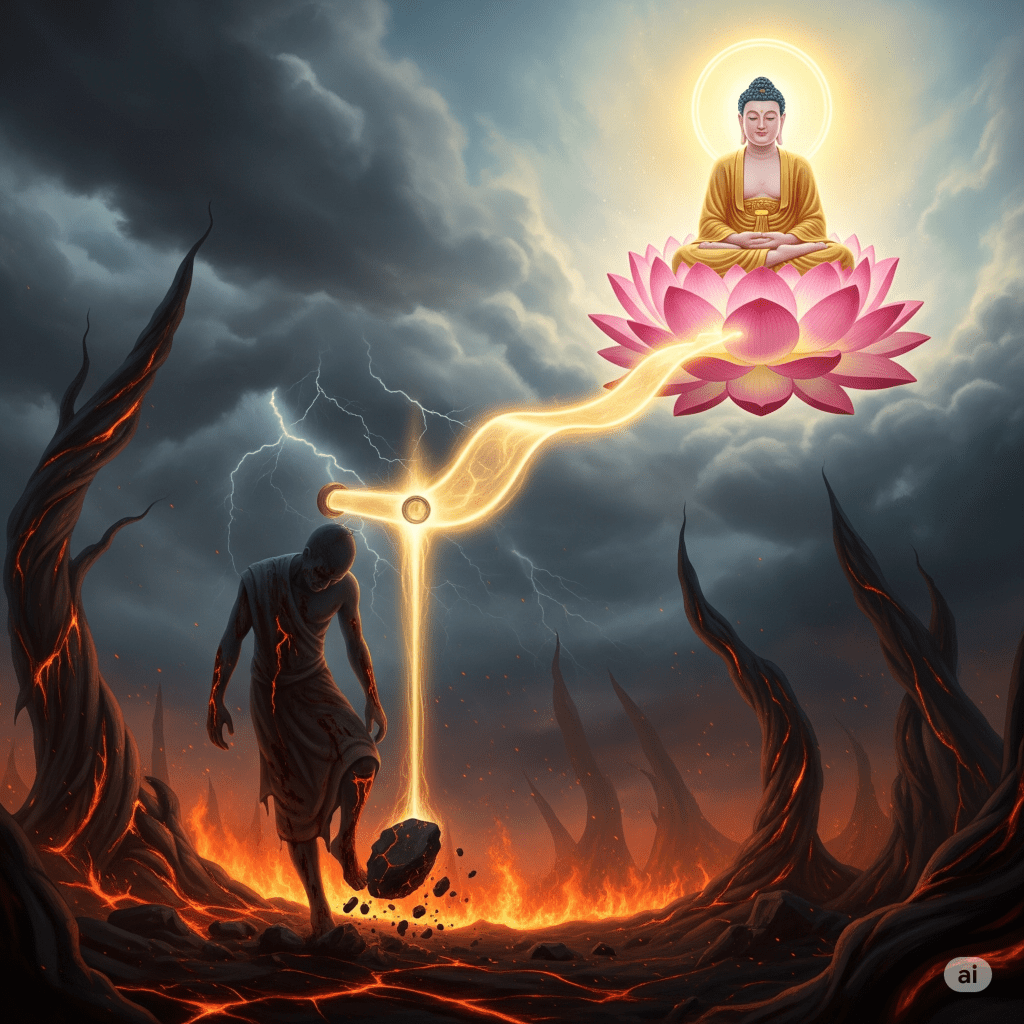
- Plots to Assassinate the Buddha: Devadatta incited Prince Ajatasattu to commit regicide and then made several attempts on the Buddha’s life. These included hiring assassins, hurling a boulder that wounded the Buddha’s foot (shedding the blood of a Buddha, one of the Five Anantarika-karma), and sending an intoxicated elephant to trample him (2.3).
- Causing a Schism in the Sangha: Devadatta attempted to divide the monastic community by proposing stricter rules that the Buddha did not make compulsory, exploiting this decision to lure away about 500 monks (2.4). This act is another of the Five Anantarika-karma (7).
As a direct result of these offenses, Devadatta is traditionally believed to have “fallen into Avīci Hell alive” (2.5), a realm of “unrelenting torment” and “perpetual flames and intense agony” (3.1). The suffering in Avīci is described as “incessant” and lasting for “innumerable kalpas,” though “ultimately impermanent” (3.1).
3. The Lotus Sutra’s Revolutionary Teaching: Devadatta’s Prophecy of Buddhahood
The “Devadatta” chapter (Chapter 12) of the Lotus Sutra fundamentally challenges conventional Buddhist doctrines, asserting that “both women and evil persons are capable of attaining Buddhahood in their present forms” and “without completing many kalpas of practice” (4.1, 10).
Key revelations and teachings include:
- Devadatta as Past Teacher: Shakyamuni reveals that in a past existence, Devadatta was a seer named Asita, who taught Shakyamuni the Lotus Sutra. This transformed Devadatta’s role from antagonist to a “good friend” who “enabled Shakyamuni to fully master Six Paramitas and ultimately attain Supreme Perfect Enlightenment” (4.2, 11). This implies that even adversity can be a catalyst for spiritual growth.
- Prophecy of Future Buddhahood: Despite his fall into Avīci Hell, Shakyamuni prophesies that Devadatta will attain enlightenment as a Buddha named Heavenly King (King of the Heavenly Gods Tathagata) (4.3, 2, 11).
- Parallel of the Dragon King’s Daughter: The chapter reinforces its message through the narrative of the eight-year-old Dragon King’s daughter, who attains “supreme Buddha wisdom instantaneously” (4.4, 10). This directly challenged traditional views that women were incapable of enlightenment and that Buddhahood required extensive austerities (4.4).
- Key Messages:Universal Buddhahood: All beings, regardless of past actions or current form, possess inherent Buddha-nature and the capacity for enlightenment. This is a “fundamental redefinition of the scope of salvation” (4.5).
- Instantaneous Attainment: Enlightenment can be achieved quickly, not requiring “countless kalpas of austere practice” (4.5).
- Irrelevance of Form: Physical or social form is “irrelevant to the attainment of Buddhahood” (4.5).
This chapter’s explicit granting of Buddhahood to “evil persons” and “women” is a “fundamental redefinition of the scope of salvation” and a “foundational aspect of Mahayana Buddhism” (4.5).
4. Nichiren’s Interpretation: The “Inexplicable Yet Precious” Path to Enlightenment
Nichiren (1222–1282) considered the Lotus Sutra the “most supreme” and “highest teaching” (5.1, 18), capable of leading individuals to liberation in the Final Dharma Age (Mappō). His interpretation of Devadatta’s Buddhahood is central to his philosophy.
- “Inexplicable Yet Precious”: Nichiren states in his Treatise on Prayers: “This is indeed inexplicable yet precious. If Devadatta does not become a Buddha, the numerous evil people who were induced by him to enter into his evil comradeship would never be able to escape the torment of the Hell of Incessant Suffering. It is solely due to the great favor of the Lotus Sutra that all of Devadatta’s comrades, too, are allowed to be Buddhas” (5.2, [User Query]). This highlights the Lotus Sutra’s “great favor” in extending salvation to Devadatta and his followers. Nichiren emphasized that “prayers based upon the Lotus Sutra are certain to be fulfilled” and produce “genuine results,” transforming one’s fundamental state of mind (5.2, 13).
- Changing Poison into Medicine: Devadatta’s Buddhahood exemplifies this principle—the ability to transform negative circumstances or individuals into “positive outcomes and opportunities for profound spiritual growth” (5.3, 13). Devadatta’s opposition “spurred the Buddha on to his attainment of the Way” (16) and made him a “good friend” (11). This suggests that challenges, when faced with the power of the Mystic Law (Lotus Sutra), can be transmuted into “fuel for deeper enlightenment” (5.3).
- Universal Buddhahood and Inherent Buddha-Nature (Ichinen Sanzen): Nichiren asserted that “all unenlightened beings innately possess the Buddha realm” (5.4, 24), and “attaining Buddhahood” means to “open or reveal” this already-possessed Buddha-nature (5.4, 19). Devadatta’s and the Dragon King’s Daughter’s enlightenment serve as “powerful admonitions” (12) demonstrating this universal potential (5.4, 10).
- Compassion and Societal Transformation: Nichiren’s teachings aim to lead all people to enlightenment, actualizing the ideal of “establishing the correct teaching for the peace of the land” (5.5, 23). His critiques were “profoundly compassionate” acts, guiding people to the sole path of liberation in the Latter Day of the Law (5.5, 22).
5. Comparative Perspectives: Devadatta’s Fate in Theravada vs. Mahayana
The narrative of Devadatta’s ultimate fate highlights fundamental doctrinal divergences between Theravada and Mahayana Buddhism.
- Theravada Buddhism: Emphasizes strict karmic accountability and individual Arhatship (6.1, 26). Devadatta’s fate is a “stark example of the severe consequences of grave offenses,” leading to “utter destruction” (20) and a definitive fall into Avīci Hell (6.1, 2, 4). While some Theravada texts mention a very distant future possibility of Devadatta becoming a Pacceka Buddha, this is contingent on a prolonged period of suffering to work off karma (6.1, 7).
- Mahayana Buddhism (Lotus Sutra): Emphasizes the Bodhisattva ideal and universal salvation (6.2, 26). The Lotus Sutra’s prophecy of Devadatta’s future Buddhahood reflects Mahayana’s core tenet that “all beings can attain buddhahood” and that “there are no permanent barriers to enlightenment” (6.2, 18). Mahayana interprets Dharma more metaphorically and emphasizes the inherent Buddha-nature (Tathāgatagarbha) in all sentient beings (6.2, 24).
This divergence shows Theravada’s ethical deterrent of immediate karmic consequences versus Mahayana’s “universalist approach” focusing on “boundless compassion and the transformative power of the Dharma” (6.3). The Devadatta story is a “critical point of divergence, showcasing the Mahayana’s radical inclusivity as a ‘Greater Vehicle’” (6.3, 27).
6. Ethical and Philosophical Implications of Universal Enlightenment
The Lotus Sutra’s teaching on universal enlightenment, particularly as interpreted by Nichiren, profoundly impacts ethics and philosophy:
- Redefining “Evil”: Devadatta’s Buddhahood challenges “the notion of evil as an intrinsic or immutable state,” suggesting it is a “temporary manifestation” that can be transcended by revealing inherent Buddha-nature (7.1, 2). This offers a path for “ultimate liberation even from the deepest hells” (7.1, 7).
- Profound Nature of Compassion: Compassion extends to “even those who cause great harm” (7.2, 11). It’s an active commitment to “seeking the happiness and enlightenment of all beings, including one’s adversaries” (7.2, 11), fostering “equanimity” towards all (7.2, 31).
- Accountability and Karma within Universal Salvation: While Devadatta’s immediate descent into Avīci Hell confirms karmic consequences, the Lotus Sutra introduces the nuance that “negative karma can be purified or transmuted” through the Dharma and faith, leading to a higher outcome (7.3, 13). This shifts the ethical framework from purely retributive justice to a transformative one, aiming for “the liberation of all beings from suffering” (7.3, 33).
- Impact on Perception and Treatment of Others: The understanding that “even those who cause great harm are capable of becoming enlightened” (7.4, [User Query]) encourages practitioners to “cultivate a mindset that seeks to help others awaken to their inherent potential, rather than simply condemning them” (7.4, 25).
7. Conclusion
The narrative of Devadatta’s Buddhahood is a radical and enduring teaching. It embodies Mahayana Buddhism’s “radical inclusivity,” redefining “evil” as a temporary state and affirming the inherent Buddha-nature in all beings. Nichiren’s principle of “changing poison into medicine” further highlights that even destructive actions can be catalysts for spiritual growth. Ethically, this teaching compels boundless compassion towards all, even adversaries, fostering a proactive engagement aimed at universal awakening. It offers a message of hope, affirming that “no individual is beyond salvation” and that the path to enlightenment is universally accessible through the Mystic Law.
 Mr. Altig’s Overview of the Wonderful Dharma of the Lotus Sutra
Leave a comment