Date: August 8, 2024
Subject: Analysis of the Dragon Girl’s Narrative in the Lotus Sūtra‘s Chapter Twelve
Purpose: This briefing provides a detailed review of the main themes and most important ideas presented in the provided sources regarding the Dragon Girl’s story in the Lotus Sūtra, highlighting its significance for Mahāyāna Buddhist doctrine, particularly concerning universal enlightenment and gender equality.
I. Introduction: A Radical Assertion of Universal Buddhahood
The Lotus Sūtra (Saddharma Puṇḍarīka Sūtra) is a pivotal Mahāyāna Buddhist text renowned for its “radical and inclusive assertion of universal enlightenment” (Source 1). It proclaims a “One Vehicle” (ekayāna) that promises Buddhahood to all beings, a doctrine powerfully illustrated through narratives like that of the eight-year-old daughter of the dragon-king Sāgara in Chapter Twelve. Her verses, “Only you know that I attain Bodhi / Because I heard the Dharma. / I will expound the teachings of the Great Vehicle / And save all living beings from suffering,” are a “revolutionary act” (Source 1), challenging deeply entrenched prejudices regarding age, gender, and traditional paths to spiritual awakening. This story serves as a “central, polemical, and foundational teaching” (Source 1) revealing the Sūtra‘s most radical truths.
II. The Narrative: Instantaneous Enlightenment Challenging Gradualism and Prejudice
The Dragon Girl’s story unfolds on Holy Eagle Peak, where Bodhisattva Mañjuśrī praises her profound wisdom and rapid spiritual advancement, stating she has “keen roots,” mastered dhāranīs, entered deep meditation, and attained non-retrogression (Source 1). This proclamation is met with skepticism from Bodhisattva Wisdom Accumulated, who questions such quick enlightenment, given the “immeasurable kalpas pursuing austerities” traditionally required (Source 1). Śāriputra, representing the gradualist path, explicitly dismisses her potential, citing “five obstacles” (pañca-āvaraṇāni) believed to prevent women from achieving Buddhahood:
- Cannot become a Brahmā heavenly king.
- Cannot become Śakra (Indra), king of the gods.
- Cannot become a Māra king (demon lord).
- Cannot become a wheel-turning sage king (universal monarch).
- Cannot become a Buddha (Source 2).
In response, the Dragon Girl performs a two-part demonstration:
- She offers a priceless, radiant jewel to the Buddha, who immediately accepts it (Source 1, Source 2).
- She proclaims she will become a Buddha even more quickly, and “before their eyes, she transforms into a male Bodhisattva” (Source 1). She then travels to the Spotless World of the South, attains perfect enlightenment on a jeweled lotus, and begins expounding the Dharma (Source 1, Source 2). This “astonishing spectacle converts the doubters, including Śāriputra and Wisdom Accumulated, who are silenced by the undeniable evidence of her attainment” (Source 1).
Juxtaposition with Devadatta: Chapter Twelve, titled “Devadatta,” deliberately pairs the Dragon Girl’s story with that of Devadatta, the Buddha’s lifelong rival. The Buddha reveals Devadatta as his “good friend” and teacher in a past life, whose opposition ultimately spurred his enlightenment (Source 1). Devadatta, despite his wickedness, is predicted to become a Buddha named Heavenly-King (Source 1, Source 2). This pairing is a “deliberate pedagogical choice” (Source 1): Devadatta The Dragon Girl Role in the Narrative Antagonist, but a teacher in a past life Protagonist, but a teacher for Śāriputra and the assembly Path to Enlightenment Gradual, over countless kalpas of immense effort Instantaneous, in a single moment Implication Validates the traditional path of sustained effort Provides radical proof of the new Mahāyāna path of sudden awakening(Adapted from Source 1)
Together, these stories demonstrate that “even the most spiritually ‘inferior’ or vilified individuals – a ruthless sinner and a young girl – are not only salvageable but destined for enlightenment” (Source 2).
III. Symbolism and Deconstruction of Barriers to Buddhahood
The Dragon Girl’s story is “rich in symbolism” (Source 2) and serves as a direct refutation of traditional Buddhist doctrines:
- Instantaneous Enlightenment (sokushin jōbutsu): Her rapid awakening directly challenges the “immeasurable kalpas” model of enlightenment, proving that “Buddhahood is not something to be acquired over eons but is an inherent state within all beings that can be awakened instantly” (Source 1). She demonstrates that “anyone, just as they are, is able to attain Buddhahood” (Source 2).
- The Priceless Jewel (cintamani gem): Her offering of the jewel to the Buddha symbolizes her “most precious possession… her very life and inherent Buddha-nature” (Source 1). It signifies her “awakening to the mystic principle of ‘three thousand realms in a single moment of life’” (ichinen sanzen), meaning all states of existence are contained within every moment (Source 1). The Buddha’s immediate acceptance “mirrors the ease and swiftness with which she attains buddhahood” (Source 2).
- Breaking Traditional Barriers:Gender Bias: The narrative directly confronts the “prejudice against women” articulated by Śāriputra’s “five obstacles” (Source 1). Her story “refutes the idea of the time that women could never attain enlightenment” (Source 2).
- Time and Capacity: It challenges the notion that Buddhahood requires “aeons of arduous bodhisattva practices” (Source 2), demonstrating a “direct path to Buddhahood without the need for countless kalpas” (Source 2). This is a “bold ‘subitist’ message” (Source 2).
- Non-Human Status: As a nāga (dragon), a “type of being often seen as lower on the spiritual hierarchy than humans” (Source 2), her swift enlightenment further emphasizes the Lotus Sūtra‘s radical inclusivity, showing that “even an animal or spirit creature can swiftly realize the highest enlightenment” (Source 2).
IV. The Gender Transformation: A Site of Enduring Debate
The Dragon Girl’s “dramatic gender transformation” (Source 1) has led to two primary interpretations:
- Literal Interpretation (henjō nanshi – “transforming the female and becoming male”): Prevalent in medieval Japan, this view held that her transformation into a man was a “necessary prerequisite for her to attain Buddhahood” (Source 1). Proponents like Hōnen believed the female body was a “fundamental impediment to salvation” (Source 1), thus reinforcing patriarchal ideals and the “five obstacles.” This perspective saw the story as an “abjuration of the female body” (Source 2).
- Expedient Means (upāya) Interpretation: This more sophisticated view, associated with early Chinese Mahāyāna masters like Zhiyi (Tiantai school), argues the transformation was a “compassionate, magical demonstration performed for the benefit of the unenlightened” (Source 1). Zhiyi asserted that women “do not have to discard their female bodies to attain Buddhahood” (Source 2), but that the act was a “skillful pedagogical tool” to shatter the biases of those like Śāriputra who were “unenlightened as to the emptiness of physical forms” (Source 2). This view is rooted in the Mahāyāna doctrine of emptiness (śūnyatā), asserting that all phenomena, including gender, are “devoid of any inherent, permanent existence” (Source 1). Her transformation “dramatizes the teaching that distinctions like male vs. female are ultimately empty and no barrier to enlightenment” (Source 2).
Henjō Nanshi (Transforming the female and becoming male) Upāya (Expedient means) Core Belief A male body is a necessary prerequisite for attaining Buddhahood.The female body is not an impediment; the act was a compassionate demonstration.Implication for Women’s Salvation Women must either be reborn as men or undergo a magical gender transformation to achieve Buddhahood.Women can attain Buddhahood in their present form, without needing to change their body.Basis of Argument Literal reading; confirmation of “five obstacles.”Ultimate truth of emptiness; pedagogical function of the narrative.(Adapted from Source 1)
V. Legacy and Enduring Significance in East Asian Traditions
The Dragon Girl’s story has had a profound impact across East Asian Buddhism:
- Tiantai (China) and Tendai (Japan): These schools championed her story as proof of instantaneous enlightenment and the emptiness of phenomena, building on Zhiyi’s interpretation (Source 1, Source 2).
- Nichiren Buddhism (Japan): The 13th-century monk Nichiren Daishonin “radicalized” (Source 1) the interpretation, seeing her instantaneous Buddhahood as definitive proof that “all women could ‘realize buddhahood with this very body’ (sokushin jōbutsu), without the need for the sexual transformation known as henjō nanshi” (Source 1). He rejected henjō nanshi as “pure and simple Buddhist misogyny” (Source 2) and declared the Dragon Girl’s enlightenment the “model for universal buddhahood” (Source 1), surpassing all other teachings in its affirmation of women’s Buddhahood (Source 2).
- Zen (Chan) Buddhism: While not a primary scripture, Zen masters used the story to emphasize “sudden enlightenment” and the “emptiness of all obstacles to awakening” (Source 2). Dōgen initially highlighted the emptiness of gender distinctions, though his later writings show grappling with the ambiguity of the transformation (Source 2).
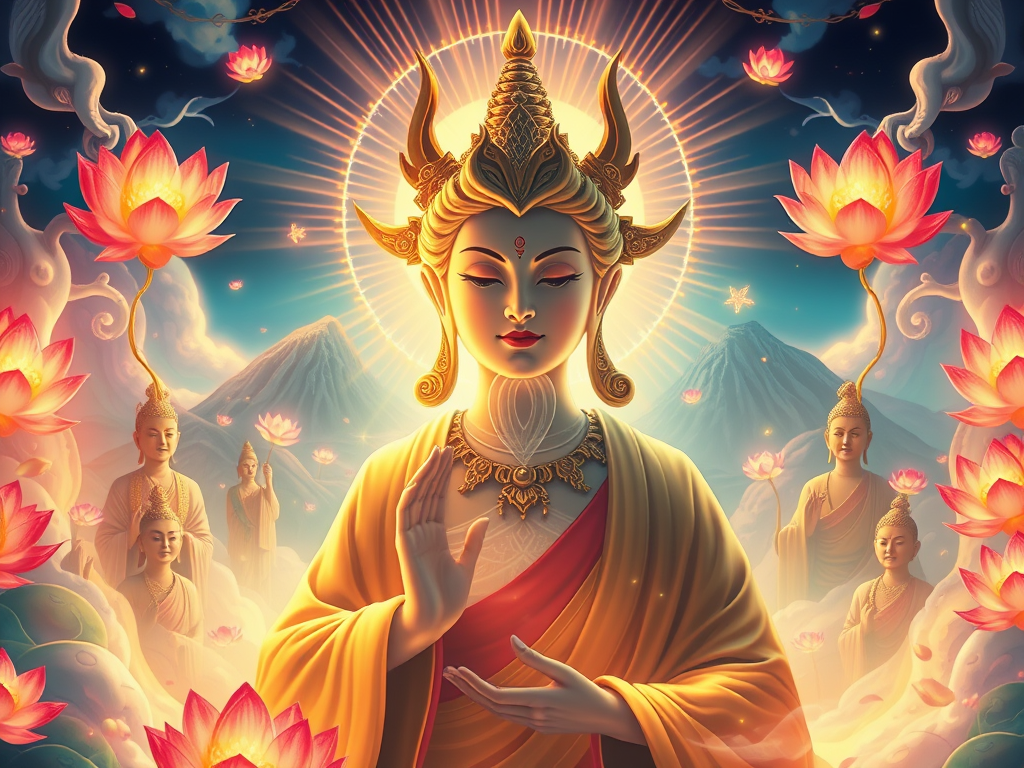
- Art and Popular Culture: Depictions of her offering the jewel appear as frontispieces, and she became an inspiring symbol of female salvation. She is often depicted as an acolyte of Guanyin (Avalokiteśvara), further cementing her revered status and linking her to universal salvation (Source 1, Source 2).
- Modern Relevance: The narrative remains vital for contemporary discussions on gender, authority, and agency in Buddhism. It is widely read as a “radical affirmation of inherent Buddha-nature, challenging the limitations of age, gender, and form” (Source 1). It serves as an “empowering example” that “youth and gender are no obstacles to the highest awakening” (Source 2).
VI. Conclusion: The Enduring Message of Universal Liberation
The Dragon Girl is more than a character; she is a “profound symbol of the Lotus Sūtra‘s central message of universal salvation” (Source 1). Her narrative masterfully converges two fundamental Mahāyāna truths:
- The ultimate reality of emptiness, where “all fixed categories, including gender and physical form, are revealed as illusions” (Source 1).
- The conventional reality of compassionate “skillful means” (upāya), where miraculous demonstrations lead unenlightened beings out of conceptual attachments (Source 1).
Her final verses, her vow to “expound the teachings of the Great Vehicle / And save all living beings from suffering,” underscore that Buddhahood is not a solitary end but a “compassionate beginning” (Source 1). The Dragon Princess remains a “timeless and essential guide to the radical humanism, universal compassion, and boundless potential for all beings that lie at the heart of the Lotus Sūtra” (Source 1), reminding us that “of any who hear the Dharma, none shall fail to achieve Buddhahood” (Source 2).


Leave a comment