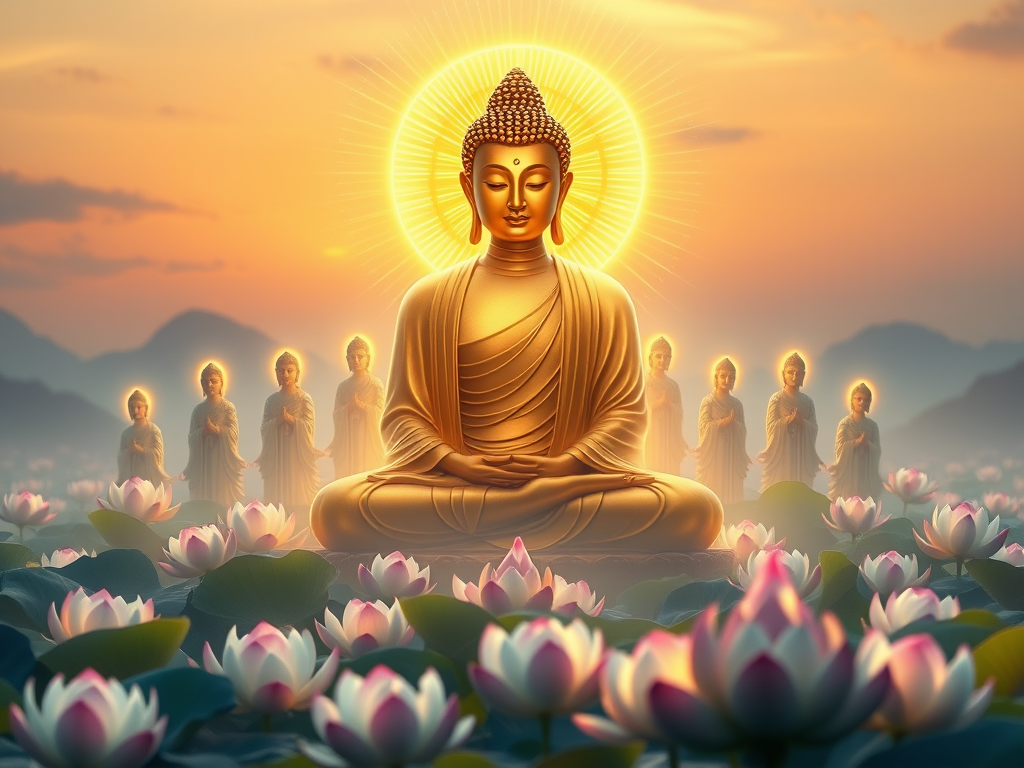
Core Thesis: The “Lotus Sūtra” deeply emphasizes the universal potential for enlightenment (Buddha-nature) inherent in all beings. The Sūtra’s profound praise for those who uphold and propagate its teachings signifies the Buddha’s recognition and encouragement of this latent Buddha-nature, effectively entrusting practitioners with the fulfillment of his original vow to lead all beings to the same enlightened state as himself.
I. The Inconceivable Merit of Upholding the Lotus Sūtra
The “Lotus Sūtra” bestows immense praise upon those who preserve and spread its teachings, highlighting their unparalleled importance within Mahāyāna Buddhism.
- Limitless Praise: Chapter 21, “The Supernatural Powers of the Tathāgatas,” contains the verse: “Even if I praise for innumerable kalpas / The keeper of this sūtra, to whom it is to be transmitted, / I cannot praise him highly enough. / His merits are as limitless, / As infinite, as boundless / As the skies of the worlds of the ten quarters.” This hyperbolic praise underscores the extraordinary significance of the Sūtra’s practitioners.
- Context of Entrustment: This praise occurs after Shakyamuni Buddha reveals his eternal lifespan (Chapter 16) and countless bodhisattvas, led by Bodhisattva Superior Practices (Jōgyō), emerge from the earth (Chapter 15) to undertake the mission of propagating the Dharma after the Buddha’s passing. Shakyamuni “entrusts” the Lotus Sūtra to them, demonstrating cosmic powers to cement the gravity of this mission.
- Historical Significance: Compiled during a period of Mahāyāna advocacy for universal Buddhahood, the Sūtra’s praise serves as encouragement and a pledge of protection for devotees, especially in the “latter age” when the Buddha is absent. It asserts that upholding the Lotus Sūtra is the highest good, making any place where it is upheld “as sacred as a Buddha’s sanctuary.”
II. Buddha’s Praise as Recognition of Buddha-Nature
The Buddha’s lavish praise for Sūtra-keepers is an acknowledgment of the inherent Buddha-nature within them, a central tenet of Mahāyāna Buddhism.
- Universal Potential: Mahāyāna Buddhism teaches that “all people inherently possess the Buddha-nature (the potential to attain enlightenment).” The Lotus Sūtra is particularly renowned for affirming this universal potential.
- Buddha’s Vow for Equality: Shakyamuni Buddha’s life was dedicated to helping individuals awaken to this potential. He made a profound vow: “At the start I took a vow, hoping to make all persons equal to me, without any distinction between us.” This indicates his “fundamental wish” was for all to reveal the wisdom of a Buddha and achieve the same enlightened state.
- Saluting the Future Buddha: Thus, the praise in Chapter 21 is seen as recognition of the “emergence of one’s Buddha-nature.” The practitioner is “actively walking the path to Buddhahood, fulfilling the Buddha’s vow.” The Sūtra emphasizes that even those previously deemed incapable of enlightenment (ordinary people, women, evil-doers) “can and will attain Buddhahood through this teaching.”
III. The Inseparable Connection: Praising the Buddha and Praising the Lotus Sūtra
Praising the Buddha is inherently linked to praising the Lotus Sūtra, which is considered the ultimate expression of his teachings and wisdom.
- The Dharma Embodiment: The Lotus Sūtra is viewed as the “king of sutras and the summation of the Buddha’s wisdom.” Therefore, expressing gratitude or praise to Shakyamuni “is naturally to praise his highest teaching contained in the Lotus Sutra.”
- Superior Merit for Sūtra Practitioners: Chapter 10, “Teacher of the Law,” explicitly states: “If there is someone who seeks the Buddha way and for the space of a kalpa presses palms together in my presence and recites numberless verses of praise [in homage to the Buddha], he will gain immeasurable blessings. And if one lauds and extols those who uphold this sutra, one’s good fortune will be even greater.” This “bold statement” suggests that honoring Sūtra practitioners yields greater merit than direct worship of the Buddha himself.
- Miao-lo’s Commentary: The medieval commentator Miao-lo reinforced this, stating that “those who give alms to them [practitioners of the Lotus Sutra] will enjoy good fortune surpassing the ten honorable titles [of the Buddha].”
- Post-Nirvana Devotion: After Shakyamuni’s physical nirvana, “the true object of devotion is the Law (Dharma) he taught for saving all beings.” Praising the Lotus Sūtra and its transmitters is thus “the truest way of praising the Buddha’s compassion and intent.”
- Nichiren’s Perspective: Nichiren Buddhist literature posits that chanting the title of the Lotus Sūtra (Odaimoku: Nam-myōhō-renge-kyō) is “repaying one’s debt of gratitude” to the Buddha.
IV. Encouraging the Buddha-Nature in All Beings
Valuing and sharing the Lotus Sūtra is a powerful means of encouraging the Buddha-nature in all people, echoing the Buddha’s own practice and vows.
- Bodhisattva Never Disparaging: Chapter 20 introduces Bodhisattva Never Disparaging, who bowed to everyone, proclaiming, “I would never dare disparage you, because you are all certain to attain Buddhahood!” He “refused to see anyone as low or hopeless” and his practice eventually led others to awaken their Buddha-nature. Shakyamuni revealed he himself was Never Disparaging in a past life, setting an example for all.
- Vehicle of Buddhahood: The Lotus Sūtra serves as “the vehicle of Buddhahood for all.” By upholding or sharing it, practitioners convey the message: “You too can become a Buddha!” It “opens the door” to enlightenment for all, including those excluded in other teachings.
- Respecting Practitioners as Buddhas: Chapter 28, “Encouragement of Samantabhadra,” states that anyone who keeps the Sūtra “should be respected as a Buddha.” This directly affirms their Buddha-nature and promotes an ethos of respect for the inherent dignity of all life.
- Fulfilling the Buddha’s Vow: The Buddha’s initial vow to make all people equal to himself means “every teaching he gave was aimed at drawing out the Buddha-nature of his listeners.” The Lotus Sūtra is said to fully reveal and enable quick realization of this inner Buddha-nature. By upholding and sharing it, practitioners “become the Buddha’s partners in fulfilling that promise.”
- Bodhisattva Vows: The Mahāyāna vow “Living beings are numberless; I vow to save them all,” and the specific vow of the Bodhisattvas of the Earth to spread the Sūtra in the “evil age,” demonstrate the commitment to universal salvation inherent in Lotus Sūtra practice.
V. Fulfilling the Buddha’s Promise of Enlightenment
Practicing the Lotus Sūtra directly fulfills the Buddha’s “promise” of universal enlightenment, carrying his mission into future generations.
- Assurance of Buddhahood: The Sūtra “repeatedly assures that those who embrace it ‘will be able to attain Buddhahood’ and that the Buddha ‘has opened the path of Buddha-wisdom to all’.”
- Nichiren’s Interpretation: Nichiren Daishonin identified his followers as the Bodhisattvas of the Earth entrusted in the Sūtra, teaching that anyone who embraces the Sūtra’s essence (Nam-myōhō-renge-kyō) in the Latter Day of the Law is an emissary carrying out the Buddha’s work.
- Continuity of Mission: The Buddha’s enlightenment initiated the enlightenment of countless others. Practicing the Lotus Sūtra means accepting the “entrustment” of the Sūtra from Shakyamuni, transferring his “spiritual mission onto the shoulders of future generations.”
- Practical Application: Fulfilling the promise means “to believe in the enlightened nature of our own life and others’ lives, to chant and live by the sutra’s principles (such as compassion, courage, and wisdom), and to share hope with those around us.”
- Mutual Reverence: The process creates a profound connection: the Buddha praised future practitioners, practitioners praise the Buddha by practicing his teaching, and they praise others by recognizing their Buddhahood. This “mutual reverence” reinforces the idea that “our enlightenment is the Buddha’s enlightenment – he rejoices in it as if it were his own, because it is the fulfillment of his original intent.”
Conclusion: The central verse from Chapter 21, praising the Sūtra-keeper, is not mere flattery but a “pledge of support and an acknowledgment of our sanctity.” By embracing and practicing the Lotus Sūtra, individuals “carry out the Buddha’s work, encourage the Buddha-nature in all people, and personally enact the Buddha’s promise that all beings can achieve enlightenment.” This act “fulfills the Buddha’s promise of our enlightenment,” uniting individual efforts with the Buddha’s timeless compassion and serving as both an honor and an inspiration to develop one’s innate Buddha-nature.
 Mr. Altig’s Overview of the Wonderful Dharma of the Lotus Sutra
Leave a comment