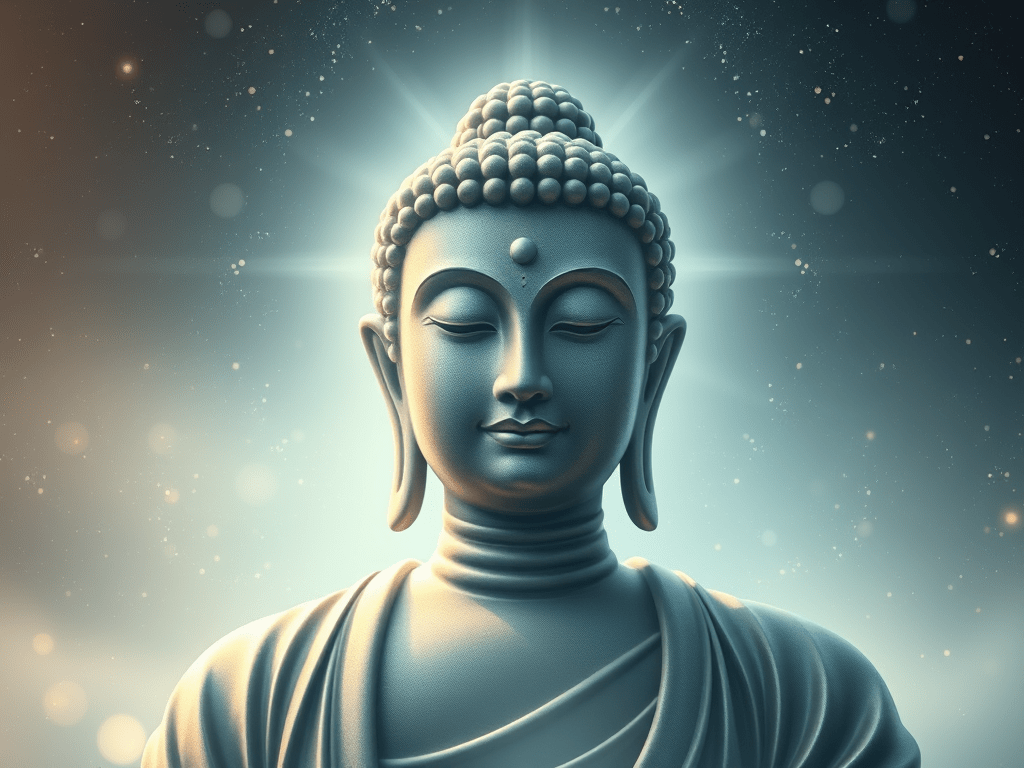
This briefing document provides a comprehensive review of the main themes and crucial ideas presented in the provided source, “The Eternal Buddha: Lifespan, Skillful Means, and Ultimate Reality.” It focuses on the re-conceptualization of the Buddha, the pedagogical role of skillful means (upāya), and the implications for practitioners and the understanding of reality within the Mahāyāna Buddhist tradition, particularly as articulated in Chapter 16 of the Lotus Sūtra.
1. The Radical Re-conceptualization of the Buddha
Chapter 16 of the Lotus Sūtra, “The Life Span of the Thus Come One,” fundamentally alters the conventional understanding of Śākyamuni Buddha.
1.1. From Transient Historical Figure to Eternal Being
The traditional view of Śākyamuni Buddha depicted him as a mortal man who attained enlightenment in his lifetime, born, taught, and then entered a definitive Nirvāṇa. This perspective saw him as a “historical, transient figure who came into being” with a “Limited; began with birth, ended with death” lifespan.
The Lotus Sūtra, however, reveals a startling truth: Śākyamuni Buddha has been enlightened for an “immeasurable, boundless hundreds, thousands, ten thousands, millions of nayutas of kalpas.” He declares that his awakening “did not occur in this fleeting, historical existence.” This revelation transforms him into a “timeless, eternal being who has always been present to teach the Dharma,” possessing an “Immeasurable, boundless, and endless” lifespan. This shift is characterized as “casting off the transient and revealing the true,” distinguishing between the “provisional, historical form of Śākyamuni” and his “timeless, essential nature as the Eternal Buddha.”
1.2. The Cosmic Scale of Buddhahood
To convey the incomprehensible antiquity of his enlightenment, the Sūtra employs a powerful metaphor: grinding “a massive number of worlds into dust” and dropping one particle for every “hundred, thousand, or million worlds” until all are gone. The time since his enlightenment is “twice as great as the number previously mentioned,” a period referred to as “numberless major world system dust particle kalpas.”
This metaphor aims to transcend linear time, suggesting true eternity rather than mere longevity. The Tiantai school interprets this “remoteness of the past” as “always beyond,” transforming the “eternal” nature of the Buddha into a “qualitative statement about his timeless, unconditioned reality,” existing “outside the linear constraints of birth and death.”
1.3. The Tri-kāya Doctrine and the Eternal Buddha
The Eternal Buddha is understood through the Mahāyāna doctrine of the Three Bodies (Tri-kāya):
- Nirmāna-kāya (Transformation Body): The historical Śākyamuni, a “temporary and localized manifestation” for specific times and places.
- Sambhoga-kāya (Perfect Reward Body): A long-lived, subtle body attained through eons of practice, aligning with a literal, unfathomably long lifespan.
- Dharma-kāya (Pure Dharma Body): The ultimate, formless, and unconditioned essence of Buddhahood, the “true thusness.” The Eternal Buddha of Chapter 16, who “abide[s] forever without entering parinirvāṇa,” is a revelation of this Dharma-kāya. The relationship is likened to the moon: “the Dharma-kāya is the ‘bright moon up in the sky,’ while the Nirmāna-kāya are the ‘reflecting moon in the water.’”
2. Upāya (Skillful Means) as a Pedagogical Principle
The Buddha’s actions, including his apparent birth and death, are revealed as a “pedagogical strategy, a masterful use of upāya, or skillful means.”
2.1. Defining Upāya and Its Function
Upāya-kauśalya refers to an enlightened being’s ability to “adapt their teachings and methods to the specific needs, capacities, and dispositions of their audience.” All prior teachings are reframed as “skillful means used to prepare beings for the ultimate truth of the One Vehicle,” which is the “singular path to enlightenment that unifies and transcends all other, seemingly disparate teachings.” The Sūtra’s teachings represent this “One Vehicle” (Ekayāna), which contrasts with the “Three separate vehicles” previously understood.
2.2. The Parable of the Skilled Physician
The “most powerful and direct explanation” of the Buddha’s expedient Nirvāṇa is the Parable of the Skilled Physician and His Sick Children:
- Physician: The wise and compassionate Buddha.
- Sick Children: Living beings suffering from “the poison of delusion, attachment, and ignorance.”
- Potent Antidote: The Dharma.
- Physician’s Feigned Death: The Buddha’s “expedient Nirvāṇa,” a skillful means to shock complacent disciples. The Buddha knows that constant presence would make people “proud, self-willed, and negligent.” His feigned death creates “a sense of urgency and scarcity,” inspiring followers to “cherish a longing heart” and cultivate “virtuous roots.”
The Buddha’s Nirvāṇa is thus “an expedient means to inspire disciples,” not a “final, definitive passing away.”
2.3. Ethical Considerations of Upāya
While essential for diverse teachings, upāya has “complexities and ethical challenges.” The source notes that the Sūtra’s apparent intolerance towards practitioners of “two vehicles” raises questions about “where a skillful means ends and sectarianism or a ‘slippery slope’ begins.” Mahāyāna tradition emphasizes that upāya must be “fundamentally grounded in wisdom (prajñā) and compassion (karuṇā)” and never justify harm.
3. The Ontology of the Eternal Buddha: Reality and Time
The revelation of the Eternal Buddha transforms understanding of reality, time, and the Buddha land.
3.1. The Nature of Time: Beyond Linear Measurement
While a literal reading might interpret the Buddha’s lifespan as merely “effectively incalculable,” the “most influential interpretations, particularly by the Tiantai school, transcend this literal understanding.” They re-frame the lifespan as “truly eternal and unconditioned by time.” The “remote past” of enlightenment is not a point on a timeline but a “metaphorical concept that is ‘always beyond no matter where one is situated.’” This shifts “from a quantitative to an ontological understanding of eternity,” asserting that ultimate reality is “beyond birth and death, and yet simultaneously present within every moment.”
3.2. Nonduality of the Buddha Land and the Saha World
A key Mahāyāna tenet is the “nonduality of the Pure Land and the saha world.” These are not separate places but “are, in fact, one.” For a deluded mind, the world is suffering; for an awakened mind, “the very same world as a ‘buddha land.’” This is linked to the “principle that all phenomena ‘constantly interpenetrate and include one another.’”
The “nonduality” extends to the practitioner’s internal state and external environment. A “human revolution”—a change in one’s heart—leads to a transformed perception and interaction with the world. The promise, “This, my land, remains safe and tranquil,” is not a distant utopia but a statement about the “inherent nature of our present reality.”
4. Implications for Practice: The Internal Buddha-Nature
The teachings of Chapter 16 culminate in profound personal implications for all living beings.
4.1. The Universal Self: “Ordinary People Are Buddhas Just as They Are”
The “most radical and personal implication” is the “identification of the Eternal Buddha with all living beings.” The declaration “It has been immeasurable… since I in fact attained Buddhahood” refers not only to Śākyamuni but to “the ‘living beings of the Dharma realm’ and ‘everyone in the Ten Worlds.’” This leads to the conclusion that “ordinary people are Buddhas just as they are” and that “we are all ‘eternal Buddhas.’” The universe itself is described as a “great living entity… the Eternal Buddha.” The life of every being is “one with this cosmic Buddha.”
4.2. Inherent Potential and Egalitarianism
This teaching asserts that there are “no grades or distinctions between people in their fundamental nature.” The difference lies only in “the degree to which an individual has realized and manifested this truth in their heart.” It is a teaching of “radical egalitarianism and universal dignity” that removes “all barriers to enlightenment.”
4.3. The Power of Faith and Practice
The Eternal Buddha’s ever-present nature means that “we do not need to rely on our own limited abilities” because the “store of the Dharma is always available to us.” This provides an antidote to powerlessness, replacing reliance on “finite capacities with an inexhaustible source of wisdom and courage that is continuously available to those who have faith in it.”
This bridges the theoretical and essential halves of the Lotus Sūtra. The promise of Buddhahood for all (the theory of the One Vehicle) is “made real by the continuous, ever-present reality of the Eternal Buddha (the essence),” providing a “tangible, constant exemplar and a living source of inexhaustible compassionate energy.” The Buddha’s declaration that he will “never pass away” and “always live here and expound the Dharma” is an “invitation for all beings to recognize their own inherent, inexhaustible connection to the store of the Wonderful Dharma.”
 Mr. Altig’s Overview of the Wonderful Dharma of the Lotus Sutra
Leave a comment