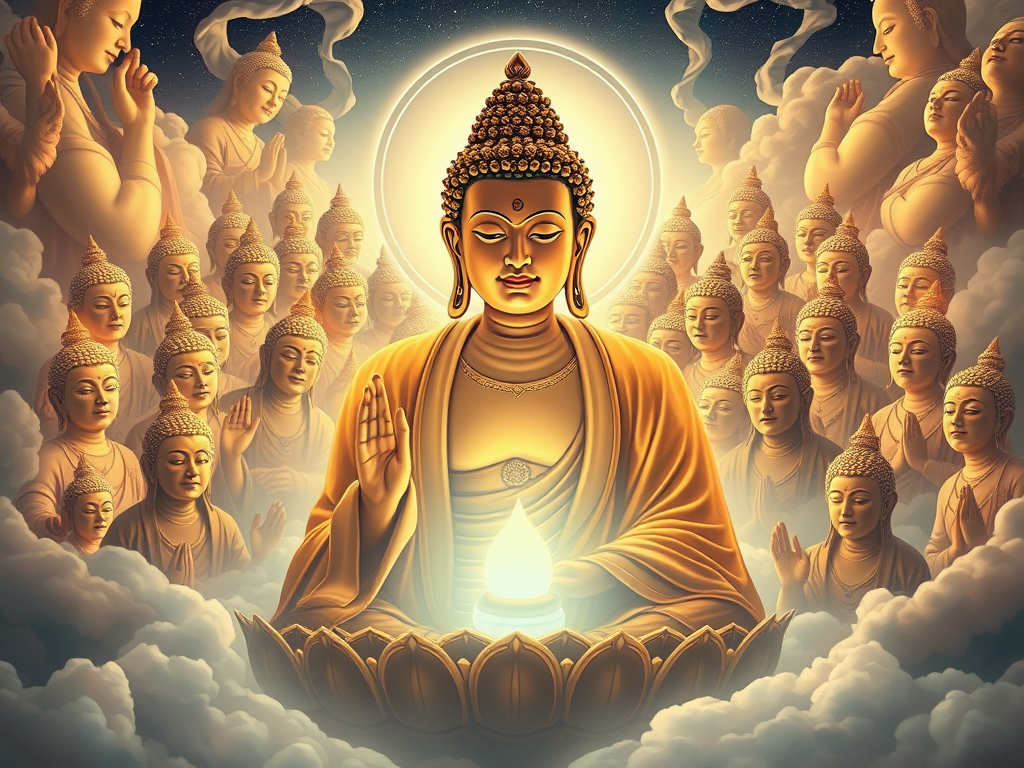
Date: August 27, 2025
Subject: Review of Chapter 15 of the Lotus Sutra, focusing on Maitreya’s inquiry and the revelation of the Eternal Buddha.
Key Themes:
- Maitreya’s Perplexity as a Pedagogical Device: Maitreya’s seemingly incredulous question about the age and origin of the Bodhisattvas of the Earth is not a sign of disbelief, but a crucial narrative tool to introduce deeper, esoteric truths.
- The Revelation of the Eternal Buddha: The Buddha’s true nature is revealed as timeless and eternal, transcending his historical manifestation. This reframes his past teachings as “skillful means” (upaya).
- The Bodhisattvas of the Earth: Symbols of Immanent Liberation: These newly emerged Bodhisattvas represent the inherent Buddha-nature within all beings and their mission to transform the Saha world.
- Transition from “Trace” to “Origin” Teachings: Chapter 15 marks a pivotal shift in the Lotus Sutra, moving from provisional, historical narratives to the ultimate, timeless truth of the Buddha’s existence.
- Modern and Sectarian Interpretations: The themes resonate strongly in various Mahayana traditions, particularly Tiantai and Nichiren Buddhism, with applications to personal transformation and the continuous propagation of the Dharma.
I. Introduction: The Cosmic Unveiling and Maitreya’s Inquiry
Chapter 15 of the Lotus Sutra, “Welling Forth from the Earth,” sets a dramatic stage with a vast assembly of Bodhisattvas Mahasattvas emerging from “empty space beneath the Saha world.” These beings, described with “golden-hued bodies, the thirty-two marks of a great being, and limitless light,” appear after Shakyamuni Buddha declines the offer of Bodhisattvas from other lands to propagate the Dharma in the Saha world, stating that it already has its own host.
This sudden and bewildering appearance prompts Maitreya Bodhisattva, the prophesied future Buddha, to voice the assembly’s astonishment. His “perplexity” is articulated through a powerful analogy:
“It is as difficult as to believe a handsome black-haired man 25 years old who points to men 100 years old and says they are my sons or as to believe men 100 years old who point to a young man and say this is our father he brought us up.”
This analogy highlights the perceived contradiction: how could Shakyamuni, who the assembly believes attained enlightenment only “forty-odd years” ago, have such ancient and spiritually advanced disciples?
Key Facts/Ideas:
- The Lotus Sutra’s Chapter 15 opens with the dramatic emergence of countless Bodhisattvas from the earth.
- Maitreya’s inquiry is presented as a “critical narrative and pedagogical device that unlocks the central, esoteric teachings of the sutra.”
- Maitreya’s doubt is not personal disbelief but a compassionate act “for the sake of people in the future who may have doubts about this point.” It serves as a “skillful means (upaya) for the Buddha to reveal his true, eternal nature.”
II. The Paradox of a Young Father and His Ancient Sons
Maitreya’s analogy directly addresses the apparent incongruity between the historical Buddha’s perceived lifespan and the immense spiritual maturity of the newly emerged Bodhisattvas. The “handsome man, 25 years old” represents the historical Shakyamuni, while the “men 100 years old” symbolize the “newly emerged Bodhisattvas, who, by virtue of their immense spiritual powers and inconceivable wisdom, are clearly figures of great antiquity who have been cultivating themselves for ‘innumerable kalpas’.”
The Buddha’s response that these are his “original disciples” whom he has been teaching “since long ago” directly sets up the profound revelation that follows.
Key Facts/Ideas:
- Maitreya’s analogy illustrates the perceived chronological impossibility: a young teacher with ancient, highly advanced disciples.
- This paradox is a deliberate setup for the Buddha to disclose a deeper truth about his existence.
- Maitreya’s questioning is essential for the “transmission of a profound and liberating truth.”
III. The Philosophical Resolution: The Eternal Buddha
The profound contradiction posed by Maitreya’s inquiry is resolved in the subsequent Chapter 16, “The Life Span of the Thus Come One.” Here, Shakyamuni Buddha reveals that his enlightenment did not occur in his historical lifetime in India, but rather he has “been a Buddha since the ‘inconceivably remote past’.” This revelation redefines his historical life as a “temporary and provisional manifestation, an act of ‘skillful means’ (upaya) designed to inspire and guide beings.”
This understanding clarifies that all of the Buddha’s teachings, including his historical life, are “pedagogically tailored methods intended to lead people to the ultimate truth of the ‘One Vehicle’ (ekayāna).” This concept resolves apparent contradictions, unifying all paths within a “single, supreme path to Buddhahood.”
Key Facts/Ideas:
- The Buddha reveals his “eternal nature,” stating he has been enlightened since the “inconceivably remote past.”
- His historical life and previous teachings are recontextualized as “skillful means” (upaya) to guide beings.
- This revelation marks the transition from the “trace teaching” (historical Shakyamuni) to the “origin teaching” (the true, eternal Buddha) in the framework of the Chinese Tiantai scholar Zhiyi.
- The analogy of the young father and centenarians serves as the “narrative hinge upon which the entire sutra pivots.”
IV. The Symbolic Meaning and Mission of the Bodhisattvas of the Earth
The Bodhisattvas who emerge from the earth are not merely a narrative device; they are powerful symbols. They emerge not from a distant Pure Land but from “beneath the Saha world,” signifying their “intimate, karmic connection to our world of suffering.” This immanent origin contrasts with Bodhisattvas from other worlds and highlights their role as “figures of immanent liberation, deeply rooted in the very ground they are tasked with saving.”
This narrative event foreshadows the philosophical doctrine of hongaku (original enlightenment) prevalent in East Asian Buddhism, which posits that “enlightenment is not something to be attained externally but is an intrinsic reality to be revealed from within.” Their “welling forth” symbolizes the realization of this innate potential, linking the narrative to the idea that “our enlightenment is already present, waiting to be recognized.”
Key Facts/Ideas:
- The Bodhisattvas of the Earth symbolize the “immanence of Buddhahood within the world of suffering.”
- Their origin “beneath the Saha world” signifies their deep connection to this realm and their mission to transform it.
- They are entrusted with propagating the Lotus Sutra, ensuring the continuity of the Dharma.
- Their emergence supports the doctrine of hongaku, emphasizing that Buddha-nature is intrinsic and awaits awakening.
V. Modern and Sectarian Interpretations
The revelations in Chapters 15 and 16 have profoundly influenced various Mahayana traditions:
- Tiantai School: Systematically integrated the teachings, viewing the Eternal Buddha as the core of the “origin teaching” that unifies the three Buddha bodies into a “single, eternal reality.”
- Nichiren Buddhism: Identifies Nichiren Daishonin as the “votary of the Lotus Sutra” fulfilling the prophecy of the Bodhisattvas of the Earth in the “Latter Day of the Law.” Practitioners are seen as modern-day Bodhisattvas of the Earth, engaged in spreading the Mystic Law and transforming the Saha world. The principle of “changing poison into medicine” is central, viewing hardships as opportunities for “profound inner transformation.”
- General Interpretation: Some traditions interpret the Eternal Buddha as signifying the truth that “the life of every being is one with this Buddha.” This posits that “ordinary people are ‘Buddhas just as they are,’ and the only meaningful distinction between individuals is the extent to which they realize this in their hearts.”
Key Facts/Ideas:
- Tiantai views the Eternal Buddha as unifying the three Buddha bodies.
- Nichiren Buddhism sees its practitioners as modern Bodhisattvas of the Earth, transforming suffering into enlightenment.
- The Eternal Buddha can be interpreted as the innate Buddha-nature within all living beings, meaning “ordinary people are ‘Buddhas just as they are.’”
VI. Conclusion: Timeless Compassion and Inner Transformation
Maitreya’s verse and his analogy are the “pivotal moment of the entire sutra.” His “compassionate inquiry” serves to elicit the profound truth of the Eternal Buddha, who has been teaching for “countless eons,” thereby reframing his historical life as a provisional, “skillful means.”
The symbolism of the Bodhisattvas of the Earth reinforces this teaching by demonstrating an “intimate, karmic connection to the world of suffering” and providing a metaphorical foundation for “original enlightenment.” The enduring relevance of this passage lies in its ability to reconcile the historical and the eternal, shifting focus from an external savior to an “internal, transformative mission.”
The Lotus Sutra, through Maitreya’s sincere questioning, ultimately teaches that “true enlightenment is not an escape from reality but the courageous act of transforming it from within.”
 Mr. Altig’s Overview of the Wonderful Dharma of the Lotus Sutra
Leave a comment