Date: September 4, 2025
Subject: Review of “The Luminous Path: An Examination of the Bodhisattva Ideal in Chapter Twenty-Three of the Lotus Sūtra”
This briefing document summarizes the key themes, ideas, and facts presented in the provided source, “The Luminous Path: An Examination of the Bodhisattva Ideal in Chapter Twenty-Three of the Lotus Sūtra,” focusing on Chapter Twenty-Three, “The Former Deeds of the Bodhisattva Medicine-King.”
I. Executive Summary
Chapter Twenty-Three of the Lotus Sūtra serves as a profound exposition of the Mahayana Buddhist path, illustrating the Bodhisattva ideal through the narrative of Medicine-King Bodhisattva. The chapter emphasizes unwavering gratitude, tireless devotion to the welfare of all beings, and the concept of “true vigor.” While it features dramatic acts of self-immolation, these are interpreted as powerful metaphors for ultimate liberation from attachment to the physical self and the cultivation of profound wisdom and compassion, rather than literal instructions for ascetic practice. The core message is that purifying the world is an internal, collective transformation that begins with individual purification and extends outward through compassionate action, making the practitioner a “source of light” for others.
II. Main Themes and Most Important Ideas/Facts
A. The Bodhisattva Ideal: A Universal Path of Selfless Devotion
- Apex of Devotion: Chapter Twenty-Three “represents a pivotal exposition of the Mahayana Buddhist path,” showcasing an “unwavering, tireless commitment to the welfare of all beings.” (Tab 1)
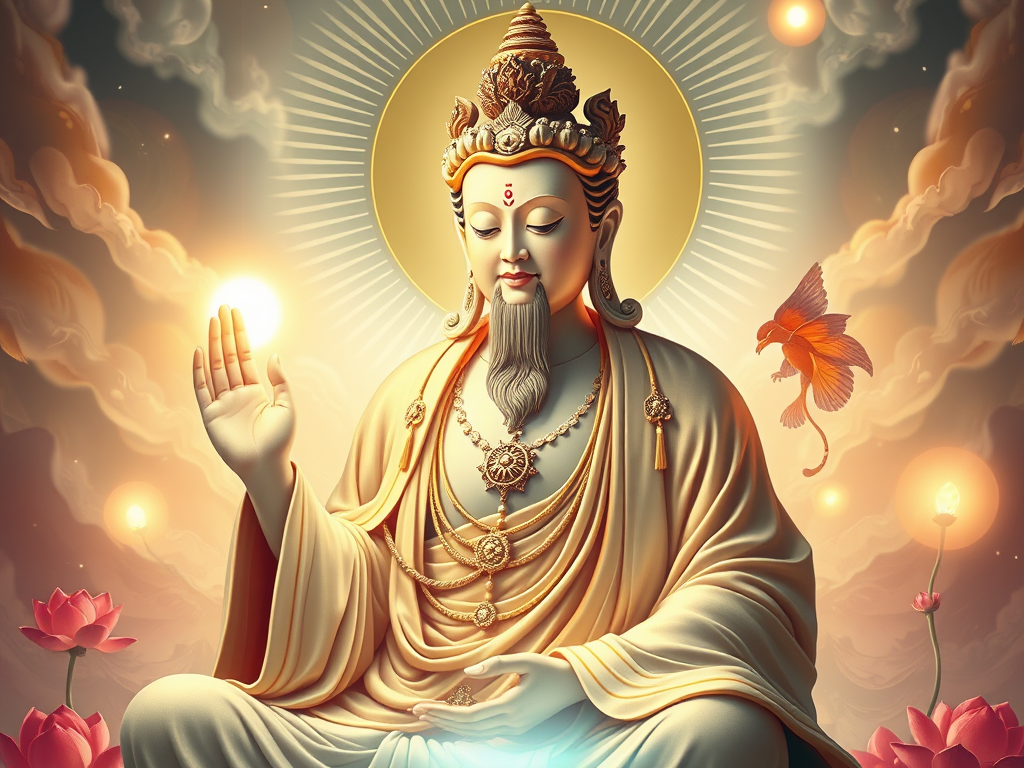
- Medicine-King Bodhisattva: The central figure, previously named Gladly-Seen-By-All-Beings (Sarvasattvapriyadarshana), embodies compassion, bringing joy through his mere presence. His current name, Medicine-King (Bhaiṣajyarāja), signifies his “vow and capacity to cure the spiritual and physical ‘illnesses’ of all sentient beings.” (Tab 1) This highlights a direct causal link between past ascetic practices and his present healing role.
- Contrast with Arhat Ideal: Mahayana Buddhism posits the Bodhisattva path as the “central, universal, and highest path to enlightenment,” contrasting it with the Arhat ideal of self-liberation, which Mahayana texts view as a “sidetrack” or “selfish.” (Tab 1)
- Bodhisattva Objective: Buddhahood for all beings.
- Bodhisattva Central Virtue: Compassion (karuṇā).
- Bodhisattva Vow: To help all beings before one’s own final liberation, rooted in the understanding that “one’s own happiness is impossible while others remain in misery.” (Tab 1)
B. The Narrative of Supreme Offering: Metaphorical Self-Immolation
- “True Vigor” and Preparation: The Bodhisattva’s journey to his supreme offering involves “extraordinary effort and ‘true vigor’,” including “single-mindedly seeking Buddhahood for a full twelve thousand years” and attaining the “samadhi of the manifestation of all physical forms.” (Tab 1) This profound state of concentration, gained after hearing the Lotus Sūtra teachings, enables him to take on “any kind of living being” to teach and save them.
- The Two Offerings:First Offering: After meticulous preparation of his body with fragrant incenses and oils, he “set his body ablaze as a Dharma offering” to the Buddha Virtue Pure and Bright Like the Sun and Moon and the Lotus Sūtra. His body burned for an “astonishing twelve hundred years, illuminating countless worlds.” (Tab 1)
- Second Offering: After the Buddha’s parinirvana, grieved, he collected relics, built pagodas, and “burned both of his arms in an act of profound devotion.” His arms were miraculously “regenerated due to the power of his great vow.” (Tab 1)
- Symbolism of Self-Immolation (Not Literal Instruction):“Most Honorable, the Supreme” Gift: Buddhas universally praise this offering, not for its extremity, but for its representation of a “total and complete dedication of oneself to the Dharma.” (Tab 1)
- Transcending Physical Form: The act is a “demonstration of ultimate liberation from attachment.” Having attained high concentration, the Bodhisattva understood the body as a “false combination of the four elements,” allowing him to transcend physical suffering. (Tab 1)
- “True Mind” as Offering: “You shouldn’t make the mistake of thinking the Buddha likes burned bodies as offerings. That’s not it at all. The Buddhas did not like the stink. They were pleased with his true mind.” (Tab 1) The external act is a “powerful visual metaphor for the complete relinquishing of the attachment to the physical self.” (Tab 1)
- Pedagogical Upāya (Skillful Means): The story is an “upāya,” designed to “shock and inspire practitioners, demonstrating the level of resolve required to follow the Bodhisattva path.” (Tab 1) The Buddha teaches that the merits of the bodily offering “cannot surpass the merits of those who accept and embrace the Lotus Sutra,” indicating it’s a means to inspire commitment and non-attachment. (Tab 1)
C. The Metaphor of Light: Wisdom, Compassion, and Illumination
- Light as Enlightenment: The Bodhisattva’s praise, “Your light illumines the worlds of the ten quarters,” draws on the Mahayana concept of “light as the quintessential metaphor for enlightenment and wisdom (prajñā).” (Tab 1)
- Interconnectedness of Wisdom and Compassion: The Lotus Sūtra links wisdom directly with compassion (karuṇā), describing the light of the sun and moon as a “function of compassion.” The universe is depicted as a “great living entity carrying out activities of compassion,” identified as the eternal Buddha. (Tab 1)
- Bodhisattva as a Vessel of Light: Through rigorous cultivation and supreme offering, the Bodhisattva “becomes a vessel for this light.” The self-immolation, which illuminates “an equivalent of eight billion Ganges’s sands of worlds,” is a literal fulfillment of his own praise. (Tab 1) This transforms the body into a “light-emitting beacon of the Dharma,” a profound allegory for practitioners who, by purifying their minds, become a “source of light for all beings and a force for positive change in the world.” (Tab 1)
D. Purifying the World: From Internal to External Transformation
- Internal State Reflects External World: The narrative’s setting, a “purified land” with ground “level as the palm of one’s hand,” is linked to the internal state of its inhabitants: “Because the people’s hearts were level.” (Tab 1) This establishes the Mahayana concept that “the external world is a direct reflection of the collective internal state of its beings.” (Tab 1)
- Personal Purification as Foundation: “Purifying this world” begins with personal purification. Practitioners must “cleanse their own life and karma” through conscious effort and methods like the “four opponent powers.” The ultimate force of this purification is the “realization of emptiness.” (Tab 1)
- Collective Transformation: Personal transformation, undertaken by many, leads to “collective purification.” The “three-time purification of the lands” is a “cosmic analogue of this process,” representing the collective effort to transform a defiled world into a pure one. (Tab 1)
- Bodhisattva Path as Purification Mechanism: The story demonstrates that “the most extreme dedication to the Bodhisattva path has the power to light up the cosmos, making the path itself the very mechanism by which the world is purified.” (Tab 1)
III. Key Takeaways and Recommendations for Modern Practice
- Cultivate “True Vigor”: Emphasize unwavering, diligent, and patient effort in spiritual cultivation as the foundation for compassionate action.
- Embody Selfless Compassion: Interpret the self-immolation as an allegory for using one’s life force as a vehicle for compassionate action, free from attachment to the physical self, to alleviate suffering.
- Contribute to World Purification: Recognize that purifying the world starts with personal, internal purification and extends to external, compassionate actions to address societal “illnesses.”
- Repay the Good: Understand that the highest form of gratitude for the Buddha’s teachings is to become a Bodhisattva oneself, thereby continuing the Dharma’s illumination of the world.
 Mr. Altig’s Overview of the Wonderful Dharma of the Lotus Sutra
Leave a comment