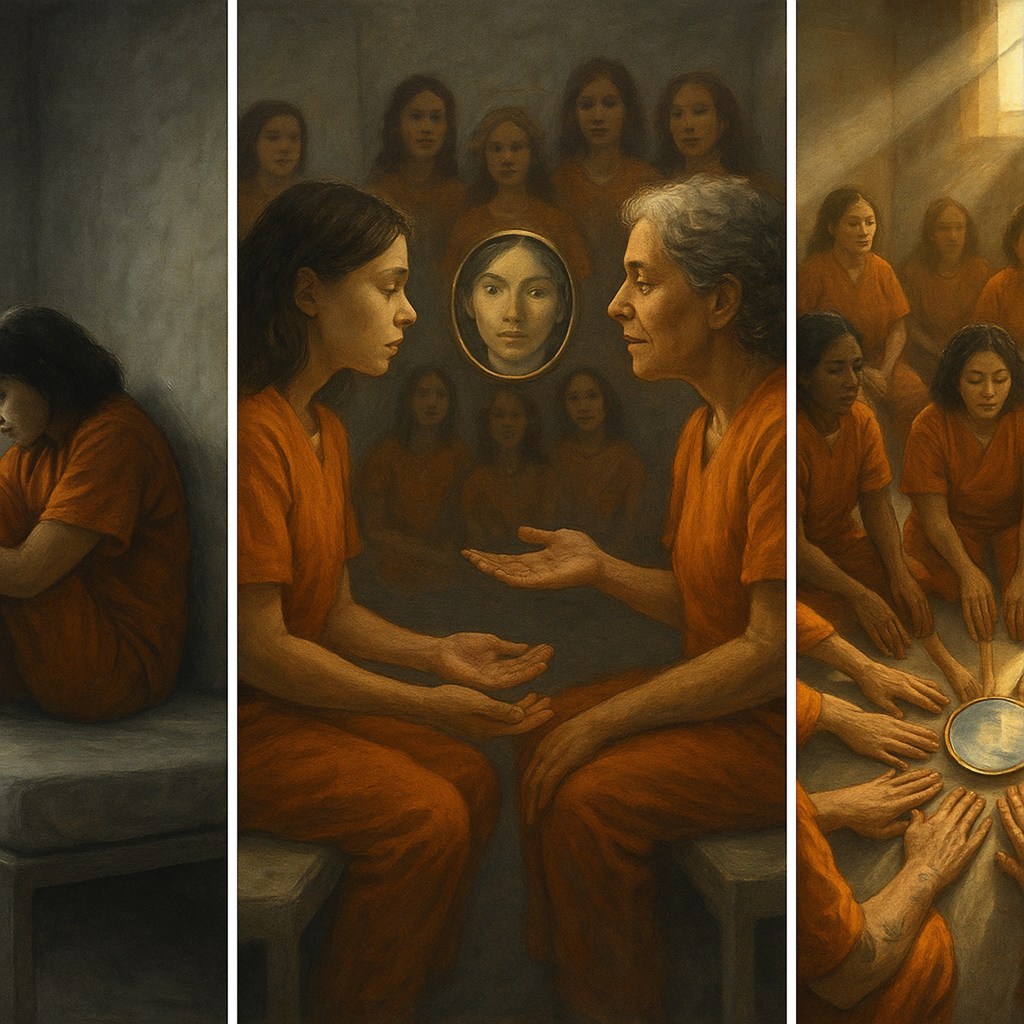
Part I: The Storm
Maya Chen sat in the county jail common room, staring at nothing. Eighteen months for embezzlement. Her legal career: destroyed. Her marriage: dissolved. Her reputation: ash.
The other inmates called her “the Ice Queen” because she never spoke, never cried, just sat there like a statue made of shame.
Until the day Rosa arrived.
Rosa was sixty-three, round-faced, and humming. Actually humming as the guards processed her in. Third DUI, she told everyone cheerfully. “Finally gonna deal with my demons instead of drowning them.”
She chose the bunk next to Maya’s.
“You’re the lawyer everyone’s talking about,” Rosa said that first night. “The one who stole from her clients to pay for her sick mom’s treatment.”
Maya’s jaw clenched. “I didn’t steal. I borrowed. I was going to pay it back.”
“Sure,” Rosa said, not unkindly. “That’s what I said about the bottles I took from work. ‘Borrowing.’” She paused. “Your mom make it?”
“No.”
“Mine neither. Lung cancer, fifteen years ago. That’s when I started drinking for real.”
Maya said nothing.
“Want to know the crazy thing?” Rosa pulled out a worn piece of paper from her belongings—one of the few personal items allowed. On it was written a phrase in what looked like Japanese. “My daughter gave me this before I came in. It’s from some Buddhist thing she’s into. You’re supposed to say it out loud. She swears it saved her life.”
“I don’t believe in magic words.”
Rosa laughed. “Neither did I. But what else we got to do in here?”
Part II: The Practice
For two weeks, Maya ignored Rosa’s morning chanting. The older woman would sit cross-legged on her bunk at dawn, eyes closed, repeating: “Nam-myoho-renge-kyo. Nam-myoho-renge-kyo.” Over and over, like a heartbeat.
“It means ‘I devote myself to the mystic law of cause and effect,’” Rosa explained once. “Every cause has an effect. Every effect becomes a cause. You’re not praying TO anything. You’re waking up something inside yourself.”
“I don’t have anything inside myself,” Maya said. “I’m hollow.”
“Then we got nothing to lose by checking.”
On the fifteenth morning, Maya’s mouth moved. Just a whisper. “Nam-myoho-renge-kyo.”
Rosa smiled but said nothing.
Part III: The Mirror
Six weeks in, Maya was chanting every morning. Something strange was happening—not magical, but undeniable. She felt… different. Clearer. The crushing shame that had pinned her to her bunk was still there, but now there was something else too. Space around it. Room to breathe.
“It’s like a mirror,” Rosa said one day, folding laundry in the common room. “When you chant, you’re wiping the fog off. You see yourself—all of yourself. The good and the terrible. And somehow that makes you stronger.”
“I destroyed people’s lives,” Maya said quietly. “I took money from a veteran’s disability settlement. From a widow’s insurance payout. To pay for treatments that didn’t even work.”
“Yeah,” Rosa said. “You did. And you can’t undo it. But you can decide what kind of person you become next. That’s the thing about this practice—it doesn’t erase your past. It transforms your relationship to it. Your shame can be a gravestone you lie under, or it can be the fuel that makes you into someone who helps people instead of hurts them.”
Maya felt something crack in her chest. “How?”
“By starting with one person. Right here. Right now.”
Part IV: The Teaching
Janelle arrived that afternoon—nineteen years old, meth possession, third strike, facing serious time. She was assigned to Maya’s cell block and spent the first night sobbing so hard she vomited.
Rosa nudged Maya. “Your turn.”
“My turn for what?”
“To pass it on.”
“I barely know what I’m doing.”
“Exactly. That’s when you’re supposed to share it. When it’s fresh. When you remember what it’s like to feel broken.”
Maya approached Janelle’s cell. The girl was curled on her bunk, shaking.
“Hey,” Maya said. “This is going to sound weird, but… there’s something that helps.”
That night, three voices chanted in Cell Block D.
The next week, five.
By the end of the month, twelve.
Part V: The Storm Inside
Maya’s parole hearing was denied. Another six months.
She felt the old darkness rushing back—the crushing certainty that she was irredeemable, that she’d never rebuild, that she’d destroyed her life beyond repair.
Rosa found her in the corner of the common room, silent again.
“This is supposed to work,” Maya said bitterly. “I’ve been chanting for four months. I got denied.”
“And?”
“And I’m still stuck here! Nothing’s changed!”
Rosa sat beside her. “Everything’s changed. Four months ago, you couldn’t get out of bed. Now you’re getting Janelle to eat. You’re helping Carmen write letters to her kids. You’re teaching Brittany how to read legal documents so she can understand her own case.” She paused. “The protection isn’t a shield from bad news, Maya. It’s the strength to handle it. To still be you when the storm hits.”
“But the hearing—”
“Was just weather. The storm isn’t out there. It’s in here.” Rosa tapped Maya’s chest. “And that storm? You’re learning to stand in it without breaking.”
Maya closed her eyes. Started to chant.
Rosa joined her.
Then Janelle. Then Carmen. Then others.
Part VI: The Paradox
Five months later, Maya was released. She couldn’t practice law anymore, but she found work at a nonprofit legal aid clinic, helping low-income clients navigate the system. The pay was terrible. The work was hard.
She loved it.
One morning, she got an email from Rosa, who’d been released two weeks earlier: “Took my first sober breath in 20 years yesterday. Went to AA, spoke for ten minutes about the chanting thing, gave three people your number. One of them is a lawyer who lost her license. Thought you two should meet.”
Maya smiled, pulling out the piece of paper she now carried everywhere—the phrase written in her own handwriting:
Nam-myoho-renge-kyo
She’d written it from memory, after Rosa left, so she wouldn’t forget.
But beneath it, she’d added something Rosa once told her:
“When you help someone else wake up, you wake up more. When you protect someone else, you become protected. It’s not two things. It’s one thing. The same mirror, reflecting both ways.”
Part VII: The Call
That weekend, Maya visited the county jail as a volunteer. Twelve women sat in the common room, waiting.
“My name is Maya Chen,” she began. “I’m a disbarred lawyer who embezzled from her clients. I spent eighteen months here. And I want to teach you something that sounds absolutely ridiculous—a phrase in Japanese that you chant out loud.”
A few women rolled their eyes. Others looked desperate enough to try anything.
“It’s not magic,” Maya continued. “It won’t make your charges disappear. It won’t erase what you did. But it will wake up something inside you that you forgot was there—or maybe never knew existed.”
A young woman in the back, barely twenty, raised her hand. “What’s it wake up?”
Maya smiled. “The part of you that can turn poison into medicine. The part that can stand in a storm without breaking. The part that knows you’re not what you’ve done—you’re what you choose to do next.”
She took a breath.
“It goes like this: Nam-myoho-renge-kyo.”
Twelve voices, hesitant at first, began to echo.
Epilogue: Three Years Later
Maya’s apartment had a small shelf by the window. On it:
- A photo of her mother
- Rosa’s original piece of paper, now laminated
- A letter from Janelle, two years sober, working at a treatment center
- A card from Carmen’s daughter: “Thank you for helping my mom come home”
- A newspaper clipping about the legal aid clinic winning a major housing discrimination case
And in the center, a small mirror.
Not for vanity. For remembering.
Every morning, Maya sat before it and chanted. And every morning, she saw not just herself, but everyone she’d helped, everyone who’d helped her, everyone who’d taught her the truth Rosa whispered in that first cell:
“The universe doesn’t protect you by removing obstacles. It protects you by making you into someone who can turn obstacles into stepping stones. And then you teach someone else how. That’s the whole thing. That’s the practice. That’s the protection. That’s the point.”
Maya looked at her reflection and smiled.
Then she picked up her phone. She had three missed calls from women she’d never met—referrals from Rosa, from Janelle, from others in the growing web.
Women in storms, looking for shelter.
Not knowing they already had everything they needed.
Just needing someone to show them the mirror.
The End
Or, as they would say: The beginning.
 Mr. Altig’s Overview of the Wonderful Dharma of the Lotus Sutra
Leave a comment