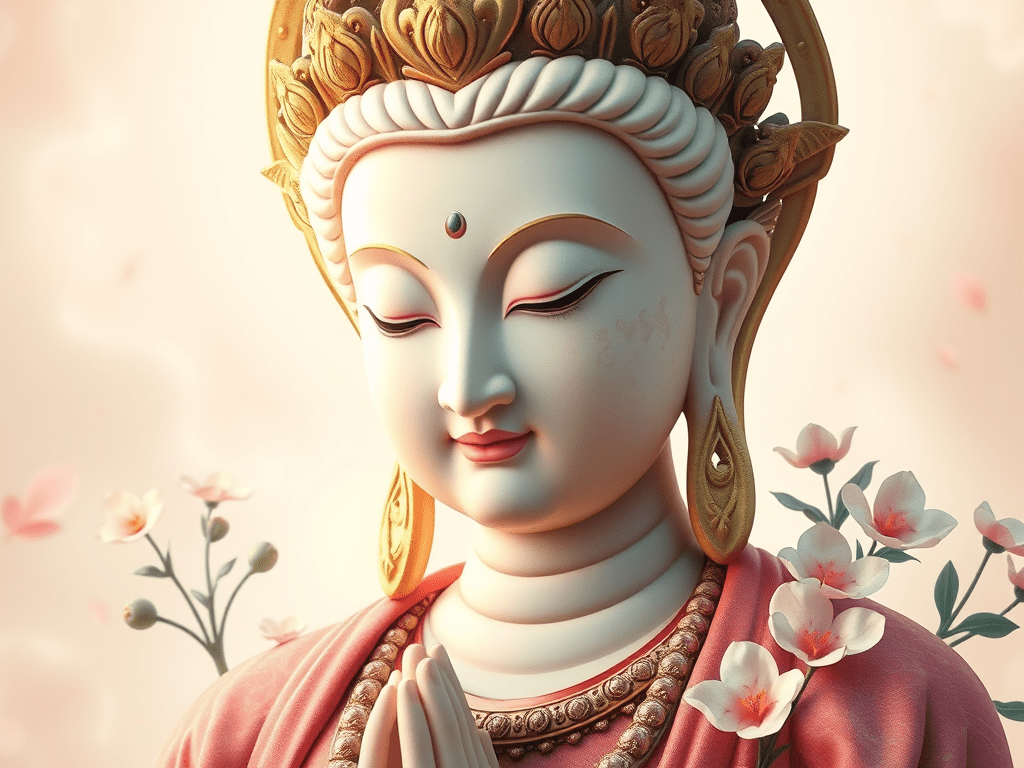
It is a deeply familiar weight in our modern age: we are confronted daily with a seemingly endless tide of global problems, and in the face of such overwhelming need, we feel crushingly inadequate. We look at the scale of what is necessary and, as one ancient text observes, come to “believe that we are not capable of doing everything that is necessary.” This sentiment can lead to paralysis, burnout, and a quiet despair.
Yet this weight is not unique to our time; it is a timeless human echo. For millennia, spiritual traditions have grappled with this very challenge. One of the most profound and counter-intuitive responses comes from the ancient figure of Avalokitesvara, the Bodhisattva of Compassion, known in China as Guanyin and in Japan as Kannon. More than a distant deity, this being’s story offers a sophisticated psychological and spiritual toolkit for navigating an overwhelming world. This article explores five surprising lessons from this Bodhisattva that can transform our approach to compassion and action.
1. True Compassion Isn’t About Ruling, It’s About Listening
We often associate helping with a kind of top-down power. The one with resources or authority acts upon the one in need. This idea is even embedded in the most common translation of the Bodhisattva’s Sanskrit name, Avalokiteśvara. The word īśvara (“lord” or “master”), often used for supreme Hindu deities like Vishnu or Shiva, renders the name as “the Lord who looks down,” implying a sovereign, watchful protector who rules from above.
But a surprising scholarly insight reveals an earlier version of the name was likely Avalokitasvara. This simple change—from īśvara to svara (“sound”)—radically transforms the meaning. The name becomes “the sound perceiver.” This interpretation was solidified for all of East Asia by the great 5th-century translator Kumārajīva and is powerfully reinforced by the Bodhisattva’s Chinese name, Guanshiyin, which translates precisely as “Perceives the Sounds of the World.”
This shift is more than academic. It reframes the very nature of compassion. It is not an exercise of power or lordship, but an act of profound, active listening. The Bodhisattva’s primary function isn’t to rule over the world, but to be completely receptive to its cries of suffering. This teaches us that the first, and most fundamental, act of compassion is not to fix, but to be present enough to truly hear.
2. The Bodhisattva Who Changed Genders: A Lesson in Ultimate Adaptability
In our world of rigid categories, the history of Avalokitesvara’s appearance is startling. In early Indian and Chinese depictions, the Bodhisattva was unequivocally male. Paintings from the Dunhuang caves in the tenth century clearly show Avalokitesvara with moustaches.
Yet, beginning around that same time, a remarkable transformation began in China. The figure of Guanyin started to be depicted with increasingly feminine features. By the 16th century, this process of cultural and spiritual indigenization was complete, and Guanyin had become the beloved female “Goddess of Mercy.” This profound shift filled a religious vacuum in China, providing an accessible, universally compassionate savior figure that had no direct precedent in the indigenous pantheon. It was a sophisticated demonstration of the Buddhist doctrine of upāya, or “skillful means”—adapting the form of the teaching to embody boundless compassion in the potent and accessible archetype of a mother’s love.
This fluidity is doctrinally intentional and speaks to a deeper truth about the nature of help.
The Lotus Sūtra makes this explicit, stating that Avalokitesvara manifests in whatever form is necessary—male, female, human, or non-human—to bring salvation.
This historical transformation challenges our fixed ideas about identity. It shows that the truest form of compassion is not attached to any single form or category, like gender, but is fluid and adaptable. More profoundly, it is a living demonstration of the doctrine of anattā (non-self). By refusing to be bound to a single, essential identity, the Bodhisattva teaches that ultimate compassion arises from a wisdom that sees beyond the fixed categories that define the ego.
3. The “Miracles” Aren’t Just Magic—They’re Metaphors for Your Mind
Chapter 25 of the Lotus Sūtra contains a list of seemingly miraculous promises. By calling the Bodhisattva’s name, the text says, a person can be saved from being in a “great fire” or being “washed away by a great flood.” For centuries, many have taken these promises literally. Yet the tradition also offers a powerful metaphorical reading, and the most nuanced understanding sees these two views not as a false dichotomy, but as deeply interconnected.
From the metaphorical perspective, the external perils are symbols for our internal afflictions. The “great fire” is not just a physical flame; it is the consuming fire of hatred and anger. The “great flood” is not just water; it is the overwhelming tide of attachment and desire. The “demons” that torment us can be seen as our own afflictive emotions.
Seen this way, calling the Bodhisattva’s name becomes a practice of mindfulness. Crucially, the sutra specifies that this must be done “single-mindedly” (ekacitta), suggesting the practitioner’s own mental state is key. The Bodhisattva’s help is not a cosmic override of reality but works in concert with our own sincerity and karmic conditions. In this synthesis, the internal and external are linked. A mind purified of the “fire of hatred” is less likely to create the conditions for external conflict, and when faced with peril, a stable mind can find a “shallow place” of calm. The greatest miracle, then, is not just altering the world outside, but transforming the landscape of our own mind.
4. Help Can Appear in Any Form (Including Yours)
When the Buddha is asked in the Lotus Sūtra how the Bodhisattva helps, the answer is revolutionary. He explains that the Bodhisattva can appear in any form necessary to teach or save someone. The list of these “thirty-three manifestations” is breathtaking in its diversity. Help can appear in the form of a king or a chief minister, a monk or a nun, a laywoman, a young boy or girl, and even non-human beings.
This list should not be taken as a literal, exhaustive count; the number thirty-three is symbolic of totality and completeness. The implication of this teaching is profound: it radically democratizes the sacred. If the ultimate embodiment of compassion can manifest as an ordinary householder or administrator, then it means any person, in their ordinary life, can embody the qualities of the Bodhisattva. The boundary between the sacred and the secular dissolves.
This empowers us to see our own lives—our jobs, our families, our communities—as a potential field for compassionate action. Help doesn’t just come from celestial beings; it can come from a neighbor, a colleague, or a stranger. And most importantly, it can come from you.
5. The Antidote to Burnout Isn’t More Power, It’s a Different Kind of Wisdom
The despair we feel often comes from operating within a “power framework.” We see ourselves as a small, separate self that must somehow fix an infinitely broken world. This perspective is a mathematical formula for burnout; our finite capacity will always be dwarfed by the world’s infinite need.
The Bodhisattva’s path offers a radical alternative: the “wisdom (prajñā) framework.” This wisdom is not mere intellectual knowledge (vijñāna), but the direct, transformative insight into the nature of reality. It is developed in stages—from learned and reflective understanding to a deeply cultivated, direct experience in meditation. This wisdom reveals the interconnectedness of all things and the non-existence of a separate, isolated self.
When this wisdom penetrates the illusion of a separate ‘I,’ the boundaries between self and other become porous. The suffering of another being is no longer perceived as an external problem to be solved, but is felt with the intimacy of one’s own pain. Compassion becomes the natural, spontaneous response of a mind that has realized its interconnectedness. Action is no longer about imposing one’s will, but about responding skillfully to the needs of an interdependent reality. The scale of this commitment, born of wisdom, is vast.
His vow to save [people] is as deep as the sea. You cannot fathom it even for kalpas.
This metaphor is precise. In Buddhism, the ocean symbolizes a reality that embraces all things, has a single taste of liberation (like the sea’s one taste of salt), and naturally expels defilement (as the ocean casts a corpse ashore). Wisdom provides the resilience and clarity to sustain a vow this deep, transforming reactive “idiot compassion” into effective, unwavering, and sustainable action.
Conclusion: From Overwhelmed to Awestruck
The teachings embodied by Avalokitesvara offer more than comfort; they provide a fundamental shift in perspective. They guide us away from the exhausting struggle of an isolated individual trying to exert power over a broken world, and toward the role of a connected participant acting with wisdom within a dynamic whole. By learning to listen, adapt, and see our own minds clearly, we find a path to meaningful engagement that does not lead to burnout.
What happens when we stop focusing on our inability to fix everything, and instead, by depending on wisdom, simply learn to see the wonders that surround us?
 Mr. Altig’s Overview of the Wonderful Dharma of the Lotus Sutra
Leave a comment