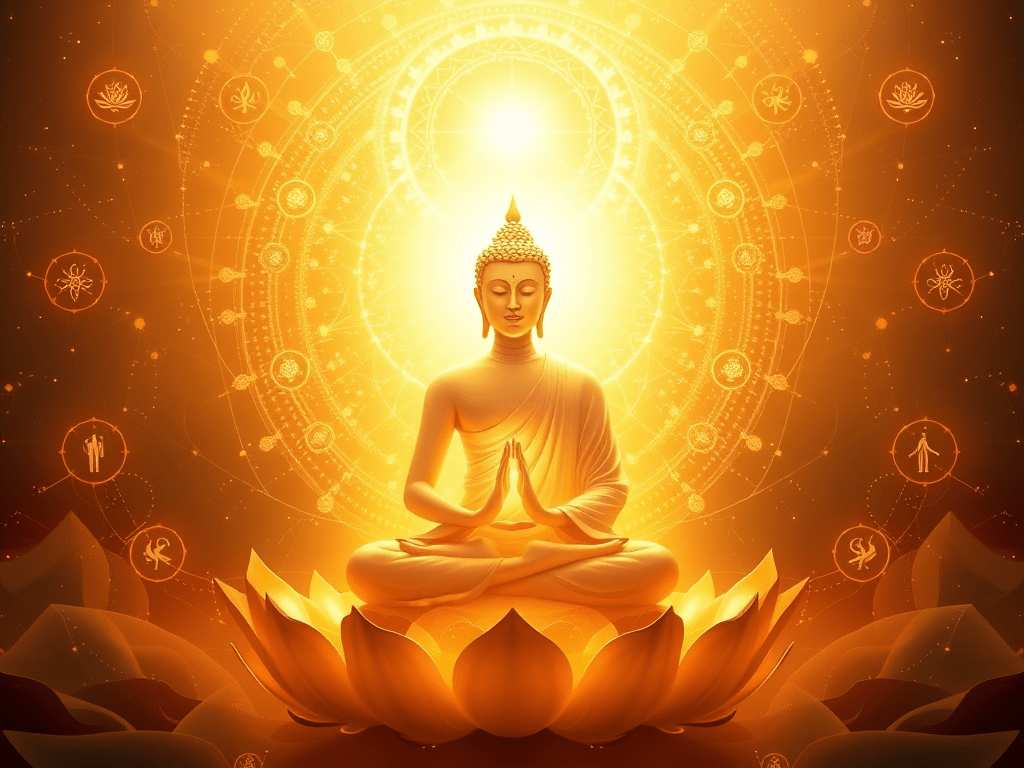
Introduction: The Hidden Economy of Spiritual Practice
Most of us share a common understanding of what it means to do good. Whether in a spiritual or secular context, we think of it as a process of accumulation—a long, steady effort of performing kind acts, maintaining ethical conduct, and contributing positively to the world. We imagine our merit as a kind of spiritual bank account, where every good deed is a deposit, and progress is measured by the balance we build over a lifetime. It is a linear, logical, and deeply intuitive idea: more effort over more time equals greater results.
But what if this entire model is incomplete? What if there is a hidden economy of spiritual practice, one where the most valuable currency isn’t the quantity of our actions but the quality of a single, transformative insight? An ancient text, the Lotus Sutra, presents exactly this kind of radical perspective. It argues that a profound internal shift can hold more weight and power than eons of conventional, outward effort.
This article explores three surprising takeaways from this remarkable text that challenge our most basic assumptions about what constitutes a truly valuable spiritual act. These are not just philosophical curiosities; they are revolutionary ideas that reframe the very nature of practice, devotion, and community.
The Astonishing Power of a Single Moment of Faith
Chapter 17 of the Lotus Sutra presents a startling paradox that fundamentally re-evaluates the nature of merit. It begins by asking us to imagine a diligent, conventional practitioner. This person dedicates themselves to practicing the five perfections (pāramitās)—giving (dāna), good conduct (śīla), perseverance (kṣānti), effort (vīrya), and meditation (dhyāna)—for an almost unimaginable duration: “eight hundred thousand million nayutas of kalpas” (an ancient measure for an immense span of time). By any standard, this is the very picture of a virtuous life.
The text then introduces a counterpoint. It describes another person who simply hears the Sutra’s teaching on the eternal nature of the Buddha and, in the depths of their mind, believes and understands it “even for a moment.” The conclusion is shocking: the merit gained by the first practitioner, over countless eons of good deeds, does not amount to even a “hundred thousand myriad millionth part” of the merit gained by the second person from that single, instantaneous moment of faith. The power of this moment comes from its content: it is the cognitive and spiritual acceptance of the Buddha not as a historical figure who passed away, but as a timeless, ever-present reality. This insight doesn’t just add to one’s merit; it fundamentally realigns the practitioner with the nature of reality itself.
This reframes spiritual progress entirely. It is no longer a linear, horizontal accumulation of actions over time. Instead, the Sutra introduces a vertical, timeless dimension. A single moment of profound belief is not just a point in time, but an event that accesses the timeless. It is a leap of realization that connects one directly to an ultimate truth, an act so potent that it outweighs lifetimes of conventional practice.
Your Practice is the Ultimate Monument
In ancient Buddhist traditions, some of the highest acts of devotion involved physical construction. Building a stūpa—a sacred monument that not only enshrines the Buddha’s relics but also symbolizes his ultimate body of reality (dharmakāya)—or founding a monastery to serve as the institutional vessel for his teachings (Dharma) and community (Saṃgha) were acts of unparalleled merit. These were tangible, lasting offerings that sustained the tradition for generations. The Lotus Sutra, however, makes another astonishing claim: for one who upholds its teachings, these acts become unnecessary.
Ajita! They need not build a stūpa or a monastery in my honor, or make the four kinds of offerings to the Saṃgha because those who keep, read and recite this sūtra should be considered to have already built a stūpa or a monastery or made offerings to the Saṃgha.
This is a profound act of “soteriological internalization”—it moves the locus of the sacred from an external object to the inner life of the practitioner. A stupa is the physical embodiment of the Buddha’s presence in the world. A monastery is the vessel that preserves his teachings. The Sutra argues that when a person keeps, reads, and recites its message, they are enshrining the Buddha’s eternal essence within their own being.
Their mind becomes the sanctuary, their voice the ritual, and their body the reliquary. They do not need to build a monument of brick and stone because their very life has become a living, breathing stūpa. Their daily practice becomes the ultimate offering, an act so complete that it is considered the fulfillment of these physical deeds in a higher, more essential form.
Everyone Practicing Beside You is “Invincible”
Throughout this teaching on merit, the Buddha addresses his disciple, the future Buddha Maitreya, by his personal name: Ajita. In Sanskrit, this name means “Invincible” or “Unconquerable.” This choice of name is no accident; it is a profound teaching in itself.
By addressing Maitreya as “Ajita,” the Buddha is simultaneously bestowing this quality upon all who will uphold this teaching in the future. The act of maintaining faith in a world of conflict is what forges this invincible spirit, making one unconquerable by both internal delusions and external obstacles. This perseverance in practice within a “world of conflict” (sāha world)—a world like ours, filled with struggle, confusion, and adversity—is what makes a person spiritually invincible.
This concept completely transforms how we view our fellow practitioners. The people practicing beside us are not just ordinary individuals struggling with their problems. They are Bodhisattvas embodying the invincible spirit of Ajita. They are engaged in the most difficult and valuable work imaginable: upholding a profound truth in a world that often ignores it.
This is why, as one modern commentary notes, they “should be treated with the same admiration we have for anyone who has done valuable work.” This fosters a community built not on hierarchy or personality, but on a deep and abiding mutual respect for each person’s sacred potential to be unconquerable.
Conclusion: The Revolution Within
The Lotus Sutra offers a quiet but profound revolution. It systematically shifts our focus away from a valuation of external, quantifiable acts toward the supreme and immeasurable power of an internal transformation. The three takeaways—the explosive power of a single moment of faith, the practitioner’s own life as a living monument, and the sacred identity of the community as an assembly of “Invincibles”—all point to the same conclusion. The most significant spiritual work is not building things in the outer world, but awakening a fundamental truth within.
This ancient text proposes a different way of measuring a life, one where the deepest changes happen in the silent, unseen space of our own minds and hearts. It leaves us with a powerful idea to carry into our modern world, a world obsessed with outward metrics of success.
How might our world change if we valued the quality of our inner belief as much as the quantity of our outer actions?
 Mr. Altig’s Overview of the Wonderful Dharma of the Lotus Sutra
Leave a comment