Introduction: The Outer Limits of Devotion
What is the greatest sacrifice you could imagine making for something you truly believe in? For an idea, a truth, or a sense of gratitude so profound that no ordinary gift would suffice?
The ancient Buddhist text, the Lotus Sutra, contains one of history’s most extreme and startling tales of devotion—a story designed to push our understanding of commitment to its absolute limit. It tells of a being named Bodhisattva Medicine King, who made an offering of his own body, not once, but twice, in an astonishing act of gratitude.
But this story is not what it first appears to be. It explores the outer limits of physical sacrifice only to reveal a deeper, more accessible truth about where real value lies. Here are the four most surprising takeaways from this ancient and powerful narrative.
1. A Bodhisattva’s Ultimate Sacrifice: The Story of the Living Fire
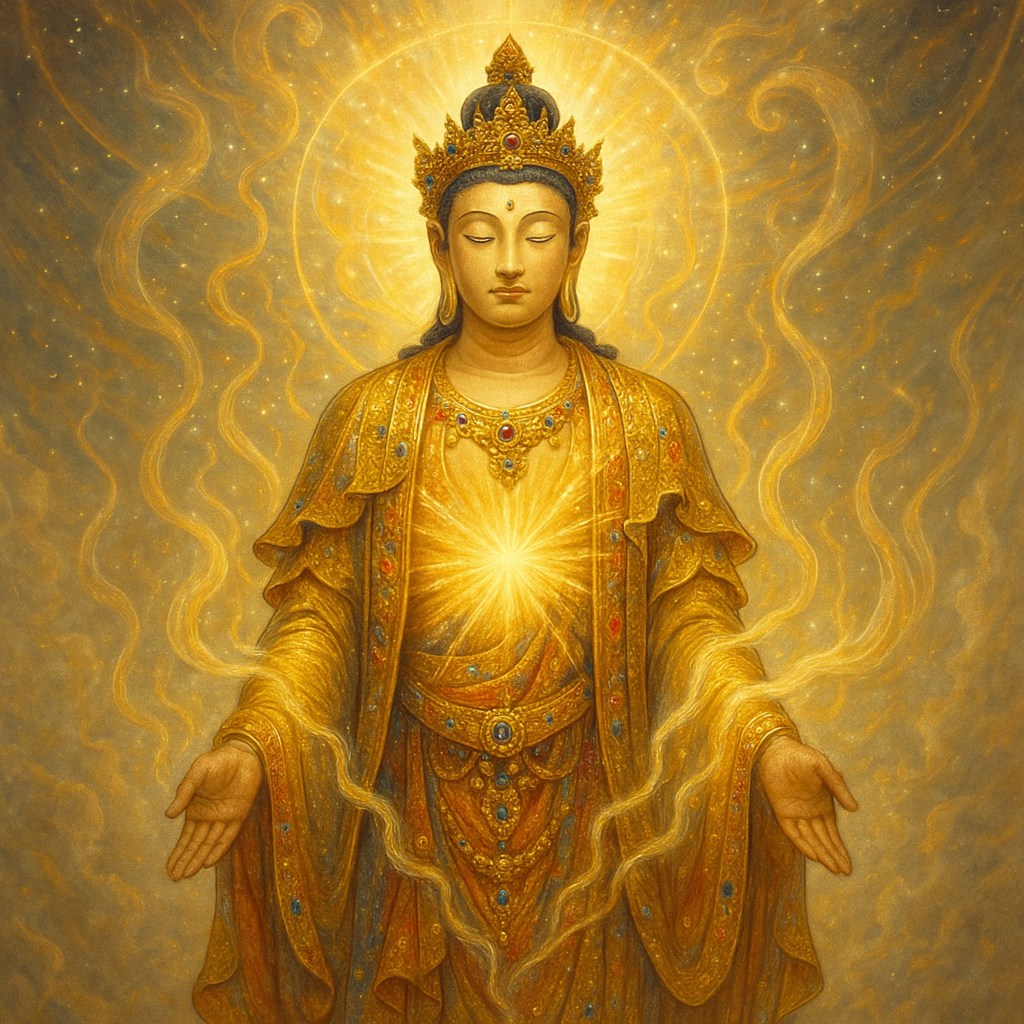
The story begins in a distant past, in an idyllic Pure Land—a perfected realm with no suffering, where all beings were born spontaneously on lotus flowers. In this world lived a Bodhisattva whose name was a perfect description of his nature: “All Beings Delight in Seeing.” Due to eons of cultivating positive connections, his very presence brought happiness to all who beheld him.
Despite this, he applied himself with extraordinary vigor, seeking enlightenment for twelve thousand years. The pivotal moment came when he heard the Buddha of his age preach the Lotus Sutra. The teaching acted as a catalyst, bestowing upon him a profound supernatural power: the “samādhi of the manifestation of all physical forms.” This was the ability to take on any shape necessary to teach and liberate others. Overcome with joy, he recognized that this incredible power was a direct gift from the teaching. His gratitude was so immense he felt no conventional offering could possibly suffice. He thought to himself:
“Although by means of spiritual powers I have made this offering to the Buddha, it is not as good as offering my body”.
He then began a methodical, 1,200-year preparation. He ingested fragrant substances like sandalwood and aloeswood until his entire being was transformed into a vessel of incense. Finally, anointing his body and wrapping himself in jeweled robes, he set himself on fire. The light from his burning body illuminated millions of worlds for 1,200 years as a radiant offering.
After this life ended, he was reborn in the same world. Still feeling his devotion was incomplete, he made a second sacrifice to honor the relics of the Buddha: he burned both of his arms for an astounding 72,000 years. At the conclusion of this act, he made a vow, and through the power of his merit and wisdom, his arms were miraculously restored. This was the absolute pinnacle of physical devotion.
2. The Best Place for Growth Is a World of Suffering
The Buddha’s telling of this ancient story is prompted by a question from an advanced being named Bodhisattva Constellation King Flower. He asks why Medicine King chooses to practice in our world, the Sahā-World. The name Sahā means “to endure,” and it is our world of conflict, challenge, and the three poisons of greed, hatred, and delusion.
To grasp the story’s true meaning, we must understand that this question is not born from ignorance. It is a form of “skillful means,” a pedagogical performance by a great Bodhisattva who already knows the answer. He asks for the benefit of the assembly, creating the space for Śākyamuni Buddha to reveal a profound, counter-intuitive truth.
Herein lies the first paradox: this difficult world is the ideal arena for spiritual practice. The perfect, blissful Pure Land where the Bodhisattva began his journey offered no resistance, no challenges against which virtues like compassion and patience could be perfected. The Sahā-World, in stark contrast, is the necessary forge where the steel of a Bodhisattva’s resolve is tempered. It is the chosen field of practice precisely because of its imperfections. This idea powerfully reframes our own struggles not as obstacles to be escaped, but as the essential raw material for our spiritual work.
3. The Great Reversal: A More Powerful Offering Is Revealed
The story establishes the Bodhisattva’s self-immolation as the ultimate act of devotion. After his body burned for 1,200 years, the assembled Buddhas from across the cosmos spoke with one voice, praising his sacrifice as the “foremost giving.” They declared:
“Excellent, excellent, good man! This is true diligence. This is what is called a true Dharma offering to the Thus Come One”.
This was not a material offering of external things, but a Dharma offering—one in which the practitioner embodies the teaching itself. By burning his body, he demonstrated a complete realization of the doctrine of no-self.
And yet, immediately after this supreme praise, Śākyamuni Buddha makes a shocking declaration that completely reframes the narrative. He reveals that the merit gained from accepting and upholding even a single four-line stanza of the Lotus Sutra is far greater than the merit from burning one’s own body for millennia.
The story’s extreme nature is a brilliant rhetorical device. It sets an impossibly high standard for physical devotion only to show that a more accessible spiritual practice—engaging with wisdom—is infinitely more profound. While no ordinary person can imitate the Bodhisattva’s sacrifice, anyone can engage with the teaching, making the highest and most meritorious path available to all.
4. The Story Isn’t a Commandment, It’s a Mirror
This shocking story is not a literal prescription for self-harm. Its purpose is allegorical. The Bodhisattva could perform this act because his wisdom had penetrated the nature of reality. He understood his body was not a “self” but a “false combination of the four elements.” His sacrifice was not an act of feeling, but an external demonstration of an internal realization: complete freedom from the attachment and fear that bind us to our physical forms.
This points to a core Mahayana doctrine: Buddha-nature. This is the teaching that all beings, without exception, possess an innate, luminous potential for enlightenment. This potential is not something we must acquire, but something that is already present, temporarily hidden by delusion and attachments, like gold hidden within ore or a clear sky covered by clouds.
Stories like Medicine King’s are not just about ancient heroes. They are meant to act as mirrors reflecting the potential that lies dormant within the reader. They don’t tell us what to do, but rather model the level of seriousness, reverence, and total commitment required to awaken our own inner Buddha.
Conclusion: What Is Your Fire?
The story of Medicine King begins with an extreme physical act and ends with a profound internal lesson. It encapsulates its protagonist’s purpose, demonstrating how to be a true “Medicine King.” The Bodhisattva chooses to operate in the Sahā-World, a realm filled with the “poison” of suffering, conflict, and illusion. His story reveals the ultimate “medicine”: the Dharma of the Lotus Sutra.
When this medicine of wisdom is applied with the unwavering faith he exemplified, it has the power to transform the greatest suffering into the very cause for supreme enlightenment. The narrative reframes sacrifice not as physical destruction, but as the “burning away” of the ego in the purifying fire of practice. The final question, then, is not whether we should imitate this ancient act, but rather: how can we use the medicine of wisdom to transform the poison of our own lives into the fuel for our awakening?
 Mr. Altig’s Overview of the Wonderful Dharma of the Lotus Sutra
Leave a comment