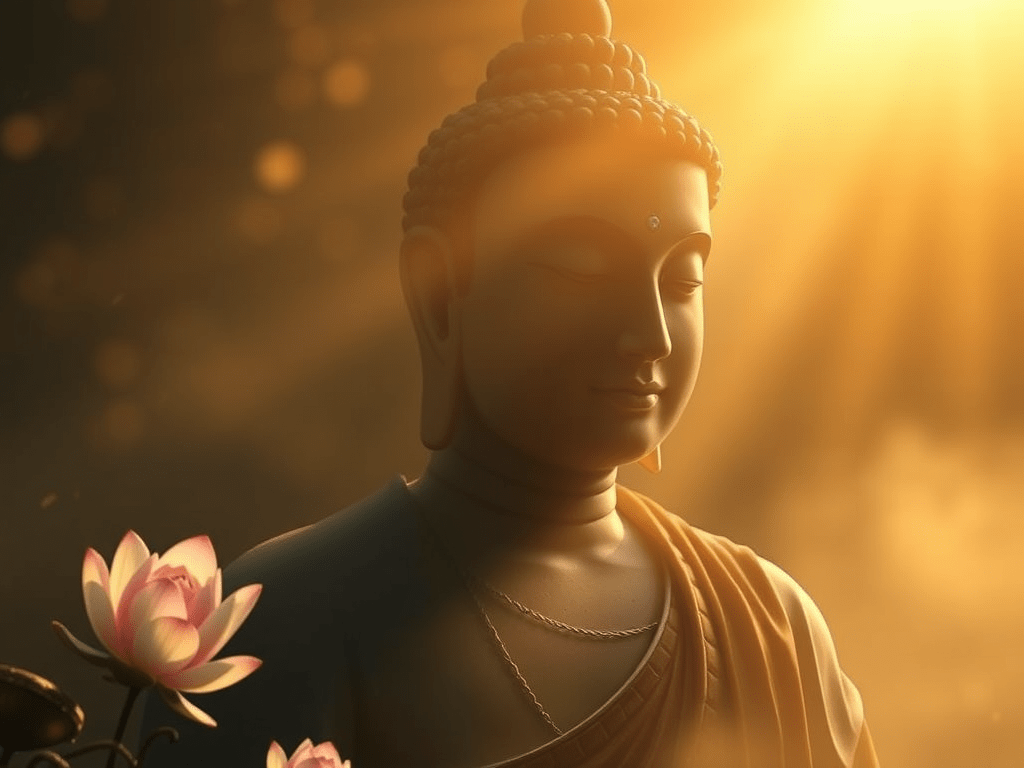
Introduction: Beyond the Historical Figure
When most of us think of the Buddha, we picture a wise, serene historical figure who lived and taught over two millennia ago. His teachings have traveled through time, but he himself is often relegated to the distant past, a memory to be revered.
But what if that perception is incomplete? An ancient text, the Lotus Sūtra, offers a radically different and more immediate understanding of the Buddha’s presence and purpose. This article will explore a few profound insights from the Sūtra that challenge our assumptions and reveal a more active, ever-present reality.
Takeaway 1: The Buddha is Not a Figure from the Past, But an Ever-Present Teacher
The Buddha is Here, Now—and Everywhere Else
The Lotus Sūtra unveils a reality-altering truth: the Buddha is not confined to a single time or place. Instead, he is described as actively teaching and benefiting beings in our own world—the “Sahā-World,” a realm of endurance and suffering—right at this very moment. This presence isn’t limited to our world alone; it extends across an almost unimaginable number of other realms simultaneously.
The scale of this activity is described in Chapter Sixteen of the Sūtra:
All this time I have been living in this Sahā-World, and teaching [the living beings of this world] by expounding the Dharma to them. I also have been leading and benefiting the living beings of one hundred thousand billion nayuta asaṃkhya worlds outside this world.
This vision transforms the Buddha from a historical memory into an active, living presence. It changes our spiritual practice from one of simple reverence for the past to one of dynamic partnership in the present. If the Buddha is here now, working for our awakening, then our path is no longer a solitary effort to follow ancient footsteps, but a collaboration with a timeless consciousness guiding us in every moment.
Takeaway 2: The Buddha’s Presence is Intentionally Subtle
Why the Buddha Seems Hidden: A Lesson in Spiritual Maturity
This stunning claim immediately raises a profound question for us: If the Buddha is always present and actively teaching, why isn’t he more obvious? Why can’t we see him? The Sūtra addresses this paradox directly with a deep psychological insight, explained through the “parable of the physician and his children.”
The text explains that the Buddha intentionally avoids revealing himself too explicitly. If he were to appear plainly to those of us still attached to our own suffering, we would simply “take him for granted.” We would fail to recognize the profound value of the “Wonderful Dharma” he offers and would not be moved to seek it for ourselves.
This is the essence of spiritual tough love. More than that, it is an expression of profound respect for our own potential. The Buddha’s subtlety is not an absence but an act of trust, honoring our capacity to discover truth for ourselves. This challenges us to see that true growth requires us to actively seek and recognize wisdom, rather than having it handed to us in a way that would breed complacency and prevent deep, personal transformation.
Takeaway 3: Enlightenment Isn’t a Personal Goal, It’s a Shared Mission
Your Awakening is Tied to Helping Others Awaken
The Sūtra presents this paradox not as a dead end, but as the very key to the path. The solution to the Buddha’s intentional subtlety is our intentional action. The way we overcome our own delusions and connect with this ever-present teacher involves two inseparable steps:
- Learning to recognize the Buddha who is living with us today.
- Taking on his work of benefiting all beings.
This is the ultimate redefinition of awakening. It transforms the quest for enlightenment from a solitary, internal achievement into an active, compassionate participation in the world. The goal is not simply to find peace for oneself, but to join in the universal work of creating peace for all. It suggests that the very act of helping others awaken is the path to our own liberation. Our awakening is no longer just a personal goal; it becomes a collective responsibility.
Conclusion: From Ancient Text to Present-Day Practice
This brief journey through the Lotus Sūtra shifts our perspective dramatically. We see that the Buddha is ever-present (Takeaway 1), but seems hidden to foster our spiritual maturity and agency (Takeaway 2), a maturity we demonstrate by joining his compassionate work to benefit all beings (Takeaway 3). We move from viewing the Buddha as a relic of the past to understanding him as a subtle, ever-present partner whose work continues today. More importantly, we are invited not just to be students, but to become active participants.
If we were to truly live as if the Buddha is here now, helping us awaken, how might our next action change?
 Mr. Altig’s Overview of the Wonderful Dharma of the Lotus Sutra
Leave a comment