It is a deeply ingrained part of human nature to take for granted that which is always available. A friend who is always there, a resource that seems limitless, or an opportunity we believe will never expire—their constant presence can paradoxically diminish their perceived value. We grow accustomed to them, and in our comfort, we can forget how precious they truly are.
But what if a great teacher understood this human flaw so well that they used their own absence as a deliberate teaching tool? What if they recognized that the path to profound wisdom wasn’t through constant availability, but through cultivating a sense of rarity and respect? This surprising and counter-intuitive concept is found within the Lotus Sūtra, and it offers a powerful lesson on how we learn to value what truly matters.
1. Constant Presence Can Lead to Complacency
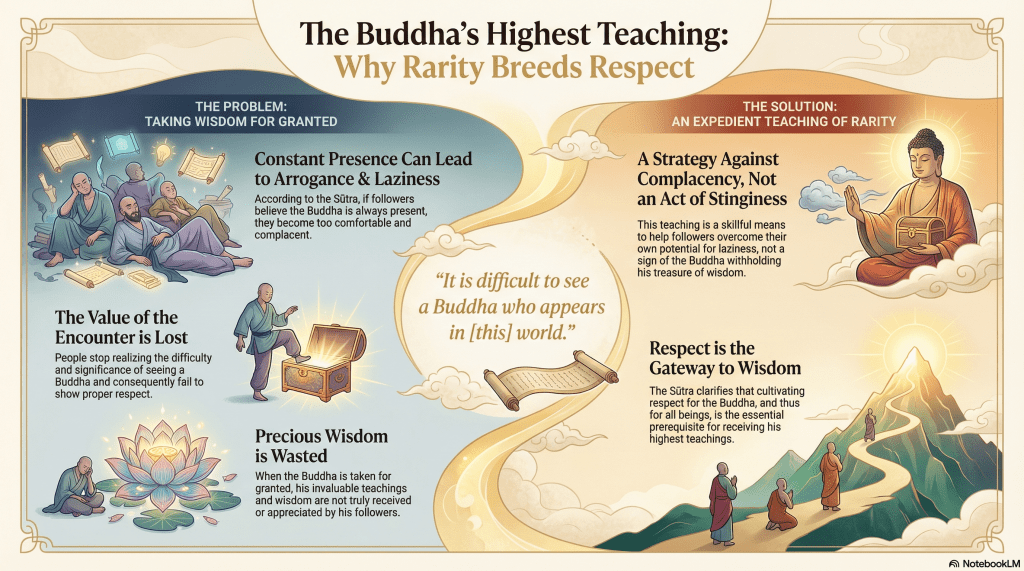
In the Lotus Sūtra, the Buddha expresses a core concern: if his followers believed he was always present and would never pass away, they would become “arrogant and lazy.” Here, the Sūtra reveals a penetrating truth about the human condition: that abundance, without reverence, can be a greater obstacle to growth than scarcity. In our modern world, we are surrounded by endless information—podcasts, articles, and courses available instantly—yet this constant access often breeds a dangerous complacency, removing the urgency to learn and the motivation to practice the very wisdom we claim to seek.
2. Scarcity Is a Tool for Cultivating Respect
Understanding this human tendency, the Buddha employed a specific strategy. He would “expediently”—that is, as a skillful and compassionate teaching tool—state the difficulty of encountering him. This was not an act of withholding, but a deliberate method to teach a lesson on value, actively working against the complacency he knew would otherwise arise in the hearts of his followers.
Bhikṣus, know this! It is difficult to see a Buddha who appears in [this] world.
This framing was a profound pedagogical choice. By highlighting the precious and uncommon nature of his appearance, the Buddha cultivated the very sense of respect and appreciation that was necessary for his teachings to be truly heard, not merely listened to. He understood that for wisdom to take root, the soil of the mind must first be prepared with awe.
3. Respect Is the Key That Unlocks Wisdom
The Buddha’s strategy was never about being stingy or hoarding the “great treasure of his wisdom.” Rather, he understood a fundamental principle of spiritual pedagogy: wisdom cannot be received without the proper mindset. The text reveals that the ultimate lesson was not just about respecting one enlightened being, but about using that reverence as a gateway. It clarifies that “unless we cultivate our respect for the Buddha, and thus for all beings, we take him for granted and lose his precious wisdom.”
This is the philosophical heart of the teaching. The respect shown to the teacher is a practice ground for developing a universal reverence for all life. This mindset of profound respect is the essential prerequisite, the key that unlocks the door to wisdom. Without it, even the most enlightened teaching remains just words, lost on a mind not yet ready to receive it.
Conclusion: A Final Thought on What We Value
The central paradox is that the Buddha’s lesson on the “difficulty of seeing” him was, in itself, one of his most powerful teachings. It was a lesson not just in words, but in action, designed to show us how we assign value and why reverence is the key that unlocks the door to understanding.
In an age of constant information, what might we gain by treating wisdom not as a commodity to be consumed, but as something precious and rare that requires our deepest respect to encounter?
 Mr. Altig’s Overview of the Wonderful Dharma of the Lotus Sutra
Leave a comment