We’ve all felt it. It is a profound paradox of the human heart: we often discover the true value of a thing only in its perceived absence. This strange quirk of human psychology is central to one of the most profound and surprising teachings in Buddhist philosophy. What if the historical Buddha’s death wasn’t an end, but a calculated teaching strategy designed to awaken us to a deeper truth?
The “Passing” Was an Expedient Teaching
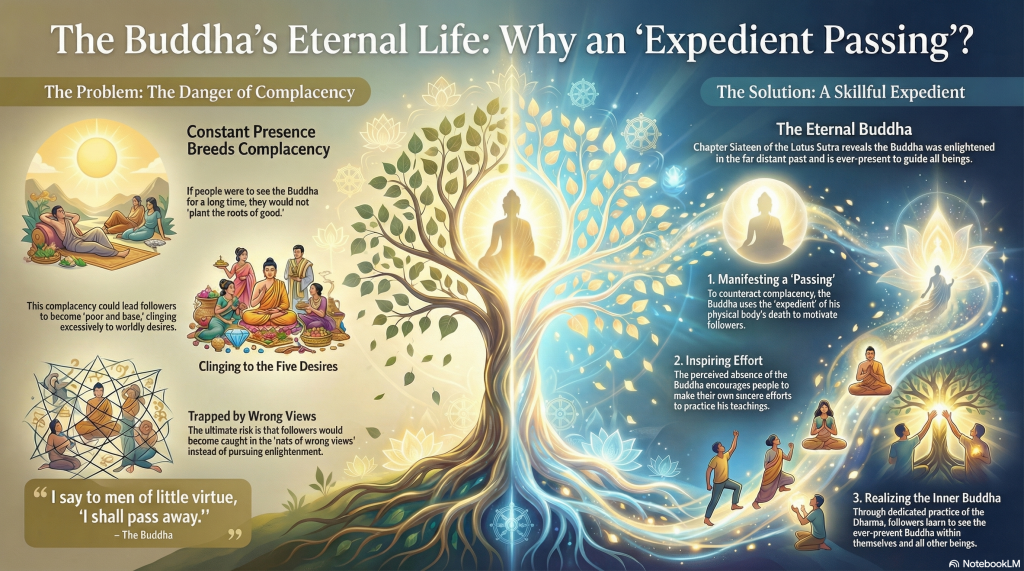
The central, surprising claim from the Lotus Sutra is that the Buddha’s entry into Nirvāṇa was not a final end but an “expedient” tool for teaching. He revealed that he would never truly pass away but only said he would to help people who were struggling on their spiritual path. This wasn’t a deception, but a skillful method born of compassion.
The Buddha states this directly:
Although I shall never enter into Nirvāṇa, I say to men of little virtue, ‘I shall pass away.’ I teach them with this expedient.
Why the Strategy Was Necessary
The Buddha’s rationale for this profound strategy was rooted in a clear-eyed view of human nature. He explained that if people saw him for a long time, they would grow complacent, taking his wisdom and presence for granted. This complacency would prevent them from making the necessary effort to “plant the roots of good” within themselves.
According to the text, the consequences of this spiritual laziness are severe. People would become “poor and base,” clinging to the “five desires” of worldly attachment, and ultimately become “caught in the nets of wrong views.” This ancient observation remains a powerful insight, as we see this same clinging today in our attachments to material consumption, social media validation, and fleeting sensory pleasures.
The Ever-Present Teacher
This teaching comes from Chapter Sixteen of the Lotus Sutra, a pivotal moment where the Buddha reveals his true nature for the very first time. He is not merely a historical figure who lived and died, but an “Ever-Present” being who became enlightened in the “far distant past” and will continue to guide beings into the “far distant future.”
This revelation of an eternal presence is the key that unlocks the entire strategy. The Buddha can use the absence of his physical form precisely because his essential teaching nature is always present.
The Final Invitation
The ultimate purpose of the Buddha’s strategy was to inspire action. By creating a sense of urgency and scarcity, he encouraged people to make sincere efforts to practice his teachings for themselves, rather than relying on his external presence.
The beautiful outcome of this practice, then, is the final revelation of the Lotus Sūtra. Through practicing this Wonderful Dharma, we learn to “see the Buddha in ourselves and all beings.” This represents a profound psychological shift—from a model of external reliance on a teacher to one of internal realization. It awakens us to the universal potential for enlightenment that exists within and all around us.
A Final Thought
The Buddha’s teaching on his own passing is a powerful lesson in motivation. It reminds us that the most profound presence is sometimes nurtured by a sense of absence, and the greatest teachings are the ones we must work to uncover for ourselves. It leaves us with a question to ponder in our own lives: What essential truth might you see more clearly if you weren’t able to take its presence for granted?
 Mr. Altig’s Overview of the Wonderful Dharma of the Lotus Sutra
Leave a comment