In our modern world, how can we truly access the wisdom of great teachers who lived thousands of years ago? It has been 2,500 years since the Buddha Śākyamuni walked the Earth, a gap of time so vast it can feel like an unbridgeable silence. How can a voice that has long since disappeared continue to guide us?
The Lotus Sutra offers a profound answer, presenting itself not as a dusty text, but as a living instrument designed to bring that voice back to life. I was stunned to discover that it views its own words as a tangible expression of that intangible teaching, making ancient wisdom feel immediate and personal. Here are four of the ideas I found most transformative.
1. A Book That Breathes: The Sutra as a Living Voice
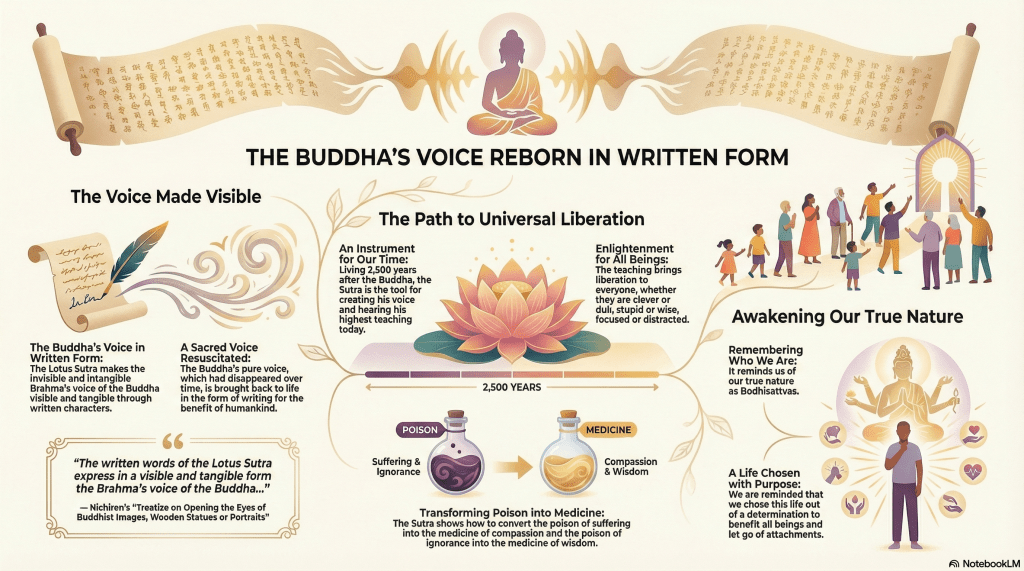
The core concept of the Lotus Sutra is that its written form is a physical manifestation of the Buddha’s teaching. The words on the page are not mere symbols; they express in a visible and tangible form the Brahma’s voice of the Buddha, which is invisible and intangible, allowing us to see and read it with our own eyes. This makes the wisdom directly accessible, even across a chasm of millennia.
In his Treatise on Opening the Eyes of Buddhist Images, Wooden Statues or Portraits (Mokue Nizō Kaigen no Koto), the teacher Nichiren captured this powerful idea:
The Buddha’s pure and immaculate voice, which had disappeared, is resuscitated in the form of written characters for the benefit of humankind.
This understanding transforms the act of reading. It is no longer a passive intellectual exercise but an active engagement with a living teaching, an instrument for creating the Buddha’s voice in our own time. But if this voice has been brought back to life, who is it for?
2. Enlightenment Isn’t an Exclusive Club
A common perception of spiritual attainment is that it is reserved for a select few—the especially gifted, the deeply focused, or those who dedicate their lives to monastic practice. The Lotus Sutra shatters this notion with a radically democratizing principle: its path to liberation is open to all beings, without exception.
The text states that its highest teaching brings all beings to liberation, whether they are “clever or dull, stupid or wise, focused or distracted.” This is a profoundly inclusive message. It declares that wisdom is not a commodity for the elite but a universal potential inherent in every person, regardless of their background, intellect, or perceived aptitude. This universal promise naturally leads to a deeper question: if this teaching is for me, what does it say about who I am?
3. You Chose This Life to Help Others
The Sutra introduces a startling idea about our own identity, reminding us of our “true nature as Bodhisattvas.” In this view, we are not here by accident or as victims of circumstance. A Bodhisattva is one who chooses to be in this world not for their own sake, but out of a deep “determination to benefit all beings.”
This reframes our entire life’s purpose. Suddenly, the daily grind, the unexpected setbacks, and even our deepest wounds are no longer random misfortunes; they are the curriculum we chose for a life of profound compassion. But if our purpose is to help others, how do we handle the inevitable suffering and confusion we encounter? The Sutra offers a radical answer: we use it.
4. Transforming Poison into Medicine
Perhaps the Sutra’s most practical and empowering teaching is its method for working with life’s greatest difficulties. It does not advocate for ignoring or bypassing hardship. Instead, it provides a spiritual alchemy for transmuting our struggles into the very ingredients of enlightenment.
The text describes two key transformations:
- Transforming “the poison of suffering into the medicine of compassion.”
- Transforming “the poison of ignorance into the medicine of wisdom.”
This perspective is revolutionary. It proposes that our pain, our confusion, and our deepest flaws are not obstacles to our growth but the raw material for it. Suffering becomes the catalyst for empathy, and ignorance becomes the impetus for seeking profound wisdom.
The Lotus Sutra is far more than a historical artifact. It is a timeless instrument designed to make a sacred voice resonate in the present moment, revealing that we are compassionate beings with a purpose, capable of turning our greatest challenges into our greatest strengths. It offers a path that is not separate from our lives, but woven directly into the fabric of our experience.
As a Bodhisattva who chose this path, what “poison” in your life right now is the very ingredient you need to fulfill your purpose of helping others?
 Mr. Altig’s Overview of the Wonderful Dharma of the Lotus Sutra
Leave a comment