We often turn to sacred texts expecting to find words of peace and solace. It can be jarring, then, to encounter a passage that sounds like a violent threat, especially when it comes from beings vowing to protect a sacred teaching. How can a demon’s harsh vow to split someone’s head into seven pieces become a gateway to understanding the depths of compassion?
A Demon’s Threat as a Mirror for the Mind
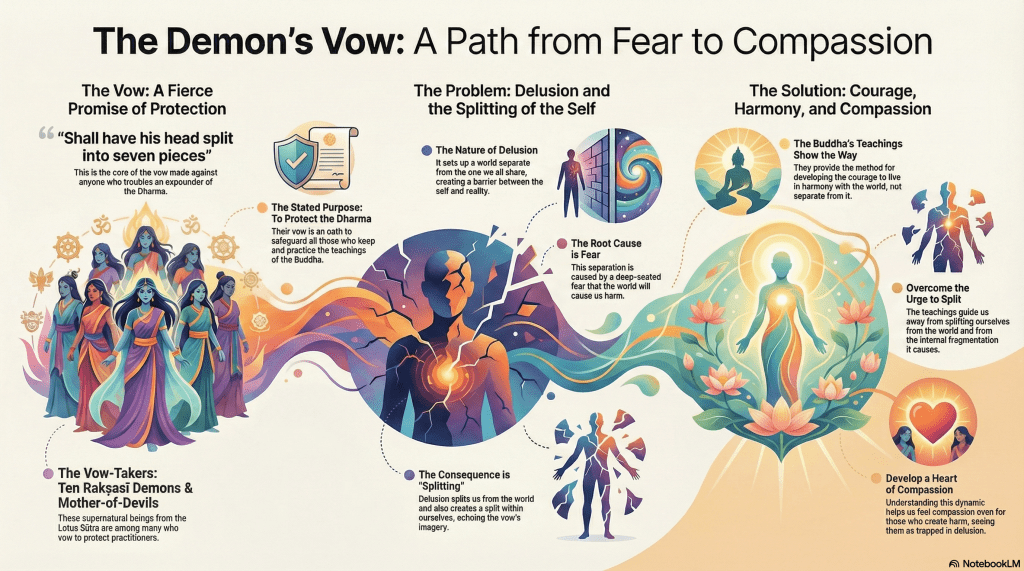
In the Lotus Sūtra, a host of supernatural beings, including the ten rakṣasī demons and the Mother-of-Devils, vow to protect practitioners of the Buddha Dharma. Their pledge, however, is delivered with shocking intensity. They state in no uncertain terms what will happen to anyone who harms an expounder of the Dharma:
Anyone who does not keep our spells
But troubles the expounder of the Dharma
Shall have his head split into seven pieces
Just as the branches of the arjaka-tree [are split].
While this reads like a literal threat, its deeper purpose is not to advocate for violence but to serve as a mirror. These verses are intended to help us understand the nature of those who create harm. By mirroring the fractured state of a mind that causes harm, the vow invites us not to condemn, but to understand the suffering that motivates such actions. This verse acts as a mirror, but what exactly does it reflect? The image it reveals is the profound internal violence of delusion.
The True Violence is Our Own Internal Division
In the Buddhist view, when we trace harmful action back to its source, we arrive at delusion. The nature of delusion is to construct a separate reality—a world walled off from the one we all share. It puts up a barrier between ourselves and the world, born from the fear that the world will harm us.
The violent imagery of a “head split into seven pieces” is a powerful metaphor for this internal state. This is not a future punishment, but a description of a present reality. To live in delusion is to have one’s mind constantly at war with itself, pulled in conflicting directions by fear, craving, and aversion—a mind already split. The verse reflects a violence that is already occurring inside the person who would cause harm. If the verse shows us that the real violence is an internal splitting born of fear, then the Dharma must offer a path back to wholeness.
The Path to Wholeness is Courage, Not Separation
In response to this internal fracture, the Buddha’s teachings offer an antidote. They provide a method for cultivating the courage needed to live in harmony with the world as it truly is. This path is a direct contrast to the fear-based separation that characterizes a deluded mind. It is a movement toward wholeness, not division.
Thus, a verse that at first appears to be a brutal threat reveals itself as a deep diagnostic tool. The sūtra isn’t warning of a future punishment, but is instead holding up a mirror to the profound suffering that is already present in a mind divided against itself.
This leaves us with a question to carry forward: How might we look at the ‘harmful’ things in our own world not as threats, but as reflections of a division that we have the power to heal?
 Mr. Altig’s Overview of the Wonderful Dharma of the Lotus Sutra
Leave a comment