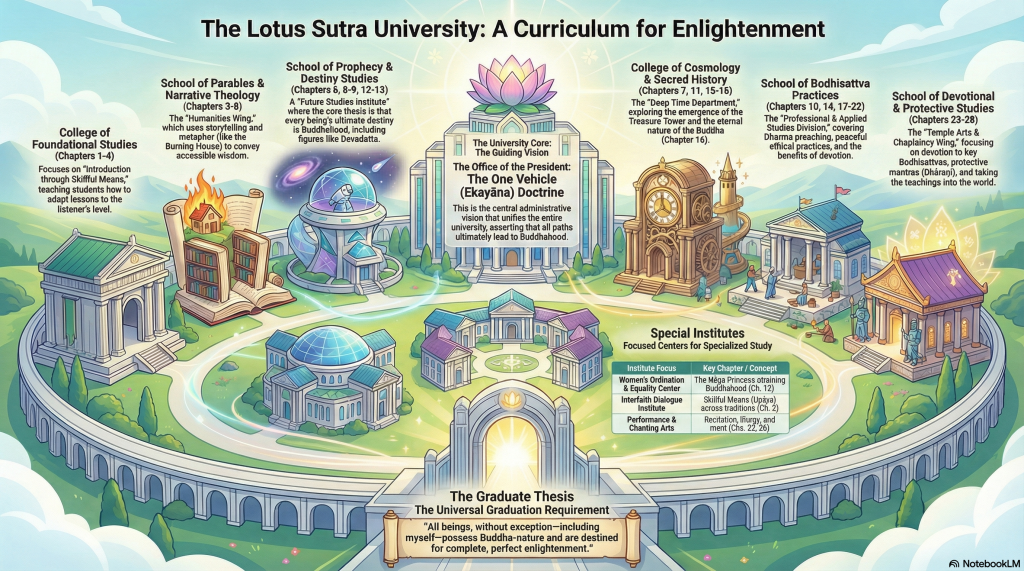
I. The University Core: Foundations in the One Vehicle (Ekayāna)
The conceptual framework for a university based on the Saddharma Puṇḍarīka Sūtra (The Lotus Sutra) requires the establishment of a core philosophical identity that dictates its mission, governance, and temporal orientation. This core is defined by the doctrine of Ekayāna (One Vehicle), transforming the institution from a conventional center of specialized learning into an academy dedicated to universal human transformation.
A. Defining the Institutional Mission: The Great Vehicle of Universal Enlightenment
The institutional mission must be established upon the principle of Ekayāna, which serves as the mandate for universal inclusivity and the non-dualistic pursuit of knowledge. The Lotus Sutra clarifies this concept, asserting that the Tathāgata (Buddha) appears in the world with a single duty and a “single task”: to inspire living beings to the mental vision of Buddhahood (tathāgatajñānadarśana). Consequently, the Buddha teaches “only a single vehicle”.[1] This doctrine mandates that all academic disciplines, schools, and departments within the university must ultimately align their goals with the purpose of comprehensive human fulfillment and ethical action, thereby superseding vocational training alone.
The Lotus Sutra is revered across East Asia as containing the “final teaching of Shakyamuni Buddha—complete and sufficient for salvation,” and its influence centers heavily on the twin themes of the One Vehicle and Skillful Means (Upāya).[2] The implementation of this Ekayāna philosophy requires the adoption of an ecumenical and inclusive model. As some practitioners suggest, Ekayāna should not be interpreted as a narrowly sectarian doctrine, but rather as the “fundamental truth—God, Allah, or the one vehicle—at the heart of all great religions”.[2] This broad, universal application prevents the university from operating as an exclusivist religious institution. Instead, it commits the academy to fostering interfaith dialogue and philosophical universalism.[3] Thus, the departments dedicated to comparative religion, philosophy, and ethics are tasked with actively clarifying shared, universal human values that accord with the core value of the sanctity of life.[4]
The Great Wisdom of Equality and Radical Access
A profound implication of the Ekayāna doctrine is the assertion of the “fundamental equality of all people”.[4, 5] This principle extends even to individuals historically subjected to discrimination, such as women and figures often labeled as “evil people” in earlier teachings.[4] This basis for equality is found in the “universally inherent potential” of all beings to manifest Buddhahood or enlightenment.[4] Buddhahood, in this context, is not viewed as a static, external state of attainment but as a dynamic, internal potential that all individuals possess and can bring forth from their lives.[4, 6]
Applying this doctrinal foundation to academic policy necessitates a radical approach to admissions and institutional access. Since the core belief validates the inherent potential (Buddha-nature) within every applicant, the university’s admissions criteria must be fundamentally non-discriminatory. Focus shifts from judging past external achievement or traditional academic prerequisites—which often reflect social inequality—to assessing a student’s commitment to manifesting their internal potential. This structural commitment to radical inclusion actively challenges conventional, elite academic selection processes.
B. Governance and Administration: The Model of Upāya (Skillful Means) Pedagogy
The governance of the Lotus Sutra University must embody the principle of Upāya (Skillful Means) [2], establishing an operational ethos that prioritizes adaptive, therapeutic, and student-centric methodology over rigid bureaucracy.
Translating Expedient Means into Adaptive Educational Policies
Upāya is defined as the practice of tailoring teachings and practices precisely to the specific capacities, needs, and temperaments of individuals.[7, 8] Faculty members are encouraged to use “expedient means” to both challenge and establish rapport with their students, fostering a relationship based on the model of a caring counselor or friend.[5] This pedagogical approach recognizes that students may have varying needs and benefit from diverse teachings.[7] The function of skillful means is therapeutic: it transforms negative impulses or mere desire into focused motivation, enabling the seeker to embark on the spiritual journey.[9] Crucially, the education process should eventually lead the student to realize that all teachings, including the doctrine of Upāya itself, are merely provisional tools.[9, 10]
The Parable of the Burning House: Institutional Flexibility and Ethical Calculus
The Lotus Sutra’s parables, functioning as potent literary and instructional models [11], offer archetypal guidance for institutional decision-making. The Parable of the Burning House (Chapter 3) presents a foundational scenario: a father uses a “lie”—promising superior carriages—to motivate his children to exit a collapsing, burning mansion, thereby saving their lives.[12] This narrative provides the basis for defining an institutional “ethical calculus.”
The structural implication of this parable is that strict, dogmatic adherence to rules (the “three lesser vehicles” being provisional) must yield to the necessary therapeutic intervention required to save the student or facilitate their ultimate realization (the “One Vehicle”). Therefore, the university mandates institutional flexibility. Administrative policies and curriculum standards must be understood as provisional structures. To oversee the rigorous application of this principle, the institution requires an advanced Ethics Review Board specifically trained in the ethical calculus of intention inherent in Upāya.[12] The operational doctrine holds that the administration must be ready to adapt rapidly, discarding “medicine” (rules or temporary curricular structures) once the “disease of suffering” (ignorance or delusion) is ended.[9]
C. The Doctrine of Immeasurable Time (Chapter 16) and Institutional Longevity
The teaching of the Eternal Buddha (Chapter 16: The Life Span of the Tathāgata) dictates the university’s temporal scope, strategic vision, and commitment to lifelong learning.
Establishing “Deep Time” and Eternal Value
In Chapter 16, the Buddha reveals that he only appears to enter final Nirvāṇa, an “expedient teaching” designed to prevent beings from becoming complacent.[2] In reality, the Buddha is eternal, constantly active, and teaching the Dharma.[2] This concept of the Eternal Buddha is considered the ultimate expression of true religious value, representing Shakyamuni’s vow to enable all people afflicted by suffering to attain Buddhahood and dwell securely in the joy of eternal life.[13] The narrative of the Sutra itself emphasizes this cosmic perspective, presenting a drama that transcends ordinary space and time, detailing Shakyamuni’s lives in the remote past and affirming an eternal life state.[14]
Strategic Planning on a Cosmological Scale
This doctrine of “Deep Time” shifts the institution’s strategic planning imperative away from conventional short-term metrics, such as quarterly enrollments or five-year fiscal plans. Instead, the focus is placed on a long-term, cosmological vision of institutional persistence. The university’s strategic goal is to sustain its mission of promoting the “joy of eternal life,” leading to an imperative for sustained innovation and a rejection of institutional complacency.[13]
If the teacher is regarded as eternally present, the student-teacher relationship is continuous and enduring. The institution must therefore emphasize lifelong transformation and the ongoing support of alumni, recognizing this commitment as an essential component of the Bodhisattva path. Consequently, the “Alumni Affairs” office is not a fundraising extension but a foundational pillar of the academy, supporting continuous learning long after the student has completed formal degree requirements. The institution strives to be an inexhaustible source of positive energy, promoting active engagement with mundane life to transform suffering and contradictions into happiness.[6]
Table 1: The Ekayāna University Core: Foundational Doctrines and Operational Mandates
| Core Doctrine | Sūtra Source/Theme | University Operational Mandate | Validation (Scholarly/Philosophical) |
| Ekayāna (One Vehicle) | Chapter 2 (Skillful Means) | Universal Access & Non-Discriminatory Policy | All provisional paths are unified toward Buddhahood.[1, 2] |
| Upāya (Skillful Means) | Parables (Burning House, etc.) | Adaptive Pedagogy & Therapeutic Education | Justification for flexible methods prioritizing spiritual realization.[5, 9] |
| Eternal Buddha | Chapter 16 (Life Span) | Lifelong Alumni Engagement & Deep Time Planning | Focus shifts from finite attainment to eternal, ongoing self-transformation.[2, 13, 14] |
| Buddha-Nature | Chapter 8 (Gem in Garment) | Self-Empowerment Curriculum | Education as the act of revealing inherent potential, not acquisition of external knowledge.[6, 15] |
II. Academic Structure: Colleges and Schools Based on Doctrinal Clusters
The academic structure of the university is derived from the structural flow of the Lotus Sutra, specifically the division between the Theoretical Teaching (Chapters 1–14) and the Essential Teaching (Chapters 15–28). These sections are translated into two major colleges, with a third college dedicated to applied practice and social engagement.
A. College of Foundational Dharma and Hermeneutics (Chapters 1-10: Theoretical Teaching)
This college is dedicated to providing students with the intellectual and interpretive tools necessary to understand the provisional nature of reality, the concept of Ekayāna, and the transformative power of Buddhist texts.
School of Comparative Hermeneutics and Literary Arts
The Lotus Sutra’s enduring appeal lies in its profound use of narrative to convey spiritual truths, its universal message, and its skillful deployment of literary devices.[16] This school focuses on analyzing the text’s employment of metaphor, poetry, and its unique meta-narrative structure, which is said to be structured like a lotus flower, where each element is an allegory of the whole.[17] The curriculum includes comparative study of the text’s historical reception and its translation into various cultural contexts (e.g., Chinese, Japanese, and early Western translations).[2, 8] Furthermore, the Sutra is recognized for offering profound psychological lessons regarding “the workings of the human heart” and providing guidance on happiness and peace.[18] The study of these textual elements is essential for faculty and students alike to grasp the full breadth of the teachings.
Department of Parabolic Education and Skillful Means Application
A central function of the Theoretical Gate is the presentation of the seven major parables, which are studied here as archetypal models for education, ethical reasoning, and applied human psychology.[11] A key text for this department is the Parable of the Gem Inside a Garment (Chapter 8), which tells of a poor, drunken man who remains unaware that his wealthy friend has fastened a priceless gem within his own garment lining.[15]
This parable asserts that the “priceless gem”—the Buddha nature—is already inherent within the ordinary person’s heart, but the person is often distracted or unaware of this inner resource, leading a precarious existence.[15] This mandates a shift in the university’s teaching philosophy. The central academic role shifts from the conventional Western model of knowledge acquisition (imparting an external gem) to the function of reminding the student of their internal, powerful potential. This is achieved through a mentorship model where the faculty serves as the “good, wealthy friend,” guiding the student toward self-discovery. Education, in this context, is the act of activating the inherent potential, not merely accumulating external certification.[6]
B. College of Human Transformation and Bodhisattva Studies (Chapters 11-22: Essential Teaching)
This college encompasses the critical teachings of the Ceremony in the Air, focusing on the realization of immediate Buddhahood and the cultivation of emergent, compassionate leadership.
School of Radical Inclusion and Immediate Potential
The Essential Teaching profoundly challenges conventional hierarchical structures regarding spiritual attainment. Chapter 12 details the story of the eight-year-old Nāga Princess, who attains instantaneous Buddhahood. This event serves as a radical theological validation of sokushin jōbutsu (attaining Buddhahood in one’s present form).[19] The story explicitly challenges restrictive views based on gender, age, and species.[2] Although some scholarly interpretations note that the Nāga Princess attains Buddhahood after a transformation into a male form, representing an ambiguous compromise with previous misogynistic doctrines [20, 21, 22], the key doctrinal point upheld in this university framework is the radical speed and accessibility of the ultimate goal, overriding traditional concepts of spiritual maturation requiring multiple lifetimes.[2, 23]
Furthermore, the inclusion of Devadatta, the Buddha’s antagonist and betrayer [24], who is also granted a prophecy of future Buddhahood [2], confirms the universal potential for transformation, even in those considered “evil persons”.[25] This forms the basis for a Curriculum of Conflict and Redemption. This school must include programs in conflict resolution, restorative justice, and transformative social work. The teaching derived from Devadatta’s prophecy is that powerful opposition or mistakes are necessary “good friends” that assist one’s spiritual progress.[25] The university cannot be risk-averse; it must proactively study and engage with societal antagonism, conflict, and personal failure as essential components of the learning process, demonstrating how negative action (pāpa or demerit) can be transformed through diligent practice into benefit (puṇya or merit).[26]
The School of Emergent Leadership (Bodhisattvas of the Earth)
Chapter 15 introduces the innumerable Bodhisattvas of the Earth, who “emerge from the earth” and are entrusted by the Eternal Buddha with the mission of propagating the Dharma in the future.[27, 28] They are regarded as the inherent, original disciples and “children of the Buddha,” demonstrating leadership that is rooted in internal realization rather than external recruitment.[19]
This doctrine informs a leadership training program focused on resilient, decentralized, and intrinsically developed leadership. The leaders produced by the university—both faculty and administration—must embody the essential teachings of the Sutra. The emergence of the colossal Treasure Tower in Chapter 11 symbolizes this reality: the highest state of life emerging from within the individual.[14, 29] The philosophical application, as discussed by Dōgen, recognizes the “treasure stupa is a treasure stupa in space, and space makes space for the treasure stupa”.[30] This understanding dictates that institutional vitality and the manifestation of spiritual ground come from the institution’s conscious creation of space for inherent potential. The faculty are not merely experts but embodiments of this emergent potential.
Department of Cosmological Ethics and Deep Time Studies
The study of the Treasure Tower—where Shakyamuni (the eternal teacher) sits alongside Prabhūtaratna (the ancient Buddha residing in the stupa) [31, 32]—represents the essential union of the Eternal Dharma and the Eternal Teacher.[32] This department integrates studies in Buddhist cosmology [33] and sacred geography.[34] The curriculum applies the concept of the Treasure Tower to institutional space, asserting that the university campus and its teaching environments are spiritual grounds where realization takes place.[29] This commitment establishes a metaphysical depth to institutional ethics, ensuring all actions are viewed within the context of cosmic time and universal interdependence.
Table 2: Mapping Lotus Sutra Clusters to Academic Divisions
| Sūtra Cluster (Chapters) | Doctrinal Focus | Proposed Academic College/School | Primary Curriculum Outcome |
| Theoretical Gate (1-10) | Hermeneutics & Pedagogical Models | College of Foundational Texts & Narrative Hermeneutics | Mastery of adaptive teaching and philosophical communication.[15, 17] |
| Essential Gate (11-22) | Transformation & Emergent Consciousness | College of Human Transformation & Bodhisattva Studies | Realization of radical inclusivity and immediate spiritual potential.[2, 19] |
| Transmission Gate (23-28) | Practice, Protection & Vows | Special Institutes for Global Protection & Outreach | Ethical leadership, compassionate action, and global dissemination of teachings.[35, 36] |
C. College of Applied Dharma and Social Action (Practical Vows)
This college functions as the applied domain of the university, focusing on the practical application of Ekayāna principles to contemporary social and ecological challenges.
School of Peaceful Practices and Kṣānti (Patience and Tolerance)
Based on the teachings of Chapter 14, this school focuses on the ethical preparation and mental fortitude required to uphold the Dharma, particularly in times of societal turbulence. The practices described in the chapter promise protection and an unwavering, fearless demeanor “like the lion king,” coupled with the attainment of luminous wisdom.[37, 38]
The curriculum integrates studies in conflict mediation, emotional intelligence, and applied ethical decision-making. These programs are grounded in the Bodhisattva perfection of patience (kṣānti) and tolerance, ensuring that students develop the inner resilience to navigate conflict without abandoning their compassionate mission. Graduates are trained not only in theoretical ethics but also in maintaining psychological equilibrium under duress.
Department of Social Welfare and Compassionate Intervention
This department is modeled after Bodhisattva Avalokiteśvara, or Guanyin, who is the “Perceiver of all Sounds” (Chapter 25).[35, 39] The Bodhisattva hears the prayers and cries of sentient beings experiencing suffering and manifests in appropriate forms to provide aid.[39] The fundamental mission is to “free them from their suffering”.[35]
The focus here is on practical disciplines such as social work, public health management, disaster relief, and human rights advocacy. The dedication to Avalokiteśvara emphasizes the necessity of responding to immediate, specific suffering with transcendent power, teaching that even the act of wholeheartedly chanting the Bodhisattva’s name (an act of focused compassion) can lead to freedom from danger, such as fire, water, or physical violence.[35] This department translates the spiritual practice of perceiving and responding to suffering into pragmatic, evidence-based social interventions.
III. Special Institutes: Transmission, Protection, and Global Outreach (The Applied Domain)
These specialized units are essential for ensuring the continuation, maintenance, and global propagation of the Ekayāna philosophy, corresponding to the mandates found in the final chapters of the Sutra.
A. The Institute for Dharma Transmission and Teacher Certification (Chapters 10 & 28)
This institute is responsible for the professional training and ethical accreditation of all faculty and outreach practitioners, ensuring the integrity of the transmission line.
Dharma Teacher Ethics and Training
The guidelines for Dharma Teachers are rigorous. They must practice great compassion, gentleness, and patience.[40] Those who fulfill this mandate are promised divine protection, enabling them to teach the Dharma without obstruction and to explain it in detail, causing assemblies to rejoice greatly.[40, 41] Individuals who follow these teachers are said to meet Buddhas and quickly attain the Bodhisattva path.[41] The curriculum emphasizes the ethical requirements for advanced Bodhisattva practitioners, specifically training them to avoid behaviors such as self-praise, slander, harboring anger, or speaking ill of the Triple Jewel.[42, 43] These trainings are fundamental prerequisites for leadership in the academy.
The institution integrates the concept of merit accumulation (Puṇya) into its professional framework.[26] The act of hearing, keeping, reading, reciting, explaining, preaching, or transcribing the Sutra confers “immeasurable merits”.[18, 44] Therefore, the university must treat ethical practice and compassionate action not just as desirable qualities, but as essential metrics for faculty evaluation, tenure review, and career advancement. This recognition of “professional merit” solidifies the commitment to integrating philosophical ethics into institutional reward systems.
The Samantabhadra Protocols for Global Outreach
Chapter 28 features Bodhisattva Samantabhadra (Universally Worthy), who represents the principle of “universal love or compassion” and the perfection of “cultivation and practice”.[36] The institute codifies its global service protocols based on Samantabhadra’s Ten Great Vows, which include beseeching those who achieve Nirvāṇa to remain for countless aeons for the benefit of all beings, and dedicating all virtue to perfect enlightenment.[45]
This institute is charged with ensuring that all outreach and global collaboration are conducted with the “Great Activity” characteristic of Samantabhadra.[36] The protocols ensure that the university’s mission is pursued globally and universally, focusing on helping people awaken to the fundamental law that is the essence of all life and phenomena.[6]
B. The Dhāraṇī and Protective Arts Research Center (Chapter 26)
This center translates the Sutra’s concept of spiritual protection into practical methods for institutional security, individual resilience, and psycho-spiritual wellness.
Mantra and Psycho-Linguistic Studies
Chapter 26 details the offering of Dhāraṇī (magical formulas or mantras) by Hāritī and other bodhisattvas to protect those who uphold and recite the Lotus Sutra.[2] Dhāraṇī, a Sanskrit term meaning “uniting and upholding,” functions to unite the three karmas (body, mouth, and mind) in purity.[46] A mantra’s purpose is to give rise to goodness and destroy evil, leading to the self-mastery of the six sense organs.[46]
The research focus includes psychological studies on concentration (Dharma Flower Samādhi), linguistics analysis of verbal hygiene (avoiding lies, harsh speech, or frivolity), and the efficacy of mindful practice in averting negative circumstances, accidents, and illness.[46] This is understood as the power of the vow-based practice to bring protection. This center translates ritualized practice into modern, secularized methods of stress reduction and resilience training, ensuring that students and faculty are shielded against affliction. The protective function of the Bodhisattvas of the Earth [47] reinforces the need for a comprehensive spiritual wellness program that assures practitioners that all affairs turn out lucky and as wished, even when facing mortal dangers.[46]
Table 3: Special Institutes for Institutional Perpetuity: The Transmission Mandate
| Chapter/Theme | Institute Name | Function in University Perpetuity | Associated Bodhisattva/Protector |
| Ch. 25 (Universal Gateway) | Dept. of Compassionate Intervention | Public service, immediate relief, and ethical outreach. | Avalokiteśvara/Guanyin.[35, 39] |
| Ch. 26 (Dhāraṇī) | Protective Arts Research Center | Spiritual resilience, psychological wellness, and institutional protection (Mantra/Ritual Studies). | Hariti/Dhāraṇī Protectors.[2, 46] |
| Ch. 28 (Samantabhadra) | Institute for Dharma Transmission | Teacher certification, global propagation, and ethical governance (Great Vows). | Samantabhadra.[36] |
C. The Center for Establishing the Buddha Land in the Present World
This center is the hub of applied action, focusing on realizing the philosophical ideal of the Buddha Land—a pure realm—as a tangible social and environmental reality.
Applied Transformation and Value Creation
The Lotus Sutra is inherently a teaching that encourages “active engagement with mundane life” and all its challenges.[6] Buddhahood is not an escape but an inexhaustible source of energy to grapple with and transform suffering.[6] This philosophy aligns with the belief that a religion’s genuine value is defined by its ability to transform actual lives and society.[13] The center, therefore, conducts applied research connecting Ekayāna principles to global issues such as environmental stewardship, economic justice, and world peace.[18] Its research projects embody the goal of creating a society that values peace and the dignity of life.[18]
Institutional Case Study and Validation
The conceptual framework finds validation in the historical and contemporary institutional models founded upon the Sutra. The Chinese Tiantai and its derivative Japanese Tendai and Nichiren schools were established directly on the Lotus Sutra’s teachings.[2, 48] Historical Buddhist educational institutions, such as the Tendai system, integrated academic study (Shikan-gō) focusing on doctrinal comprehensive methods, with esoteric practice (Shana-gō) focused on ritual.[49] This dual track serves as a strong model for unifying rigorous academic theory with disciplined personal and spiritual practice within the university structure.
Furthermore, this center promotes the understanding that the university’s physical campus and community engagement locations are intrinsically sacred space. By identifying the location of the teaching with the realm of the Sutra, such as equating Mount Hiei with Sacred Vulture Peak [34], the university actively “transposes the world of the sutra” onto its current topography. This concept mandates that the university must treat its physical and communal presence as a decentralized sacred space where the Eternal Buddha constantly preaches the Dharma.[34]
IV. Conclusion and Validation
The analysis confirms the robust conceptual mapping of the Lotus Sutra‘s 28 chapters onto a comprehensive university framework, demonstrating that the structure is philosophically justified and pedagogically sound.
The university core is unified under the singular, ultimate purpose of Ekayāna (Universal Enlightenment), which mandates a radical policy of inclusion based on inherent Buddha-nature. This core purpose is governed by the operational principle of Upāya (Skillful Means), translating into an administrative commitment to therapeutic, adaptive educational policies that prioritize the student’s ultimate spiritual realization over bureaucratic rigidity. The strategic vision is dictated by the doctrine of the Eternal Buddha, committing the institution to a “Deep Time” perspective that emphasizes sustainability and lifelong transformation.
The academic structure successfully translates the narrative flow of the Sutra—from the theoretical explanation of the Dharma to the essential teaching of radical potential—into concrete colleges. The College of Foundational Dharma masters hermeneutics and the use of parables as pedagogical archetypes, focusing on awakening inherent potential (the Gem in the Garment). The College of Human Transformation addresses immediate realization and the transformation of suffering (the Nāga Princess and Devadatta narratives), cultivating decentralized, resilient leadership (Bodhisattvas of the Earth). Finally, the Special Institutes ensure transmission and protection through the codification of advanced ethical practices (Samantabhadra Vows) and the translation of protective rituals (Dhāraṇī) into modern psycho-spiritual resilience training.
This framework moves beyond a simple allegory. It is a blueprint for a transformative academy dedicated to the compassionate mission of awakening the potential of all people, thereby actively realizing the Buddha Land in the present world.[6, 18] The validity of the Lotus Sutra University rests upon its foundational commitment to view every educational endeavor as an act of compassionate intervention, leveraging narrative, ethics, and universal potential to relieve suffering and establish a foundation for genuine, enduring happiness.[18]
——————————————————————————–
1. The Single Vehicle (ekayāna) in the Avaivartikacakrasūtra and Lotus sūtra – ResearchGate, https://www.researchgate.net/publication/344262865_The_Single_Vehicle_ekayana_in_the_Avaivartikacakrasutra_and_Lotus_sutra
2. Lotus Sutra – Wikipedia, https://en.wikipedia.org/wiki/Lotus_Sutra
3. What is the relationship between Tendai and other schools of Buddhism?, https://noblechatter.com/faq/3202/Tendai
4. Buddhism and the Lotus Sutra | Daisaku Ikeda Official Website, https://www.daisakuikeda.org/main/philos/buddhist/buddh-02.html
5. Teaching Tips from the Lotus Sutra – Digital Commons at St. Mary’s University, https://commons.stmarytx.edu/cgi/viewcontent.cgi?article=1314&context=facarticles
6. Lotus Sutra | Soka Gakkai (global), https://www.sokaglobal.org/about-the-soka-gakkai/buddhist-lineage/lotus-sutra.html
7. An Introduction to Skillful Means – Ancient Dragon Zen Gate, https://www.ancientdragon.org/2019/02/07/an-introduction-to-skillful-means/
8. The Lotus Sutra – neo polytheist, http://romanpagan.blogspot.com/2016/04/the-lotus-sutra.html
9. 9 The Dilemma of Skillful Means in Buddhist Pedagogy – Desire and Education in the Lotus Sutra – Tao Jiang, https://taojiangscholar.com/papers/Dilemma_of_Skillful_Means_in_Buddhist_Pedagogy.pdf
10. The Lotus Sutra – Chapter Two – Skillful Means | Celestial Drum Tendai Buddhist Sangha, https://www.adirondacktendai.org/the-lotus-sutra/the-lotus-sutra-%E2%80%93-chapter-two-%E2%80%93-skillful-means/
11. The Parable as a Vehicle to Elucidate the Lotus Sutra, https://www.totetu.org/assets/media/paper/j031_55.pdf
12. Skillful Means | E-Learning Programs, https://elearning.thanhsiang.org/node/1611
13. Key Passages From The Record of the Orally Transmitted Teachings (Part 13) – World Tribune, https://www.worldtribune.org/2024/96243/
14. The Treasure Tower Within – World Tribune, https://www.worldtribune.org/2019/the-treasure-tower-within/
15. STUDY CLASS ON THE LOTUS SUTRA AND NICHIREN SHONIN’S TEACHINGS | ARTICLE, https://www.nichiren.or.jp/english/article/read/id1034/
16. Lotus Sutra – Most Influential Sutra of Mahayana Buddhism – Original Buddhas, https://www.originalbuddhas.com/blog/lotus-sutra
17. A Question Regarding the Lotus Sūtra : r/Buddhism – Reddit, https://www.reddit.com/r/Buddhism/comments/1lyur6t/a_question_regarding_the_lotus_s%C5%ABtra/
18. The Lotus Sutra – SGI USA, https://www.sgi-usa.org/the-humanism-of-the-lotus-sutra/the-lotus-sutra/
19. Dogen’s Appropriation of Lotus Sutra Ground and Space – Ancient Dragon Zen Gate, https://www.ancientdragon.org/2019/02/20/dogens-appropriation-of-lotus-sutra-ground-and-space/
20. The Dragon Girl and the Abbess of Mo-Shan: Gender and Status in the Ch’an Buddhist Tradition – The New York Public Library, https://www.nypl.org/sites/default/files/week_2_levering_1982_the_dragon_girl_and_the_abbess_of_mo_shan.pdf
21. Male-Projection-and-the-Female-Body-in-Buddhism-A.-Kulisz.docx – Philosophy at YSU, http://philrel.ysu.edu/wp-content/uploads/2014/07/Male-Projection-and-the-Female-Body-in-Buddhism-A.-Kulisz.docx
22. Revisiting the Dragon Princess: Her Role in Medieval Engi Stories and Their Implications in Reading the Lotus Sutra – ResearchGate, https://www.researchgate.net/publication/287149303_Revisiting_the_Dragon_Princess_Her_Role_in_Medieval_Engi_Stories_and_Their_Implications_in_Reading_the_Lotus_Sutra
23. Mahayana Buddhism: Origins and Meaning | Meridian University, https://meridianuniversity.edu/content/mahayana-buddhism-origins-and-meaning
24. Devadatta – Greatest Enemy of Lord Buddha, https://www.originalbuddhas.com/blog/devadatta
25. Chapter 7: The Mission and Practice of the Bodhisattvas of the Earth | Soka Gakkai (global), https://www.sokaglobal.org/resources/study-materials/buddhist-study/the-basics-of-nichiren-buddhism-for-the-new-era-of-worldwide-kosen-rufu/chapter-7.html
26. Merit (Buddhism) – Wikipedia, https://en.wikipedia.org/wiki/Merit_(Buddhism)
27. Bodhisattvas of the Earth – Wikipedia, https://en.wikipedia.org/wiki/Bodhisattvas_of_the_Earth
28. NBANichiren Shu San Francisco Bay Area, https://www.nichirenbayarea.org/session-three-april-15
29. On the Treasure Tower | WND I – Nichiren Buddhism Library, https://www.nichirenlibrary.org/en/wnd-1/Content/31
30. Dogen’s Cosmology of Space and the Practice of Self-Fulfillment – Ancient Dragon Zen Gate, https://www.ancientdragon.org/2019/02/25/dogens-cosmology-of-space-and-the-practice-of-self-fulfillment/
31. Prabhutaratna: Significance and symbolism, https://www.wisdomlib.org/concept/prabhutaratna
32. Prabhutaratna – Wikipedia, https://en.wikipedia.org/wiki/Prabhutaratna
33. Part 3.1 – Buddhist cosmology in Saddharmapuṇḍarīka Sūtra, https://www.wisdomlib.org/buddhism/essay/buddhist-sutra-literature-study/d/doc1502646.html
34. “Realizing This World as the Buddha Land” (2009) – Princeton University, https://www.princeton.edu/~jstone/Articles%20on%20the%20Lotus%20Sutra%20Tendai%20and%20Nichiren%20Buddhism/Realizing%20This%20World%20as%20the%20Buddha%20Land%20(2009).pdf
35. Chapter XXV – [manifested By Bodhisattva Avalokiteśvara], https://www.wisdomlib.org/buddhism/book/the-lotus-sutra/d/doc62801.html
36. The Vows of Bodhisattva Samantabhadra Sutra – The Huntington Archive, https://huntingtonarchive.org/resources/downloads/sutras/05bodhisattvaYana/Samantabhadra%20Sutra.pdf
37. Peaceful Practices | LSOC – Nichiren Buddhism Library, https://www.nichirenlibrary.org/en/lsoc/Content/14
38. Chapter 14: Peaceful Practices – 500 Yojanas, https://www.500yojanas.org/lotus-sutra/chapter14/
39. Bodhisattva Avalokitesvara: Guanyin (article) – Khan Academy, https://www.khanacademy.org/humanities/art-asia/beginners-guide-asian-culture/buddhist-art-culture/a/bodhisattva-avalokitesvara-guanyin
40. Chapter 10: Dharma Teachers – The Lotus Sutra, https://lotus-happiness.com/the-lotus-sutra-minerva-t-y-lee/chapter-10-dharma-teachers/
41. Chapter 10: Dharma Teachers – 《The Wonderful Dharma Lotus Sūtra》 – YouTube, https://www.youtube.com/watch?v=vjhXQ9frFiI
42. Bodhisattva Precepts – Wikipedia, https://en.wikipedia.org/wiki/Bodhisattva_Precepts
43. Ethical Conduct Is the Essence of Dharma Practice | Lion’s Roar, https://www.lionsroar.com/ethical-conduct-is-the-essence-of-dharma-practice/
44. Secularized Buddhism and the Lotus Sutra – NBANichiren Shu San Francisco Bay Area, https://www.nichirenbayarea.org/secularized-buddhism-and-the-lotus-sutra
45. Excerpts from The Vows of Bodhisattva Samantabhadra Sutra: The Aspiration of Bodhisattva Samantabhadra, Part 1 of 2 – Supreme Master Television, https://suprememastertv.com/en1/v/127853761556.html
46. The Wonderful Dharma Lotus Flower Sutra with Commentary 26 – City of Ten Thousand Buddhas, https://www.cttbusa.org/dfs26/dfs26.asp.html
47. Bodhisattvas of the Earth : The Way of Devotion – The Zen Gateway, https://www.thezengateway.com/teachings/bodhisattvas-of-the-earth
48. Nichiren Buddhism – Wikipedia, https://en.wikipedia.org/wiki/Nichiren_Buddhism
49. Tendai In Japan – Part 1 | Tendai Buddhist Institute – Jiunzan Tendaiji, https://www.tendai.org/tendai/japan-1/
 Mr. Altig’s Overview of the Wonderful Dharma of the Lotus Sutra
Leave a comment