In a world that seems to spin faster every day, many of us are searching for a still point—a source of clarity and grounding that can help us navigate the complexities of life with more grace. We look for frameworks to make sense of the chaos, often feeling that our challenges are uniquely modern. Yet the quest for wisdom is timeless, and sometimes the most profound guidance comes from ancient sources.
One such source is the Lotus Sūtra, a foundational Buddhist text composed two millennia ago. Within its tenth chapter, the Buddha offers a simple yet powerful three-part framework for living with greater purpose. Presented through a series of elegant metaphors—a room, a robe, and a seat—these instructions provide a practical path for cultivating compassion, patience, and a clear view of reality.
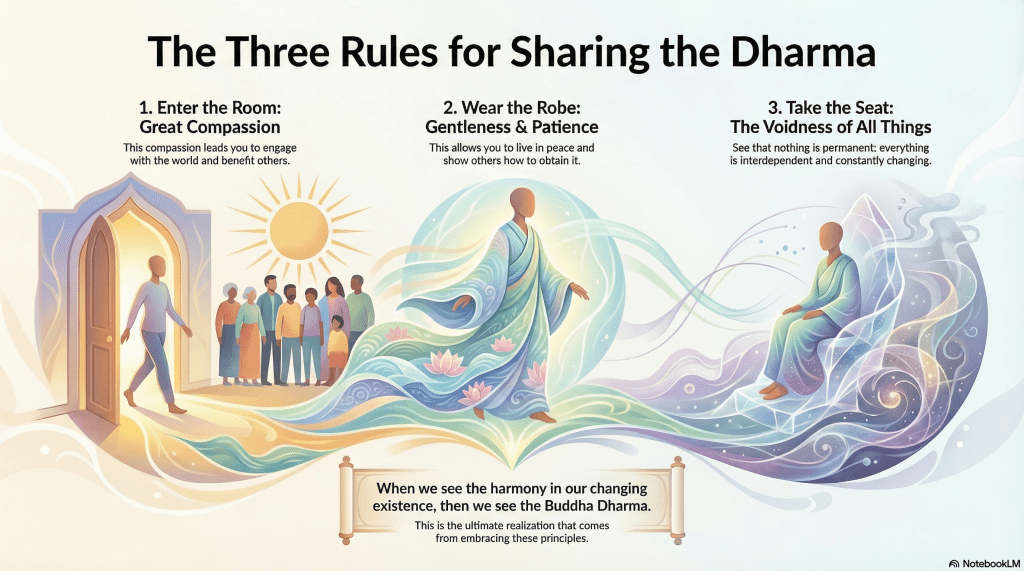
First, Enter the Room: The Foundation of Great Compassion
The first instruction is “To enter the room of the Tathāgata,” which the text explains is a metaphor for cultivating “great compassion.” This is the essential first step, the very entry point into a wiser way of being. In a culture often focused on self-improvement and personal peace, this teaching is radical: the path doesn’t begin with looking inward, but by turning our attention outward.
Compassion is presented as the foundation, the very motivation for our engagement with the world. The source text explains that our compassion leads us to engage with the world and benefit others. It shifts our focus from isolated, personal concerns to the interconnected well-being of all. Before we can find our own peace, we must first choose to enter the room where everyone’s story matters.
Second, Wear the Robe: The Practice of Gentleness and Patience
Once inside the room of compassion, the second rule is “To wear his robe,” a metaphor for being “gentle and patient.” This is not the passive patience of merely waiting or suppressing frustration. It is an active, protective practice—the method we use to navigate the world without creating more harm. It is the steady mind that can face a stressful workday, a difficult conversation, or a heated online debate without adding to the agitation.
By consciously cultivating a gentle and patient nature, we learn to embody the peace we seek. As the text suggests, this practice allows us to “live the peace everyone wants and show them how to obtain it.” Gentleness becomes our response and patience our strength, protecting both ourselves and others from reactive harm.
Third, Sit on the Seat: The Wisdom of Seeing “Voidness”
The third rule, “To sit on his seat,” represents the culmination of this practice: “to see the voidness of all things.” This concept of “voidness” is perhaps the most profound and easily misunderstood. It does not mean that things don’t exist or that life is meaningless. Instead, it points to the fundamental truth that nothing is permanent or self-existing. The text states it directly: “Only what is interdependent and changing truly exists. Only that which is connected with everything else truly exists.” In this web of total interconnection, the rigid distinctions between “self” and “other” begin to dissolve.
We often make a fundamental error in how we perceive reality, devaluing anything that doesn’t last forever.
“We presume that things that do not exist forever do not exist at all. A wisp of smoke. A fleeting smile.”
By letting go of our demand for permanence, we can finally appreciate the profound beauty of our transient, interconnected world. This shift in perspective is the ultimate reward of the practice. When we see this flowing, interdependent reality, the text reveals, “Nothing hinders us. Nothing opposes us.” Challenges cease to be external forces attacking a separate self and instead become part of the same changing reality we inhabit. To see this profound harmony is to sit on the seat of reality—to see the world as it truly is.
The Final Instruction
After laying out this three-part path, the text offers one final, crucial command, emphasizing that these are not merely ideas to be understood, but principles to be lived:
“Expound the Dharma only after you do these [three] things!”
A Framework for Living
The three rules from the Lotus Sūtra—entering the room of compassion, wearing the robe of gentleness, and sitting on the seat of interconnected reality—offer a holistic and practical framework for life. It is a sequence that builds upon itself: compassion provides the motivation to engage, patience provides the method for that engagement, and the wisdom of interdependence provides the perspective that makes it all sustainable. Together, they guide us away from opposition and toward a harmony with our changing existence.
If we approached our lives by first entering the room of compassion, what might we discover on the seat of reality?
 Mr. Altig’s Overview of the Wonderful Dharma of the Lotus Sutra
Leave a comment