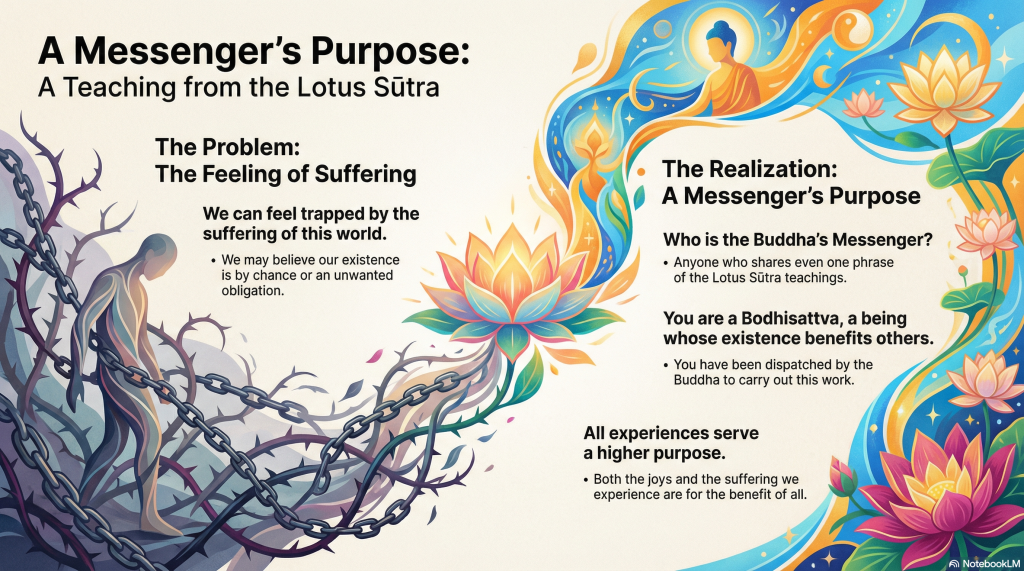
It’s a heavy time to be alive. The endless scroll of crises, the psychic weight of global conflict, the quiet helplessness that settles in when the world feels broken—it can all become too much. This feeling can lead to a deep yearning for escape, a sense that life is not a choice we made but an unwanted obligation, a burden we wish we could finally set down.
But what if this very feeling of being burdened was part of a profound purpose? An ancient teaching from the Lotus Sūtra offers a radical and empowering shift in perspective. It suggests that our presence here, amidst the struggle, is not an accident or an obligation, but a deliberate and meaningful mission.
1. You Don’t Have to Be a Master to Be a Messenger.
In the tenth chapter of the Lotus Sūtra, the Buddha offers a radical redefinition of agency to a figure aptly named Medicine-King Bodhisattva. This philosophy challenges our assumption about who is qualified to make a difference, positing that the role of a “messenger” of wisdom is not reserved for enlightened masters or ordained experts. Instead, it is accessible to anyone.
One becomes a messenger simply by sharing “even a phrase” of the teaching with another person, even if done in secret. This democratizes the role, meaning that small, quiet acts of sharing wisdom are profoundly significant. The text states this with beautiful clarity:
The good men or women who expound even a phrase of the Sūtra of the Lotus Flower of the Wonderful Dharma even to one person even in secret after my extinction, know this, are my messengers. They are dispatched by me.
But being a messenger isn’t just about repeating a phrase; it’s about embodying a truth. And that truth is found in the very fabric of our personal experience—our joy, and most radically, our suffering.
2. Your Joy and Suffering Are Not Just for You.
Here, the sūtra reveals its most counter-intuitive and powerful idea: the reframing of our entire personal experience. From this perspective, we are all Bodhisattvas—beings whose very existence is for the benefit of all other beings.
This means our personal lives take on a new dimension. Our individual joys and our individual sufferings are not just for us; they exist to benefit others. Your struggle is not a random cosmic punishment; it is the raw material for compassion. The empathy you forge in your own hardship becomes the medicine you can offer to others. Your resilience becomes a quiet lesson for those who are watching.
Consider a challenge you are facing right now. What if its primary purpose wasn’t to test you, but to equip you to understand and serve someone else down the line?
When we understand that our suffering cultivates a deeper empathy, we realize what our true message is. We don’t just share a teaching; we become the teaching. Our lives, shaped by both pain and peace, become the “phrase” of the sūtra we share with the world, transforming us from victims of circumstance into agents with a profound purpose.
Conclusion: From Burden to Mission
This ancient perspective offers a powerful way to reframe our experience. It proposes a shift from seeing life’s challenges as a meaningless burden to seeing them as part of a meaningful mission. The struggles we endure and the joys we experience are not just personal events; they are the very substance of the message we are here to embody for the good of all.
What might change if you viewed your next challenge not as an obstacle, but as an assignment?
 Mr. Altig’s Overview of the Wonderful Dharma of the Lotus Sutra
Leave a comment