In our modern world, we’re swimming in a digital deluge, a constant static that fogs our perception and leaves us longing for stillness. In our search for clarity, a profound teaching from the ancient Lotus Sūtra offers a surprising perspective, reframing our entire understanding of what it means to truly see, hear, and experience our lives.
——————————————————————————–
Spiritual “Merits” Aren’t Status Symbols
The practice of earning spiritual “merits” is often misunderstood as a way to accumulate points or achieve a higher status. The Lotus Sūtra, however, explicitly reframes this concept, teaching us that the benefits gained through practice are not external rewards to be shown off.
Merits in this sense are not status symbols.
The true goal, then, is not to collect achievements like trophies, but to gently cultivate a deeper, more authentic way of being. This brings a profound sense of freedom, releasing us from the exhausting pursuit of spiritual validation in a culture obsessed with metrics and performance.
Practice Is for Engaging With the World, Not Escaping It
A common misconception is that spiritual practice is a retreat from the difficulties of daily life. The teachings in the Lotus Sūtra present a direct contradiction to this idea, emphasizing that practice is meant to equip us for the world, not remove us from it.
This is another reminder that the practice of the Wonderful Dharma does not take us out of the world of conflict we live in.
This perspective reframes spiritual discipline as a practical tool that helps us find our center within the storm. It translates into more compassionate relationships, clearer decision-making under pressure, and the quiet strength to find peace amidst chaos, not just in isolation from it.
The Ultimate Goal Is Clarity, Not Superpowers
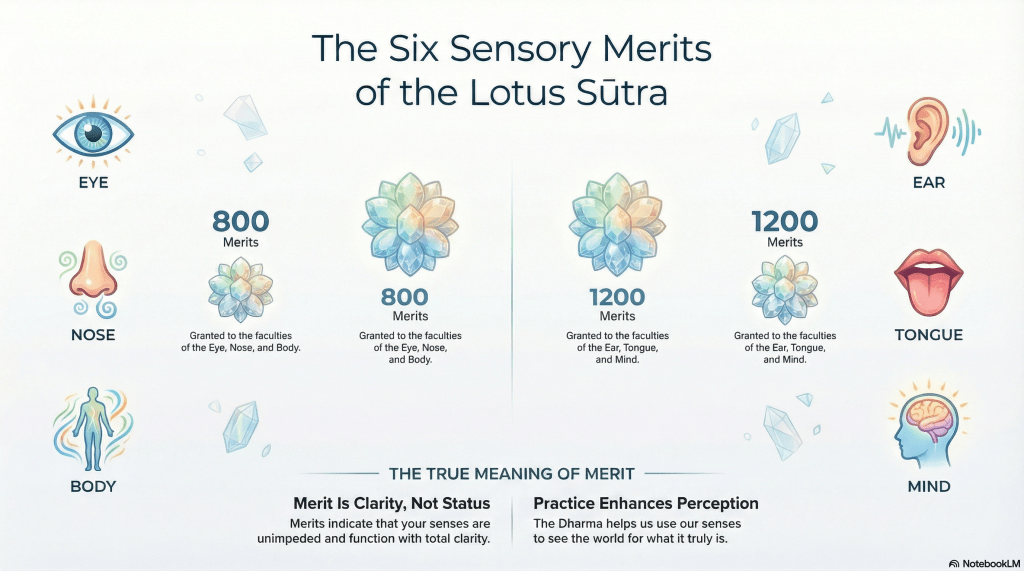
So, if spiritual merits are not status symbols and practice isn’t an escape, then what exactly are the “eight hundred merits of the eye,” “twelve hundred merits of the ear,” or even the “twelve hundred merits of the mind” that the Sūtra promises? The text clarifies that these numbers don’t imply gaining supernatural abilities, but rather represent achieving a state of perfect, unimpeded awareness. It’s about the eye, ear, nose, tongue, body, and mind all functioning without distortion.
Imagine our everyday perception is like looking through a smudged, dirty window. The world outside is vibrant and clear, but our view is clouded. This practice teaches us to wield the senses we already possess with a startling new proficiency, allowing us to finally perceive the world as it truly is. It is the simple, patient act of cleaning the glass.
They are an indication of clarity, of our faculties not being impeded by anything that blocks their capacity.
This insight makes a profound goal feel accessible. It isn’t about becoming something more than human, but about refining the incredible faculties we already possess to experience the world with true lucidity.
——————————————————————————–
A Final Thought
The invitation of the Lotus Sūtra, then, is not to an otherworldly escape, but to a radical homecoming—a return to the clarity of our own senses, free from the distortions of ego, fear, and distraction. It is an internal journey toward cultivating a mind so clear that we can engage with the world more fully and perceive reality as it is.
What could you perceive differently if your senses were completely free from obstruction?
 Mr. Altig’s Overview of the Wonderful Dharma of the Lotus Sutra
Leave a comment