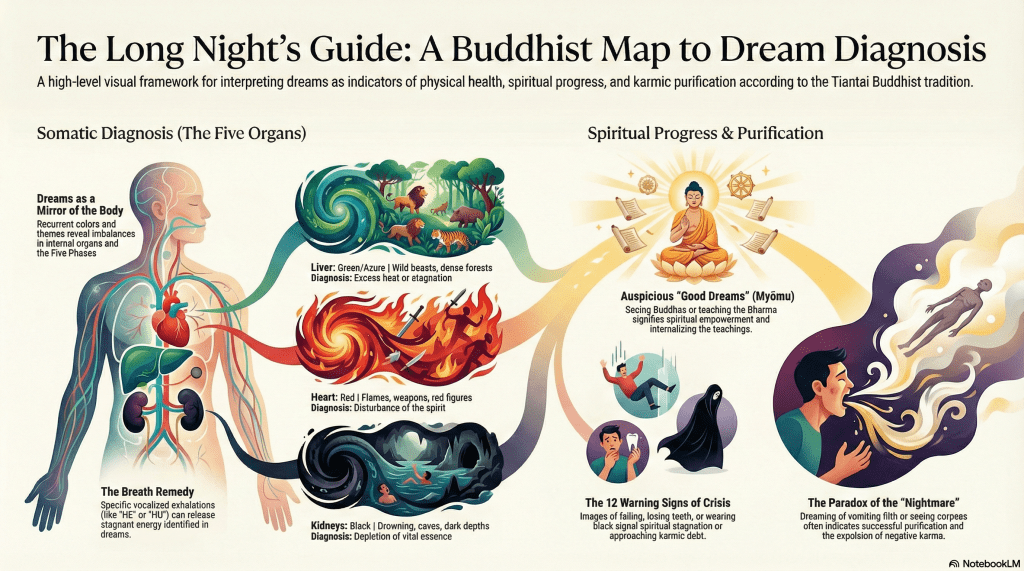
Lotus Sutra Manual of Dream Signs and Spiritual Progress
Loading the Elevenlabs Text to Speech AudioNative Player…
A Buddhist Diagnostic System for Dream Interpretation
Preface
This manual presents a systematic approach to dream interpretation drawn from the East Asian Buddhist tradition, specifically the Tiantai school founded by Master Zhiyi (智顗, 538–597 CE). It synthesizes material from four primary textual traditions:
- The Saddharmapuṇḍarīka-sūtra (Lotus Sutra), particularly the “Peaceful Practices” chapter
- The Mohe Zhiguan (Great Calming and Contemplation), Zhiyi’s masterwork on meditation
- The Mahāparinirvāṇa-sūtra (Nirvana Sutra), especially its treatment of karmic diagnosis
- The Mahāsannipāta-sūtra (Great Collection Sutra), with its material on dream-guides and realm-signs
The goal is twofold: (1) to make available in accessible form the traditional Buddhist approach to dream interpretation, and (2) to provide practitioners with a usable diagnostic framework for understanding their nightly experiences in light of their spiritual development.
Methodology
The translations and interpretations in this manual follow these principles:
1. Primary Source Fidelity
All dream-sign categories and interpretations trace to specific textual sources, cited by Taishō number and fascicle. Where the tradition offers multiple interpretations, the Tiantai reading is prioritized while alternatives are noted.
2. Integration with Chinese Medical Theory
Part II incorporates the Five Phase (wǔxíng) medical framework as it was understood by Zhiyi and his successors. This represents an authentic synthesis that occurred within Chinese Buddhism, not a later addition.
3. Pastoral Orientation
The texts excerpted were written for practitioners, not solely for scholastic analysis. This manual maintains that orientation. Diagnosis implies remedy; interpretation implies action.
4. Dual-Track Presentation
The Scholarly Edition provides full technical vocabulary, source citations, and doctrinal context. The companion Practitioner’s Guide offers the same content in vernacular language for general readers.
Clinical and Pastoral Boundary
This manual treats dream material as contemplative and diagnostic data within Buddhist practice. It is not a substitute for psychiatric, psychological, or medical diagnosis. Where persistent distress, trauma activation, or functional impairment is present, clinical care takes priority, and this manual should be used only as adjunctive support.
A Note on Terminology
Sanskrit terms appear in IAST transliteration (e.g., dhāraṇī, vyākaraṇa).
Chinese terms appear in pinyin with characters (e.g., Mohe Zhiguan, 摩訶止觀).
Japanese readings are provided where the term is more commonly known in that form (e.g., Anrakugyo-hon for the Peaceful Practices chapter).
The Glossary provides definitions for all technical terms.
Acknowledgments
This work draws upon the research of:
- Paul L. Swanson on Zhiyi and Tiantai meditation theory
- Leon Hurvitz on the Lotus Sutra
- Mark L. Blum on the Mahāparinirvāṇa-sūtra
- Étienne Lamotte on the Mahāsannipāta
- The CBETA digital corpus of Chinese Buddhist texts
How to Use This Manual
Reading Order (Parts I-IV)
The argument is sequential and cumulative:
- Part I establishes auspicious signs and baseline orientation.
- Part II provides organ-element and time-sign diagnostics.
- Part III differentiates purification phenomena from warning/retribution patterns.
- Part IV reframes dream interpretation within non-dual and liberative doctrine.
Reading out of sequence is possible, but full interpretive reliability depends on this progression.
Edition-Control Note
The Scholarly and Practitioner editions transmit the same core framework. Differences are editorial: citation density, technical vocabulary load, and level of doctrinal apparatus. Where wording differs, doctrinal claims are intended to remain equivalent.
For Scholars:
Each part begins with source citations. Footnotes reference the Taishō edition. The Bibliography provides editions and secondary literature for further research.
For Practitioners:
Begin with Part I (Auspicious Signs) to understand what “good dreams” look like. Proceed to Part II (Diagnostic Dreams) for physical and meditative feedback. Consult Part III (Purification and Retribution) when disturbing dreams arise. Read Part IV (The Great Awakening) for the philosophical frame.
For Dream Journaling:
Use Appendix D (Dream Journal Template) for daily recording. Cross-reference dreams with the Quick Reference (Appendix A) for rapid diagnosis.
Abbreviations
| Abbreviation | Full Reference |
| T. | Taishō Shinshū Daizōkyō (Taishō Tripiṭaka) |
| T.262 | Saddharmapuṇḍarīka-sūtra (Kumārajīva trans.) |
| T.374 | Mahāparinirvāṇa-sūtra (Northern version) |
| T.375 | Mahāparinirvāṇa-sūtra (Southern version) |
| T.397 | Mahāsannipāta-sūtra |
| T.1715 | Fahua Jing Yiji (Fayun’s commentary) |
| T.1718 | Fahua Wenju (Zhiyi’s textual commentary) |
| T.1911 | Mohe Zhiguan |
| CBETA | Chinese Buddhist Electronic Text Association |
*The Buddha said: “All conditioned phenomena are like a dream.”
This manual teaches you to read that dream.*
Part I: The Auspicious Signs of the Peaceful Practitioner
*Scholarly Edition*
Source: Saddharmapuṇḍarīka-sūtra, Chapter 14: Anrakugyo-hon (安樂行品, “Peaceful Practices”)
Introduction
This section details the “Good Dreams” (妙夢, myōmu) that arise for practitioners who uphold, read, recite, and expound the Lotus Sutra while dwelling in the Four Peaceful Practices (四安樂行):
- Body (身安樂行) — Physical conduct free from harm and attachment
- Mouth (口安樂行) — Speech free from slander, lies, and divisiveness
- Mind (意安樂行) — Mental cultivation free from envy, pride, and contempt
- Vow (誓願安樂行) — The bodhisattva’s commitment to universal liberation
These dreams are not ordinary subconscious phenomena but rather adhiṣṭhāna (加持, spiritual empowerment) manifestations, indicating that the practitioner has entered the “Room of the Tathāgata” (如來室) and is receiving protection from the Buddhas of the ten directions.
The Lotus Sutra states:
若善男子、善女人、持法華經者、… 是人若坐、若經行、… 如是夢中雖見種種諸佛說法。
>
“If good men or good women who uphold the Lotus Sutra… when sitting or walking in practice… in their dreams they will see the various Buddhas preaching the Dharma.”[^1]
Category 1: The Vision of the Holy Assembly (見如來座)
The Dream
The practitioner sees the Tathāgatas seated on lion-thrones (siṃhāsana, 獅子座), surrounded by a vast assembly of monks (bhikṣu), bodhisattvas (bodhisattva), and celestial beings, preaching the Dharma.
The Sign
This indicates alignment with the “wisdom of the Buddhas” (佛智慧). The practitioner is no longer merely studying the text but has begun to participate spiritually in the eternal assembly of the Dharma—the Vulture Peak (Gṛdhrakūṭa) that exists beyond time.
Detailed Imagery
- Celestial beings: Dragons (nāga), spirits (yakṣa), and asuras “as numerous as the sands of the Ganges” (恆河沙等), all offering reverence
- The Buddha’s form: Golden body (suvarṇa-varṇa) emitting immeasurable light that illuminates the dharmadhātu
- The teaching voice: The voice of Brahmā (brahma-svara), penetrating all worlds
Doctrinal Context
This category corresponds to the first of the Four Great Vows in Tiantai interpretation—the aspiration to save all beings. The appearance of the vast assembly indicates the practitioner’s bodhicitta has reached sufficient depth to resonate with the Buddha-field.
Category 2: The Vision of Agency (見自己說法)
The Dream
The practitioner sees themselves standing among the assembly, joining palms (añjali) in reverence, and—crucially—teaching the Dharma to others: to kings, householders, brahmins, monks, nuns, laypeople, and celestial beings.
The Sign
This signifies the attainment of Dhāraṇī (陀羅尼, total retention of the teachings) and entry into the stage of Non-Retrogression (Avaivartika, 不退轉). The Dharma has become internalized; the practitioner has transformed from student to vessel.
The Prophecy (*Vyākaraṇa*)
In this category of dream, the Buddha (or a Buddha-figure) may directly address the practitioner:
「善男子!汝當來世、當得無量智慧、佛之大道。」
>
“Good man! In the future, you will attain immeasurable wisdom and the great Way of the Buddha.”[^2]
This constitutes a vyākaraṇa (授記), a formal prophecy of future Buddhahood—one of the most significant spiritual events in Mahāyāna soteriology.
Doctrinal Context
The Lotus Sutra famously extends vyākaraṇa to all beings, including Śrāvakas previously thought to be on the “lesser” path. The appearance of this dream-prophecy confirms that the practitioner’s trajectory toward complete perfect enlightenment (anuttara-samyak-saṃbodhi) is irreversible.
Category 3: The Vision of Ascetic Practice (見己在山林)
The Dream
The practitioner sees themselves dwelling in mountain forests (山林) or solitary places, cultivating good dharmas and practicing meditation (dhyāna).
The Sign
This indicates purification of the sense-faculties (indriya) and solidification of intent (adhyāśaya). The practitioner’s mind has begun to stabilize in renunciation.
Detailed Imagery
- *Realization of dharmatā: Seeing oneself perceive the “True Aspect” of all phenomena (諸法實相, dharma-svabhāva*)
- *Deep dhyāna:* Entering profound states of concentration and seeing the Buddhas of the ten directions simultaneously
- Solitude without loneliness: The practitioner experiences the “emptiness” of the environment as fullness
Doctrinal Context
This category relates to the practice of śamatha (止, calming). The mountainous imagery represents withdrawal from saṃsāric entanglement—not escapism, but strategic positioning for cultivation.
Category 4: The Royal Transfiguration (見王出家)
The Dream
The practitioner dreams of being a great King who abandons palace, family, and the five sense-desires to seek the Way. The dream unfolds as a narrative:
- Renunciation (出家): Departing the royal life to go to the Bodhimaṇḍa (道場, place of awakening)
- Attainment (成道): Sitting on the lion-seat beneath the Bodhi tree, seeking the Way for seven days, and attaining the wisdom of the Buddhas
- Turning the Wheel (轉法輪): Rising to preach the Dharma to the four assemblies—monks, nuns, laymen, laywomen—for thousands of millions of kalpas
- Parinirvāṇa: Teaching the “wondrous Law without outflows” (anāsrava-dharma) to save sentient beings, then entering Nirvāṇa “like a lamp extinguishing when the smoke is exhausted”
The Sign
This is the ultimate sign of “Great Purification” (大淨). It confirms that the practitioner possesses the tathāgatagarbha (Buddha-seed) and will, in future existences, perform exactly as the Buddhas perform. The Lotus Sutra calls such a one a “True Son of the Buddha” (真佛子).
Doctrinal Context
This dream-narrative recapitulates the arc of Śākyamuni Buddha’s own life: renunciation, awakening, teaching, and final nirvāṇa. Its appearance in the practitioner’s dream is understood as a confirmation of their buddha-lineage (buddha-gotra)—not mere potential, but destiny.
Footnotes
[^1]: T.262.9.37a, Saddharmapuṇḍarīka-sūtra, Kumārajīva translation, Chapter 14.
[^2]: T.262.9.37b, adapted.
Part II: The Mirror of the Elements (Diagnostic Dreams)
*Scholarly Edition*
Source: Mohe Zhiguan (摩訶止觀, T.1911), Fascicle 8, “Chapter on Curing Illness” (治病章); Chinese Medical Theory of the Five Phases (wǔxíng, 五行)
Introduction
This section shifts from spiritual prophecy to somatic and meditative diagnosis. The Mohe Zhiguan treats dreams as feedback signals revealing:
- The state of the practitioner’s internal organs (zàng-fǔ, 臟腑)
- The balance of the Five Elemental Phases (五行)
- Specific obstructions and interferences arising during meditation (zuòchán, 坐禪)
Master Zhiyi states in the Mohe Zhiguan:
五臟隱蔽、病難知者、當觀禪定中相驗知所起因。
>
“When the five organs are hidden and diseases are difficult to know, one should observe the images arising in meditative concentration to verify the cause.”[^1]
This constitutes a proto-psychosomatic diagnostic system, integrating Buddhist meditation theory with Chinese medical frameworks of organ-emotion-element correspondence.
Chapter 1: The Five Organs and Color Diagnostics (五臟色診)
This chapter interprets dream colors and figures as symptoms of organ imbalance (excess or deficiency). The system derives from the Five Phase (wǔxíng) correspondences systematized in the Huangdi Neijing tradition and integrated into Buddhist contemplative practice by Chinese meditation masters.
The Liver (肝) — Wood Element (木)
| Category | Correspondence |
| Element | Wood (mù, 木) |
| Color | Green/Azure (qīng, 青) |
| Season | Spring |
| Direction | East |
| Emotion | Anger (nù, 怒) → manifests in dreams as Fear |
Dream Imagery:
- Green colors, green-skinned figures
- Wild beasts: lions (shīzi, 獅子), tigers (hǔ, 虎), leopards
- Dense forests, overwhelming vegetation
Diagnosis: Excess heat or stagnation in the Liver (gān-huǒ, 肝火)
Breath Remedy: The “HE” (呵) Breath — A soft exhalation from the back of the throat, visualizing green-dark energy releasing from the liver region.
The Heart (心) — Fire Element (火)
| Category | Correspondence |
| Element | Fire (huǒ, 火) |
| Color | Red (chì, 赤) |
| Season | Summer |
| Direction | South |
| Emotion | Joy (xǐ, 喜) → manifests in dreams as extremes of joy or sudden fear |
Dream Imagery:
- Red colors, flames, rising fire
- Red weapons, knives, swords
- Intimate scenes: young men and women embracing
Diagnosis: Excess heat in the Heart (xīn-huǒ, 心火), disturbance of shén (神, spirit)
Breath Remedy: The “HU” (呼) Breath or “CHUI” (吹) Breath — Rounded-lip exhalation releasing heat from the chest center.
The Lungs (肺) — Metal Element (金)
| Category | Correspondence |
| Element | Metal (jīn, 金) |
| Color | White (bái, 白) |
| Season | Autumn |
| Direction | West |
| Emotion | Grief (bēi, 悲) |
Dream Imagery:
- White colors, white-clad figures
- Metal objects: armor, weapons with metallic sheen
- Flying, floating, weightlessness
- Weeping, funerals
Diagnosis: Deficiency or dryness in the Lungs (fèi-zào, 肺燥)
Breath Remedy: The “XU” (噓) Breath — Hissing exhalation, visualizing white energy releasing from the lungs.
The Kidneys (腎) — Water Element (水)
| Category | Correspondence |
| Element | Water (shuǐ, 水) |
| Color | Black (hēi, 黑) |
| Season | Winter |
| Direction | North |
| Emotion | Fear (kǒng, 恐) |
Dream Imagery:
- Black colors, darkness, depth
- Drowning, deep water, ocean depths
- Caves, underground spaces
- Trembling, paralysis
Diagnosis: Deficiency in the Kidneys (shèn-xū, 腎虛), depletion of jīng (精, essence)
Breath Remedy: The “CHUI” (吹) Breath — Deep exhalation releasing dark, heavy energy from the lower back.
The Spleen (脾) — Earth Element (土)
| Category | Correspondence |
| Element | Earth (tǔ, 土) |
| Color | Yellow (huáng, 黃) |
| Season | Late Summer / Transitions |
| Direction | Center |
| Emotion | Worry/Pensiveness (sī, 思) |
Dream Imagery:
- Yellow colors, yellow-clad figures
- Earth, mud, heaviness, sinking
- Singing, playing music (the Spleen “governs” singing in Chinese medical theory)
Diagnosis: Stagnation or dampness in the Spleen (pí-shī, 脾濕)
Breath Remedy: The “XI” (嘻) Breath — High-pitched gentle exhalation, releasing muddy energy from the mid-abdomen.
Chapter 2: The Twelve Time-Beasts (十二時魅)
This section addresses “Time Charm Ghosts” (Shí Mèi, 時魅)—entities that disturb the practitioner during meditation or sleep, taking specific animal forms based on the shíchén (時辰, two-hour period) of their appearance.
The Mohe Zhiguan notes:
若見諸獸相、當驗其所起時。
>
“If one sees various beast-forms, verify the time of their arising.”[^2]
The Complete Time-Beast Correspondence
| Period | Branch | Direction | Element | Primary Animal | Secondary Forms |
| 3–5 AM | Yín (寅) | East | Wood | Tiger (虎) | Leopard, Wild Cat |
| 5–7 AM | Mǎo (卯) | East | Wood | Rabbit (兔) | Fox, Badger |
| 7–9 AM | Chén (辰) | East | Wood | Dragon (龍) | Turtle, Fish |
| 9–11 AM | Sì (巳) | South | Fire | Snake (蛇) | Eel, Carp |
| 11 AM–1 PM | Wǔ (午) | South | Fire | Horse (馬) | Deer, Roebuck |
| 1–3 PM | Wèi (未) | South | Fire | Sheep (羊) | Goose, Hawk |
| 3–5 PM | Shēn (申) | West | Metal | Monkey (猴) | Ape |
| 5–7 PM | Yǒu (酉) | West | Metal | Rooster (雞) | Crow, Pheasant |
| 7–9 PM | Xū (戌) | West | Metal | Dog (犬) | Wolf, Jackal |
| 9–11 PM | Hài (亥) | North | Water | Pig (豬) | Boar |
| 11 PM–1 AM | Zǐ (子) | North | Water | Rat (鼠) | Cat, Bat |
| 1–3 AM | Chǒu (丑) | North | Water | Ox (牛) | Crab, Turtle |
The Cure: Naming the Entity
The traditional remedy upon recognition is to directly address the entity:
「汝是卯時老狐精。」
>
“You are the Old Fox-spirit of the Mǎo Hour.”
The Mohe Zhiguan states that upon being recognized and named, such entities lose their power to disturb and “the illusion will vanish” (幻即滅).
This operates on the principle that māyā-based phenomena depend on concealment; recognition disrupts the mechanism of delusion.
Chapter 3: Paradoxical Dreams (不淨觀驗)
This section reinterprets certain “nightmares” as positive signs of meditative progress, specifically within the context of the Nine Contemplations of the Corpse (jiǔxiǎng, 九想) and the Impurity Meditation (aśubha-bhāvanā, 不淨觀).
The Dream of the Corpse (死屍夢)
Dream Content: A corpse swelling, turning blue-green, rotting with pus and blood.
Interpretation: Not a negative omen. This signifies that the practitioner’s aśubha-bhāvanā has succeeded in weakening attachment to the body. The very imagery used in deliberate contemplation now arises spontaneously—the meditation has “taken.”
Doctrinal Precedent: The nine stages of corpse meditation (navāśubha) progress from bloating to decomposition to skeleton. Dreams reflecting these stages indicate internalization of the teaching.
The Dream of the Skeleton (白骨夢)
Dream Content: One’s own body appearing as a white skeleton, sometimes emitting light.
Interpretation: A sign of high meditative attainment in the “Skeleton Visualization” (aṭṭhika-saññā). The practitioner has succeeded in perceiving the body as neither solid nor permanent. The light indicates the contemplation has moved from conceptual to luminous—bhāvanā-maya-prajñā (wisdom born of cultivation).
The Dream of Insects (蟲夢)
Dream Content: Insects crawling in and out of the body—under the skin, through orifices.
Interpretation: The Mohe Zhiguan describes the body as a “nest of 80,000 worms” (八萬戶蟲). This dream indicates the practitioner has genuinely realized this teaching—not intellectually, but viscerally. The disgust phase precedes equanimity.
Footnotes
[^1]: T.1911.46.100c, Mohe Zhiguan, Fascicle 8.
[^2]: T.1911.46.101a, adapted.
Based on the Lotus Sutra (specifically the “Parable of the Poor Son” in Chapter 4) and the Mohe Zhiguan (Great Calming and Contemplation), here is a detailed outline for Part III: Dreams of Purification and Retribution.
This section helps the practitioner distinguish between dreams that signal Karmic Retribution (current spiritual stagnation or attachment to lesser paths) versus Purification (the breaking of obstructions and clearing of past sins).
**Part III: The Treasury of Purification and Retribution**
Introduction:
“One dream involves many lifetimes; waking up involves one moment”. This section guides the practitioner in interpreting dream narratives as indicators of their spiritual “wealth” or “poverty,” and recognizing the visceral signs that heavy karma is leaving the body.
**Chapter 1: The Dream of Spiritual Poverty (Retribution Signs)**
Drawing from the Parable of the Poor Son, this chapter interprets dreams of poverty, menial labor, and fear as signs that the practitioner is attached to “Lesser Vehicle” (Hinayana) teachings or is trapped in a cycle of self-doubt and karmic limitation.
- The Dream of Menial Labor: Dreaming of being hired to clean piles of dung or engaging in filthy, difficult work.
- Interpretation: This indicates an attachment to “provisional teachings” or a belief that enlightenment must be earned through grueling, harsh asceticism, rather than accepting the immediate wealth of the Buddha-nature,.
- The Dream of Fearful Authority: Dreaming of seeing a magnificent King or a wealthy elder and feeling terrified, thinking, “This is not my place; I will be captured or killed.”
- Interpretation: A sign of “Inferior Resolve.” It suggests the practitioner encounters the Great Vehicle (Mahayana) teachings but feels unworthy or terrified of their vastness, preferring to retreat to “poverty” (smaller, safer practices),.
- The Dream of Scavenging: Dreaming of wandering through villages seeking clothing and food, finding little, and suffering from hunger and cold.
- Interpretation: Represents the “Retribution of Transmigration.” It signifies a mind still searching externally for spiritual sustenance (the Dharma) rather than realizing the treasure within,.
**Chapter 2: The Visceral Expiation (Purification Signs)**
Based on the Mohe Zhiguan and the Lotus Sutra’s description of repentance, this chapter details the physical sensations in dreams that signal the successful destruction of heavy negative karma.
- The Dream of Vomiting: Dreaming of vomiting black substances, insects, or filth.
- Sign: This is a primary sign of “Breaking Obstruction.” It indicates that the repentance (specifically the Fangdeng or Lotus repentance) is working, and the heavy accumulation of past offenses is being expelled from the spiritual body.
- The Dream of Washing: Dreaming of seeing oneself washing the body or clothes, or seeing dirty water flow away.
- Sign: A confirmation of purification and the restoration of the precepts. It signifies that the “Dharma Medicine” has taken effect and the “poison” of ignorance is being cleared,.
- The Dream of Light and Flowers: Dreaming of holding fresh flowers, or seeing a light enter the room/body.
- Sign: A sign of the “Theory of Reality” penetrating the mind. It often accompanies the “Dream of Vomiting” as the positive replacement for the expelled filth.
**Chapter 3: The Shield of the Dharani (Protection from Evil)**
This section outlines how specific invocations (Dharani) protect the dreamer from spiritual attacks or “Nightmare Ghosts” that seek to disturb the practitioner.
- The Attack of the Rakshasas: Dreaming of ghosts, demons, or black entities trying to torment or frighten the dreamer.
- Remedy: These are external obstructions (“Heavenly Demon” or “Time Charm Ghosts”). The text advises reciting specific Dharani (spells) mentioned in the Lotus Sutra (e.g., “Anye manye mane mamane…”) to bind these forces.
- The Vow: “If you trouble this Dharma teacher, even in their dreams, may your head be split into seven pieces like an arjaka branch”.
- The Dream of the White Elephant: Dreaming of a six-tusked white elephant or a bodhisattva riding an elephant protecting you.
- Interpretation: A sign of the protection of Universal Worthy Bodhisattva (Samantabhadra). It confirms that the practitioner is under the direct guardianship of the Mahayana sutras and that no demon can disturb their concentration.
**Chapter 4: The Nightmare of the Ill King (The Warning Signs)**
Sources: Nirvana Sutra (大般涅槃經)
This chapter draws from a powerful parable in the Nirvana Sutra where nightmares serve as urgent diagnostic signals—not evil omens, but calls to seek the “Good Doctor” (the Buddha). These dreams appear when the spiritual body is gravely ill.
- The Narrative: A man with a heavy illness (representing accumulated negative karma or the five grave offenses) experiences terrifying dreams. Each image signals specific spiritual danger.
- The Twelve Warning Signs:
| Dream Image | Spiritual Diagnosis |
| Climbing a dried tree | Attachment to lifeless doctrines; spiritual stagnation |
| Sinking in water or mud | Drowning in the three poisons (greed, hatred, ignorance) |
| Sleeping on a pile of ashes | Mistaking nihilism for liberation |
| Eating ashes | Consuming “dead” teachings that provide no nourishment |
| Surrounded by monkeys | Mind scattered by restless thoughts |
| Wearing black clothes | Covered by the darkness of ignorance |
| Surrounded by foxes | Deceived by false teachings or spirit-beings |
| Teeth falling out | Loss of the wisdom-faculties |
| Hair falling out | Loss of good roots (kuśala-mūla) |
| Embraced by a disheveled woman | Seduced by Māra or worldly attachment |
| Falling from a great height | Pride before a fall; loss of spiritual gains |
| Walking naked among crowds | Shame of broken precepts exposed |
- The Interpretation: These are not curses but urgent alarms. The text says such a person needs an immediate “Good Doctor” (the Buddha-Dharma). The nightmares are themselves a form of compassion—the spiritual body screaming for help before it is too late.
- The Remedy: Upon waking, the dreamer must recognize these images as symptoms, not fate. They should immediately seek repentance practice, devotional recitation, or the guidance of a qualified teacher.
**Chapter 5: Dreams of Hell as the Seed of Bodhi**
Sources: Nirvana Sutra, Mohe Zhiguan
This chapter presents a profound teaching: even the most terrifying nightmare—dreaming of falling into hell—can become the very seed of awakening if it triggers genuine repentance.
- The Teaching:
“If a person who slanders the Dharma or commits grave sins dreams of falling into hell and feels great suffering and fear… and upon waking feels repentance, thinking: ‘Alas! I have invited this sin!’—this very fear becomes a cause for Bodhi.”
- The Mechanism:
- The Nightmare: The practitioner dreams of the hells—fire, ice, cutting, crushing. They experience visceral suffering.
- The Wake-Up Call: Upon waking, instead of dismissing the dream, they feel genuine dread: “What have I done to deserve this vision?”
- The Turn: This fear (惧, jù) becomes not paralysis but motivation. It drives the person to seek the Dharma, to practice repentance, to change their conduct.
- The Transformation: The nightmare becomes a spiritual gift—the fear converts to Bodhi-mind.
- The Paradox: The person who never has such dreams may be more endangered than the one who does. The nightmare proves the spiritual body is still alive enough to feel its own illness. Total numbness—dreaming of nothing, or only pleasant distractions—may indicate deeper spiritual death.
- Practical Application:
- If you wake from a dream of suffering, do not suppress the fear. Sit with it.
- Ask: “What is this dream revealing about my current path?”
- Use the fear as fuel for practice—the terror of saṃsāra is itself a doorway to liberation.
**Chapter 6: The Ultimate Realization (Waking Up)**
- The Dream of the Treasure: Dreaming that the “King” or “Father” reveals the treasury of gold, silver, and lapis lazuli belongs entirely to you.
- Interpretation: The ultimate sign of the Lotus Sutra. It signifies the realization that “there was never any poverty”—the Buddha-nature was possessed all along. The practitioner realizes they are not a servant, but the true heir to the Buddha,.
Dreams of the Six Realms
Your leg slips. The tree has no bark—gray, dead, crumbling under your fingers. You are falling. The fall never ends. You wake gasping at 3 AM, your shirt soaked.
Where were you falling toward?
The Six Realms (*Ṣaḍ-gati*, 六道)
Also called “Six Destinations” or “Six Paths.” This chapter uses “Six Realms” as the primary term.
The Buddhist tradition maps six realms where consciousness can land after death—and before death, in the imagery that visits your sleep:
| Realm | Core Experience | Dream Signature |
| Hell | Intense suffering | Sinking, decay, paralysis |
| Hungry Ghost | Insatiable craving | Starvation, rakshasas, cold |
| Animal | Instinct without reflection | Becoming a beast, being beaten |
| Human | Mixed experience, choice | Ordinary washing, conversation |
| Asura | Jealousy and conflict | War, rivalry, frustration |
| Deva | Pleasure and ease | Flying, light, palaces |
These dreams are not random. They are the mind showing you where it is inclined to go next.
⚠️ Safety Note: If you experience repeated terror dreams, have a trauma history, or notice significant sleep disturbance, seek medical or mental-health support alongside any practice approach. Dream work is not a substitute for professional care. If dreams involve self-harm imagery or suicidal content, contact a mental health provider immediately. This chapter assumes a baseline of psychological stability.
👁 Notice this week: After recording a dream, ask: which realm does this most closely resemble?
1. Hell Realm Dreams
You are climbing a dead tree. Gray, leafless. Your foot slips. You fall—but never hit ground. The falling is the dream. You wake with your stomach in your throat.
Or: The mud. It rises around your ankles, your knees. You try to run but your legs won’t move. The mud reaches your chest, your neck. You open your mouth to scream and the mud fills it.
Or: Everything is ash. You try to brush it from your skin but your hands produce more. You eat and taste only ash.
What to Look For
| Image | Sensory Detail | Meaning |
| Dead tree | No bark, gray, crumbling, you’re gripping it | Life-force exhausted |
| Sinking | Slow descent, paralyzed legs, mud/water rising | Drowning in negative karma |
| Ash | Gray coating on skin, in mouth, on food | Aftermath of destructive action |
| Black clothes | Everyone in funeral robes, including you | Approaching the lower realms |
| Teeth falling | Spitting teeth, feeling them crumble | Body disintegrating |
Two Interpretations—and the Difference
Medical reading: Night terror. Sleep apnea. Hypnic jerk during Stage 1 sleep. The falling sensation is the nervous system misfiring.
Karmic reading: The mind is previewing its own trajectory. These are “flower retribution”—early fruits of karma that is ripening toward hell. The dream is a final alarm.
How to tell: Does it repeat? Does it carry meaning that outlasts the morning? Does it coincide with conduct you know is wrong? If yes to any two, it is karmic.
When this may be more than ordinary nightmare: If the dream repeats, if it carries meaning that persists past morning coffee, if it coincides with conduct you know is wrong—then it may be diagnostic rather than random. Ordinary nightmares lack this moral weight.
The Case of King Ajatasatru
Ajatasatru murdered his father for the throne. The Mahāparinirvāṇa-sūtra (T.374, 卷32-36, “The Chapter on King Ajātaśatru”) records that he was “afflicted with abscesses, filled with remorse, and unable to sleep peacefully.” He dreamed the nightmare signs—sinking, decay, black robes. These were not punishment; they were the last warning before his karma fully ripened.
When he asked his ministers for help, five of them made his condition worse by telling him his actions were justified. Only when he met the Buddha and confessed did his mind begin to stabilize.
📝 Try this tonight: If you have had a Hell-realm dream, before sleep say: “Show me whether this is medical or karmic.”
What to Do With This Dream
Immediately:
Sit with the fear. Don’t dismiss it. Let it sink in for 60 seconds. Then ask: What am I ashamed of from the last month?
Within 24 hours:
Confess. To a teacher, a sangha member, or in formal repentance. Take or reaffirm the five precepts.
This week:
Make material amends. If you stole, return. If you lied, correct. If you harmed, apologize.
Ongoing:
Monitor your dreams. If the imagery shifts—from mud to water to solid ground—purification is working.
This echoes Part III’s warning signs (see “The Twelve Signs of Approaching Crisis”)—the same imagery under the lens of karma rather than diagnosis. If Part III is not yet finalized in your edition, these warning signs include: dead trees, sinking, ashes, monkeys, teeth falling, black clothes, and the disheveled woman.
2. Hungry Ghost Dreams
You are walking through a village at dusk. Smoke rises from chimneys. You smell bread baking. Your stomach cramps with hunger. But every door is locked. Every window shuttered. You knock and no one answers.
Or: A figure appears—tall, emaciated, ribs visible through gray skin. Its eyes are too large. It says: “You will die.”
You cannot move.
What to Look For
| Image | Sensory Detail | Meaning |
| Rakshasa appearing | Skeletal, speaks directly, threatens life | Wrathful warning |
| Wandering, seeking food | Moving through markets, kitchens—finding nothing | Spiritual poverty |
| Extreme hunger | Throat burning, stomach clenched, no relief | Craving that cannot be fed |
| Cold forests | Dark trees, bones visible, wind | Preta dwelling-places |
Two Interpretations—and the Difference
Psychological reading: Anxiety. Resource scarcity. The locked doors represent rejection you’ve experienced.
Traditional reading: These are the realms of those who slandered the Dharma or refused to generate the aspiration for awakening. The Rakshasa is not a punishment—it is compassionate terror, the alarm before the house burns.
How to tell: Did a figure speak? In Buddhist dream interpretation, speaking figures indicate karmic or spiritual content, not mere psychological projection. If the Rakshasa spoke, it is transmission.
When this may be more than suppressed anxiety: If a figure spoke—especially if it addressed you by condition (“you who have not generated bodhicitta”)—this indicates karmic or spiritual content. If doors are locked and you can name who locked them, it may be psychological. If the doors are locked by no one and everywhere, it may be karmic.
The Rakshasa Who Saves Your Life
The Mahāparinirvāṇa-sūtra (T.374, 卷16, “師子吼品”—”The Lion’s Roar Chapter”) describes this dream specifically: The Rakshasa says, “Halt! If you do not generate the Bodhi mind, I will cut off your life.”
The terror drives the generation of bodhicitta. That is the function. You wake in horror; you vow to awaken for the sake of all beings. The Rakshasa disappears because its job is done.
Thank it.
📝 Try this tonight: If a threatening figure spoke in your dream, recall its exact words. Write them down before they fade.
What to Do With This Dream
Immediately:
Recall what the figure said. The exact words are the teaching.
Within 24 hours:
Ask yourself: Have I slandered any teaching or teacher recently? Am I refusing to commit to awakening—keeping my options open?
If the Rakshasa appeared: Generate formal bodhicitta today. Use the Four-Part Aspiration Vow.
This week:
Give. The remedy for preta-realm karma is generosity. Give food, money, or time—today.
Ongoing:
Open your mouth for Dharma. Slander came from speech; Dharma-speaking purifies speech.
3. Animal Realm Dreams
You are on all fours. Your hands have become paws. You smell things you have never smelled—rot, musk, urine. You feel hunger but you have no words for it. You wake and for a moment you’re not sure who you are.
Or: You are a donkey. Heavy bundles on your back. Someone strikes you with a stick. You want to speak but only bray. The load gets heavier. You cannot move.
Or: At 4 AM, a tiger walks through your bedroom. It looks at you. It knows something you don’t.
What to Look For
| Image | Sensory Detail | Meaning |
| Becoming a dog/donkey/jackal | Experiencing animal body, no speech | Retribution for sutra-slander |
| Being beaten, sores | Suffering abuse, unable to escape | Animal-realm suffering preview |
| Tigers, wild cats | Seeing them at specific hours | Liver imbalance OR time-beast |
| Dragons in storms | Giant serpents, violent weather | Pride mixed with charitable karma |
Two Interpretations—and the Difference
You see a tiger:
This is likely medical—liver fire. Check: Was it 3–5 AM? Do you feel irritable lately? Apply the HE breath. Reduce alcohol; examine anger.
You become an animal:
This is karmic. You are generating animal-realm karma. Take precepts immediately. Read Dharma texts aloud to reactivate human consciousness.
The critical distinction: Observer-dreams (seeing the animal) are usually diagnostic. Identity-dreams (being the animal) are karmic.
When this may be more than Jungian symbolism: If you were the animal (not just saw it), if you lost speech, if the experience carried shame upon waking—it may be karmic rather than symbolic. Jungian animal-figures tend to empower; karmic animal-dreams tend to diminish.
A Modern Case
A practitioner in the 1990s reported three consecutive nights of tiger dreams. Her teacher asked: “Are you angry at someone?” She admitted she had been furious at a family member for weeks but hadn’t expressed it. The dreams stopped the night after she admitted the anger and began working with it directly.
The tiger was her liver fire—but the teacher diagnosed it in two questions.
👁 Notice this week: When you dream of animals, note the exact time you wake. Is it during the organ-hour of the animal’s element?
What to Do With This Dream
Immediately:
Note the time. Check Appendix B (“The Twelve Time-Beasts: Organ-Hour Correspondences”) for which animal rules that hour. Check Appendix C (“Breath Remedies for Elemental Imbalance”) for the appropriate corrective breath. If these appendices are not yet finalized in your edition: the HE breath cools liver fire; the HO breath calms heart fire; the SI breath releases lung grief.
Within 24 hours:
If identity-dream: Review the five precepts. Which have you broken?
If observer-dream at specific hour: Apply the organ remedy.
This week:
Read or recite Dharma aloud for 10 minutes daily. Human-realm karma activates through language.
Ongoing:
Treat animals with care. No casual killing. Feed birds. This creates distance from animal affinity.
Animal dreams usually shift within 7 days of serious precept-taking.
4. Human Realm Dreams
You are washing dishes. The water is warm. Soap bubbles rise. Nothing dramatic happens. You wake feeling neutral.
Or: You are sitting at a table with coworkers—talking about small things. The light is ordinary. No one is glowing. No one is terrifying.
These are not failures.
What to Look For
| Image | Sensory Detail | Meaning |
| Washing, bathing | Warm water, clean towel, fresh clothes after | Precepts maintained |
| Sitting in meditation | Yourself on cushion, hall with others, ordinary quiet | Practice naturalized |
| Daily activities | Cooking, walking, conversation | Moderate karma; stability |
Two Interpretations—and the Difference
Contentment reading: Stability. Your precepts are solid. Body is healthy. Keep going.
Stagnation reading: Flatness. When was the last time you dreamed of holy beings, flying, or light? If it’s been months, you may be coasting.
How to tell: Do you feel contentment or numbness? The first is health; the second is warning.
When this may be more than “nothing happening”: If you feel contentment rather than numbness, this is health. If you feel flat, vaguely bored, and haven’t dreamed of holy beings in months—you may be coasting. The human realm is precious, but it’s a platform, not a destination.
The Parable of the Poor Son
The Lotus Sutra (T.262, 卷2, “信解品”—”Chapter on Faith and Understanding”) tells of a son separated from his father, wandering for decades, working as a day laborer, sleeping in sheds. He doesn’t know he’s the heir to a vast fortune.
Human-realm dreams can be like this: you are practicing, maintaining precepts, doing ordinary work—but you have not yet claimed your inheritance.
📝 Try this tonight: Before sleep, ask for a sign of the next level. Say: “Show me what I’m ready for.”
What to Do With This Dream
Immediately:
Notice: contentment or flatness?
Within 24 hours:
If contentment: Practice gratitude. Human rebirth is rare.
If flatness: Add 10 minutes to your practice. Interview a teacher. Take on a new text.
Ongoing:
Human-realm dreams are baseline. If only these appear for 30+ days, ask: Am I avoiding the depth?
The stability here is what makes Part I’s auspicious signs possible. See Part I (“Auspicious Signs of the Peaceful Practitioner”) for what emerges when the ground is stable: visions of holy assemblies, flying, clean clothes, self-preaching. If Part I is not yet finalized in your edition, these are the dreams that indicate practice is deepening.
5. Asura Realm Dreams
You are in a meeting. Your colleague presents your idea. Your idea. Heat rises in your face. You spend the rest of the dream plotting how to expose them.
Or: Battle. Armies clash. You are winning, then losing, then winning. The war never ends. You wake exhausted, muscles clenched.
Or: You see someone successful—a practitioner with calm eyes, a teacher surrounded by students—and bile rises. Why them? Why not me?
What to Look For
| Image | Sensory Detail | Meaning |
| War, battle | Armies, swords, endless conflict | Asura activity |
| Jealousy of others | Resentment at another’s success | Core asura emotion |
| Frustrated power | You have power but can’t use it | Asura condition |
| Fighting shining beings | Combat with gods/teachers | Classic asura pattern |
Two Interpretations—and the Difference
Competitive drive reading: This is healthy ambition being processed. Use the energy for productive work.
Asura-karma reading: This is generosity mixed with resentment. You wanted to help—and be recognized as the one helping. You wanted to practice—and be seen as the most advanced.
How to tell: Does the jealousy linger after waking? Does it feel righteous? Asura-mind always believes its position is justified.
When this may be more than neutral ambition: If the jealousy lingers after waking, if it feels righteous, if you construct justifications for why you should have won—this is asura-mind. Healthy competition is processed and released. Asura-karma festers and seeks vindication.
The Asura Cycle
Asuras are powerful. They are not stupid. They accumulated virtue—but mixed with anger, jealousy, competitive edge. They gave generously—but counted recognition. They practiced hard—but compared themselves to other practitioners.
Result: rebirth in a realm of endless war with beings slightly more blessed.
👁 Notice this week: When you feel competitive about practice, name it: “Asura-mind.”
What to Do With This Dream
Immediately:
Name the jealousy. Whose success bothered you? Who in waking life do they represent?
Within 24 hours:
Practice mudita (sympathetic joy). Spend 5 minutes deliberately rejoicing in another’s success.
This week:
Give anonymously. Do hidden service. Break the link between generosity and recognition.
Ongoing:
When comparison arises: name it, then redirect. The Lotus Sutra describes “preaching to asuras” as an auspicious sign—meaning you’ve mastered the energy, not succumbed to it.
6. Deva Realm Dreams
You are flying over a landscape of impossible beauty. Crystal palaces. Music you have never heard. You feel light, weightless, joyful. You don’t want to wake up.
Or: A being of pure white light appears. It offers you something—a flower, a jewel, a sutra. You feel chosen.
You wake elated. “My practice is working!”
Maybe. Or maybe you’re falling in love with a prettier prison.
What to Look For
| Image | Sensory Detail | Meaning |
| White light | Glowing landscape, white-robed beings | Heavenly purity |
| Flying, ascending | Effortless flight, rising toward peaks | Rising karma |
| Palaces | Crystal, gold, gem-encrusted | Deva-realm vision |
| White elephant | Six-tusked, Samantabhadra’s mount | Bodhisattva protection |
Two Interpretations—and the Difference
Progress reading: Genuine virtue. Your practice is generating heavenly karma. Keep going.
Attachment reading: Pleasure-addiction. You’re meditating for bliss, not insight. The heaven-realm is still saṃsāra.
How to tell: Do you want to stay in the dream? That reluctance to leave is information. Clinging to pleasure—even spiritual pleasure—binds.
When this may be more than evidence your practice has “worked”: If you wake wanting to return to the dream, if you feel disappointed by ordinary reality, if you chase the bliss in waking meditation—you may be cultivating attachment rather than insight. Deva-realm birth is still rebirth.
The Floating Bag
The Mahāparinirvāṇa-sūtra (T.374, 卷16, “師子吼品”) compares the body to a “floating bag” for crossing the ocean. If you give even a mote of dust to the Rakshasa (one small precept-break), you lose the whole bag and drown.
Deva dreams can indicate genuine virtue—or they can indicate the attachment that will eventually run out, dropping you back into suffering when the merit exhausts.
📝 Try this tonight: Before sleep, say: “Let me see my motivation clearly.” Watch what the dream reveals.
What to Do With This Dream
Immediately:
Notice the reluctance to leave. Sit with it.
Within 24 hours:
Check motivation: Am I practicing for bliss or for liberation?
Is my generosity attached to feeling virtuous?
This week:
Include suffering in your practice scope. Don’t only meditate when calm—practice when agitated.
Ongoing:
Dedicate merit explicitly to awakening, not to pleasant rebirth: “May this merit lead to complete liberation, not comfortable rebirths.”
Dream Log Protocol
Use this format to track your dreams and actions over time:
| Date | Dream Image | Realm | Emotion Intensity (1-10) | Likely Reading | Action Taken | 3-Day Result |
| Feb 8 | Mud rising to chest, paralyzed | Hell | 8 | Karmic—guilt over lie to partner | Confessed, took precepts | Dream shifted to water, then dry ground |
| Feb 9 | Flying over mountains, crystal palace | Deva | 6 | Attachment—wanted to stay | Dedicated merit to liberation | Next dream ordinary washing |
| Feb 12 | Tiger at 4 AM | Animal (observer) | 5 | Medical—liver fire | HE breath, reduced alcohol | No repeat |
📝 Start tonight: Copy this table to your dream journal. Fill in your first entry tomorrow morning.
Summary: Diagnostic Table
| Realm | Color | Core Image | Emotion | Cause | First Action |
| Hell | Black | Sinking, decay | Terror | Extreme harm | Confess |
| Ghost | Gray | Starvation, rakshasa | Hunger | Slander, closure | Give |
| Animal | Various | Becoming beast | Dullness | Broken precepts | Study Dharma |
| Human | Natural | Ordinary washing | Neutral | Moderate karma | Intensify |
| Asura | Red | War, jealousy | Frustration | Generosity + anger | Anonymous giving |
| Deva | White/Gold | Flying, light | Pleasure | Virtue + attachment | Check motivation |
Tonight, when you close your eyes:
Where are you falling toward?
The dream is not the destination. It is the map. The action after waking is the step.
Based on the Lotus Sutra (specifically the parables found in Chapters 2, 3, 4, 5, and 7) and the commentaries (T1715, T1718), here is a detailed outline for Part IV: The Philosophy of the Dream (The Awakening).
This concluding section transcends specific dream symbols to address the nature of dreaming itself. It reframes the practitioner’s entire existence—and their spiritual journey—as a transition from the “Sleep of Ignorance” to the “Great Awakening” of the One Vehicle.
**Part IV: The Great Awakening (Transcending the Dream)**
Introduction:
“The Three Realms are like a dream or an illusion”. This section guides the reader to understand that interpreting individual dreams is only a provisional step. The ultimate goal is to wake up from the “Long Night of Ignorance” and realize that the dreamer and the waking world are One.
**Chapter 1: The Drunkard’s Sleep (The Unseen Jewel)**
Drawing from the Parable of the Jewel in the Robe (Chapter 8), this chapter addresses the “dream” of spiritual poverty and the ignorance of one’s own potential.
- The Narrative: A man visits a close friend, gets drunk on wine, and falls asleep. The friend, having to leave on official business, sews a priceless jewel into the inside of the man’s robe. The man wakes up ignorant of the jewel, wanders through foreign lands, and suffers great hardship to find food and clothing, content with the little he gets.
- The Interpretation:
- The Sleep/Drunkenness: Represents the state of the sravaka (voice-hearer) or common mortal, intoxicated by the “wine” of ignorance and affliction,.
- The Jewel: Represents the Buddha-nature (the seed of All-Knowledge) that was planted in the practitioner’s mind in the distant past (at the time of Great Universal Wisdom Excellence Buddha) but has been forgotten,.
- The Awakening: The realization that you do not need to “dream” of suffering or beg for “little” spiritual attainments (Hinayana fruits). The wealth of the Buddha is already sewn into the lining of your existence.
**Chapter 2: The Magic City (The Lucid Dream of Nirvana)**
Drawing from the Parable of the Magic City (Chapter 7), this chapter reinterprets “Nirvana” not as the final waking state, but as a “Lucid Dream”—a temporary resting place created by the Buddha to prevent despair.
- The Narrative: A group of travelers seeks a treasure cache across a 500-yojana dangerous road. They become exhausted and want to turn back. Their guide uses magic to conjure a city in the middle of the wasteland. The travelers enter, feel safe, and think they have arrived. Once rested, the guide dissolves the city and says, “The treasure is near; this was just an illusion”,.
- The Interpretation:
- The Fatigue: The practitioner’s fear of the endless cycle of birth and death.
- The City: Represents Arhatship or “Lesser Nirvana.” It is a state of peace and cessation, but it is illusory (not the ultimate truth). It is a “rest stop” in the dream, provided by the Buddha so the practitioner does not retreat,.
- The Dissolution: The realization that “extinction” (Hinayana Nirvana) is not real extinction. One must wake up from the peace of the Magic City to continue to the true Treasure Place (Buddhahood),.
**Chapter 3: The Burning House (The Nightmare of Saṃsāra)**
Drawing from the Parable of the Burning House (Chapter 3), this chapter deals with the “nightmare” of existence and the means of escape.
- The Narrative: Children are playing in a decaying, massive house. It catches fire (old age, sickness, death). The children are absorbed in their games (play/desire) and do not realize the danger. The father lures them out by promising three types of carts (Sheep, Deer, Bullock), but once they escape, he gives them all a single, magnificent Great White Bullock Cart,.
- The Interpretation:
- The House: The Three Worlds (Desire, Form, Formless). The “old/decaying” state represents the impermanence of the dream world.
- The Games: The practitioner’s attachment to worldly desires and theoretical views, unaware of the “fire” of impermanence consuming the dream.
- The Great Cart: The “One Vehicle” (Ekayana). The realization that there are not three different paths (dreams of escape), but only one Reality. The waking state is realizing that the Father (Buddha) possesses infinite wealth and gives it freely to all,.
**Chapter 4: The Rain and the Earth (The Unity of the Dreamer)**
Drawing from the Parable of the Medicinal Herbs (Chapter 5), this chapter synthesizes the diversity of dreams into the unity of the Dharma.
- The Narrative: A great cloud rises and covers the whole world, raining equally on all vegetation. The grasses and trees are of different sizes (small, medium, large), and though the rain is of “one flavor,” the plants grow differently according to their nature,.
- The Interpretation:
- The Cloud/Rain: The Buddha’s teaching is “One Flavor” (the flavor of liberation/Reality).
- The Plants: The practitioners (Humans, Gods, Sravakas, Bodhisattvas). Even though their “dreams” (levels of understanding/attainment) differ, they are all rooted in the same “Earth” (Ultimate Reality) and nourished by the same Truth,.
- The Philosophy: There is no difference in the source (the Rain) or the foundation (the Earth). The differences in the dream (small herb vs. large tree) are merely provisional distinctions based on capacity. Ultimately, all are growing toward the same single Omniscience (Sarvajna).
**Chapter 5: The Long Night (長夜) — The Sleep of Ignorance**
Sources: Lotus Sutra, Mohe Zhiguan, Mahāsannipāta-sūtra
This chapter explores the most powerful metaphor in Buddhist dream-philosophy: the “Long Night” (changye, 長夜) — the endless darkness of ignorance through which all beings wander like sleepwalkers.
- The Lament of the Disciples (Lotus Sutra):
The śrāvakas, upon finally understanding the One Vehicle, cry out:
“We during the long night, regarding the Buddha’s wisdom, had no greed or attachment, and had no further aspiration; but regarding the law, considered ourselves satisfied.”
“We during the long night, cultivated the empty law, and gained release from the suffering of the three worlds.”
“We during the long night, upheld the Buddha’s pure precepts, and only today have we obtained the fruit and reward.”
- Interpretation: The “long night” is not a period of time but a state of being. The disciples were not wicked—they were diligent practitioners! But they were asleep to the full truth, dreaming of “small” liberation while the treasury of Buddha-wisdom lay unopened.
- The Accumulation of Karma (Mohe Zhiguan):
The meditation master Zhiyi warns:
“A moment of arising evil causes misfortune to fall into the Avici Hell… how much more so for the long night of evil thoughts, the karma is boundless.”
- Interpretation: Every night we sleep, we dream. Every moment of ignorance, we accumulate more karma. The “long night” is not just passive darkness—it is active dreaming, the endless generation of karmic seeds while unconscious of our Buddha-nature.
- The Light that Breaks the Night (Mahāsannipāta):
“This Sun Store Sutra illuminates the long night, describing the inconceivable retributions of all dragons’ evil deeds.”
“Able to make the Buddha’s law burn brightly for a long night.”
- Interpretation: The Dharma is described as a sun, a lamp, a torch. The practitioner’s task is not to escape the night but to illuminate it. The dream does not vanish—it becomes lucid.
**Chapter 6: The Bright Star Bodhisattva (The Dream-Guide)**
Sources: Mahāsannipāta-sūtra (大方等大集經, T.397)
This chapter introduces a remarkable figure from the Mahāsannipāta: the Bright Star Son of Heaven (明星天子, Míngxīng Tiānzǐ)—a bodhisattva who vows to appear in the dreams of practitioners to provide guidance.
- The Vow:
The Bright Star Bodhisattva pledges to aid all beings who wander through the “long night” of the world. He does not wait for practitioners to find him in waking life—he comes to them in their dreams, acting as teacher and parent.
- The Significance:
- Unlike ordinary dreams (which arise from karmic residue or physical conditions), the appearance of the Bright Star is a visitation—an intentional teaching from the Dharma realm.
- The practitioner who sees this figure in dreams should understand: you are not alone in the darkness. Guides exist even within the dream.
- Recognition Signs:
How does one know if a dream-figure is the Bright Star (or any genuine dharma-protector) versus a Time Charm Ghost (魅) or delusion?
- The teaching test: Does the figure point toward the Dharma, or toward attachment?
- The fear test: Do you wake with terror, or with clarity?
- The residue test: Does the dream leave greed, hatred, or confusion—or does it leave peace, aspiration, and the wish to practice?
- Practical Application:
Before sleep, the practitioner may invoke the protection of the bodhisattvas and request guidance. Upon waking, record any dreams of teachers, light-figures, or clear instructions. These may be authentic transmissions from the Dharma realm.
**Chapter 7: Reality as Dream, Dream as Reality**
Sources: Lotus Sutra, Nirvana Sutra, Mohe Zhiguan
This chapter synthesizes the entire book’s philosophy into the ultimate teaching: the “dream” of saṃsāra and the “reality” of enlightenment are not two things.
- The Diamond Sutra Formula:
“All conditioned phenomena are like a dream, an illusion, a bubble, a shadow, like dew or a flash of lightning—thus should you view them.”
- The Nirvana Sutra Teaching:
“Just as a person in a dream might see heavenly palaces, upon waking they realize it was mind-created; similarly, the practitioner realizes the ‘dream’ of self and existence arises from conditions.”
- The Paradox:
If saṃsāra is a dream, then so is the “awakening.” If the Buddha-nature was never lost, then there is no “finding” it. The book that interprets dreams must end by questioning: who is the dreamer?
- The dreamer is not separate from the dream.
- The waking state is not separate from sleep.
- The Buddha is not separate from the sentient being.
- The Final Understanding:
To “wake up” does not mean to leave the dream-world for some other realm. It means to see through the dream while remaining within it—to live in the burning house without being burned, to walk through the long night with the sun in your heart.
**Conclusion: The True Aspect of All Phenomena (諸法實相)**
The book concludes by asserting that the “Dream,” the “Dreamer,” and the “Waking” are not separate.
- The Middle Way: Reality is “not appearing, not disappearing, not real, not false, not like the Three Worlds, nor different from them”.
- The Final Sign: To see the Buddha not as an external figure who enters Nirvana (dies), but as a constant presence on Eagle Peak. To realize that “this world is the Land of Eternally Tranquil Light” is to finally wake up.
- The Dreamer’s Vow:
Having traversed the four parts of this manual—from auspicious signs, through diagnostic colors and creatures, through purification and warning, to the philosophy of awakening—the practitioner takes up the vow:
“May I illuminate the long night for all beings. May I appear in their dreams as a friend. May we wake together.”
Case Studies from the Historical Record
Dreams from the Buddhist Canon and Commentarial Tradition
Introduction
The following case studies are drawn from actual historical records preserved in the Buddhist canon: biographical accounts, sutras, and meditation manuals. They demonstrate how dreams were understood, interpreted, and used for spiritual diagnosis in the living tradition.
Case Study 1: The Dream of Monk Lang
*Category: Auspicious Sign (Authorization Dream)*
Source: Fahua Wenju (T.1718), Preface
Historical Context:
In the Tang Dynasty, the monk Lang (Lang Hoshang, 朗法師) of Qingtai Temple wished to create a structural outline for Master Zhiyi’s massive Textual Commentary on the Lotus Sutra. The original work was dense and difficult for students to navigate. However, Lang hesitated—who was he to alter the work of the Great Master?
The Dream:
Lang prayed to Zhiyi’s spirit for guidance. That night, he received what the text calls a “dream response” (夢感). In the dream, he received authorization to proceed with his scholarly work.
The Outcome:
“Due to this dream response, he began to arrange the sections.” The organizational format Lang created became the standard structure used by generations of students thereafter.
Category Fit: This exemplifies Part I, Category 2: The Vision of Agency—a dream in which the practitioner receives confirmation of their role as a vessel for teaching. The dream authorized Lang’s scholarly mission.
Lesson: Dreams can provide authorization for work that one hesitates to begin. When the waking mind doubts, the deeper consciousness may know—and communicate—that the action is sanctioned.
Case Study 2: The Dream of Sariputra’s Mother
*Category: Auspicious Sign (Conception/Prophecy Dream)*
Source: Fahua Wenju (T.1718), Fascicle 2
Historical Context:
Before the birth of Sariputra—who would become the Buddha’s disciple foremost in wisdom—his mother had a remarkable dream. Her husband was himself a renowned debater and scholar.
The Dream:
She dreamed of a man wearing armor, holding a vajra (diamond mace). This armored figure crushed all mountains except one, beside which he stood.
The Interpretation:
Her husband, understanding the symbolism, interpreted the dream: “You are carrying a child of supreme wisdom who will defeat all other debaters.” The mountains represented rival schools of thought; the one mountain left standing was the truth the child would embody.
The Outcome:
Sariputra was born and indeed became known as the foremost in wisdom, ultimately recognizing the Buddha’s teaching as supreme.
Category Fit: This is a vyākaraṇa-type dream—a prophecy of future attainment, here occurring before birth. It demonstrates that prophetic dreams can appear to mothers, family members, and close associates—not only to the individual themselves.
Lesson: Pay attention to dreams that concern others in your life, especially children or students. The dream may reveal their trajectory before their own practice begins.
Case Study 3: Queen Maya’s Dream
*Category: Auspicious Sign (Divine Conception)*
Source: Fahua Wenju (T.1718), Fascicle 21; also found in multiple sutras
Historical Context:
Before the birth of Siddhartha Gautama (the future Buddha), his mother Queen Maya had the most famous conception dream in Buddhist literature.
The Dream:
The Bodhisattva, descending from Tushita Heaven, appeared as a white elephant and entered her womb from the right side.
The Interpretation:
The dream signified the descent of a great being who had cultivated perfection over countless lifetimes. The white elephant represented purity, strength, and royalty.
The Outcome:
The Buddha was born and fulfilled the prophecy.
Category Fit: This is the archetypal Category 1: Vision of the Holy Assembly—but in conception form. It represents the entry of awakened consciousness into the world.
Lesson: This dream has become a template. When practitioners dream of white elephants, or of luminous beings entering their body or space, this may indicate a significant spiritual transmission or the arrival of a new phase of practice.
Case Study 4: The Nightmare of King Ajatasatru
*Category: Warning Dream (Karmic Retribution Signs)*
Source: Mahāparinirvāṇa-sūtra (T.374), Fascicle 19
Historical Context:
King Ajatasatru had committed patricide—killing his father King Bimbisara, a devoted disciple of the Buddha—to seize the throne. His karma was extremely grave. To explain his spiritual condition, a minister describes the nightmares that afflict those with “heavy illness” (重病)—meaning heavy evil karma.
The Dream Imagery:
The king (or anyone with similar karma) will dream of:
- Climbing a dried, dead tree
- Sinking in water or mud
- Sleeping on a pile of ashes, or eating ashes
- Being surrounded by monkeys
- Wearing black clothes
- Teeth and hair falling out
- Being embraced by a woman with disheveled hair
The Interpretation:
These images signify imminent death or a fall into the hell realms. They are not random anxieties but specific karmic diagnostic signs.
The Outcome:
King Ajatasatru eventually repented, went to the Buddha, and received teaching. The sutra uses his case to demonstrate that even the most extreme karma can be purified through genuine repentance.
Category Fit: This is the core material for Part III: Warning Dreams. The “Twelve Warning Signs” we extracted come directly from this passage.
Lesson: Recurring nightmares of decay, falling, darkness, and dishevelment are not to be dismissed. They may be diagnostic of a serious karmic condition requiring immediate attention—typically through confession, purification practices, and taking refuge.
Case Study 5: The Dream of the Rakshasa
*Category: Warning Dream Transformed into Bodhicitta*
Source: Mahāparinirvāṇa-sūtra (T.374), Fascicle 9
Historical Context:
The Buddha describes a specific type of dream that will come to those who slander the Mahayana teachings or refuse to generate the aspiration for awakening (bodhicitta).
The Dream:
A Rakshasa (恐怖鬼, a terrifying demon) appears in the dream. It threatens the dreamer directly: “Halt, good man! If you do not generate the Bodhi mind, I will cut off your life.”
The Outcome:
Upon waking, the terror of the dream drives the person to immediately generate bodhicitta. The nightmare causes their awakening.
The Interpretation:
The Buddha explains that even such a frightening dream serves a salvific purpose. The Rakshasa is, paradoxically, a wrathful form of compassion—a last-resort alarm before karmic disaster.
Category Fit: This exemplifies Part III: Dreams of Hell as the Seed of Bodhi—terror that awakens rather than merely punishes.
Lesson: Not all nightmares are punishment. Some are emergency interventions. Ask after any terrifying dream: What is this trying to wake me up to?
Case Study 6: The Dream of the King’s Sword
*Category: Diagnostic Dream (Delusion About Self)*
Source: Mahāparinirvāṇa-sūtra (T.374), Fascicle 8
Historical Context:
To explain the difference between the True Self (Buddha-nature) and the illusory self (ego-construction), the Buddha tells a parable involving a dream.
The Narrative:
A poor man sees a prince’s fine sword and covets it. Later, fleeing, he sleeps in another house. In his sleep, he talks in his dream, saying “Sword, sword!” Bystanders hear him, and the King demands he produce the sword. The poor man describes the sword as looking like a “ram’s horn.”
The Interpretation:
The sword represents the True Self. The poor man’s dream-speech reveals his ignorance of its actual nature—he has never truly seen it, so he imagines it incorrectly (like a ram’s horn). This symbolizes how ordinary beings cling to false concepts of “Self.”
Category Fit: This is a teaching parable rather than an individual case, but it demonstrates diagnostic use of dream content—what someone says or sees in dreams reveals the true state of their understanding.
Lesson: Our dream imagery reveals our actual beliefs—not our aspirations. If you dream of a “ram’s horn” when reality is a “jeweled sword,” your practice hasn’t yet penetrated to the truth.
Case Study 7: Diagnostic Dreams of the Organs
*Category: Medical/Somatic Diagnosis*
Source: Mohe Zhiguan (T.1911), Fascicle 8
Historical Context:
Master Zhiyi systematized the use of dream imagery for diagnosing physical conditions in meditators. These are not individual cases but a diagnostic framework derived from accumulated practice experience.
The Framework:
| Organ | Dream Color | Dream Animals | Dream Emotion |
| Liver | Green | Lions, tigers | Fear |
| Heart | Red | Fire, weapons | Joy/fear extremes |
| Lungs | White | Flying, metal | Grief |
| Kidneys | Black | Drowning, depths | Deep fear |
| Spleen | Yellow | Earth, heaviness | Lethargy |
Application:
A practitioner dreaming repeatedly of green forests filled with wild beasts, waking in fear, should investigate liver imbalance and apply the corresponding breath remedy (the HE breath).
Category Fit: This is the core material for Part II: Diagnostic Dreams.
Lesson: Set aside time after recurring dreams to cross-reference the imagery. Patterns reveal conditions; conditions have remedies.
How to Use These Case Studies
- As Templates: When your own dream echoes one of these patterns, use the historical interpretation as a starting point—then adapt to your specific circumstances.
- As Legitimation: You are not inventing this practice. You are joining a tradition that has used dreams diagnostically for over 1,500 years.
- As Warning: The case of King Ajatasatru shows that even the worst karma can be addressed—but only when the warning is heeded, not dismissed.
- As Encouragement: Monk Lang hesitated. The dream authorized him. Sometimes we need permission from somewhere deeper than the conscious mind.
Glossary of Terms
How to Use This Glossary
Use this as a quick-reference companion while reading Parts I-IV. The first bold term is the preferred form; alternate forms used in the manuscript are noted in parentheses where needed.
Buddhist Terms
Ālaya-vijñāna (阿賴耶識)
“Storehouse consciousness.” The eighth and deepest level of consciousness in Yogācāra philosophy, containing the seeds (bīja) of all experiences and karmic imprints.
Ānāpānasati (安那般那念)
“Mindfulness of breathing.” A foundational meditation practice focusing on the breath.
Anuttara-samyak-saṃbodhi (阿耨多羅三藐三菩提)
“Supreme perfect enlightenment.” The complete awakening of a Buddha.
Aśubha-bhāvanā (不淨觀)
“Impurity meditation.” Contemplation practices using corpse imagery to reduce attachment to the body.
Avaivartika (不退轉)
“Non-retrogression.” A stage of the bodhisattva path from which one cannot fall back to lower states.
Bodhi (菩提)
“Awakening” or “enlightenment.” The state of a Buddha.
Bodhicitta (菩提心)
“Awakening mind.” The aspiration to attain enlightenment for the benefit of all beings.
Bodhimaṇḍa (道場)
“Place of awakening.” The site where enlightenment is attained, as under the Bodhi tree.
Bodhisattva (菩薩)
“Awakening being.” One who aspires to Buddhahood while working for the liberation of all sentient beings.
Buddha-gotra (佛種性)
“Buddha-lineage.” The inherent capacity for Buddhahood present in all beings.
Dhāraṇī (陀羅尼)
“Total retention.” The ability to memorize and maintain teachings without loss; also protective incantations.
Dharmadhātu (法界)
“Dharma-realm.” The totality of phenomena; ultimate reality.
Dharmatā (法性)
“Dharma-nature.” The true nature of all phenomena; reality as it actually is.
Dhyāna (禪)
Meditative absorption; the states of concentrated meditation.
Gṛdhrakūṭa (靈鷲山)
“Vulture Peak.” The mountain where the Buddha preached the Lotus Sutra.
Karma (業)
“Action.” Volitional deeds that produce results in this or future lives.
Māyā (幻)
“Illusion.” The quality of conditioned phenomena as dream-like and insubstantial.
Nirvāṇa (涅槃)
“Extinction.” The cessation of suffering; liberation from the cycle of rebirth.
Prajñā (般若)
“Wisdom.” Transcendent insight into the nature of reality, especially emptiness.
Saṃsāra (輪迴)
“Wandering.” The cycle of birth, death, and rebirth.
Śamatha (止, zhǐ)
“Calming.” Meditation practice focused on developing concentration and tranquility.
Śūnyatā (空)
“Emptiness.” The absence of inherent existence in all phenomena.
Tathāgata (如來)
“Thus-Come-One.” An epithet of the Buddha.
Tathāgatagarbha (如來藏)
“Buddha-embryo” or “Buddha-womb.” The inherent potential for Buddhahood in all beings.
Vipaśyanā (觀, guān)
“Insight.” Meditation practice focused on developing wisdom through investigation.
Vyākaraṇa (授記)
“Prophecy.” A Buddha’s prediction of a being’s future enlightenment.
Flower Retribution (華報)
“Blossom-stage karmic effect.” Early karmic consequences that appear before full karmic fruition.
Chinese Medical/Taoist Terms
Gān (肝)
Liver.
Xīn (心)
Heart.
Fèi (肺)
Lungs.
Shèn (腎)
Kidneys.
Pí (脾)
Spleen.
Wǔxíng (五行)
“Five Phases” or “Five Elements.” The system of correspondences: Wood, Fire, Earth, Metal, Water.
Qì (氣)
“Vital energy” or “breath.” The circulating life-force in the body.
Jīng (精)
“Essence.” The refined substance stored in the kidneys, associated with vitality and reproduction.
Shén (神)
“Spirit.” The aspect of consciousness housed in the heart.
Shí Mèi (時魅)
“Time Charm Ghosts.” Entities that disturb meditation at specific hours.
Liù Zì Jué (六字訣)
“Six-Character Formula.” The Six Healing Sounds practice.
Textual Sources
Lotus Sutra (Saddharmapuṇḍarīka-sūtra, 法華經)
The “king of sutras” in East Asian Buddhism, teaching the One Vehicle to Buddhahood.
Mohe Zhiguan (摩訶止觀)
“Great Calming and Contemplation.” Zhiyi’s masterwork on meditation practice.
Nirvana Sutra (Mahāparinirvāṇa-sūtra, 涅槃經)
The Buddha’s final teachings, emphasizing Buddha-nature in all beings.
Mahāsannipāta-sūtra (大集經)
“Great Collection Sutra.” A compilation including teachings on dream practice.
Dream-Specific Terms
Myōmu (妙夢)
“Good Dream” or “Auspicious Dream.” Dreams indicating spiritual progress.
Chángyè (長夜)
“Long Night.” The metaphor for cyclic existence as endless sleep in ignorance.
Míngxīng Tiānzǐ (明星天子)
“Bright Star Deva.” A bodhisattva who appears as a dream-guide.
Jiǔxiǎng (九想)
“Nine Contemplations.” The progressive stages of corpse meditation.
Aṭṭhika-saññā (白骨想)
“Skeleton perception.” The contemplation of one’s body as a skeleton.
Time-Beast (時魅 / Shí Mèi)
Working term in this manual for recurring dream-forms linked to specific time windows; often discussed as “Time Charm Ghost” patterns.
Bibliography
Primary Sources
Chinese Buddhist Texts (Taishō Tripiṭaka)
T.262 妙法蓮華經 (Miaofa Lianhua Jing)
Saddharmapuṇḍarīka-sūtra (Lotus Sutra)
Translated by Kumārajīva, 406 CE.
7 fascicles, 28 chapters.
T.374 大般涅槃經 (Daban Niepan Jing)
Mahāparinirvāṇa-sūtra (Nirvana Sutra, Northern Version)
Translated by Dharmakṣema, 421 CE.
40 fascicles.
T.375 大般涅槃經 (Daban Niepan Jing)
Mahāparinirvāṇa-sūtra (Southern Version)
Edited by Huiguan and Huiyan, 436 CE.
36 fascicles.
T.397 大方等大集經 (Dafangdeng Daji Jing)
Mahāsannipāta-sūtra (Great Collection Sutra)
Multiple translators, 5th–6th centuries CE.
60 fascicles.
T.1715 法華經義記 (Fahua Jing Yiji)
Commentary on the Lotus Sutra by Fayun (光宅法雲), Liang Dynasty.
8 fascicles.
T.1718 法華文句 (Fahua Wenju)
Words and Phrases of the Lotus Sutra
By Zhiyi (智顗), recorded by Guanding (灌頂), Sui Dynasty.
10 fascicles.
T.1911 摩訶止觀 (Mohe Zhiguan)
Great Calming and Contemplation
By Zhiyi, recorded by Guanding, 594 CE.
10 fascicles.
T.1912 止觀輔行傳弘決 (Zhiguan Fuxing Zhuan Hongjue)
Guketsu — Commentary on the Mohe Zhiguan
By Zhanran (湛然, Miao-lo), Tang Dynasty.
10 fascicles.
Modern Scholarship and Translations
Lotus Sutra
Hurvitz, Leon. Scripture of the Lotus Blossom of the Fine Dharma. New York: Columbia University Press, 1976.
Reeves, Gene. The Lotus Sutra: A Contemporary Translation of a Buddhist Classic. Boston: Wisdom Publications, 2008.
Watson, Burton. The Lotus Sutra. New York: Columbia University Press, 1993.
Nirvana Sutra
Blum, Mark L. The Nirvana Sutra (Mahāparinirvāṇa-sūtra), Volume 1. BDK America, 2013.
Yamamoto, Kosho. The Mahayana Mahaparinirvana Sutra. 3 vols. Ube City: Karinbunko, 1973–1975.
Tiantai Texts
Donner, Neal, and Daniel B. Stevenson. The Great Calming and Contemplation: A Study and Annotated Translation of the First Chapter of Chih-i’s Mo-ho chih-kuan. Honolulu: University of Hawai’i Press, 1993.
Swanson, Paul L. Foundations of T’ien-T’ai Philosophy: The Flowering of the Two Truths Theory in Chinese Buddhism. Berkeley: Asian Humanities Press, 1989.
Swanson, Paul L. Clear Serenity, Quiet Insight: T’ien-t’ai Chih-i’s Mo-ho chih-kuan. 3 vols. Honolulu: University of Hawai’i Press, 2018.
Buddhist Dream Theory
Bulkeley, Kelly. Dreaming in the World’s Religions: A Comparative History. New York: NYU Press, 2008.
Young, Serinity. Dreaming in the Lotus: Buddhist Dream Narrative, Imagery, and Practice. Boston: Wisdom Publications, 1999.
Chinese Medical Theory
Unschuld, Paul U. Huang Di Nei Jing Su Wen: Nature, Knowledge, Imagery in an Ancient Chinese Medical Text. Berkeley: University of California Press, 2003.
Kaptchuk, Ted J. The Web That Has No Weaver: Understanding Chinese Medicine. New York: McGraw-Hill, 2000.
Tiantai Buddhism
Penkower, Linda. T’ien-t’ai during the T’ang Dynasty: Chan-jan and the Sinification of Buddhism. Honolulu: University of Hawai’i Press, 2000.
Ziporyn, Brook. Evil and/or/as the Good: Omnicentrism, Intersubjectivity, and Value Paradox in Tiantai Buddhist Thought. Cambridge: Harvard University Asia Center, 2000.
Ng, Yu-kwan. T’ien-t’ai Buddhism and Early Mādhyamika. Honolulu: University of Hawai’i Press, 1993.
Eminent Monks Biographies
Kieschnick, John. The Eminent Monk: Buddhist Ideals in Medieval Chinese Hagiography. Honolulu: University of Hawai’i Press, 1997.
Wright, Arthur F. “Biography and Hagiography: Hui-chiao’s Lives of Eminent Monks.” Silver Jubilee Volume of the Zinbun-Kagaku-Kenkyusyo, 1954.
Digital Resources
CBETA (Chinese Buddhist Electronic Text Association)
Complete searchable corpus of Chinese Buddhist texts in the Taishō canon.
SAT Daizōkyō Text Database
Japanese-hosted database with cross-referencing capabilities.
Digital Dictionary of Buddhism
http://www.buddhism-dict.net/ddb/
Charles Muller, ed. Comprehensive dictionary of Buddhist terminology.
Editions Consulted
This manual was prepared using:
- CBETA 2023 digital edition of the Taishō Tripiṭaka
- SAT database for cross-referencing
- Swanson’s Clear Serenity, Quiet Insight for Mohe Zhiguan interpretation
- Hurvitz’s Scripture of the Lotus Blossom for Lotus Sutra passages
All Taishō references follow the format: T.[text number].[volume].[page][column][line].
 Mr. Altig’s Overview of the Wonderful Dharma of the Lotus Sutra
Leave a comment